
Table of Contents
What if your security system did more than just make noise whilst you were asleep or away from the office? For many UK homeowners and business managers, the sound of a siren or a sudden smartphone notification often brings more anxiety than assurance. You might worry about a false alarm bothering your neighbours or wonder if you’ll even see a ‘smart’ alert in time to act. If you’ve ever questioned what is remote security monitoring, it’s important to understand that it represents a shift from simple detection to active, professional incident management.
We understand that your primary goal is the safety of your property and the people within it. This guide will show you how remote security monitoring transforms passive alarms into proactive protection, ensuring your system remains a reliable shield rather than a source of stress. We’ll examine the latest British standards for 2026, explain how professional oversight keeps you compliant with UK insurance requirements, and outline how a dedicated response chain provides 24/7 peace of mind.
Key Takeaways
- Understand what is remote security monitoring and how it moves beyond basic smartphone alerts to professional oversight from a UK-based Alarm Receiving Centre.
- Learn the precise sequence of a professional response, from the moment a sensor is triggered to the instant transmission of data to security specialists.
- Explore how monitored CCTV and fire systems provide visual verification and rapid emergency intervention to protect your property whilst you are away.
- Discover how professional monitoring ensures compliance with UK insurance standards and provides a reliable, cost-effective layer of protection for your premises.
- Identify the importance of selecting an SSAIB-accredited partner and the role that regular maintenance plays in keeping your monitored system functional.
Understanding the Basics: What is Remote Security Monitoring?
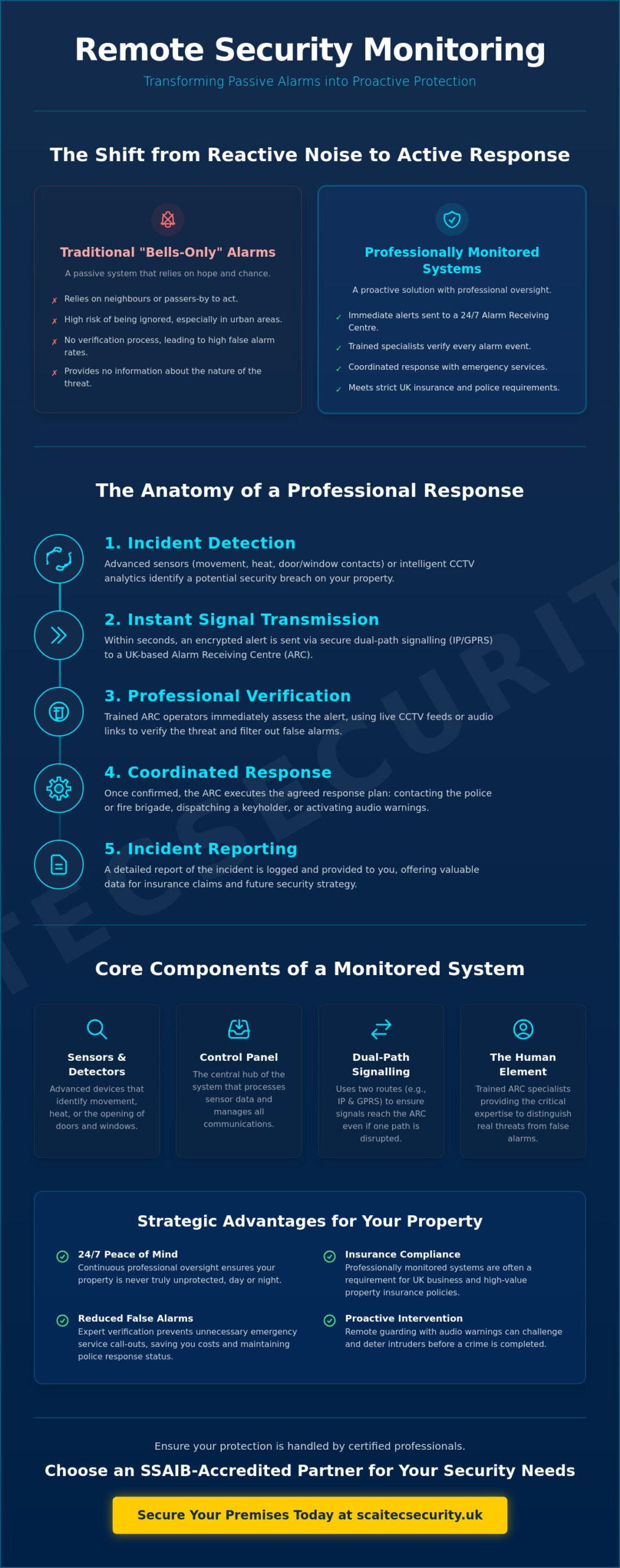
To define it simply, remote security monitoring is the continuous, off-site oversight of your security assets by trained professionals. Whilst a standard alarm might sound locally, a monitored system sends a secure signal to a dedicated facility known as an Alarm Receiving Centre (ARC). In this environment, security specialists assess the situation in real-time, ensuring every alert is handled with precision. This professional layer of protection is what distinguishes a truly secure property from one that merely has a siren.
Many homeowners and business managers often confuse “smart” app notifications with professional oversight. If you rely solely on a smartphone alert, you’re the one responsible for the response. If your phone is on silent, out of signal, or you’re simply busy, the alert might go unanswered for hours. Professional monitoring removes this risk by ensuring a human expert is always available to verify the threat and initiate the correct response protocol immediately. When we consider what is remote security monitoring, we must view it as the evolution from a simple notification to a managed safety solution.
We’ve observed that traditional “bells-only” alarms are increasingly seen as an outdated solution for UK businesses. These passive systems rely on the hope that a neighbour or passer-by will take action; a gamble most organisations cannot afford to take. Professional monitoring removes this element of chance by ensuring that your site “talks” to the monitoring centre through encrypted, reliable signals that cannot be easily bypassed.
The Shift from Passive to Proactive Protection
Proactive protection is about intervention before a crime is completed. This concept, often referred to as Remote guarding, allows for immediate action. Instead of discovering a break-in the following morning, you have a team that can challenge intruders via audio links or coordinate with emergency services. This approach prevents escalation and provides the peace of mind that comes from knowing your property is never truly alone. Our goal is to transform your security from a reactive cost into a proactive asset.
Key Components of a Monitored System
A reliable monitored system relies on a combination of high-quality hardware and secure communication channels. We ensure that every installation includes the necessary components to maintain a constant link to the ARC. These typically include:
- Sensors and Detectors: Advanced devices that identify movement, heat, or the opening of doors and windows.
- The Control Panel: The central hub of the system that processes sensor data and manages communication.
- Dual-Path Signalling: A method that uses two separate communication routes, such as IP and GPRS, to ensure signals reach the ARC even if one path is disrupted or tampered with.
The final, and perhaps most critical, component is the human element. The operators at the ARC are trained to distinguish between false alarms and genuine threats. This expertise ensures that emergency services are only called when necessary, which helps maintain your police response status and prevents the frustration of unnecessary call-outs.
The Anatomy of a Response: How Remote Monitoring Works
Whilst a standard alarm simply screams into the night, a monitored system begins a structured, professional response chain the moment a threat is detected. The process is rapid and methodical, ensuring that no alert is left to chance. When considering what is remote security monitoring in a practical sense, it’s best understood as a five-step lifecycle that manages an incident from the first sensor trigger to the final report.
The journey begins with incident detection. Modern systems use high-specification sensors or CCTV analytics to identify unusual activity. To understand the sophistication of these systems, one might look at The Future of Remote Security with AI, which highlights how intelligent algorithms now filter out environmental noise. Once a potential threat is identified, the system moves to instant signal transmission. An encrypted alert is sent via secure channels to a UK-based Alarm Receiving Centre (ARC), typically in less than a few seconds.
The third and most vital stage is verification. This is where the human element provides its greatest value. Operators at the ARC assess the incoming data to distinguish between a stray animal, a wind-blown branch, or a genuine intruder. Once a threat is confirmed, the protocol execution phase begins. Depending on your specific requirements, the ARC will immediately notify your designated keyholders or contact the police and fire services. Finally, incident logging ensures you receive a comprehensive report of the event, providing the documentation needed for insurance claims or future remote monitoring adjustments.
The Role of the Alarm Receiving Centre (ARC)
An ARC is not a standard office; it’s a highly secure, bunker-like facility designed to withstand physical and digital interference. These centres are often NSI or SSAIB-approved, ensuring they meet the most rigorous British standards for security and resilience. Because threats don’t keep office hours, these facilities operate 24/7/365. The operators inside undergo intensive training to maintain a calm, authoritative presence, allowing them to manage high-pressure situations and make split-second decisions that protect your property. To understand the full scope of how this benefits your organisation, exploring the benefits of alarm receiving centre monitoring for UK businesses provides a detailed look at how professional ARC oversight delivers 24/7 protection and insurance compliance.
Verification Protocols: Reducing False Alarms
False alarms are more than just a nuisance; they can jeopardise your standing with emergency services. We utilise visual verification, where operators use live CCTV feeds to confirm an intruder’s presence before taking action. Another common method is sequential alarm verification, which requires multiple sensors to trigger in a specific pattern before an alert is escalated. These rigorous checks are essential for maintaining a police Unique Reference Number (URN). Without professional verification, many UK police forces will not attend an alarm signal, making this step a cornerstone of effective security.
The Different Faces of Monitoring: CCTV, Fire, and Intruder
Remote security monitoring isn’t a one-size-fits-all service; it’s a versatile framework that we tailor to address specific risks. Whilst some clients require visual patrolling for large external perimeters, others need the absolute certainty that a fire in an empty warehouse won’t go unnoticed. When people ask what is remote security monitoring, they’re often looking for a solution that covers the “core trio” of protection: CCTV, fire, and intruder detection. By integrating these systems, we create a unified shield that protects assets, people, and property around the clock.
We’ve found that a holistic approach is most effective. This involves several specialised layers:
- Remote CCTV Monitoring: Active surveillance where operators use live feeds to intervene during suspicious behaviour.
- Monitored Intruder Alarms: A system that ensures a break-in attempt triggers a professional response chain rather than just a local siren.
- Fire Alarm Monitoring: A critical life-safety service that summons the Fire and Rescue Service even when a building is vacant.
- Access Control Monitoring: Managing entry points remotely, allowing us to oversee who enters and leaves your premises in real-time.
Visual Surveillance and Audio Deterrence
Modern CCTV systems have evolved significantly. With expert CCTV installation, we can deploy AI-driven analytics that distinguish between a person and environmental factors like swaying foliage or heavy rain. This precision allows operators to focus only on genuine threats. If an intruder is spotted, the operator can use on-site speakers to deliver a live audio challenge. Hearing a human voice stating that they’re being watched and that the police have been called is often enough to stop a crime before any damage occurs. This proactive stance is a fundamental part of what is remote security monitoring in 2026.
Life Safety: Why Fire Monitoring is Non-Negotiable
Fire doesn’t wait for business hours. For an empty warehouse or office, an undetected fire can be catastrophic, often leading to total property loss before anyone notices the smoke. Professional fire alarm monitoring bridges this gap. The moment a detector is triggered, the signal is sent to the ARC, which then dispatches the Fire and Rescue Service. This rapid intervention is often a mandatory requirement for UK insurance compliance and is essential for meeting current fire safety regulations. To ensure your detection equipment remains fully operational and compliant, understanding the requirements for fire alarm servicing in South Yorkshire is an essential part of your overall life safety strategy. It ensures that your commitment to life safety remains steadfast, even when the building is entirely vacant.
The Strategic Advantages for British Businesses and Homeowners
Investing in professional security is as much a financial decision as it is a safety one. Whilst previous sections have explained the technical mechanics, the true value for most UK property owners lies in the long-term operational benefits. When evaluating what is remote security monitoring, it’s vital to look at the return on investment through reduced insurance premiums, lowered liability, and the significant cost savings compared to traditional on-site methods. We see these systems as a strategic asset that protects your bottom line just as much as your physical assets.
Beyond the immediate response to a crime, the presence of a monitored system changes the risk profile of a property. Clear signage stating that a site is under professional surveillance acts as a powerful psychological deterrent. Criminals are far less likely to target a building where they know their presence will be instantly verified and challenged. This proactive layer of protection reduces the likelihood of vandalism and theft, which in turn minimises the disruption to your daily operations or home life.
Meeting Insurance and Legal Requirements
For many businesses, especially high-risk commercial properties in South Yorkshire, professional monitoring is no longer optional. Many UK insurers now mandate that security systems must be monitored by an accredited centre to maintain valid cover. We recommend that you verify the specific conditions of your policy with your broker; often, an SSAIB-accredited system is a prerequisite for obtaining competitive premiums. By meeting these rigorous standards, you demonstrate a commitment to risk management that insurers reward with lower costs and more comprehensive protection. If you are ready to upgrade your compliance, you can explore our remote monitoring solutions to ensure your property meets every industry standard.
A Modern Alternative to Manned Guards
One of the most compelling arguments for technology-led security is the sheer efficiency it offers compared to traditional on-site personnel. Manned guarding comes with high overheads, including wages, training, and the logistical challenges of managing staff shifts. Technology doesn’t require breaks, it doesn’t sleep, and it doesn’t suffer from lapses in concentration during a long night shift.
Remote monitoring provides a “birds-eye” view of your entire premises simultaneously. Whilst a single guard can only be in one place at a time, a network of monitored cameras and sensors can oversee every entry point and vulnerable area at once. This comprehensive coverage ensures that no incident goes unnoticed. By shifting from a human-heavy approach to a tech-driven response chain, organisations can achieve a higher level of security at a fraction of the traditional cost, all whilst maintaining a robust, professional response to every alert.
Professional Implementation: Choosing Your Monitoring Partner
Selecting the right partner is the final, most critical step in securing your property. Whilst the technology provides the “eyes,” the quality of the installation and the accreditation of the provider determine the “teeth” of your response. When we discuss what is remote security monitoring with our clients, we emphasise that the service is only as robust as the standards it adheres to. A professional partner doesn’t just install a box; they design a comprehensive safety ecosystem that integrates with your daily operations and local emergency services.
We believe that local expertise offers a distinct advantage. Working with a South Yorkshire-based partner ensures that you receive rapid support and a team that understands the specific security landscape of the region. This proximity allows for more efficient site visits and a closer working relationship, which is essential when managing complex security requirements for commercial or residential premises. Understanding what is remote security monitoring in 2026 means recognising it as a collaborative partnership between the property owner and the security specialist.
The Importance of SSAIB Accreditation
SSAIB (Security Systems and Alarms Inspection Board) certification is the gold standard for UK security installers. This accreditation ensures that a company meets rigorous safety and technical standards, providing you with the assurance that your system is fit for purpose. Crucially, SSAIB certification facilitates a direct link to police dispatch via the Alarm Receiving Centre. Without this official standing, your system may not be eligible for a police Unique Reference Number (URN), which can significantly delay emergency response times. Scaitec Security Solutions has maintained a long-standing commitment to these standards in Rotherham and Sheffield, ensuring our clients receive the highest level of professional recognition.
Ensuring Long-Term Reliability
A monitored system is not a “set and forget” solution. There is a vital synergy between monitoring and preventative security maintenance. Before any site is connected to an ARC, we perform an extensive health check to ensure every sensor, communicator, and signalling path is functioning perfectly. This initial audit prevents the frustration of false alarms and ensures the integrity of the data being sent to the operators.
Ongoing care is equally important. Regular CCTV maintenance in Rotherham is essential to prevent signal failure or blurred footage that could hinder the verification process during a real event. We also allow you to customise your response protocols entirely. You decide who gets called and when, whether that is a site manager, a designated keyholder, or the emergency services. This tailored approach ensures that your security remains efficient and aligned with your specific needs. To ensure your property is truly protected, Contact Scaitec Security Solutions to organise a remote monitoring audit for your premises.
Securing Your Property for the Years Ahead
Professional oversight transforms your security from a simple deterrent into a managed response system. By moving beyond passive alarms, you ensure that every alert is verified and handled by experts who understand the urgency of the situation. Understanding what is remote security monitoring is the first step toward a more resilient strategy that meets UK insurance standards and provides genuine, 24/7 peace of mind for your home or business.
Scaitec Security Solutions has been a dedicated partner for clients across South Yorkshire since 2005. As an SSAIB Accredited Installer, we provide the technical proficiency and local expertise needed to protect premises in Rotherham, Sheffield, Barnsley, and Doncaster. We’re committed to the long-term safety of our community through rigorous standards and reliable maintenance.
If you’re ready to upgrade your protection, our team is here to help you navigate the transition to a professionally overseen system. Secure your peace of mind with a monitored security quote from Scaitec today. We look forward to helping you build a safer future.
Frequently Asked Questions
Is remote security monitoring the same as having a smart home app?
No, professional remote security monitoring is distinct from self-monitoring via a smartphone app. Whilst an app sends a notification directly to you, professional monitoring ensures that a trained operator at an Alarm Receiving Centre (ARC) receives the signal immediately. This specialist assesses the threat and takes action, even if you are asleep, in a meeting, or your phone is out of signal. This ensures that a response is never missed or delayed.
Will the police automatically attend if my monitored alarm goes off?
The police do not attend every alarm automatically; they require a “verified” signal to dispatch units. This usually means that two separate sensors have triggered in sequence or an operator has visually confirmed an intruder via a CCTV feed. To receive a police response in the UK, your system must also have a Unique Reference Number (URN), which is only issued for systems that are professionally installed, maintained, and monitored by accredited providers.
Can I add remote monitoring to my existing security system?
In many cases, we can add remote monitoring to an existing security system by installing a compatible signalling device. However, the system must first undergo a thorough health check to ensure it meets the technical standards required by the Alarm Receiving Centre. If your hardware is outdated or doesn’t support modern signalling paths, we may recommend a partial upgrade to ensure the connection is stable and reliable.
What happens if my internet connection or phone line is cut?
Professional systems typically use dual-path monitoring to prevent communication failure. This means the system uses two different routes, such as a wired broadband connection and a 4G or GPRS mobile signal. If one path is cut or fails, the system automatically switches to the second path to send the alert. This redundancy is a core part of what is remote security monitoring in terms of its resilience against tampering.
Is remote monitoring only for large commercial businesses?
No, remote monitoring is highly effective for residential properties and small businesses as well as large commercial sites. Any property owner who wants to ensure a professional response whilst they are away can benefit from this service. It’s particularly valuable for homes in isolated areas or businesses that hold high-value stock, where a local siren alone might not be enough to deter a determined intruder.
How much does professional remote monitoring cost per month in the UK?
Monthly costs for remote monitoring in the UK generally vary based on the level of response required. As of May 2026, basic keyholder notification services typically start around £15 per month, whilst full police response monitoring can reach up to £40. Third-party alarm monitoring services often range between £30 and £60 per month, depending on the complexity of the system and the level of visual verification involved.
What is an Alarm Receiving Centre (ARC) and where are they located?
An Alarm Receiving Centre is a highly secure, 24-hour facility where professional operators monitor incoming security signals. These centres are built to rigorous British standards, such as BS EN 50518, to ensure they remain operational during power cuts or physical attacks. Whilst there are several ARCs located across the UK, we ensure your system is connected to a centre that provides the fastest possible response for South Yorkshire and the surrounding regions.
Does remote monitoring help with my business insurance premiums?
Yes, many UK insurers offer more favourable terms or lower premiums for businesses that use professional remote monitoring. For high-risk commercial properties, having a monitored system is often a mandatory policy condition. By using an SSAIB-accredited installer to connect your site to an ARC, you demonstrate a proactive approach to risk management that can help lower your annual costs and ensure your cover remains valid in the event of a claim.
Protect Your Business
Protect Your People
Book Your FREE Site Protection Survey

Since pioneering Scaitec Security Solutions in 2005, Paul Scaife, with his roots in the industry dating back to 1994, has distinguished the firm as a leading provider of bespoke fire and security solutions, servicing clients across Sheffield, Rotherham, and surrounding areas.
His leadership, underpinned by accreditation from the Security Systems and Alarms Inspection Board, ensures that Scaitec surpasses client expectations by blending advanced technology with a deep understanding of their unique needs.
Paul's ethos champions innovation and efficiency, driving Scaitec to deliver tailored, cutting-edge solutions that enhance safety and operational ease.
Discover more about Paul’s commitment to excellence on LinkedIn.