
Table of Contents
A single administrative oversight in your fire safety strategy could now result in an unlimited fine or even a two-year prison sentence. Managing a House in Multiple Occupation (HMO) has never been more complex, especially as the 2026 regulations tighten the grip on property standards across the country. We understand the anxiety that comes with deciphering technical jargon, particularly when trying to distinguish between Grade A and Grade D systems whilst facing pressure from local council enforcement in South Yorkshire. Keeping up with the latest HMO fire alarm requirements UK is no longer just a recommendation; it is a vital safeguard for your livelihood.
This guide provides the professional reassurance you need to navigate these shifting rules, ensuring your property meets the rigorous BS 5839-6:2019+A1:2020 standards. We will provide a clear roadmap to legal compliance that protects your investment and your tenants’ lives. You will discover how to select a system that minimises frustrating false alarms caused by communal cooking and learn why securing an SSAIB-accredited installer is the most reliable way to maintain your licence and your peace of mind.
Key Takeaways
- Understand how the 2026 amendments to the Regulatory Reform (Fire Safety) Order 2005 demand significantly higher safety standards than standard residential lets.
- Identify the specific HMO fire alarm requirements UK for your property, from Grade D1 mains-powered alarms for small houses to complex Grade A control panels for larger buildings.
- Learn why transitioning to LD1 or LD2 detection categories is essential for providing standard-compliant protection in high-risk rooms and circulation spaces.
- Discover how to integrate your fire detection with electronic access control systems to ensure mag-locks release instantly for a fail-safe exit during an emergency.
- Recognise the importance of using SSAIB-accredited installers to secure your local council licence and protect your investment against the risk of unlimited fines.
HMO Fire Alarm Requirements UK: Compliance in 2026
An HMO is legally defined as a property rented by at least three people who are not from the same “household” but share facilities like the bathroom or kitchen. Because these properties house multiple unrelated individuals, the risk to life during a fire is significantly higher than in a standard family home. This increased risk is why HMO fire alarm requirements UK are so much more stringent. In 2026, compliance isn’t just about having a few sensors; it’s about adhering to the latest amendments of the Regulatory Reform (Fire Safety) Order 2005.
The 2026 updates place a heavy emphasis on the “Responsible Person.” This is usually the landlord or the property manager. You hold the legal accountability for the fire risk assessment and the ongoing maintenance of all life safety systems. To meet these expectations, you must ensure your system aligns with the updated BS 5839-6:2025 for domestic shared houses or BS 5839-1:2025 for larger, commercial-style HMOs. These standards dictate exactly where detectors must be placed and how they should communicate with each other to ensure every tenant is alerted simultaneously.
The Legal Framework for Landlords
Councils across South Yorkshire, including Sheffield and Doncaster, now require specific alarm grades as a condition of your HMO licence. The Fire Safety Act 2021 clarified that fire safety duties extend to the structure and external walls of the building, meaning your detection system must be part of a holistic safety strategy. Standard battery-operated smoke alarms are insufficient for HMOs because they don’t provide the interlinked, fail-safe protection required by law. We recommend visiting our fire safety systems page to understand how professional installation meets these local criteria.
Consequences of Non-Compliance
The financial and legal risks of ignoring these standards are immense. Recent enforcement actions have seen landlords facing fines well over £44,000 for failing basic fire safety inspections. Beyond the courts, non-compliant systems often completely invalidate your building insurance, leaving you personally liable for any property damage or injury claims. Under 2026 law, your duty of care is a non-delegable legal obligation to ensure that every tenant can detect a fire and evacuate safely at any time of day or night.
Deciphering Alarm Grades and Categories (LD1 vs LD3)
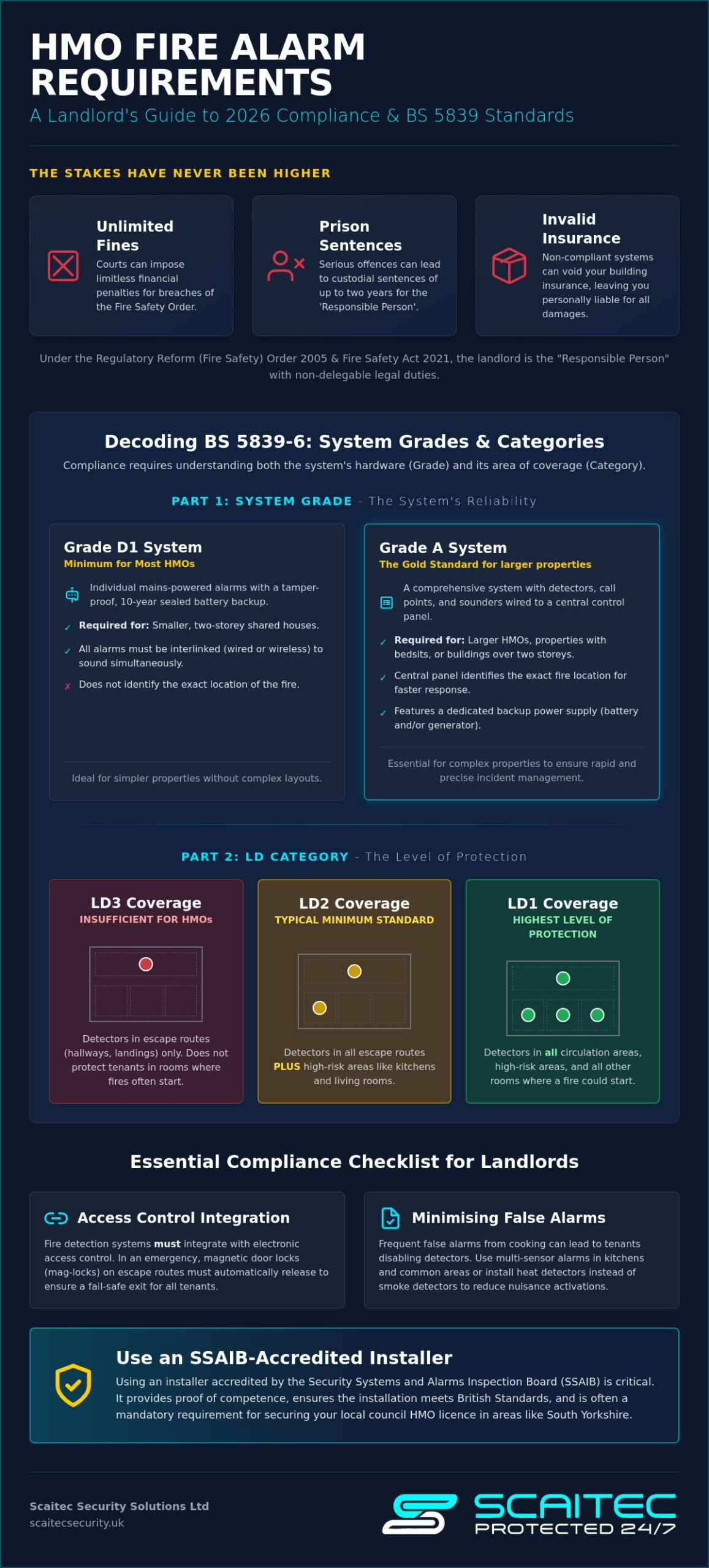
Choosing the right equipment is the next logical step once you understand the legal framework. To meet HMO fire alarm requirements UK, you must consider both the ‘Grade’ of the system and its ‘Category’. The Grade refers to the technical reliability and power supply of the hardware, whilst the Category defines the level of coverage and sensor placement throughout the property. These two factors combined determine whether your property is legally compliant or dangerously under-protected.
Interlinking is a non-negotiable requirement for modern HMOs. If a fire starts in a ground-floor kitchen, the alarm in a second-floor bedroom must sound instantly. In larger properties, we often suggest using addressable systems. These allow a central control panel to identify exactly which sensor has been triggered, saving precious seconds during an evacuation. This level of detail ensures your tenants stay safe whilst minimising the disruption caused by false alarms.
Grade A vs Grade D1 Systems
Grade A systems are the most robust. They feature a central control panel with a dedicated backup power supply. These are often mandatory for larger HMOs or those converted into bedsits where tenants have their own cooking facilities. For smaller, two-storey shared houses, a Grade D1 system is typically the minimum standard. These are mains-powered alarms with a tamper-proof, 10-year battery backup. Whilst simpler to install than a full fire alarm system, they still require professional certification to satisfy local council licensing inspectors.
Sensor Placement: LD1, LD2, and LD3
The ‘Category’ defines where your sensors live. LD1 provides the highest level of life protection, with detectors in all rooms where a fire might start, including lofts and large cupboards. Most standard HMOs now require at least LD2 coverage. This includes smoke detectors in all escape routes, such as hallways and landings, and heat detectors in high-risk areas like kitchens. We strongly advise against LD3 systems, which only cover escape routes; in 2026, these are widely considered insufficient for the safety needs of a multi-occupied building.
False alarms are a significant pain point that can lead to tenants tampering with sensors. By using heat detectors in communal cooking areas instead of standard smoke sensors, you can prevent triggers from steam or burnt toast. This thoughtful approach ensures the system remains a trusted safety tool rather than a daily nuisance. If you are unsure which grade your property requires, our team can help you organise a professional maintenance check to clarify your current compliance status.
HMO Requirements by Property Type and Storeys
Property layout is the primary factor that dictates HMO fire alarm requirements UK. A standard two-storey terrace presents different risks than a large Victorian villa converted into multiple bedsits. For small, two-storey shared houses, you might only need a Grade D1 system with LD2 coverage. However, once a property reaches three storeys or more, the complexity increases significantly. These larger buildings usually require a Grade A system with a central control panel to meet the 2026 standards, ensuring reliable communication across all floors.
Don’t forget the basement. Many South Yorkshire terrace properties feature cellars that house gas and electric meters or are used for tenant storage. These are high-risk zones that require specific attention under the updated BS 5839-6:2025 code of practice. Fire officers often insist on detection here even if it isn’t a habitable room. Neglecting a cellar can lead to a failed inspection and a delay in your licence approval, so it’s vital to include these areas in your initial system design.
Shared Houses vs Bedsits
Bedsits create a unique challenge because tenants cook behind closed doors. This setup often shifts the legal requirement to an LD1 category to ensure maximum life protection. Unlike a shared house where tenants typically follow a simultaneous evacuation, bedsits sometimes use a ‘stay put’ strategy if the compartmentation is high enough. This strategy relies heavily on your fire doors. FD30s fire doors must be maintained alongside the alarm system to ensure smoke doesn’t bypass the sensors and enter communal escape routes.
Mixed Systems for Complex Properties
In complex buildings, we often see mixed systems. This might involve a Grade A system for communal areas like hallways and kitchens, whilst individual bedrooms use Grade D1 alarms. The critical task is ensuring these systems talk to each other. If an in-room alarm triggers, the communal system must be alerted to initiate a building-wide evacuation. Whilst this sounds complicated, a unified addressable system is often the most cost-effective long-term solution for large properties.
A unified system simplifies system maintenance and provides clear data on system health, which is vital for your annual safety records. Ensuring your property meets the latest HMO fire alarm requirements UK is a continuous process that depends on the specific architecture of the building. By choosing the right configuration for your storey count and tenant type, you protect both your investment and the people living within it.
Integrating Fire Detection with Access Control and Monitoring
A sophisticated fire alarm is only effective if it allows for an immediate and unobstructed exit. For many modern properties, meeting HMO fire alarm requirements UK involves a critical integration between your detection system and your building’s physical security hardware. If a fire is detected, the priority shifts from keeping the building secure to ensuring every occupant can leave without delay. This requires a seamless technical link that automatically overrides security measures during an emergency.
This integration is a common area where DIY installations fail to meet the 2026 standards. A professional setup ensures that the ‘handshake’ between your fire sensors and your electronic access control system is fail-safe. Without this link, tenants could find themselves trapped behind electronically locked doors during a power failure or a fast-moving fire, creating a catastrophic safety breach that would leave a landlord legally vulnerable.
Fail-Safe Egress and Access Control
Magnetic locks, or mag-locks, are common in shared houses for their durability and ease of use. However, these locks rely on a constant power supply to remain closed. Your fire alarm system must be configured to trigger a ‘fire drop’, which cuts power to these locks the moment the sensors detect smoke or heat. This ensures that doors on escape routes are instantly released. To provide an additional layer of safety, every electronic door must also feature a green ‘break glass’ override unit. We recommend testing this integration during your regular security maintenance visits to ensure the relay between the alarm and the door remains functional.
The Value of 24/7 Remote Monitoring
Whilst local bells and sirens alert those inside the building, they do little to protect your property if a fire breaks out when the building is empty. Remote monitoring connects your fire alarm to an Alarm Receiving Centre (ARC). These centres operate 24/7, providing a vigilant eye over your investment even during holiday periods when student HMOs in Sheffield might be unoccupied. If a fire is confirmed, the ARC can contact the fire service immediately, significantly reducing response times. This monitored protection is often a mandatory requirement for specialist building insurance policies, providing a vital safety net for both your property and your tenants.
Ensuring your systems work in harmony is the hallmark of a responsible landlord. If you want to ensure your exits are truly fail-safe, you can book a fire and access integration audit with our specialist team today.
Professional Installation and Maintenance in South Yorkshire
South Yorkshire councils, from Sheffield to Doncaster, maintain some of the most rigorous licensing standards in the country. Meeting the HMO fire alarm requirements UK is not merely a matter of purchasing the correct hardware; it is about ensuring that the system is professionally commissioned and documented. DIY installations almost always fail to meet these criteria because they lack the formal certification that local fire officers and licensing teams demand. Without a commissioning certificate from a competent person, your property remains legally non-compliant regardless of how many sensors you’ve installed.
We provide a comprehensive service that bridges the gap between a Fire Risk Assessment (FRA) and a fully operational system. Our team supports you through the initial design phase, ensuring every sensor placement aligns with the specific needs of your property layout. By choosing SSAIB accredited installers, you’re securing a system that’s recognised by both local authorities and major UK insurers as meeting the highest industry benchmarks for reliability and safety.
Statutory Maintenance and Log Books
Installation is only the beginning of your safety obligations. The law requires a dual-layered approach to maintenance: weekly user tests and professional six-monthly servicing. During a routine inspection, a fire officer will prioritise your Fire Alarm Log Book. They look for consistent records of weekly tests and evidence that any faults have been rectified immediately. Common issues we identify during system maintenance include battery degradation in backup units and sensor contamination from dust, both of which can lead to system failure or persistent false alarms.
Why Landlords Choose Scaitec Security Solutions Ltd
With over 20 years of experience securing properties across Rotherham, Barnsley, and the wider Yorkshire region, we understand the unique pressures facing HMO landlords. We don’t believe in one-size-fits-all security; instead, we offer tailored fire and security packages designed to protect diverse property portfolios. Whether you manage a single three-storey shared house or a large collection of bedsits in Huddersfield or Wakefield, our organised approach ensures your safety systems are always up to date and fully certified. Scaitec Security Solutions Ltd remains a dedicated partner to South Yorkshire landlords, providing the technical proficiency and rigorous standards required to ensure total regulatory compliance.
Future-Proofing Your HMO Safety Strategy
Navigating the 2026 regulatory landscape requires a shift from basic property management to proactive risk mitigation. We have seen how the latest HMO fire alarm requirements UK demand more than just interlinked sensors; they require a holistic approach that integrates fail-safe access control with professional commissioning. Prioritising these technical standards protects your tenants whilst securing your standing with local South Yorkshire councils.
Since 2005, we have supported landlords across Sheffield and Rotherham by providing steadfast reliability and authoritative expertise. As SSAIB-accredited installers, we offer the peace of mind that comes with 24/7 alarm receiving centre monitoring and methodical system maintenance. Taking action now prevents the anxiety of future enforcement and ensures your property remains a safe, compliant investment for years to come.
If you are ready to ensure your property meets every legal benchmark, book a professional HMO fire safety audit with our dedicated team today. We are here to simplify the complexities of compliance and provide the protective vigilance your property deserves.
Frequently Asked Questions
Is a Grade A fire alarm system mandatory for all HMOs?
Grade A systems are not mandatory for every property, but they are typically required for larger HMOs of three storeys or more. They are also the standard for buildings converted into bedsits where tenants have individual cooking facilities. For smaller, two-storey shared houses, a Grade D1 system is often the acceptable minimum standard. You should always check your specific local council licensing conditions to ensure your chosen grade meets their criteria.
How often must I professionally service my HMO fire alarm?
Professional servicing must occur at least every six months to remain compliant with BS 5839 standards. This technical inspection ensures that all detectors, sounders, and backup batteries are functioning correctly. In addition to these biannual visits, you or a designated person must perform a user test every week. All tests and services must be recorded in your fire safety log book to provide a clear audit trail for fire officers.
Can I use wireless fire alarms in an HMO to avoid damaging decor?
Wireless systems are a perfectly valid way to meet HMO fire alarm requirements UK without the need for invasive cabling. These systems are particularly useful in heritage properties or buildings where running wires through walls is impractical. However, you must ensure the equipment is specifically designed for fire safety and meets the relevant British Standards. Professional installation is essential to ensure the wireless signal remains robust across all floors of the property.
What is the difference between an LD1 and an LD2 fire alarm category?
The primary difference lies in the extent of the coverage provided within the property. An LD1 system offers the highest level of protection by placing detectors in all rooms and circulation spaces where a fire could start. An LD2 system is more common and focuses on escape routes, such as hallways and landings, plus high-risk rooms like kitchens and living areas. Most modern HMO licences now demand at least LD2 coverage to ensure tenant safety.
Do I need a fire alarm panel for a two-storey shared house?
A central fire alarm panel is generally not required for standard two-storey shared houses. These properties typically utilise a Grade D1 system, which consists of mains-powered alarms that are interlinked either by wire or radio frequency. If one alarm triggers, they all sound simultaneously. Panels are a feature of Grade A systems, which are reserved for more complex or larger buildings that require more sophisticated monitoring and control.
What happens to the magnetic door locks if the fire alarm is triggered?
Magnetic locks must automatically de-energise and release the moment the fire alarm is triggered. This “fire drop” is a critical safety requirement that ensures tenants can exit the building without needing a key or a code during an emergency. We always install a green “break glass” override alongside these locks as a secondary fail-safe. Regular maintenance is vital to ensure the relay between the alarm and the access control system remains fully functional.
Who is the ‘Responsible Person’ for fire safety in a managed HMO?
The ‘Responsible Person’ is typically the landlord who owns the property and holds the HMO licence. If you use a professional management agency, this responsibility can sometimes be shared, but the ultimate legal duty often remains with the owner. This individual is legally accountable for ensuring the fire risk assessment is current and that all HMO fire alarm requirements UK are met. Clear contracts are essential to define who handles the weekly testing and maintenance schedules.
Are battery-only smoke alarms legal for HMO landlords in 2026?
Battery-only alarms are strictly prohibited for use as a primary fire detection system in any UK HMO. The law requires systems to be mains-powered with a reliable backup supply, such as a sealed 10-year lithium battery. This ensures the system remains operational even during a power cut. Whilst you can use battery-only units as extra temporary protection, they do not count towards your mandatory licensing requirements and will result in a failed inspection.
Protect Your Business
Protect Your People
Book Your FREE Site Protection Survey

Since pioneering Scaitec Security Solutions in 2005, Paul Scaife, with his roots in the industry dating back to 1994, has distinguished the firm as a leading provider of bespoke fire and security solutions, servicing clients across Sheffield, Rotherham, and surrounding areas.
His leadership, underpinned by accreditation from the Security Systems and Alarms Inspection Board, ensures that Scaitec surpasses client expectations by blending advanced technology with a deep understanding of their unique needs.
Paul's ethos champions innovation and efficiency, driving Scaitec to deliver tailored, cutting-edge solutions that enhance safety and operational ease.
Discover more about Paul’s commitment to excellence on LinkedIn.