
Table of Contents
Could a single misplaced camera or an outdated privacy sign really expose your business to crippling ICO penalties? For many UK organisations, the line between effective security and a data breach is thinner than they realise. You’ve likely installed surveillance to protect your assets and staff, yet the fear of unintentional non-compliance often lingers in the background. It’s often frustrating to manage the technical side of security whilst simultaneously trying to decode complex legal jargon.
We understand that you need clear, actionable guidance rather than vague warnings. This article provides a comprehensive roadmap for GDPR compliance for CCTV systems UK, designed to give you total peace of mind that your surveillance is lawful. By following our 2026 essential checklist, you’ll master the intricacies of Data Protection Impact Assessments, signage requirements, and secure footage retention. We’ll break down the necessary steps to ensure your system acts as a shield against both crime and malicious litigation.
Key Takeaways
- Identify the specific legal roles your business plays to ensure every aspect of your surveillance meets the Data Protection Act 2018 standards.
- Learn how to configure your hardware with privacy masking to protect neighbouring windows and avoid capturing private dwellings.
- Establish clear protocols for managing recorded footage, including automated deletion and efficient handling of Subject Access Requests.
- Secure your organisation against ICO penalties by following a structured 2026 checklist for GDPR compliance for CCTV systems UK.
- Discover why SSAIB-accredited maintenance is a critical component in demonstrating due diligence and technical proficiency to regulators.
Understanding the Legal Framework for UK CCTV Compliance
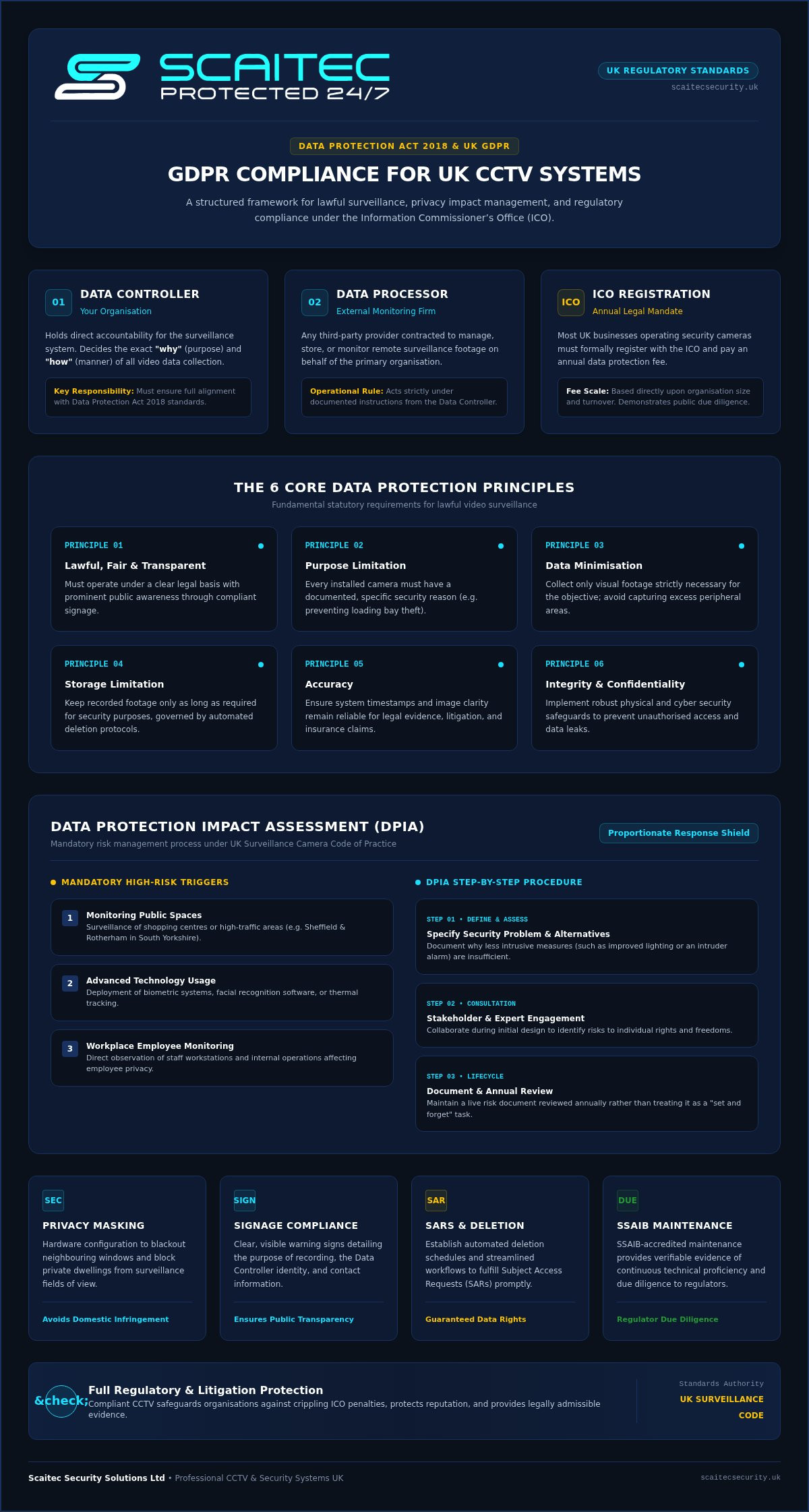
Managing a modern security system involves more than just mounting cameras. You must align your operations with the UK GDPR and the Data Protection Act 2018. These laws dictate how you collect and store footage of identifiable individuals. In a security context, your organisation acts as the “Data Controller.” You hold the responsibility for the “why” and “how” of data collection. If you hire a firm for remote monitoring, they serve as the “Data Processor.” By 2026, the ICO has made it clear that closed-circuit television (CCTV) is a high-risk area. This means “privacy by design” isn’t a luxury; it’s a requirement.
There are six core principles you must follow to stay on the right side of the law. Your surveillance must be lawful, fair, and transparent. You should only collect what is necessary (data minimisation) and keep it only as long as required (storage limitation). Accuracy and security are equally vital to prevent data leaks. If you don’t have a clear purpose for every camera, you’re likely overstepping these boundaries.
Why CCTV Compliance Matters for Your Business
Financial penalties for ignoring these rules are significant. The ICO can levy fines based on your turnover, which could impact your business’s stability. However, the cost of non-compliance goes beyond the balance sheet. Unlawful recording can damage your reputation and destroy employee morale. When you prioritise GDPR compliance for CCTV systems UK, you create a robust legal shield. Compliant systems provide reliable evidence that holds up during litigation or insurance claims, protecting you from false accusations or malicious lawsuits.
Registering with the Information Commissioner’s Office (ICO)
Most UK businesses using cameras for security must register with the ICO and pay an annual data protection fee. This fee varies depending on your organisation’s size and turnover. Registration is a public statement of transparency. It tells the regulator and the public that you take data rights seriously. You must ensure your registration details accurately reflect your surveillance activities. Neglecting this simple administrative step is an easy way to attract unwanted regulatory attention. It’s an essential part of your “due diligence” that proves you’re acting as a responsible guardian of public data.
Conducting a Data Protection Impact Assessment (DPIA)
A Data Protection Impact Assessment (DPIA) is the cornerstone of any lawful surveillance strategy. It’s essentially a risk management process that helps you identify and minimise the data protection risks of your project. Before you even mount a bracket, you must clearly define the specific security problem you’re trying to solve. Is it to prevent theft in a loading bay or to ensure staff safety after dark? By documenting the nature, scope, and context of your intended surveillance, you demonstrate that your system is a proportionate response to a genuine threat.
The UK Surveillance Camera Code of Practice emphasises that cameras should only be used when they’re truly necessary. You’ll need to assess whether a less intrusive method, such as improved lighting or an intruder alarm, could achieve the same result. This level of rigour is what ensures your GDPR compliance for CCTV systems UK remains airtight against regulatory scrutiny. Identifying risks to the rights and freedoms of individuals early allows you to build in safeguards that protect both your business and the public.
When is a DPIA Mandatory?
You can’t skip this step if your surveillance activities are considered “high risk” by the ICO. This includes monitoring public spaces like shopping centres in South Yorkshire or high-traffic areas in Sheffield and Rotherham. If you plan to use advanced technology such as thermal tracking or facial recognition, a DPIA is a strict legal requirement. Monitoring employees in the workplace also triggers this necessity, as it directly impacts their privacy rights. We often find that businesses underestimate how many of their operations fall into these high-risk categories.
Step-by-Step Guide to Completing Your DPIA
Start by consulting with stakeholders and security experts during the initial design phase. This collaborative approach helps you identify potential risks to individuals’ rights and freedoms that you might have otherwise missed. You must document exactly why more privacy-friendly options were rejected in favour of video surveillance. Once completed, your DPIA isn’t a “set and forget” document. You should review it annually or whenever you make significant changes to the system’s configuration. If you’re unsure where to begin, our team can assist with a specialist security audit to ensure your assessment is thorough, accurate, and fully compliant.
Hardware and Physical Installation Compliance Checklist
Positioning cameras correctly is a fundamental requirement for GDPR compliance for CCTV systems UK. You must ensure that your cameras are strictly focused on your property. If a camera lens captures a neighbouring garden or a private dwelling’s window, it can be deemed an intrusive breach of privacy. Modern IP cameras offer a solution through privacy masking. This technical feature allows us to digitally “black out” specific areas of the frame, ensuring that sensitive zones or public footpaths are never recorded. It’s a proactive way to demonstrate that your surveillance is proportionate and targeted.
Physical security for your recording equipment is just as critical as the cameras themselves. We recommend housing your Network Video Recorders (NVRs) or Digital Video Recorders (DVRs) within secure, locked cabinets. Only authorised personnel should have the keys. Similarly, you must consider where your monitoring screens are placed. If a screen is visible to the public or unauthorised staff, you’re inadvertently sharing personal data. Position monitors in restricted areas or use privacy filters to keep the footage confidential. These small physical adjustments prevent “data leaks” that could lead to formal complaints.
The Importance of Compliant Signage
Clear signage is your primary tool for transparency. To meet UK standards, your signs must clearly state the purpose of the surveillance, such as “Crime Prevention.” They also need to identify the data controller and provide contact details so individuals can exercise their rights. We place these signs at all main entry points and within the monitored zones. For outdoor use, ensure the materials are weather-resistant and the text remains legible over time. A faded sign is a compliance failure that suggests a lack of system oversight.
Technical Security Measures for Video Data
Securing the data itself requires a multi-layered approach. You should implement high-level encryption for video data both whilst it sits on the hard drive and when it’s being transmitted to a mobile device. Strong password policies are non-negotiable; we always recommend multi-factor authentication (MFA) for any remote viewing apps. Regular firmware updates are also essential to patch cyber vulnerabilities that hackers might exploit. Choosing professional CCTV installation services ensures these technical safeguards are correctly configured from day one, protecting your organisation from both physical and digital threats.
Managing Recorded Footage and Subject Access Requests (SARs)
Storing footage indefinitely is a major compliance risk that often attracts regulatory attention. Most UK organisations find a 31-day retention period sufficient for identifying incidents and making insurance claims. After this point, your system should be programmed to automatically overwrite the oldest data. This “set and forget” automation ensures you aren’t holding personal information longer than necessary, which is a core tenet of the Data Protection Act 2018. If you need to keep specific footage for a longer period, such as for an ongoing police investigation, you must document the justification clearly.
Managing a Subject Access Request (SAR) is often the most complex part of GDPR compliance for CCTV systems UK. When an individual asks for footage of themselves, you’re legally obliged to provide it. However, you must redact or blur the faces of any other people in the video. Redaction is not just a recommendation; it is a mandatory safeguard to protect the privacy of third parties. Handing over unedited footage that identifies other people is a breach of their rights and could lead to a formal ICO complaint. If your internal team lacks the tools to blur faces, professional support is often required to process the request safely.
Responding to a Subject Access Request
Verification is key. Before releasing any data, ask for a photo ID and a specific time, date, and location of the recording. This narrows the scope and prevents “fishing expeditions” for data. You have one month to comply with the request, though this can be extended for complex cases if you notify the individual within the initial timeframe. You can legally refuse a request if it’s “manifestly unfounded or excessive,” such as repeated requests from the same person without cause. However, you must be prepared to justify this decision to the ICO if challenged.
Staff Training and Access Control
Human error remains the most common cause of data breaches in the UK. Organising regular training sessions for your staff ensures they understand their legal obligations and the importance of confidentiality. You should also maintain a strict digital audit log. This log must record who accessed the footage, the reason for viewing it, and whether any data was exported. Integrating your surveillance with Integrated Access Control Solutions adds a physical layer of protection, ensuring only vetted and authorised personnel can enter the room where your recording hardware is stored.
Book a professional system health check
Professional Maintenance: Safeguarding Continuous Compliance
Achieving GDPR compliance for CCTV systems UK isn’t a one-off administrative task. It requires a commitment to ongoing vigilance and technical precision. Regular system health checks are vital to ensure your equipment operates within the legal boundaries established during your initial Data Protection Impact Assessment. Over time, environmental factors like wind or building subsidence can shift camera angles. Even a slight movement might cause a digital privacy mask to become misaligned, inadvertently recording a private dwelling. If your system starts capturing data it shouldn’t, you’re technically in breach of the law. Maintenance ensures these physical and digital boundaries remain intact.
Accountability is a core pillar of the UK GDPR. You must be able to demonstrate that you’re actively managing your surveillance risks. Documenting every maintenance visit, software update, and hardware adjustment creates a robust accountability record. If the ICO ever investigates a complaint against your organisation, these logs serve as evidence that you’ve acted with “due diligence.” We help our clients maintain these records, ensuring that their commitment to privacy is as visible as their commitment to security. This methodical approach prevents “data gaps” where cameras fail to record during critical incidents, protecting you from both crime and legal scrutiny.
The Benefits of a Maintenance Contract
Accuracy is everything when footage is used as evidence. A maintenance contract ensures that your system’s time and date stamps remain perfectly synchronised with the UK’s master clock. If timestamps are inaccurate, the footage may be ruled inadmissible in court, leaving your business vulnerable during a dispute. Our technicians also verify that all mandatory signage remains visible, legible, and hasn’t been obscured by overgrown foliage or weathering. For a deeper look at how to structure your oversight, see our Preventative Security Maintenance Guide. We take the time to check every component, from the lens clarity to the integrity of the secure storage cabinets.
Choosing an SSAIB Accredited Partner in South Yorkshire
Working with an SSAIB accredited installer provides a level of professional reassurance that uncertified contractors simply can’t match. SSAIB accreditation is a mark of quality that insurers and regulators recognise as evidence of technical proficiency. It shows you’ve chosen a partner that adheres to the highest industry standards for both hardware installation and data safety. Since 2005, Scaitec Security Solutions has supported commercial and residential clients across Rotherham and Sheffield with tailored security strategies. We don’t just mount cameras; we design systems that simplify your complex safety requirements. If you’re concerned about your current setup, we can perform a comprehensive security audit to identify any compliance gaps before they become a liability for your organisation.
Securing Your Future with Lawful Surveillance
Maintaining a secure premises shouldn’t come at the cost of legal uncertainty. By implementing a thorough Data Protection Impact Assessment and ensuring your hardware uses precise privacy masking, you’ve already taken the most significant steps toward full GDPR compliance for CCTV systems UK. These actions do more than just satisfy the Information Commissioner’s Office; they build a foundation of trust with your employees and the public whilst protecting your organisation from malicious litigation.
As SSAIB Accredited Installers, we understand that true security requires a balance of technical proficiency and regulatory awareness. We provide professional security audits for Rotherham businesses and tailored maintenance contracts to ensure your system remains a reliable asset rather than a liability. Our team acts as a dedicated expert guide, helping you navigate every requirement from initial installation to long-term aftercare.
Ensure your business is fully compliant with a Scaitec Security audit
Let us handle the complexities of data law so you can focus on what you do best. With the right partner by your side, you can enjoy total peace of mind that your surveillance is both effective and entirely lawful.
Frequently Asked Questions
Do I need to register my business CCTV with the ICO?
Yes, almost all organisations using cameras for crime prevention must register with the Information Commissioner’s Office (ICO) and pay the annual data protection fee. This applies to businesses across South Yorkshire, from small shops in Rotherham to large warehouses in Sheffield. Failing to register is a criminal offence. It’s a vital step in achieving GDPR compliance for CCTV systems UK, as it ensures your surveillance activities are transparent and recorded on the public register.
How long can I legally keep CCTV footage in the UK?
There is no single statutory limit, but 31 days is the industry standard for most commercial premises in Barnsley and Doncaster. You shouldn’t keep data longer than is strictly necessary for your stated purpose. If you need to retain footage beyond a month, perhaps for an ongoing insurance claim or police investigation, you must document a clear legal justification. Our maintenance contracts help you automate this deletion process to prevent accidental over-retention.
Can my neighbours complain about my security cameras under GDPR?
Yes, neighbours can certainly raise concerns if your cameras overlook their private dwellings or gardens. Under the UK GDPR, you must ensure your surveillance is proportionate and doesn’t infringe on the privacy rights of others. We recommend using technical features like privacy masking to black out neighbouring windows or boundaries. This proactive approach demonstrates due diligence and helps prevent disputes with residents in areas like Chesterfield and Worksop.
What should be written on a CCTV warning sign?
Your signage must be clear, visible, and contain three specific pieces of information. It should state the purpose of the surveillance, such as “Crime Prevention,” and identify the Data Controller, which is usually your business name. You also need to provide contact details so individuals can exercise their rights. Placing these signs at entry points around your Wakefield or Huddersfield site is essential for maintaining the transparency required by the ICO.
Do I have to give CCTV footage to the police without a warrant?
You aren’t legally required to provide footage without a warrant or a formal request under Schedule 2 of the Data Protection Act 2018. However, most organisations cooperate with the police to assist in the prevention or detection of crime. You should always verify the officer’s identity and keep a log of what was shared. Our SSAIB accredited installers can set up secure export protocols to ensure you handle these requests safely and lawfully.
Is audio recording on CCTV systems legal under UK GDPR?
Audio recording is considered highly intrusive and is rarely justifiable under the UK GDPR. The ICO generally views continuous sound recording as a breach of privacy unless there is an exceptional security need that can’t be met by video alone. If you do use audio, you must inform people through clear signage and be prepared to defend the necessity of such measures. Most businesses in Sheffield find that high-quality video provides sufficient protection.
What happens if I fail to comply with CCTV regulations?
Failing to follow the rules can lead to substantial financial penalties from the ICO and damage your business’s reputation. Beyond fines, any footage captured by a non-compliant system may be ruled inadmissible as evidence in a court of law or during an insurance claim. This leaves your South Yorkshire premises vulnerable. Ensuring your GDPR compliance for CCTV systems UK is robust protects you from both regulatory action and the risk of malicious litigation.
Can employees request to see CCTV footage of themselves at work?
Yes, your staff have the same rights as any member of the public to submit a Subject Access Request (SAR) for footage of themselves. You must provide the data within one month and ensure that the faces of any other colleagues or customers are redacted. This protects the privacy of third parties whilst fulfilling your legal obligations. We can help you establish clear internal protocols to manage these requests efficiently and without error.
Protect Your Business
Protect Your People
Book Your FREE Site Protection Survey

Since pioneering Scaitec Security Solutions in 2005, Paul Scaife, with his roots in the industry dating back to 1994, has distinguished the firm as a leading provider of bespoke fire and security solutions, servicing clients across Sheffield, Rotherham, and surrounding areas.
His leadership, underpinned by accreditation from the Security Systems and Alarms Inspection Board, ensures that Scaitec surpasses client expectations by blending advanced technology with a deep understanding of their unique needs.
Paul's ethos champions innovation and efficiency, driving Scaitec to deliver tailored, cutting-edge solutions that enhance safety and operational ease.
Discover more about Paul’s commitment to excellence on LinkedIn.