
Table of Contents
The executive board rarely cares about camera resolution or door controller specifications; they care about protecting revenue and maintaining business continuity. If you are struggling with how to get buy-in for a new security system, you aren’t alone. It often feels like an uphill struggle when finance treats electronic security purely as an unrecoverable overhead, whilst departments like HR and IT raise conflicting concerns about data privacy, network integrity, and workplace disruption.
Securing senior approval doesn’t require a high-pressure pitch. Instead, it demands translating technical safeguards into clear commercial value. In this guide, you’ll discover proven strategies to build a robust business case, engage internal stakeholders effectively, and secure executive funding for your commercial security investment. We’ll walk through a structured framework to calculate long-term risk mitigation, answer difficult board-level objections, and de-risk your procurement using accredited engineering standards.
Key Takeaways
- Master how to get buy-in for a new security system by shifting executive perception from an unavoidable overhead expense to strategic operational risk management.
- Align internal priorities across Finance, Operations, IT, and HR by addressing departmental concerns regarding data protection, network resilience, and operational disruption.
- Build an evidence-based business case using comprehensive site audits and historical incident analysis to demonstrate measurable commercial return.
- Overcome executive hesitation and budget pushback by contrasting structured lifecycle costs against the hidden operational liabilities of legacy hardware.
- De-risk capital proposals by engaging SSAIB-accredited installation partners to ensure full British insurance compliance and eligibility for police response dispatch.
Why Securing Buy-In for a Security System Upgrade Is Critical
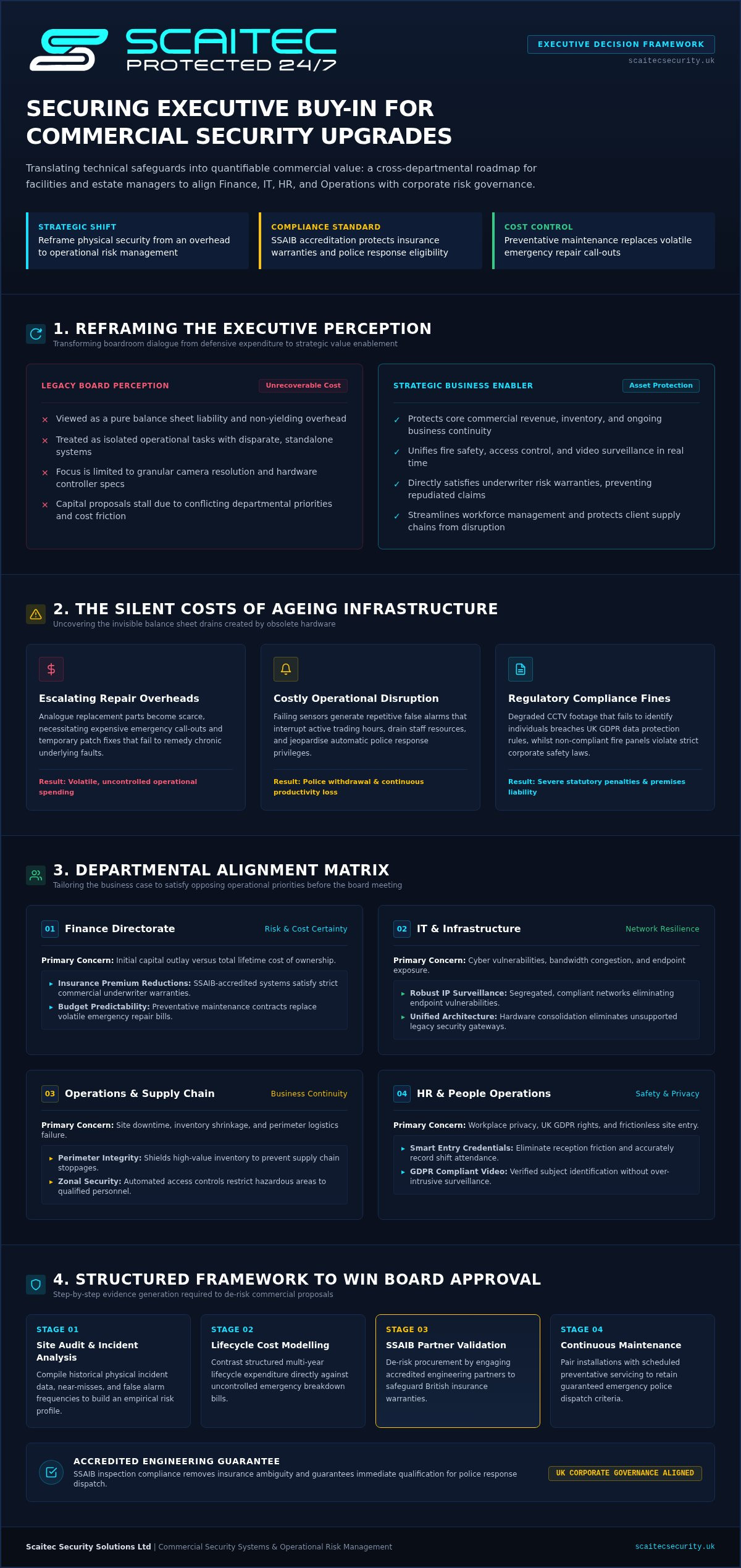
Internal buy-in is not merely about gaining a signature on a purchase order. It represents a cross-departmental consensus that connects organisational risk management directly with capital expenditure. Understanding how to get buy-in for a new security system requires bridging the gap between estate management and boardroom strategy. Modern commercial premises can no longer rely on isolated, disparate devices; they require unified environments where fire safety, access control, and video surveillance communicate continuously to protect staff and physical assets.
When leadership views security upgrades solely through the lens of cost, silent liabilities accumulate. Established security management principles demonstrate that treating physical protection as an isolated operational task leaves critical blind spots. Today, securing modern premises involves integrating tailored business security solutions that align daily operations with overarching corporate governance.
The Hidden Costs of Maintaining Outdated Security Infrastructure
Relying on ageing infrastructure generates silent operational drains that routinely escape initial balance sheet scrutiny. As analogue parts become scarce, businesses face several preventable liabilities:
- Escalating repair overheads: Sourcing obsolete replacement components leads to expensive emergency call-outs and temporary workarounds that fail to solve underlying system faults.
- Costly operational disruption: False alarms triggered by failing sensors disrupt working hours, drain staff resources, and can lead to local authorities or emergency services revoking automatic response privileges.
- Regulatory compliance penalties: Outdated CCTV systems that capture poor footage violate UK GDPR expectations for subject identification, while non-compliant fire panels breach stringent safety legislation.
Reframing Security from a Cost Centre to an Asset Enabler
To master how to get buy-in for a new security system, facility managers must demonstrate how physical infrastructure protects profitability. A robust installation shields brand reputation by safeguarding high-value inventory and ensuring client supply chains remain uninterrupted by perimeter breaches or vandalism.
Modern access control also streamlines workforce management. Smart entry credentials reduce reception friction, log operational attendance accurately, and restrict hazardous zones to qualified personnel without manual oversight. Crucially, modernising these electronic systems directly satisfies insurer risk warranties. Commercial underwriters demand verified compliance with rigorous installation standards; fulfilling these criteria removes policy ambiguities and protects the organisation against costly claim repudiations following an operational incident.
Mapping Your Internal Stakeholders: What Each Department Needs to Hear
A capital expenditure proposal often stalls because different leaders evaluate physical risk through opposing lenses. Knowing how to get buy-in for a new security system means tailoring your message to satisfy four distinct operational agendas before stepping into the boardroom. Executive teams face clear accountability under UK corporate governance and premises liability mandates, but cross-functional consensus is what truly drives approval. Taking time to align departmental priorities early dissolves internal friction and transforms potential detractors into active advocates.
Winning Over Finance: Capital Expenditure, Insurance, and Risk
Finance directors look beyond the initial invoice to the total cost of ownership. Frame the investment around risk reduction and financial predictability. Highlight how installations accredited by the Security Systems and Alarms Inspection Board (SSAIB) satisfy strict underwriter warranties, often unlocking lower insurance premiums. Point out that pairing modern infrastructure with scheduled preventative maintenance agreements eliminates volatile emergency repair bills, replacing sporadic reactive costs with an agreed operational budget.
Addressing IT and Facilities Priorities: Connectivity and Compliance
Technical directors worry about network congestion and cyber vulnerabilities introduced by connected hardware. Reassure IT leadership by choosing modern IP surveillance systems that support encrypted transmission protocols, dedicated virtual local area networks (VLANs), and strict role-based access. When preparing technical justifications, reviewing formal guidance on building a business case for security helps demonstrate how segregated network architecture protects core corporate infrastructure. For facilities managers, an integrated design uniting access hardware, intruder alarms, and commercial CCTV into a single operational interface removes the daily administrative burden of legacy estates.
Engaging HR and Staff: Workplace Culture and Physical Safety
Human Resources teams focus on staff wellbeing and legal privacy obligations. Position access control and CCTV as essential tools for safeguarding lone workers and preventing unauthorised visitors from entering sensitive work areas. When presenting surveillance plans, address Information Commissioner’s Office (ICO) data protection codes directly to prove that personal privacy remains respected. Replacing clunky physical keys with encrypted fobs or mobile credentials removes administrative friction, making daily office movement both frictionless and secure.
By consulting each team beforehand, you present a united commercial front. If you need help tailoring your technical rationale for internal stakeholders, our engineers can design a bespoke commercial security strategy that addresses every departmental priority across your business.
How to Build a Watertight Business Case for Security Investment
Securing executive sign-off requires moving beyond technical jargon to present a disciplined, commercially focused proposal. To understand how to get buy-in for a new security system, you must build an evidence-based narrative that connects capital outlay directly to commercial resilience. Boards approve investments that solve operational headaches and protect the bottom line. Industry frameworks on establishing a strong business case for corporate security highlight that framing electronic safeguards around continuity makes approval far more attainable.
A structured proposal follows five distinct stages:
- Step 1: Conduct an on-site audit: Map physical entry points, high-risk assets, and blind spots across your estate.
- Step 2: Quantify historical incident losses: Calculate the real financial impact of past disruptions, false alarms, theft, and maintenance call-outs.
- Step 3: Specify future-proof hardware: Focus on scalable, open-protocol technologies such as integrated business security access control and modern IP cameras that avoid proprietary obsolescence.
- Step 4: Model total cost of ownership: Combine hardware design, certified installation, remote monitoring, and scheduled preventive maintenance into one clear lifecycle projection.
- Step 5: Deliver an executive summary: Summarise how the integrated system eliminates operational liabilities, maintains regulatory compliance, and protects shareholder value.
Conducting a Thorough Threat and Vulnerability Assessment
Your business case needs an objective baseline. Walk your site to document vulnerable zones, such as dimly lit loading bays, unmonitored rear fire doors, or shared server rooms. Review security logbooks from the previous twenty-four months to identify recurring patterns of unauthorised access, false sensor triggers, or unexplained stock shortages. Conducting this methodical review enables you to match hardware investments to documented, real-world vulnerabilities across your premises.
Quantifying the Return on Investment and Risk Reduction
Proving commercial return is where many proposals falter. When showing how to get buy-in for a new security system to financial decision-makers, calculate both direct and indirect operational recoveries:
- Shrinkage and damage reduction: Track how modern high-definition surveillance deters opportunistic stock loss, inventory diversion, and exterior property vandalism.
- Administrative time savings: Account for hours saved by replacing manual visitor sign-in sheets and physical key tracking with cloud-based credentials and automated activity reports.
- Incident intervention value: Highlight the commercial benefit of pairing perimeter sensors with an accredited Alarm Receiving Centre (ARC), delivering real-time intervention and rapid keyholder or emergency services dispatch before losses spiral.
Overcoming Common Board Objections and Budget Pushback
Anticipating executive pushback turns a tense boardroom interrogation into a collaborative discussion. Knowing how to get buy-in for a new security system means preparing robust answers for predictable financial and operational hesitations. Directors often question timing, suggest consumer-grade alternatives, or express alarm over potential building disruption during trading hours. Addressing these points head-on shows commercial awareness and protects project momentum.
A frequent hurdle is the assumption that off-the-shelf, DIY smart products save money. Consumer kits lack the tamper-resistance, data encryption, and component longevity required for commercial facilities. They carry zero eligibility for automated police response, fail to meet British Standards, and quickly incur heavy replacement costs when deployed in high-traffic environments. True commercial hardware is designed specifically to withstand relentless operational wear.
Managing the “Why Change When Nothing Has Happened?” Mindset
Waiting for a crisis is dangerous. Relying on an incident-free history is a classic case of survivor bias, where absence of loss is mistaken for adequate protection. Opportunistic thieves and industrial trespassers actively identify visibly aged equipment, targeting premises with blind spots or failing perimeter sensors. A catastrophic break-in or fire creates immediate financial ruin through lost orders, damaged client relationships, and invalidated insurance claims. Underwriters frequently repudiate claims if an outdated installation was not serviced in accordance with policy conditions.
Phased Rollouts vs Full System Overhauls: Minimising Disruption
When capital constraints arise, a phased migration plan secures project approval without demanding an all-at-once budget release. A staged deployment balances risk management with cash flow:
- Phase 1: Mission-critical assets: Upgrade perimeter monitoring, primary external entrances, and sensitive IT server infrastructure first.
- Phase 2: Hybrid infrastructure: Retain functional legacy cabling where appropriate, retrofitting intelligent IP controllers and modern sensors to spread expense.
- Phase 3: Lifecycle protection: Establish scheduled maintenance to preserve installed hardware performance and prevent premature replacement cycles.
To overcome staff productivity concerns, insist on planned out-of-hours engineering. Scheduling cable pulls, device mounting, and system cutovers outside core working hours ensures zero interference with daily client trading. Understanding how to get buy-in for a new security system involves proving that installation logistics will not compromise business operations.
Book a professional security audit and maintenance consultation
Selecting an Accredited Security Partner to Guarantee Project Success
Procuring commercial protection is ultimately an exercise in risk management. A core strategy in mastering how to get buy-in for a new security system is eliminating execution risk before presenting to the board. Leadership teams frequently worry that complex technical projects will overrun, underdeliver, or fail regulatory scrutiny. Recommending an accredited installer reassures directors that your chosen provider has been vetted independently against strict national criteria.
During commercial tender evaluations, look beyond glossy sales brochures. Ask prospective providers these critical questions:
- Certification: Do you hold direct certification from a recognised inspectorate like the SSAIB?
- Police Dispatch: Can your installations obtain a Unique Reference Number (URN) from local police forces for immediate Priority 1 response dispatch?
- Lifecycle Upkeep: Do you provide direct preventive maintenance contracts and 24/7 monitoring capabilities?
- Engineering Heritage: Can you demonstrate verifiable installation expertise across similar regional commercial facilities?
Why SSAIB Accreditation Matters to Your Board and Insurers
Third-party accreditation is not merely a marketing badge; it represents rigorous independent oversight. The Security Systems and Alarms Inspection Board (SSAIB) routinely inspects an installer’s engineering quality, financial stability, and staff vetting procedures to ensure full compliance with British and European standards. For corporate boards, this external validation removes procurement ambiguity. Commercial insurance underwriters often stipulate recognised certification as a non-negotiable policy condition; failing to use an accredited installer can leave claims rejected following an incident.
Selecting an accredited firm also provides access to 24/7 remote monitoring connected directly to emergency services. Unaccredited installations simply cannot secure automated police attendance under UK police response guidelines.
Next Steps: Securing Your Professional Security Audit
Transforming internal agreement into operational reality begins with a professional site survey. Establishing an objective, expert assessment gives you the empirical evidence needed to answer board questions with authority. Established in 2005, Scaitec Security Solutions Ltd brings over two decades of local engineering expertise to commercial sites across South Yorkshire, including Rotherham, Sheffield, Barnsley, and Doncaster.
Our team handles the entire system lifecycle, encompassing system design, SSAIB-accredited installation, scheduled maintenance, and round-the-clock remote monitoring. If you are preparing your capital expenditure proposal and want to know how to get buy-in for a new security system backed by engineering data, request a comprehensive commercial security consultation to strengthen your business case today.
Transforming Security Proposals into Boardroom Approval
Successfully mastering how to get buy-in for a new security system comes down to framing physical protection as an operational enabler rather than an unrecoverable overhead. When you align cross-departmental priorities early, quantify the true financial cost of historical vulnerabilities, and present a clear lifecycle model, securing executive funding becomes a collaborative commercial decision.
With over 20 years protecting South Yorkshire businesses with tailored electronic systems, Scaitec Security Solutions delivers the technical authority your leadership team expects. As a fully accredited SSAIB installer, we ensure total compliance with stringent UK insurance standards whilst backing your estate with dedicated engineering support, proactive maintenance, and dependable 24/7 remote monitoring.
Partner with Scaitec Security for your commercial security audit
Armed with structured risk assessments and accredited engineering data, you don’t have to face boardroom pushback alone. Step into your next budget review with complete confidence and protect your organisation’s future.
Frequently Asked Questions
How do I calculate the return on investment for a new commercial security system?
Calculate ROI by contrasting total ownership costs against tangible historical losses and operational savings. Combine direct recoveries from reduced stock shrinkage, eliminated vandalism repairs, and avoided false alarm call-out charges with administrative hours saved by automated access control. Understanding how to get buy-in for a new security system relies on framing these operational recoveries alongside lower commercial insurance premiums to prove the investment pays for itself over its lifecycle.
Why do executive boards frequently reject security upgrade proposals?
Executive boards typically reject proposals that present physical security purely as an unrecoverable overhead rather than a strategic operational enabler. When submissions focus strictly on technical hardware specifications like camera resolution without demonstrating business continuity, risk mitigation, or regulatory compliance, directors push back. Clear commercial alignment across finance, operations, and IT is essential to demonstrate why deferred upgrades create silent financial liabilities that threaten everyday trading.
What is the difference between SSAIB and non-accredited security system installers?
SSAIB accreditation confirms an installer undergoes rigorous independent auditing covering engineering competence, staff vetting, and technical standards. Non-accredited installers lack external verification and cannot issue the compliance certificates demanded by major UK insurers. Crucially, installations completed by unaccredited providers cannot secure a Unique Reference Number (URN) from regional police forces, leaving premises without automated Priority 1 police dispatch during a confirmed activation.
Can we phase a commercial security system installation across multiple financial quarters?
Yes, phased deployments are an effective method for distributing capital expenditure whilst managing operational disruption. A strategic rollout prioritises high-risk perimeter zones, external entry points, and mission-critical assets first. In subsequent fiscal quarters, engineers expand internal access control points and integrate unified monitoring platforms. This modular path spreads procurement costs over agreed financial periods without leaving primary business operations exposed during the transition.
How does an upgraded security system help reduce corporate insurance premiums?
Insurers calculate commercial premiums directly against demonstrable physical risk and premises vulnerability. Modernising your estate with SSAIB-accredited intruder alarms, monitored access control, and high-definition CCTV satisfies strict underwriting warranties. Insurers view verified installations and formal preventive maintenance contracts as significant risk mitigators. This compliance reduces the likelihood of disputed claims, encouraging underwriters to offer preferential policy terms and lower annual premiums.
What role does IT play in approving modern IP security camera systems?
Modern electronic security operates on corporate data networks, making IT leaders vital decision-makers in the procurement process. Network administrators must review hardware to prevent network congestion and protect corporate infrastructure. They evaluate bandwidth consumption, verify that video streams run on dedicated VLANs, and require encrypted transmission protocols. Engaging IT early ensures hardware specifications align with company data policies and network security requirements.
How do I handle staff privacy concerns regarding new access control and CCTV?
Address workplace concerns through transparency and strict adherence to Information Commissioner’s Office (ICO) guidelines. Clearly explain that surveillance cameras cover high-risk operational areas and external perimeters rather than private spaces, aiming to protect personnel and deter crime. Frame electronic access control around safeguarding lone workers. Sharing documented data retention policies demonstrates respect for staff privacy whilst showing how to get buy-in for a new security system across your organisation.
Protect Your Business
Protect Your People
Book Your FREE Site Protection Survey

Since pioneering Scaitec Security Solutions in 2005, Paul Scaife, with his roots in the industry dating back to 1994, has distinguished the firm as a leading provider of bespoke fire and security solutions, servicing clients across Sheffield, Rotherham, and surrounding areas.
His leadership, underpinned by accreditation from the Security Systems and Alarms Inspection Board, ensures that Scaitec surpasses client expectations by blending advanced technology with a deep understanding of their unique needs.
Paul's ethos champions innovation and efficiency, driving Scaitec to deliver tailored, cutting-edge solutions that enhance safety and operational ease.
Discover more about Paul’s commitment to excellence on LinkedIn.