
Table of Contents
What if the lowest per-camera quote leaves you with the least useful comparison? A camera price can look straightforward, but the commercial CCTV cost per camera UK businesses are quoted may not include installation, recording equipment or commissioning. The figure alone does not show whether the proposed system will cover the areas your site needs to protect.
It is reasonable to want a clear figure before committing to a project. Yet proposals can differ in camera capabilities, coverage, recording and storage, as well as what is included after installation. Without an itemised scope, it is difficult to compare like with like or budget for ongoing maintenance and monitoring.
This guide explains what a commercial CCTV quote should set out and which site and system details can affect the proposal. You will learn how to compare equipment, coverage and service scope, and what to clarify about aftercare and recurring costs. The aim is to help you assess proposals confidently and request a site-specific assessment based on your security needs, rather than starting with an arbitrary camera count.
Key Takeaways
- The commercial CCTV cost per camera UK quotes show may mean hardware alone or a share of a complete system, so check exactly what the figure includes.
- Building layout, lighting, viewing distance and installation access can all affect the equipment and work a site requires.
- Compare proposals by camera purpose, recording, storage, installation and support, not just by camera count.
- Map priority areas and viewing needs before requesting a site assessment. Share practical details such as lighting and access constraints.
- A written scope helps clarify who is responsible for designing, installing, commissioning and maintaining the proposed system.
Commercial CCTV cost per camera UK: what does the figure actually include?
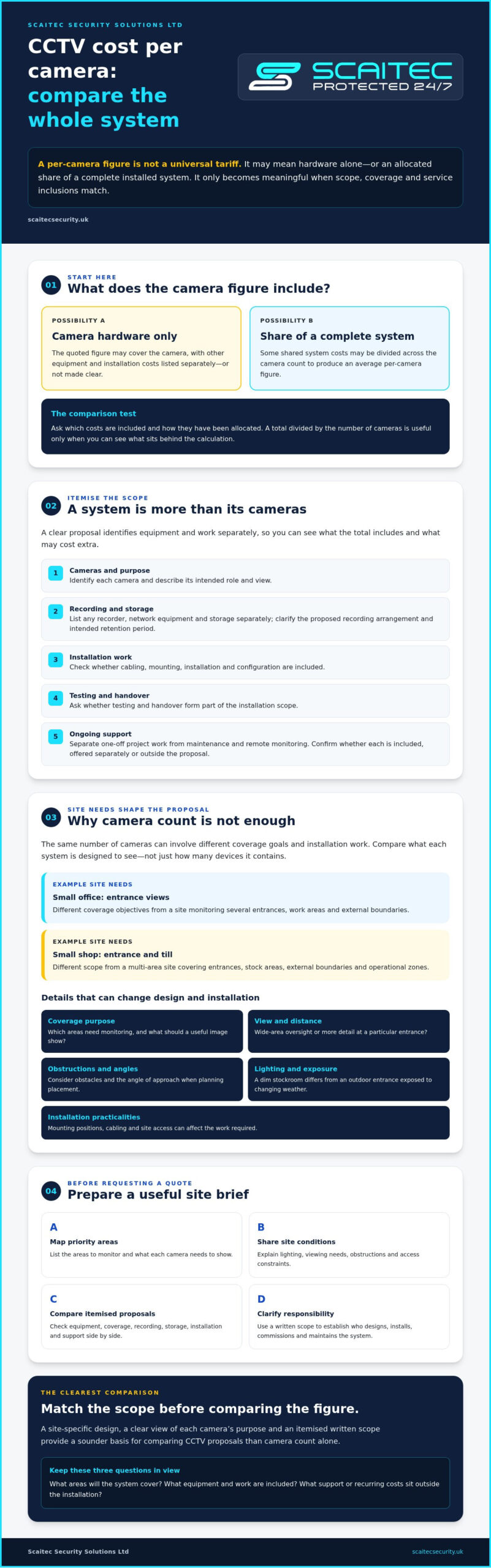
A per-camera figure can refer to camera hardware alone or to an allocated share of a complete installed system. These are not like-for-like measures. A commercial CCTV proposal may also cover recording and network equipment, storage, cabling, installation, configuration, testing and handover. Ask for the items to be listed separately so you can see what the total includes and what may cost extra.
There is no single UK figure that suits every commercial site. A system designed for a small office entrance has different coverage objectives from one intended to monitor several entrances, work areas and external boundaries. Equipment and installation should reflect the site and each camera’s purpose, rather than a standard camera count. For a general introduction to the technology, see Closed-circuit television (CCTV).
What should a commercial CCTV camera quote include?
Check whether the proposal identifies each camera and describes its intended role. It should also list any recorder, network equipment and storage separately, rather than leaving you to assume these are included in the camera price. Ask whether cabling, mounting, configuration, testing and handover are part of the installation scope.
Separate one-off project work from ongoing support. Maintenance and remote monitoring are distinct arrangements, so confirm whether either is included, offered separately or outside the proposal. If you are reviewing a system for a business, Scaitec’s commercial CCTV systems page provides more information about its CCTV offering.
Why a per-camera figure can be misleading
Some parts of a system serve several cameras. Shared equipment, such as a recorder or storage, and installation work might appear as separate line items or be divided across the camera count to produce an average per-camera figure. That calculation can be useful, but only if you know which costs were included and how they were allocated.
Camera count alone also says little about the coverage achieved. A proposal with cameras focused on a few entrances is not directly comparable with one covering a larger or more complex area, even if both list the same number of devices. Compare the purpose and intended view of each camera alongside the full equipment and service scope.
Per-camera cost is a comparison measure, not a universal tariff. It only becomes meaningful when the system scope, coverage objectives and service inclusions match. A site-specific design and clearly itemised proposal provide a sounder basis for comparing CCTV options than dividing a total by the number of cameras.
What changes commercial CCTV installation costs from one camera to the next?
The same camera count can involve very different work. A small shop may need clear views of its entrance and till, while a multi-area site may need coverage across entrances, stock areas, external boundaries and operational zones. The commercial CCTV cost per camera UK businesses are quoted depends on what each camera must capture, how the system records footage and the practical demands of installation.
How site layout and image requirements affect the design
Start by identifying which areas need monitoring and what a useful image must show. A wide view may help oversee a larger space, while a camera positioned to capture a particular entrance may need to show more detail. Viewing distance, obstructions and the angle of approach all inform camera placement and selection.
Lighting and exposure matter too. Conditions inside a dim stockroom differ from those at an outdoor entrance exposed to changing weather. A site assessment can help establish whether light levels, mounting positions or obstacles affect the proposed coverage. The Surveillance Camera Code of Practice is a useful reference when considering the responsible use of surveillance cameras.
How recording, cabling and installation complexity affect scope
Recording arrangements shape the system beyond the cameras themselves. Local recording equipment stores footage on site, while a networked setup uses connected equipment to manage and record camera feeds. Ask the installer to specify the proposed arrangement, the intended retention period, and the image quality and recording settings required. These details inform the storage and recorder capacity needed.
Installation conditions also vary. Cable routes may be straightforward in one building and difficult in another. The route, mounting surface and need for access equipment can affect the work. Ask whether the survey has accounted for equipment access, possible disruption to normal operations, and how the system will be configured and tested.
For example, a small business with a few priority areas may have shorter cable routes and a simpler recording setup than a site spread across separate buildings or operational zones. The latter may need more complex cable routing, storage planning and camera positioning. A commercial CCTV systems assessment can help translate site requirements into a clear design and scope. Share your priority areas and operating conditions so the proposed system reflects how the premises are used.
How to compare commercial CCTV quotes without being misled by camera count
A lower total or smaller per-camera figure does not automatically mean better value. Proposals can use the same camera count but provide different views, recording arrangements and installation work. Compare the intended coverage and complete scope first, then consider how each option meets your business’s needs.
Which CCTV quote details should businesses compare?
Use a simple checklist to put proposals side by side. Ask suppliers to identify camera positions, intended views and any areas excluded from the design. Check that recording capacity, storage assumptions, access requirements and commissioning are clearly described. The table below can help you identify missing details and prepare follow-up questions.
| Quote item | What to check |
|---|---|
| Camera purpose | Location, intended view and the security need it addresses. |
| Specification | Proposed camera capabilities and any differences between cameras. |
| Recording | Recorder arrangement, capacity and how commissioning is handled. |
| Storage | Storage method, retention assumptions and any stated limits. |
| Installation | Cabling, mounting, access arrangements, configuration and testing. |
| Support | Whether maintenance or remote monitoring is included, optional or excluded. |
Ask each supplier to list exclusions, assumptions and optional items separately. If you may extend the system later, ask whether the proposal explains what extra equipment or work could be needed. Record the answers in the same comparison document so an unclear inclusion is not mistaken for a confirmed one.
How to assess value without choosing on price alone
Match each quoted component to a defined coverage outcome. For example, check whether the proposed view covers the entrance you prioritised instead of simply comparing camera numbers. If specifications differ, ask the supplier to explain in plain English what the difference means for the image or the way you can use the system.
This matters when calculating the commercial CCTV cost per camera UK proposals appear to show. Dividing a total by the camera count will not reveal whether one quote includes commissioning or support while another lists these separately. A lower figure may reflect a narrower scope, not better value.
For wider planning context, explore Scaitec’s commercial CCTV systems information. If you are assessing a proposed system, request a written scope that sets out camera positions, inclusions and exclusions. This gives you a clearer basis for comparison.
How to budget for commercial CCTV and request a useful UK quote
A clear quote starts with a clear brief. You do not need to decide the final camera count before speaking to an installer. Describe the risks and operational needs the system should address, then ask for a site assessment and itemised proposal. This makes it easier to understand how the suggested design meets your requirements.
What information should you prepare before requesting a quote?
Use this sequence to organise your request:
- Map the risks: Note the incidents, access concerns or operational issues you want CCTV to help address.
- Mark priority areas: Sketch entrances, boundaries, stock areas and other locations where coverage matters. A basic site plan is useful.
- Set viewing needs: Explain what each view should capture and who needs authorised access to footage.
- Request a site assessment: Share the plan and ask the installer to check camera positions, cable routes and practical installation conditions.
Include details that can affect the design: opening hours, lighting conditions, access constraints, existing CCTV equipment and any network limitations. Mention preferred project timings too. These details help the assessor understand the premises and identify questions that may not be clear from a plan alone.
What to check before approving the proposal
Ask for the quote to itemise equipment, labour, recording, storage and commissioning, and to distinguish these project costs from optional aftercare. Check that it states the proposed coverage, equipment assumptions, exclusions and handover arrangements. If a component or service is unclear, ask the supplier to explain it in plain English before comparing totals.
Consider ongoing system upkeep as well. Ask how maintenance is documented, what it covers and whether support options are separate from installation. Scaitec provides information about CCTV maintenance and servicing for businesses planning beyond installation.
Finally, check the legal and data-protection responsibilities that apply to your site and intended use. Requirements can depend on how and where cameras operate, so do not assume an equipment proposal settles those responsibilities. Confirm what is within the installer’s scope and what your organisation needs to manage itself.
With these details in hand, the commercial CCTV cost per camera UK figure is easier to assess against the proposed coverage and full project scope, rather than an assumed camera count.
Choosing a commercial CCTV installer in South Yorkshire and across the UK
A suitable installer should help you define security objectives before recommending camera numbers. A site survey gives them the chance to understand how the premises are used, identify practical installation considerations and discuss which areas need coverage. A written scope then records the proposed positions, intended views, equipment and work, giving you something clear to compare and refer to later.
Check who is responsible at each stage. The proposal should make clear who designs the system, carries out the installation, commissions it and explains how to use it. It should also state what handover information you will receive and whether ongoing maintenance or other support arrangements are included or offered separately. This clarity matters as much as the commercial CCTV cost per camera UK quote, because it explains what service sits behind the figure.
Questions to ask a CCTV installation company
Before approving a proposal, ask how the installer will establish coverage objectives and decide on camera positions. Request confirmation of the testing included, the handover information provided and whether staff guidance forms part of the agreed scope. Clarify how maintenance and support options are documented so you can distinguish installation work from ongoing services.
Ask the installer to explain specification choices in practical terms. You should be able to understand which operational need each camera serves and what the proposed system is intended to capture. If the written scope leaves an area, task or responsibility uncertain, ask for clarification before committing.
Arrange a commercial CCTV assessment
Scaitec Security Solutions Ltd is an independent security and fire systems company established in 2005. It designs, installs and maintains CCTV systems for commercial and residential properties. Review its commercial CCTV installation and systems information when considering what support to discuss. Confirm current coverage for your premises directly when making an enquiry.
Scaitec is based in Rotherham, with local relevance for businesses in Sheffield, Barnsley, Doncaster, Chesterfield, Worksop, Wakefield and Huddersfield. Bring your priority areas, operational requirements and questions about handover and maintenance to the discussion. A site-specific assessment can help turn these details into a proposed design and written scope, without asking you to settle on an arbitrary camera count first.
Make your next CCTV decision with confidence
The commercial CCTV cost per camera UK businesses are quoted is useful only when you know what sits behind it. Compare coverage objectives, equipment, recording, installation and ongoing support, and ask suppliers to make exclusions and assumptions clear. A site-specific design is a more reliable basis for deciding what your premises need than choosing a system by camera count alone.
Before requesting a proposal, note your priority areas, operating conditions and what you need each camera to capture. Then ask for a written scope explaining how the proposed system addresses those requirements and what happens after installation.
Scaitec Security Solutions Ltd is an independent security company established in 2005, providing commercial CCTV design, installation and maintenance. Discuss your site requirements with the team to explore an assessment tailored to your premises.
A considered design and clear proposal can help you make a confident choice and plan for dependable coverage over time.
Frequently Asked Questions
How much does commercial CCTV cost per camera in the UK?
There is no single commercial CCTV cost per camera UK figure that applies to every business. A quote might cover camera hardware only or show an allocated share of a complete system, including recording equipment and installation. Site layout, coverage requirements, storage and installation access all affect the proposed scope. Request an itemised, site-specific quotation, then compare what each figure includes rather than relying on a headline amount.
What is usually included in a commercial CCTV installation quote?
A commercial quote may include camera equipment, recording or network equipment, cabling, mounting, installation, configuration, testing and handover. The exact scope varies, so check that each item is clearly listed and ask about exclusions. Storage, maintenance and remote monitoring may be included, offered separately or excluded. Confirm what the installer will provide and what your business will need to arrange, especially for system upkeep after installation.
Does a commercial CCTV quote charge separately for each camera?
Not necessarily. A proposal may list each camera separately, while shared items such as recording equipment, storage or installation work appear as project costs. Some suppliers may divide the total by the camera count to provide an average figure. Ask how any per-camera amount was calculated and whether it includes shared equipment and labour. This helps you compare proposals fairly, even when their pricing formats differ.
What factors affect the cost of installing business CCTV?
Costs depend on the site and the system’s intended purpose. Camera positions, viewing distance, lighting, weather exposure and the image detail required can influence equipment choices. Cable routes, mounting surfaces, access needs and potential disruption affect installation work. Recording arrangements and the intended footage retention period can also shape storage requirements. A site assessment helps establish which factors apply to your premises.
Is it cheaper to install more CCTV cameras at once?
Installing several cameras during one project may allow some work, such as planning or cable routing, to be considered together. However, that does not automatically make each camera cheaper or mean adding cameras is good value. The result depends on the building, coverage objectives and equipment required. Ask suppliers to explain any project efficiencies and compare the complete scope with the areas and risks your business needs to address.
Do commercial CCTV systems have ongoing costs after installation?
They can. Depending on the system and proposal, ongoing costs may include maintenance, remote monitoring or storage services. These are not necessarily part of the initial installation price, so check whether they are included, optional or excluded, and ask what each arrangement covers. Scaitec provides system maintenance and remote monitoring. Confirm the specific terms and any applicable charges in the quotation before approving the work.
How can I compare commercial CCTV quotes in South Yorkshire?
Compare camera locations and intended views, equipment, recording, storage, installation, commissioning and support. Ask each supplier to identify exclusions, assumptions and optional items, then judge whether the proposed coverage meets your needs rather than dividing the total by the camera count. Scaitec is based in Rotherham and serves locations including Sheffield, Barnsley, Doncaster, Chesterfield, Worksop, Wakefield and Huddersfield. Confirm current commercial coverage directly when requesting an assessment.
Protect Your Business
Protect Your People
Book Your FREE Site Protection Survey

Since pioneering Scaitec Security Solutions in 2005, Paul Scaife, with his roots in the industry dating back to 1994, has distinguished the firm as a leading provider of bespoke fire and security solutions, servicing clients across Sheffield, Rotherham, and surrounding areas.
His leadership, underpinned by accreditation from the Security Systems and Alarms Inspection Board, ensures that Scaitec surpasses client expectations by blending advanced technology with a deep understanding of their unique needs.
Paul's ethos champions innovation and efficiency, driving Scaitec to deliver tailored, cutting-edge solutions that enhance safety and operational ease.
Discover more about Paul’s commitment to excellence on LinkedIn.