
Table of Contents
What if your weekly fire alarm test passes, but a fault elsewhere in the system remains undetected? If you’re asking how often should fire alarms be serviced Doncaster, the practical answer for many non-domestic systems is every six months, following the recommendations in BS 5839-1:2025. Weekly user tests are essential, but they do not replace professional servicing.
It can be difficult to distinguish routine checks from legal responsibilities. In England, the Regulatory Reform (Fire Safety) Order 2005 requires the responsible person to ensure fire safety measures are suitable and maintained. The six-monthly interval comes from the relevant British Standard, while the fire risk assessment and the system itself may call for additional attention.
This guide explains what weekly tests should cover, what a professional service adds and how to keep useful maintenance records. It also sets out practical steps for building a dependable plan for your Doncaster property, with servicing tailored to the site and fire alarm system.
Key Takeaways
- If you’re researching how often should fire alarms be serviced Doncaster, six-monthly professional servicing is a common benchmark, not a universal statutory interval.
- Understand how the responsible person’s legal duty differs from the maintenance recommendations in the relevant British Standard.
- Keep routine user tests, professional servicing and corrective maintenance distinct, with a clear purpose and owner for each task.
- Build a practical schedule by reviewing system documents, building use, occupancy and any faults or changes, then recording each outcome.
- Planned maintenance tailored to your site and system can help keep your fire alarm dependable. Scaitec supports properties in Doncaster and across South Yorkshire.
How often should fire alarms be serviced in Doncaster?
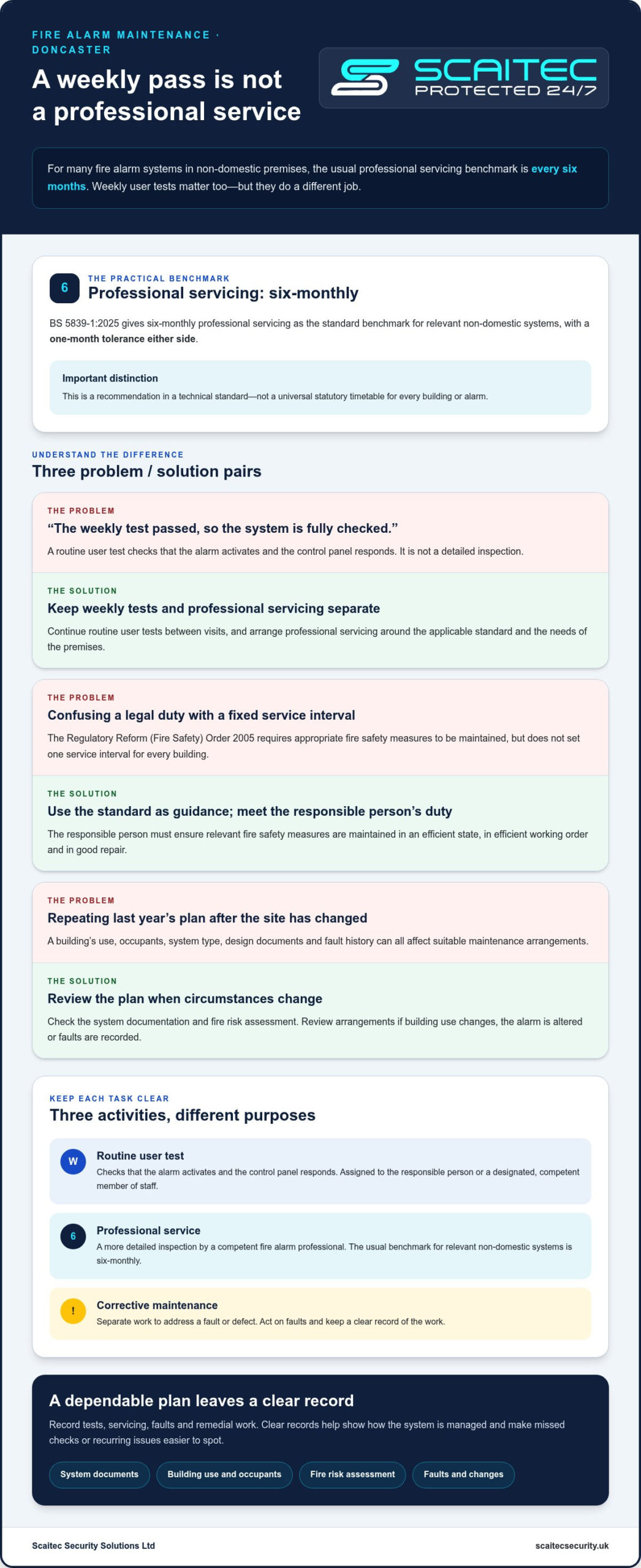
For many fire alarm systems in non-domestic premises, professional servicing every six months is the usual benchmark. If you’re searching for how often should fire alarms be serviced Doncaster, note that this interval comes from the relevant British Standard, not from a universal law setting the same schedule for every building. Routine user tests are separate and should continue between service visits.
Doncaster premises follow the same applicable England-wide fire safety framework as comparable premises elsewhere. There is no separate Doncaster servicing interval. The appropriate maintenance plan depends on the system and the site.
What is the usual professional fire alarm service interval?
For relevant non-domestic systems, BS 5839-1:2025 gives six-monthly professional servicing as the standard benchmark, with a one-month tolerance either side of that interval. This is a recommendation within the technical standard, not a statutory timetable that automatically applies to every alarm.
The system’s design, its documentation and the premises’ risk profile can affect the maintenance plan. A professional service is a detailed inspection, not just a check that the alarm sounds. For a general overview of components and how a fire alarm system works, see this introductory reference.
Does every Doncaster fire alarm follow the same schedule?
No. A commercial system in a shop, office or shared building may be covered by different guidance from an alarm in a private home. The building’s use, its occupants, the system type and its design documents all help determine suitable arrangements. For non-domestic premises, the responsible person’s fire risk assessment is an important part of deciding what precautions are needed and how they should be maintained.
Treat six-monthly servicing as a useful starting point, then compare it with the system records and site-specific assessment. If the building’s use changes, the alarm is altered or faults are recorded, review the maintenance plan rather than simply repeating the previous dates.
In short: schedule professional servicing around the applicable standard and the needs of the premises, while keeping routine user tests on their own schedule. Planned fire alarm maintenance can be tailored to the site and system, supporting dependable aftercare for properties in Doncaster and across South Yorkshire.
What UK fire safety guidance says about alarm servicing
For relevant non-domestic premises, fire alarm maintenance is part of a wider legal duty to keep fire precautions suitable and working. The Regulatory Reform (Fire Safety) Order 2005 places responsibility on the designated “responsible person”, commonly an employer, building owner or manager, depending on the premises. The law requires appropriate maintenance, but does not set one universal fire alarm service interval for every building.
The UK fire safety guidance explains the responsible person’s duties. Recording tests, servicing, faults and remedial work helps show how the system is being managed and makes it easier to spot missed checks or recurring issues. The precise duties depend on the building and its circumstances. The Order generally concerns non-domestic premises, including relevant shared areas in residential buildings, rather than the inside of an individual private home.
What does the responsible person need to maintain?
The responsible person must ensure that relevant fire safety measures are maintained in an efficient state, in efficient working order and in good repair. For an alarm system, this means arranging appropriate checks and maintenance, acting on faults and keeping a clear record of the work. Where duties involve more than one person, responsibilities should be clear.
How does BS 5839-1 inform servicing frequency?
For fire detection and alarm systems in non-domestic premises, BS 5839-1:2025 provides technical recommendations for design, installation, commissioning and maintenance. It offers a framework for planning service visits, but it is not legislation. The commonly recommended six-monthly service interval comes from this standard, not from a universal statutory rule.
Use the system’s design and maintenance documentation alongside the current standard and the premises’ fire risk assessment. The building’s purpose, occupancy, system configuration and fault history can all affect the plan. So, when considering how often should fire alarms be serviced Doncaster, base the answer on the applicable guidance and specific site, not on a separate local rule.
For more information about fire protection options, see our fire safety systems. Scaitec also provides planned system maintenance tailored to the site and system, supporting dependable fire alarm aftercare across Doncaster and South Yorkshire.
Weekly fire alarm tests versus professional servicing: what is the difference?
A weekly test and a professional service have different purposes. The user test is a brief, routine check that the system responds. A service is a more detailed inspection by a competent fire alarm professional. Corrective maintenance is separate again: it addresses a fault or defect that needs attention.
| Activity | Purpose | Who is responsible? |
|---|---|---|
| Routine user test | Checks that the alarm activates and the control panel responds. | The responsible person or a designated, competent member of staff. |
| Professional servicing | Inspects and functionally checks the system, including its condition and components. | A competent fire alarm engineer. |
| Corrective maintenance | Investigates and rectifies a fault or damage identified during a test, service or normal operation. | A competent person with the appropriate expertise for the work. |
What should routine user checks tell you?
For relevant workplace systems, the usual routine is a weekly test. Following the site’s procedures, activate a different manual call point each week and check that the alarm sounds and the control panel indicates the activation. This is a basic function check, not a test of every detector or device.
Record the date, call point tested and result in the site log. Note any fault or unexpected behaviour and make sure it is followed up. A successful test gives useful reassurance about that check, but it cannot confirm the condition of every part of the system.
What does a professional service add?
During a planned service, a competent engineer carries out a wider inspection and functional assessment of the system. This can identify issues a brief user test may not reveal, including problems affecting other devices, connections or the system’s overall condition. Under BS 5839-1:2025, every device should be tested at least once across the two six-monthly service visits for relevant non-domestic systems.
A successful weekly test does not replace professional servicing. Keep both activities in your maintenance plan and records. If a test reveals a fault, record it and arrange follow-up rather than waiting for the next planned visit. Scaitec provides corrective maintenance support for fire alarm faults. Keeping the tasks separate also clarifies how often should fire alarms be serviced Doncaster: routine tests continue weekly, while professional servicing follows the system’s applicable maintenance plan.
How to plan a fire alarm servicing schedule for a Doncaster property
A clear schedule helps you organise access, assign responsibilities and keep maintenance evidence together. For a Doncaster property, build the plan around the alarm system and how the building is used, rather than relying on a calendar reminder alone. These steps provide a practical starting point.
- 1. Identify the system. Establish what type of alarm is installed and which areas or devices it covers. Note any building or system changes that could affect how it operates.
- 2. Review the records. Locate the design and commissioning documents, previous service reports and site logbook. Look for the existing maintenance arrangements, outstanding recommendations and repeat faults.
- 3. Set a site-specific schedule. Use the applicable system guidance and fire risk assessment to plan professional visits and routine checks. Consider the building’s purpose, occupancy, system design and known faults. Set reminders and assign a named person to coordinate access and support each visit.
- 4. Record results and follow up. Keep each visit report with the site’s alarm records. Log defects, remedial action and follow-up requirements, then track outstanding work until it is completed.
What information should you gather before setting the schedule?
Start by gathering the paperwork, even if it is incomplete. Note the alarm type, building use, access arrangements and recurring faults. For example, if rooms are locked or occupied at different times, plan how the relevant areas can be accessed during maintenance. Keep the fire risk assessment with the system records so the schedule reflects the premises and its current use.
What should a servicing visit and its records cover?
The precise checks depend on the system, so do not assume every visit follows an identical checklist. The report should explain what was inspected or tested, the findings, any defects and recommended or completed remedial actions. It should also say whether further work or a follow-up is needed.
Complete records give the responsible person a useful history of system care, rather than a collection of dates without context. They also help when staff or building management change: the next person can see what was done, what remains outstanding and where the latest documents are held. Scaitec’s preventative maintenance support is tailored to the site and system, helping make planned aftercare part of an organised routine.
For managers asking how often should fire alarms be serviced Doncaster, the records and site assessment help turn general guidance into a practical schedule. Keep the logbook accessible, name the person responsible for updating it and review the plan after system or building changes.
Use planned fire alarm maintenance to keep visits, records and follow-up actions organised.
Arrange planned fire alarm maintenance in Doncaster with Scaitec
Once you have established a suitable interval for your system, make maintenance part of the site’s routine. A schedule is only useful if visits happen, access is organised and recommendations are followed up. If you are still considering how often should fire alarms be serviced Doncaster, use the system records and needs of the premises to shape a practical plan, rather than treating a general interval as a rule for every building.
Review your arrangements if a planned visit has been missed, faults keep recurring, or the building’s use or layout has changed. Check that service dates, findings and completed work are entered in the site log. This gives the responsible person a clearer picture of the system’s history and helps staff understand what needs attention next.
When is it time to review your maintenance arrangements?
A change in occupancy, a new use for part of the building or alterations to the alarm system can affect how maintenance is organised. Review the arrangements after these changes, as well as following a missed visit or repeat fault. If a warning or fault appears between planned services, record it and arrange appropriate corrective attention instead of waiting for the next scheduled inspection. Track any follow-up work until it is completed.
Good records also support continuity when the person coordinating maintenance changes. Make sure the site log and system documents are accessible to staff who organise checks, arrange access and review service reports. A diary reminder can prompt the next visit, but it should sit alongside the site’s documented maintenance plan.
How can Scaitec support a Doncaster site?
Scaitec Security Solutions is based in Rotherham and supports properties in Doncaster and across South Yorkshire. Established in 2005, the company provides fire alarm system maintenance and support, with planned arrangements tailored to the site and system. Scaitec serves businesses and properties in Rotherham, Sheffield, Barnsley, Doncaster, Chesterfield, Worksop, Wakefield and Huddersfield. This connects general guidance with the practical needs of a particular property, its alarm documentation and ongoing maintenance records.
Whether you are organising planned visits or reviewing an existing arrangement, clear information about the system, site access and recorded issues helps make the next steps straightforward. Planned maintenance is part of dependable fire system aftercare, while faults identified between visits need their own timely follow-up.
Explore Scaitec’s planned fire alarm maintenance support to organise ongoing servicing and aftercare.
Put a dependable fire alarm maintenance plan in place
If you’re asking how often should fire alarms be serviced Doncaster, six-monthly professional servicing is a common benchmark for relevant non-domestic systems. The right schedule depends on the applicable guidance, system documentation and needs of the premises. Keep routine user tests in place too: they can flag issues but do not replace a professional service.
A practical plan needs clear responsibilities, scheduled visits and accurate records. Review it if the building’s use changes, a visit is missed or faults recur, and track any follow-up work through to completion. These steps help responsible persons maintain a clear picture of their alarm system and its upkeep.
Scaitec Security Solutions, established in 2005, provides fire system maintenance support to properties in Doncaster and across South Yorkshire. Planned arrangements are tailored to the site and system, helping keep ongoing aftercare organised.
With a suitable schedule and well-kept records, you can take the next step towards a dependable fire alarm system and a more organised maintenance routine.
Frequently Asked Questions
How often should a commercial fire alarm be serviced in the UK?
For many non-domestic systems, professional servicing every six months is the common benchmark in BS 5839-1:2025. If you’re asking how often should fire alarms be serviced Doncaster, the same England-wide guidance applies as elsewhere, but your system design, documentation and site risk may affect the maintenance plan. Review the records and fire risk assessment, and keep routine user tests on their own schedule.
Is six-monthly fire alarm servicing a legal requirement?
No. Six-monthly servicing is not a universal statutory interval. The Regulatory Reform (Fire Safety) Order 2005 requires the responsible person for relevant non-domestic premises to ensure fire safety measures are maintained, but it does not prescribe one servicing timetable for every alarm. BS 5839-1:2025 provides technical recommendations for relevant systems, including the usual six-monthly benchmark. Suitable arrangements depend on the premises, system and applicable guidance.
Can weekly fire alarm tests replace professional servicing?
No. A weekly user test is a basic check that the alarm activates and the control panel responds, usually by testing a different manual call point. It does not inspect or assess every part of the system. Professional servicing involves wider checks by a competent person. Keep both activities in the maintenance plan, record weekly test dates and results, and follow up faults rather than waiting for the next planned service.
What happens if a fire alarm is not serviced regularly?
Without planned maintenance, defects or deterioration may go unnoticed, and the alarm might not operate as intended in an emergency. Missed visits and incomplete records can also make it harder to demonstrate that fire precautions are being maintained. For relevant non-domestic premises, the responsible person must meet duties under the Regulatory Reform (Fire Safety) Order 2005. Review overdue servicing, document the position and arrange appropriate maintenance.
Who is responsible for arranging fire alarm servicing at a business?
The responsible person has duties under the Regulatory Reform (Fire Safety) Order 2005 for fire safety in relevant non-domestic premises. Depending on the circumstances, this may be an employer, building owner or manager. They should make sure responsibilities are clear, routine checks are assigned to a competent person and suitable professional maintenance is arranged. Keep service reports and test records accessible so staff handovers do not disrupt the schedule.
Does a home fire alarm need the same servicing schedule as a business system?
Not necessarily. Commercial fire alarm systems are commonly maintained with reference to BS 5839-1, while domestic alarms may be covered by different guidance and product instructions. A self-contained home alarm is not automatically subject to the same schedule as a system in a workplace or shared building. Follow the alarm manufacturer’s instructions, test it as directed and seek suitable advice if your home system is part of a larger building arrangement.
What should be recorded after a fire alarm service?
Keep the service report with the site’s fire alarm records. It should identify the visit date and system, describe the checks and findings, and note defects, remedial work completed or recommended, and any follow-up required. Record when outstanding actions are completed. This gives the responsible person a clear maintenance history, helps track recurring issues and supports continuity if building management or the staff coordinating maintenance change.
Protect Your Business
Protect Your People
Book Your FREE Site Protection Survey

Since pioneering Scaitec Security Solutions in 2005, Paul Scaife, with his roots in the industry dating back to 1994, has distinguished the firm as a leading provider of bespoke fire and security solutions, servicing clients across Sheffield, Rotherham, and surrounding areas.
His leadership, underpinned by accreditation from the Security Systems and Alarms Inspection Board, ensures that Scaitec surpasses client expectations by blending advanced technology with a deep understanding of their unique needs.
Paul's ethos champions innovation and efficiency, driving Scaitec to deliver tailored, cutting-edge solutions that enhance safety and operational ease.
Discover more about Paul’s commitment to excellence on LinkedIn.