
Table of Contents
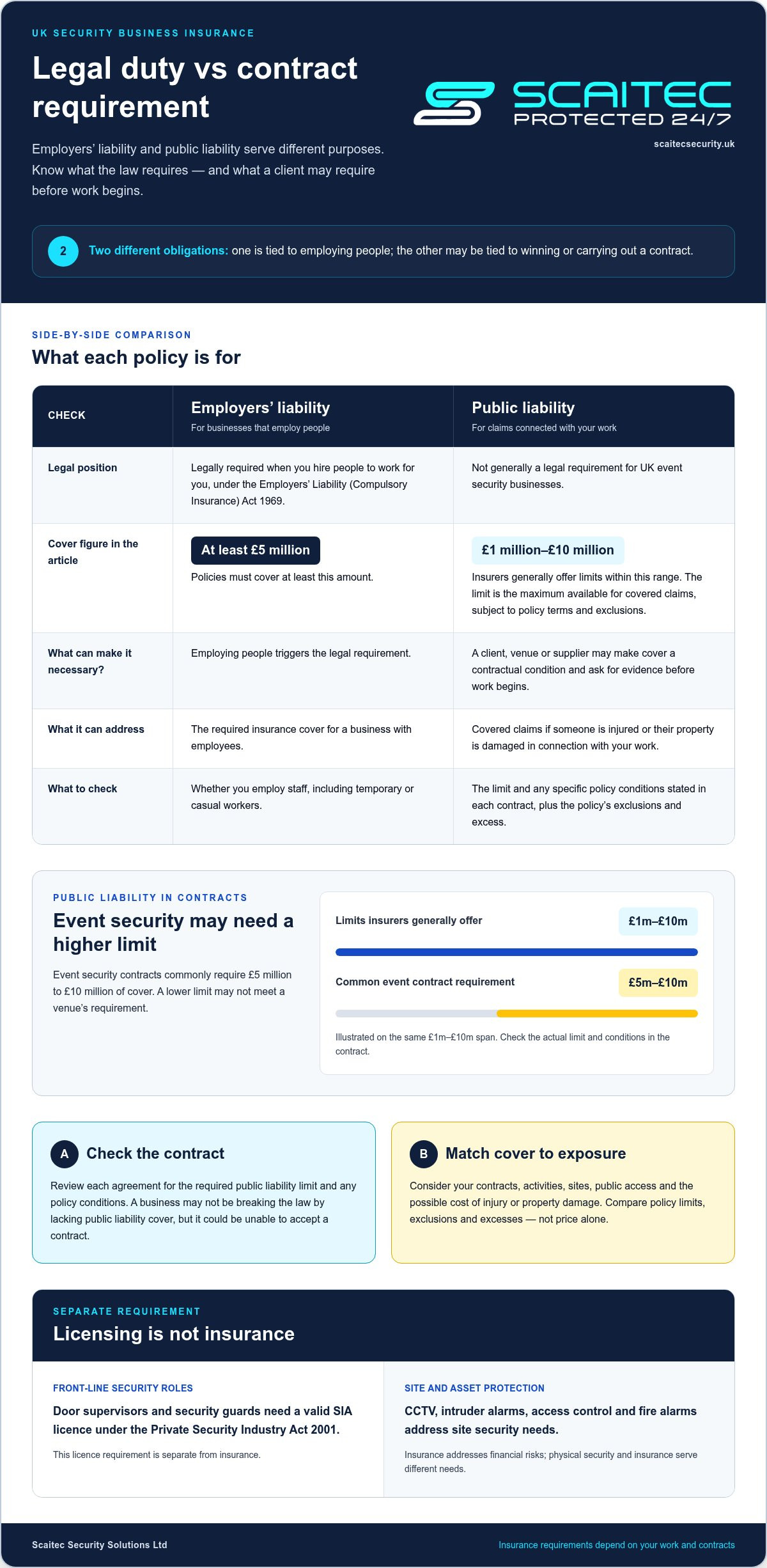
For UK security businesses, employers’ liability insurance is legally required when you hire people to work for you: the Employers’ Liability (Compulsory Insurance) Act 1969 requires it, according to UK Parliament, and policies must cover at least £5 million, according to the UK Government. Public liability insurance isn’t generally a legal requirement, but clients and venues may make it a condition of a contract; insurers typically offer limits from £1 million to £10 million. These are key business insurance security requirements in the UK, but the cover that makes sense depends on the work you do and the contracts you take on.
It’s reasonable to want a clear picture before arranging cover, especially when policy requirements and premiums vary. This guide explains which insurance may be required by law or contract, how public liability limits are used, what can affect a quote, and what information to prepare. It also covers questions about employees, vehicles, equipment and professional services, helping you focus on the cover your business may need.
Key Takeaways
- Match public liability cover to your work and contract requirements, and compare policy limits, exclusions and excesses rather than focusing on price alone.
- Insurance costs can reflect whether you employ staff, the clients you serve and where you work. Give accurate details about your business activities when requesting a quote.
- Prepare information about your workforce, work locations, contracts, vehicles and equipment to help insurers assess the cover you need.
- Front-line door supervisors and security guards need a valid SIA licence under the Private Security Industry Act 2001, according to the Security Industry Authority.
- Separate insurance obligations from security measures: CCTV, intruder alarms, access control and fire alarms address site security needs, while insurance addresses financial risks.
Public liability limits
Public liability insurance can cover claims if someone is injured or their property is damaged in connection with your work. The appropriate limit depends on your contracts, activities and exposure to claims.
Choosing a public liability limit
Insurers generally offer public liability cover from £1 million to £10 million. The limit is the maximum amount available for covered claims, subject to policy terms and exclusions.
Review each contract before choosing a limit. Event security contracts commonly require £5 million to £10 million of cover, so a lower limit may not meet the venue’s requirements. Consider the sites you work at, the public’s access to them and the possible cost of injury or property damage. A broker can help compare limits and policy wording against those exposures.
Legal requirements for public liability cover
Public liability insurance is not generally a legal requirement for UK event security businesses. However, clients and suppliers may make it a contractual condition and ask for evidence of cover before work begins.
That distinction matters: a business may not be breaking the law by lacking public liability cover, but it could still be unable to accept a contract. Check the required limit and any specific policy conditions in each agreement. In the UK, front-line door supervisors and security guards need a valid SIA licence under the Private Security Industry Act 2001, according to the Security Industry Authority. This licence requirement is separate from insurance.
Directors’ and officers’ liability
Public liability insurance can protect against certain claims involving injury to others or damage to their property. Directors’ and officers’ liability insurance addresses a different risk: claims against managers personally over decisions made in their roles.
Claims may involve alleged health and safety law breaches, pension misadministration or errors in financial reporting. Investors may also ask whether a business has this cover when considering an investment. Assess your directors’ roles and responsibilities alongside investor and contract expectations, rather than treating this policy as a replacement for public liability insurance.
Read the policy wording closely. Management liability policies vary, and some exclude insolvency. That exclusion may matter if a claim arises while the business is financially distressed. Review the exclusions, limits and conditions that could affect cover, and consider how the policy responds to the risks your business faces.
Insurance and physical security address different needs. A claim policy does not secure premises, whilst business security arrangements concern protection of sites and assets. Keep those decisions distinct when assessing liability exposure and contractual requirements.
Factors affecting business insurance costs
Security insurance premiums reflect a business’s activities, clients and operating locations. A company providing security at a venue faces different exposures from one working at private premises. Insurers assess these details when considering potential claims, including accidental injury or property damage linked to the work. When reviewing business insurance security requirements in the UK, describe your actual assignments rather than relying on a broad business label.
Whether the business employs staff also affects the cover insurers assess. Employees can change the protection needed and the risks associated with the operation. Describe the workforce accurately, including staff roles and whether you use temporary or casual workers. For example, explain whether staff work at client sites, venues or your own premises. A precise account helps insurers assess how the business operates.
- Client type: Describe whether assignments are for venues, businesses or private clients. Contracts and working environments can affect the liability exposure insurers consider.
- Work location: Explain where assignments take place and whether employees visit client sites. Location matters alongside the activities carried out there.
- Workforce: State whether you employ staff and outline their duties. This helps insurers assess employee-related risks and relevant cover.
The cover selected also influences a quote. Public liability insurance can protect against covered claims involving injury to another person or damage to their property. Insurers consider the potential exposure associated with the limit and the work involved. Explain contract requirements and the activities behind them. For instance, describe the setting and tasks involved, not just the limit a client requests.
Professional indemnity may be relevant if claims could arise from professional advice or services. An allegation that advice caused a customer financial loss presents a different risk from accidental property damage during a site visit. Include any advice or services in your business description so the insurer can understand what you are responsible for delivering.
The premium depends on the business and is provided after a quote request. Insurers weigh factors such as employees, client types, work locations and chosen cover. Preparing details about assignments, staff and contract conditions can make the assessment more relevant. Keep the description consistent across quote documents and policy information.
Review your details whenever the business changes its activities, clients or working locations. If you take on a new type of assignment, describe how it differs from your existing work. This helps keep your insurance information aligned with current operations. Clear records also make it easier to explain why particular cover is needed under business insurance security requirements in the UK.
For a useful quote, set out what the business does, who performs the work, where it happens and what cover contracts require. These details help insurers assess relevant risks instead of relying on assumptions. Keeping the information accurate supports decisions about business insurance security requirements in the UK as your operation changes.
Choosing an insurance provider
UK businesses can arrange insurance directly with an insurer, through a broker or using a comparison website. Each route may present different options, so compare policy wording, not just premiums. A low price may come with an excess, exclusion or condition that affects whether a claim is covered. Start with the work your business performs and the contracts it must meet.
Make a like-for-like comparison. Put the cover types, limits, excesses and exclusions from each quote side by side. Check what the policy protects against, who counts as an insured person, and whether compensation and legal costs fall within or outside the stated limit. For example, a policy excluding an activity may not suit a business whose staff regularly perform that work.
- Cover: Match the policy to your activities, workforce and client contracts.
- Limits and excesses: Compare the maximum cover and the amount the business contributes towards a claim.
- Exclusions and conditions: Identify risks not covered and requirements the business must follow.
- Changes: Consider whether the policy can adapt as your services, workforce or contracts change.
A broker can help explain differences between policy terms and identify options suited to a security business. Contacting an insurer directly may suit a business that already understands the cover it needs. Comparison websites can help you view alternatives, but a headline result alone does not show how exclusions or conditions affect protection. Read the policy documents before deciding.
Use your contracts as a practical test. If a client requires a particular cover limit or policy type, make sure the quote meets that condition. Check whether the requirement applies to every assignment or only specific work. A venue contract, for instance, may set a minimum public liability limit that differs from another client’s terms.
Think beyond your current assignment. A policy should reflect the business’s present operations and account for changes such as taking on new clients, adding employees or working at different sites. Tell the insurer how the business operates instead of relying on a broad label such as “security services”. Clear details help align the quote with the actual risks.
Before accepting cover, review the schedule, wording, exclusions, limits and conditions together. Confirm that the named business and covered activities match your operation, and note renewal dates and any notification requirements. Keep the final documents with contract records so relevant staff can find the terms. This comparison gives you a sound basis for weighing the premium against the protection provided.
Information needed for an insurance quote
A clear description of your security business helps an insurer assess its activities, workforce and potential claims. Prepare information about what the business does, where it works and who could be affected by an incident. For example, a company working at client premises should describe those assignments rather than give only a general business label.
Start with the work itself. List each activity, the type of client and the settings where it takes place. Explain whether employees work at public venues, commercial sites or private premises. A detailed description helps the insurer distinguish between risks arising from different assignments and assess relevant liability cover.
- Business activities: Describe the services performed and the tasks employees undertake.
- Clients and locations: Identify the types of clients served and the premises where work happens.
- Workforce: Explain whether the business employs staff, including temporary or casual workers, and outline their roles.
- Contracts: Note any insurance limits or cover conditions required by clients or suppliers.
Workforce details matter because employers’ liability insurance is required when employers hire people to work for them. Give an accurate account of who works for the business and what they do. Include temporary and casual staff, since their work may affect the insurer’s assessment of employee-related claims.
Next, gather the insurance requirements in your client agreements. Record the required cover types and limits, along with any special conditions. For instance, an event contract may set a public liability limit that the business must meet before accepting the assignment. This information helps ensure the quote reflects your contractual obligations.
Describe the business premises and equipment where relevant to the cover requested. Explain whether belongings are kept on site or taken to client locations. If equipment travels between sites, say so clearly. A policy intended for items kept at business premises may not address the same risks as cover for portable equipment.
Claims information also helps insurers understand the business’s risk profile. Prepare a factual account of previous claims, including what happened, the activity involved and the outcome. Keep dates and supporting records together so the details are consistent with the business’s insurance history.
Finally, set out the cover your business needs and why. Separate liability for injury or property damage from risks involving advice, staff, vehicles or equipment. A concise quote pack with activities, workforce details, premises, contract requirements and claims history gives the insurer a clear picture of the operation and supports a relevant assessment.
Insurance requirements for UK security businesses
Insurers’ security conditions depend on the cover, premises and risks insured. Read the policy schedule and endorsements alongside the main wording.
Premises security requirements
Premises security requirements are policy conditions describing measures expected at an insured property. The schedule or an endorsement may specify locks, doors, shutters, safes, CCTV, access control or security lighting. There is no single set of measures for every business: the property, stock and insured risks shape the terms.
For valuable stock, record the specified protections and where they apply. A condition may distinguish between external doors and storage areas, so a general note that the premises are secured may not demonstrate compliance.
Alarm standards and monitoring
Alarm conditions state the system or response arrangements required for the insured premises. A policy may name NSI or SSAIB, require monitoring, or specify a police response connection. These requirements depend on the policy wording, not a universal rule.
Look for the required alarm standard, maintenance condition and response process in the schedule and endorsements. If a policy specifies monitored intruder alarms, an unmonitored system may not meet that particular condition. Compare the written terms with the intruder alarm and monitoring arrangements at the premises.
Physical security measures
Physical security conditions identify the protections expected for doors, windows, shutters, locks or safes. The insurer’s wording may set different conditions for the main entrance and areas holding valuable stock, so note each requirement separately.
CCTV, access control and security lighting may also appear in premises conditions. The policy should make clear what equipment or operation it requires. Don’t assume that installing a system alone satisfies a specified condition.
Requirements by cover type and business risk
Property insurance concerns insured premises or belongings, so security conditions may address theft prevention. Public liability insurance concerns claims for injury or property damage to others, while employers’ liability insurance covers claims involving employees. A high-risk trade or valuable stock may lead to specific property protections in the policy wording.
In the UK, the Employers’ Liability (Compulsory Insurance) Act 1969 requires employers to obtain employers’ liability insurance when they hire people to work for them, according to UK Parliament. Policies must cover employers for at least £5 million, according to the UK Government. UK businesses can face fines of up to £2,500 for each day they are uninsured for employers’ liability, according to the Health and Safety Executive.
To document compliance, keep the schedule, endorsements, installation records and maintenance information together. Check each condition against the relevant premises and record how it is met. If a required measure was absent when a loss happened, the claim outcome may depend on the policy terms and circumstances. Read the wording for consequences, including any limits or exclusions, rather than assuming every breach has the same effect.
Explore security systems for business
Scaitec Security Solutions: CCTV Systems
Scaitec Security Solutions Ltd can help businesses plan electronic security measures for their premises, including CCTV Systems, Intruder Alarms and Access Control systems. These services may be useful when a policy sets security conditions for a site or when you want to manage visibility and access more effectively.
We design, install and maintain security and fire systems for homes and businesses in Rotherham, Sheffield, Barnsley and Doncaster. CCTV can support visibility around a site, while access control helps manage entry and intruder alarms provide another layer of premises protection. Our Fire Alarm installations meet current British Standards. These measures complement insurance, but don’t replace the need to understand and follow your policy’s specific terms.
For support planning security systems for your business, contact Scaitec Security Solutions Ltd or visit scaitecsecurity.uk.
Make your next security decision with confidence
Use your insurance review as a prompt to consider how your premises are protected as well as how risks are insured. Business insurance security requirements in the UK can involve both policy conditions and practical site security, but installing equipment alone doesn’t guarantee that an insurer’s requirements are met. Keep the decisions connected: understand what your policy asks for, then plan security measures around your site and the people who use it.
Scaitec Security Solutions Ltd provides CCTV Systems, Intruder Alarms and Access Control systems for businesses in Rotherham, Sheffield, Barnsley and Doncaster. These can support site visibility, alerting and control over entry as part of a considered approach to premises security. The right focus depends on your building, how it is used and the risks you want your systems to address.
Take the next step by discussing security measures for your business premises with Scaitec Security Solutions Ltd.
A clear plan can help you move forward with greater confidence and a considered approach to protecting your business.
Frequently Asked Questions
As a security company, do I need cover for other types of work?
Yes. Insurance should reflect every activity your business undertakes, not just its main security service. For example, if your firm also gives professional advice, professional indemnity may be relevant, while work vehicles need appropriate business-use motor insurance. A security company operating across Rotherham and Sheffield should describe each type of assignment and where it takes place, so the policy reflects its actual work and associated risks.
What does it cover?
Security business insurance can combine different policies, each addressing a particular type of loss. Public liability may cover claims for accidental injury to a client or member of the public, or damage to their property. Employers’ liability relates to employee injury or illness connected with work, while professional indemnity can respond to claims alleging poor or misleading advice caused a customer loss. Equipment cover may address loss or damage to business tools and machinery.
What types of business insurance are legally required?
Employers’ liability insurance is required when you hire people to work for you, under the Employers’ Liability (Compulsory Insurance) Act 1969, according to UK Parliament. Businesses using vehicles for work must also have motor insurance, including when using a personal vehicle for business. Professional indemnity is legally required in certain professions, including law, accountancy and financial services. Requirements depend on the business’s workforce, vehicle use and regulated profession.
Do you need to have it by law?
Public liability insurance isn’t generally required by law in the UK, although a client or venue may make it a contract condition. Employers’ liability is different: employers who hire people to work for them must obtain it. If you’re self-employed without employees, the employers’ liability rule may not apply in the same way, but your assignments and client agreements can still set insurance conditions you need to meet.
Protect Your Business
Protect Your People
Book Your FREE Site Protection Survey

Since pioneering Scaitec Security Solutions in 2005, Paul Scaife, with his roots in the industry dating back to 1994, has distinguished the firm as a leading provider of bespoke fire and security solutions, servicing clients across Sheffield, Rotherham, and surrounding areas.
His leadership, underpinned by accreditation from the Security Systems and Alarms Inspection Board, ensures that Scaitec surpasses client expectations by blending advanced technology with a deep understanding of their unique needs.
Paul's ethos champions innovation and efficiency, driving Scaitec to deliver tailored, cutting-edge solutions that enhance safety and operational ease.
Discover more about Paul’s commitment to excellence on LinkedIn.