
Table of Contents
Knowing how to test a smoke detector correctly starts with a monthly test: press and hold its test/hush button for up to 10 seconds, rather than using real smoke or an open flame. The alarm should sound within a few seconds. Check that you can hear it from bedrooms, hallways, landings and escape routes.
Testing should be safe and straightforward, but a beeping alarm or flashing light can leave you unsure whether it’s working properly. This guide explains how to test your alarm, what to look for in its warning indicators, and how to check an interconnected system. You’ll also learn what to do if an alarm doesn’t sound or keeps beeping, so you can respond calmly and take the right next step.
Key Takeaways
- Test household smoke alarms monthly using the test/hush button, and listen for the alarm from bedrooms and escape routes.
- Never use real smoke or an open flame to test an alarm; these methods can create hazards or damage the unit.
- Intermittent beeps, failed tests and visual warning signs can point to a battery issue, obstruction or fault.
- For interconnected alarms, check that activating one unit also triggers the others.
- A user test is a useful check, but it doesn’t confirm that every part of a fire alarm system is in perfect condition.
How Often Should You Test Smoke Alarms?
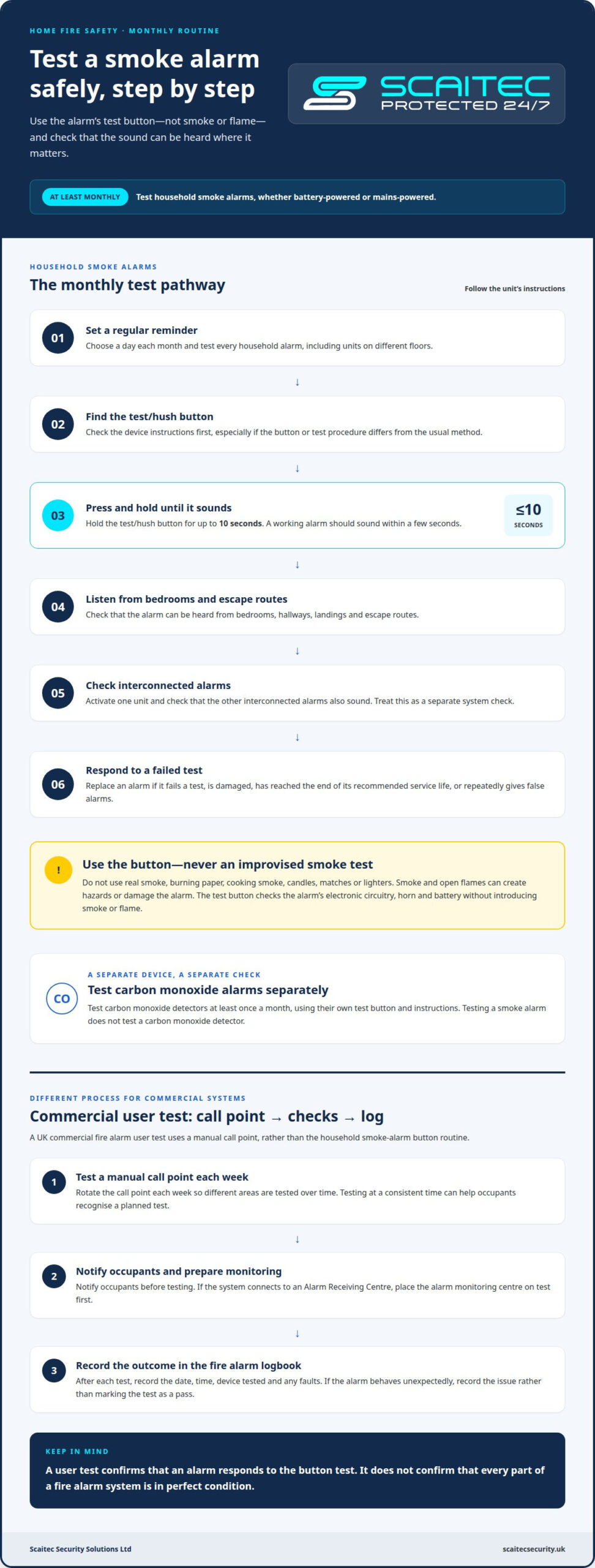
Test household smoke alarms at least once a month, using the test/hush button rather than real smoke or fire. To learn how to test a smoke detector correctly, start with the unit’s instructions and use its test button. This monthly routine applies to both battery-powered and mains-powered alarms.
Replace a UK smoke alarm if it has reached the end of its recommended service life, is damaged, fails a test or repeatedly gives false alarms. Choose a suitable replacement so your home retains working smoke detection.
- Set a monthly reminder. Choose a regular day and test each household alarm, including units on different floors. Regular testing is a useful routine for keeping smoke alarms in working order. A reminder helps make the check part of routine home safety rather than something left until a warning beep occurs.
- Use the test/hush button. Press and hold the button until the alarm sounds, for up to 10 seconds. A working alarm should sound within a few seconds. This checks the electronic circuitry, horn and battery without introducing smoke or a flame. Follow the unit’s instructions if its button or test procedure differs.
- Test carbon monoxide alarms separately. Test carbon monoxide detectors at least once a month, using the unit’s test button and instructions. Testing a smoke alarm doesn’t test a carbon monoxide detector: they are separate devices with different detection functions.
- For commercial systems, test a manual call point. A UK commercial fire alarm user test uses a manual call point. Rotate the call point each week so different areas are tested over time. Notify occupants before testing, and place the alarm monitoring centre on test first if the system connects to an Alarm Receiving Centre.
- Record commercial test results. After each test, enter the date, time, device tested and any faults in the fire alarm logbook. Testing at a consistent time each week can help occupants recognise a planned test. If an alarm behaves unexpectedly, record the issue rather than marking the test as a pass.
- Understand what a user test can and can’t show. Hearing an alarm confirms that it responds to the button test, but a UK fire alarm user test doesn’t confirm that the entire system is in perfect condition. In commercial buildings, logging each call point tested helps track which devices have been covered over time.
- Avoid improvised tests. Don’t use a candle, lighter or real smoke to check a detector. An open flame can damage the alarm or ignite nearby combustible materials, creating a fire risk. When learning how to test a smoke detector correctly, use the test button for a safer check of its response.
Avoiding real smoke or fire during tests
- Use the alarm’s test button, not a smoke source. Press the test feature and follow the unit’s instructions. It checks the alarm’s electronic circuitry, horn and battery without introducing smoke into the room. This provides a controlled way to check the unit’s response without burning material or creating smoke for the sensor.
- Keep lighters, matches and candles away from the detector. An open flame can damage the alarm or ignite combustible materials, creating a fire risk. A candle held near a ceiling-mounted smoke alarm is not a safe alternative to the test button, even if you intend to extinguish it immediately.
- Don’t burn paper or use cooking smoke as a test. Smoke from burning paper or a smoky pan can trigger alarms, but it doesn’t provide the controlled check offered by the test feature. It can also introduce heat or residue into the area. Use the button instead, then listen for the alarm.
- Test one alarm at a time in a household installation. Choose a convenient moment, warn anyone nearby, and press the relevant test button. If the smoke alarms are interconnected, check the system’s response as a separate step: activating one alarm should cause the others to sound. Don’t create smoke to test this response.
- Follow the device instructions if the alarm doesn’t respond. Don’t try to force a result by applying smoke, heat or flame. Check the manufacturer’s guidance for the unit’s test procedure, then consider whether the alarm is damaged or has failed its test. A real-smoke experiment won’t identify or resolve an electrical or battery fault.
- Leave specialist testing equipment to trained work. Professional fire alarm maintenance may involve approved detector testing equipment, smoke aerosols and specialist tools. These are not the same as burning household materials or using an open flame. For a building fire alarm system that needs professional attention, fire alarm system support provides a more appropriate next step than an improvised test.
- Keep the test area clear and predictable. Before pressing a button, let people in nearby rooms know an alarm may sound. For example, warn someone working in an adjoining room so they can distinguish the planned test from an unexpected alarm. Don’t place objects against the detector or cover it during testing.
Intermittent beeping and battery problems
- Listen for the pattern before taking action. A brief, repeated chirp differs from the loud sound during a button test. Note which smoke alarm is making the noise, when it occurs and whether another alarm responds. This can help distinguish a local warning from a sound travelling through an interconnected system. Don’t assume every intermittent beep has the same cause.
- Check the battery guidance for that alarm. Erratic or low sounds may indicate a fault, and some smoke alarms have user-replaceable batteries. If the instructions identify a battery warning, fit the specified replacement type as directed. Don’t remove a battery and leave the alarm without power, even if the chirping stops. Restore the unit to working order, then test it using its button.
- Retest after addressing a battery warning. Press the test button and listen for the alarm’s normal response. If the sound remains weak, irregular or absent, don’t treat a battery change alone as proof that the smoke alarm works. Check the model’s instructions and look for other warning signs, such as damage or persistent false alarms.
- Take a failed test seriously. If pressing the central button for more than 20 seconds produces no sound, the alarm may have a fault or another issue. Don’t keep removing and reinserting the battery as a substitute for resolving it. A damaged alarm or one that continues to fail needs attention; replace it if it has failed testing or reached the end of its recommended service life.
- Treat carbon monoxide detector beeps as a separate warning. A detector that keeps beeping intermittently may need a battery replacement. Follow the instructions for that specific carbon monoxide unit, rather than automatically applying the smoke alarm’s battery procedure. After changing a user-replaceable battery, use the detector’s test button and check whether the intermittent sound continues.
- Don’t silence a warning and forget the cause. The test/hush button can reset an alarm, but a stopped sound doesn’t establish that the underlying issue is resolved. For example, if a smoke alarm chirps again after its battery has been replaced, note the recurrence and check the unit’s guidance. Repeated low or erratic sounds can point to a fault rather than a simple battery problem.
Visual checks and warning indicators
If the test button fails, visual indicators alone can’t confirm that a smoke alarm works. Remove dust or cobwebs, check its power indicator and repeat the button test. Replace an alarm that still fails.
- Look for damage before pressing anything. Check the alarm casing and vents for cracks, staining or other visible damage. Dust, cobwebs and kitchen grease can obstruct the sensor, so inspect the openings rather than judging the unit by its exterior alone. A damaged or obstructed alarm may not respond as expected during a test.
- Check the light in context. Indicator patterns vary by alarm, so check the unit’s instructions rather than treating a light as proof that it works. Battery-operated alarms should have no visible lights. Indicators differ by power source, so don’t assume that every unlit alarm has failed or that a green light proves the alarm can detect smoke.
- Don’t treat a flashing light as proof of operation. Some battery-operated alarms may flash quickly every 30-45 seconds. That pattern doesn’t necessarily show that the alarm is working. Use the test button to check its response, and refer to the unit’s instructions if the light pattern differs from what you expect.
- Clean visible obstructions before testing again. Use a clean cloth or vacuum cleaner to remove dust and cobwebs around the vents. Kitchen grease can also collect near an alarm, particularly if it’s close to the cooking area. Don’t push objects into the vents or use liquids, which could damage the unit.
- Repeat the test after cleaning. Press the test button and listen for the alarm. Pressing the button also resets an alarm, but a reset doesn’t prove the unit has passed its test. If it remains silent, shows damage or makes erratic sounds, treat the warning as unresolved.
- Replace an alarm that fails testing. A UK smoke alarm should be replaced if it’s damaged, fails testing, repeatedly gives false alarms or reaches the end of its recommended service life. Choose a suitable replacement, then use its test button to check its response. A light alone can’t replace this functional check.
- Arrange professional attention for persistent faults. If cleaning and a repeat button test don’t resolve the issue, don’t rely on a visual check as evidence of safe operation. Leave repairs, professional servicing, system alterations and replacements to qualified fire alarm installers. Specialist testing equipment can check detector response beyond what household indicators show.
How do you test an interconnected smoke alarm system?
- Tell people in the building before testing. Let household members know the alarms may sound, especially anyone in a separate room. This helps distinguish a planned check from an unexpected warning. In a commercial building, notify occupants before activating the fire alarm to avoid unnecessary confusion.
- Choose one alarm as the test point. Press and hold its test feature, following the unit’s instructions. In an interconnected installation, testing any one alarm should cause all linked alarms to sound. You don’t need real smoke or a flame to check that connection.
- Listen for the other alarms to activate. After the first alarm sounds, the other interconnected alarms should begin sounding within 10 seconds. Move through the building only if it’s safe and practical, and note any unit that remains silent. Testing one device can reveal whether the signal reaches other parts of the property.
- Check each area, not just the first alarm. Listen in separate rooms and on different floors to identify which alarms respond. For example, if the hall alarm sounds but a bedroom unit stays silent, record the difference. A response from nearby alarms alone doesn’t show that every connected unit has activated.
- Release the test button and allow the sequence to finish. Interconnected alarms may continue sounding for a further 3-4 seconds after the first alarm’s test button is released. Wait for the sound to stop before deciding that the test has ended. This short continuation is part of the expected response described for interconnected alarms.
- Record any alarm that doesn’t respond. If only the tested alarm sounds, there may be a fault in the interconnect circuitry, wiring or an alarm. Note which unit was tested and which alarms stayed silent. Don’t assume that one working test alarm proves the rest of the system is functioning correctly.
- Arrange attention for a persistent connection fault. A button test checks the user-facing response, but it doesn’t establish that the entire system is in perfect condition. If the same alarm fails to sound during a repeat test, arrange professional fire alarm system maintenance. Keep a record of the affected unit and test result for the person investigating the system.
Arrange fire alarm system maintenance
Test household smoke alarms at least once a month. In UK homes, check that alarms can be heard from bedrooms, hallways, landings and escape routes.
Scaitec Security Solutions
Scaitec Security Solutions Ltd can help when a smoke alarm repeatedly fails its test, an interconnected unit stays silent, or a fire alarm system needs maintenance. We design, install and maintain fire systems for residential and commercial properties, helping address faults that a household button test cannot diagnose.
If testing highlights a wider security need, our services also include CCTV systems, intruder alarms and access control systems. The right next step depends on the issue: a single failed detector may need attention, while repeated connection problems can call for a broader system assessment.
Contact Scaitec Security Solutions Ltd to discuss your fire alarm system or maintenance needs.
Make your next step a safer one
Knowing how to test a smoke detector correctly gives you a practical starting point, but a test is most useful when it leads to action. Treat an unexplained beep, a silent interconnected alarm or a repeated fault as a reason to investigate, not something to ignore. A clear record of the affected alarm and what happened during testing can help explain the issue when you arrange professional support.
For homes and businesses, dependable fire protection also relies on equipment being properly maintained over time. If your checks reveal a persistent fault or system concern, Scaitec Security Solutions Ltd can help you consider the appropriate next step. You can also discuss CCTV Systems, Intruder Alarms or Access Control Systems when reviewing wider site security.
A measured approach helps turn an uncertain warning into a clear plan. Build confidence in your safety arrangements, one considered step at a time.
Frequently Asked Questions
How often should you test a smoke alarm in the UK?
Test each household smoke alarm at least once a month. Add the check to a recurring calendar reminder and work through the property room by room. Include alarms on every floor, rather than testing only the unit nearest the kitchen or entrance. If you manage a commercial fire alarm system, carry out its scheduled manual call point test and record the result in the fire alarm logbook.
How do you test a smoke detector using its test button?
Press and hold the alarm’s test button until its sounder activates, following the instructions supplied with that model. The test checks the electronic circuitry, horn and battery response without using smoke or flame. If the alarm is interconnected, listen for the other linked units too. For example, ask someone in another room to confirm whether a distant alarm sounds, then note any unit that stays silent.
How long should you press the smoke alarm test button?
Hold the test button until the alarm sounds, for up to 10 seconds. A working unit should respond within a few seconds, so release the button once you hear its test tone. If there’s no sound after holding the central button for more than 20 seconds, the alarm may have a fault or another issue. Don’t extend the test with smoke or a flame; check the model’s instructions instead.
How do you test smoke alarms without setting off the whole house?
You can test an individual alarm using its test button, but interconnected alarms are designed to sound together. If testing one unit activates the linked system, you can’t test that connection without the other alarms sounding. Tell people in the property beforehand and choose a suitable moment. If you only need to check a standalone unit, first identify whether it’s linked to other alarms.
How do you test smoke alarms with sealed batteries or mains power?
Use the test button on both battery-powered and mains-powered smoke alarms. A sealed battery isn’t intended for routine removal, so don’t try to open the casing or replace the battery yourself. Check the manufacturer’s instructions for the alarm’s indicators and service life. For a mains-powered unit, a test-button response checks the alarm’s circuitry and horn, but a visual power indicator alone doesn’t prove it works fully.
What should you do if a smoke alarm keeps beeping during testing?
Note which alarm is beeping and whether the sound is a brief intermittent chirp or the full test tone. Erratic or low sounds may indicate a fault; some alarms have user-replaceable batteries, so follow the model’s instructions if they identify a battery warning. Retest after taking the appropriate action. If beeping continues, the alarm fails its test or is damaged, arrange attention or replace it when required.
Protect Your Business
Protect Your People
Book Your FREE Site Protection Survey

Since pioneering Scaitec Security Solutions in 2005, Paul Scaife, with his roots in the industry dating back to 1994, has distinguished the firm as a leading provider of bespoke fire and security solutions, servicing clients across Sheffield, Rotherham, and surrounding areas.
His leadership, underpinned by accreditation from the Security Systems and Alarms Inspection Board, ensures that Scaitec surpasses client expectations by blending advanced technology with a deep understanding of their unique needs.
Paul's ethos champions innovation and efficiency, driving Scaitec to deliver tailored, cutting-edge solutions that enhance safety and operational ease.
Discover more about Paul’s commitment to excellence on LinkedIn.