
Table of Contents
A camera can capture an incident without helping to interrupt it as it happens. With monitored CCTV, trained professionals view live feeds, assess potential threats and follow an appropriate response process; recording-only systems store footage for review later. The benefits of monitored CCTV for business can therefore extend beyond having a record of events, particularly when a prompt response matters.
It’s understandable to value clear footage when investigating an incident, but recording and monitoring serve different purposes. This guide explains how monitored CCTV can support investigations and insurance claims, help deter crime and enable remote responses. It compares these benefits with a recording-only system and outlines what to consider, including your site’s risks, when it needs protection and how incidents should be handled, so you can choose an approach that fits your business.
Key Takeaways
- Choose monitoring when live assessment and a response to potential incidents matter; recording-only systems preserve footage for later review.
- Plan camera coverage and image quality around the evidence your business may need for investigations or insurance claims.
- Visible cameras can support crime deterrence, especially when they form part of a wider security plan.
- Consider how remote monitoring could help manage risks at times when your premises are unattended.
- Match the system to your site’s risks, privacy responsibilities and incident response needs before deciding which approach fits.
1. What Is CCTV Monitoring?
CCTV monitoring adds live observation to the familiar process of capturing and storing footage. With recording-only cameras, staff review saved images after incidents such as theft or vandalism. Monitored CCTV adds a response step: operators assess live feeds or alerts and follow agreed procedures if activity appears suspicious. Depending on the service, this may include an audio warning or contacting a nominated keyholder.
Monitoring can be continuous or follow an agreed schedule, such as overnight coverage when a warehouse is unstaffed. Construction sites, retail premises, logistics yards, schools, offices and managed buildings all have different security risks. A retail shop might focus on entrances and stock areas, while a logistics yard may prioritise gates and vehicle movements. Camera placement and monitoring arrangements should reflect the site’s layout and risks.
Visible cameras may discourage some intruders, while live monitoring gives operators the opportunity to respond to activity as it unfolds. It does not make premises immune to crime, and cameras cannot cover every location. Poor positioning, obstructed views or unclear images can limit what operators see. Monitoring also depends on agreed response procedures, so alert assessment and escalation arrangements matter as much as camera coverage.
Remote monitoring can reduce reliance on security guards stationed on site, particularly when the main need is observing defined areas or responding to alerts. It is not a substitute for every guarding task: a camera operator cannot physically intervene, manage visitors face to face or patrol a building. When comparing options, consider the tasks required, coverage hours and response arrangements rather than assuming monitoring and manned guarding provide the same service.
The price depends on factors including site size, camera numbers, monitoring hours, risk profile and response arrangements, and is provided after a quote request. To choose a reputable UK provider, look for a clear explanation of how alerts are assessed, who is contacted and what happens next. For example, a business CCTV system should have a defined process for handling activity at a closed entrance.
Monitoring also brings responsibilities. UK businesses using CCTV should consider their responsibilities under the UK GDPR and the Data Protection Act 2018, where applicable, according to the Information Commissioner’s Office. That includes considering why footage is collected, who can access it and how long it is kept. A business CCTV system should support a clear security purpose without overlooking privacy. Clear procedures help staff understand how monitoring is used and how incidents are handled.
2. Evidence for criminal investigations and insurance claims
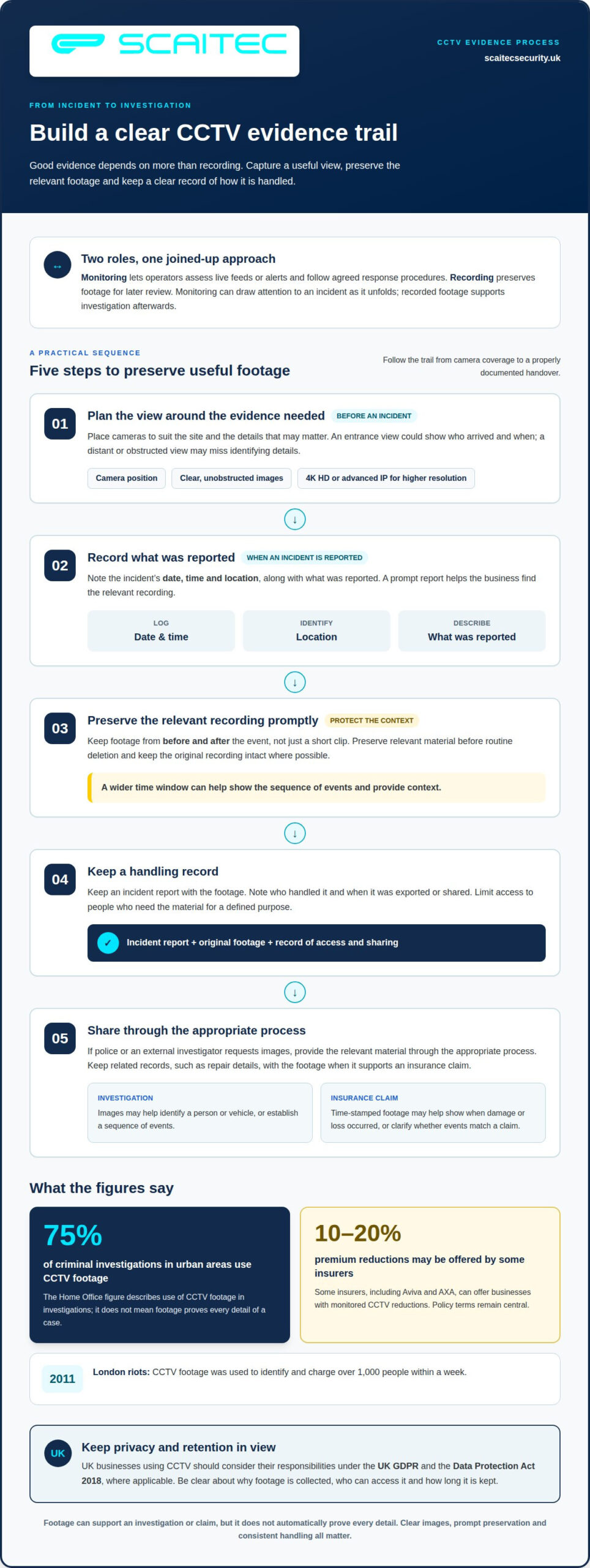
Recorded footage can help establish what happened before, during and after an incident. The Home Office says CCTV footage is used in 75% of criminal investigations in urban areas. For a business, images may help investigators identify a person, vehicle or sequence of events. They can also provide context when accounts differ, but footage does not automatically prove every detail of a case.
Image quality and camera position affect what footage can show. A camera aimed at a delivery entrance, for example, may capture who arrived and when, while a distant or obstructed view may miss identifying details. Where clear images matter, a 4K HD system or advanced IP installation can provide higher resolution. Monitoring can help draw attention to an incident as it happens; recording preserves material for later review.
After an incident, note the date, time, location and what was reported. Preserve the relevant recording promptly, including the period before and after the event, rather than relying on a short clip without context. Keep an incident report with the footage, noting who handled it and when it was shared. If police or an external investigator requests images, provide the relevant material through the appropriate process.
The same approach can support an insurance claim. Time-stamped footage may help show when damage or a loss occurred, or clarify whether events match the claim. For example, recordings of a vehicle entering a yard followed by a damaged gate may help document the sequence. Keep related records, such as the incident report and repair details, together so the footage can be understood alongside other evidence.
Footage is more useful when access and retention are managed consistently. Limit access to people who need it for a defined purpose, and record when material is exported or shared. A security guard reporting an incident should note the time promptly, helping the business locate the correct recording. Preserve relevant footage before routine deletion, and keep the original recording intact where possible.
Can monitored CCTV reduce business insurance premiums in the UK? Some insurers, including Aviva and AXA, can offer businesses with monitored CCTV premium reductions of 10–20%. CCTV may therefore support both incident evidence and discussions about insurance, though the policy and its terms remain central. If your business is reviewing camera coverage for evidence needs, explore business CCTV systems as part of that assessment.
CCTV footage can also provide time-stamped evidence to support or refute insurance claims. After the 2011 London riots, Over 1,000 people were identified and charged within a week using CCTV footage.
3. Crime deterrence through visible monitoring
Visible security cameras can make potential intruders reconsider entering a business. The British Security Industry Association says visible CCTV cameras help deter up to 67% of crimes in public and commercial areas. That figure describes deterrence, not a guarantee for each site. A clearly positioned camera near a staffed entrance, for example, signals that activity may be observed and recorded.
Retailers can use visible cameras to discourage shoplifting around entrances, tills and higher-risk stock areas. A camera aimed towards a shop exit may capture movement past the tills, while coverage near shelves can help staff observe activity. Keep views clear and avoid leaving important areas outside the camera’s field. A visible system can also support staff awareness, but should not replace sensible stock controls or attentive customer service.
Vandalism and attempted theft may also be discouraged when cameras are visible at exposed points. For a business with a rear service yard, that might mean positioning cameras to cover a loading entrance or stored equipment. At a commercial building, a visible camera facing an accessible side door can signal that unauthorised access may be noticed. If an incident occurs, the recording may help clarify what happened.
Coverage matters more than simply having cameras on display. Start by identifying likely entry points, valuable stock, vehicle areas and places with limited natural oversight. Then position cameras so their views overlap where practical, and check that signs or structures do not obstruct important sightlines. For example, a delivery gate and the route to a stockroom may both need attention, rather than concentrating every camera on the front entrance.
Monitored CCTV adds the possibility of a response while activity is taking place. If an operator sees someone testing a locked door, the agreed process may include an audio warning or contacting a nominated keyholder. This active oversight can strengthen deterrence, particularly outside normal opening hours. The response still depends on what operators can see and the procedures set for that site.
Cameras work best as part of a coordinated approach, not as a promise that crime will stop. Combining visible coverage with controlled entry can make unauthorised access harder. For example, a door camera may cover a staff entrance while business access control limits entry to authorised users. Clear procedures also help employees know what to do if they notice suspicious activity. This layered approach can support peace of mind without suggesting that any single measure prevents every incident.
4. Remote monitoring using CCTV cameras, sensors and other devices
Remote monitoring connects cameras at a business premises with professionals who assess live feeds or alerts. Some UK businesses use this service 24 hours a day, seven days a week, including when staff have left for the evening. For example, an alert from a delivery-yard camera can prompt an operator to check whether activity appears routine or needs action. Recording-only systems capture footage, but do not provide that live assessment.
At an Alarm Receiving Centre, trained operators can assess potential threats and follow agreed incident procedures. Depending on the system and circumstances, they may issue an audio warning, contact a nominated keyholder or alert emergency services. A warning may be appropriate if someone enters a restricted area after closing. Clear instructions help operators understand which events need escalation and whom to contact.
CCTV cameras can work alongside alarms and other devices to give operators useful context. If a door sensor triggers an alarm, camera footage may help show whether someone entered or whether the signal needs further assessment. Systems can also integrate with access control or perimeter detection. For example, an alert near a vehicle gate can direct attention to that area, rather than requiring staff to review every camera feed.
Out-of-hours monitoring is useful for sites with predictable quiet periods, such as offices after employees leave or warehouses between shifts. A business can define which areas matter most, what activity should trigger assessment and how operators should respond. This creates a structured process for overnight alerts and helps avoid treating every movement as an incident, especially where routine deliveries or cleaning take place.
Remote monitoring and manned guarding perform different roles. A security guard can patrol, speak to people on site and take physical action within their duties. A remote operator can assess camera views and follow agreed escalation procedures, but cannot physically intervene. Monitoring may suit businesses that need oversight of specific areas; a site requiring a physical presence may need another form of protection alongside cameras.
Effective monitoring starts with suitable installation and clear response procedures. Camera angles need to show relevant areas, while alarms must connect to the correct zones and contact details. A business should also decide who receives calls and what action follows each type of alert. Linking CCTV with intruder alarms can help operators assess an alarm alongside the relevant camera view, rather than treating each signal in isolation.
5. CCTV monitoring compared with recording-only systems
A recording-only CCTV system captures footage for someone to review later. Monitored CCTV adds live assessment and an agreed response process. The practical difference is timing: a manager may discover an incident during a later review, while monitoring can bring suspicious activity to attention as it unfolds. Neither approach removes the need for suitable camera coverage, clear procedures and reliable equipment.
Choose recording-only CCTV when the main requirement is a record for later investigation. For example, a small office might need footage to review after a reported missing item, with a manager responsible for locating relevant recordings. This approach still depends on someone knowing an incident occurred, finding the right camera and reviewing the correct period. It offers no live assessment or intervention while the event is taking place.
Monitoring is more relevant when a business needs alerts assessed during unattended periods. A distribution site, for instance, may want suspicious movement near a vehicle entrance reviewed overnight. Operators can follow the agreed process, such as contacting a nominated keyholder. Remote monitoring is not equivalent to an on-site security guard: operators cannot physically attend, patrol or manage people at the premises.
Compare the approaches against the risks and response the business actually needs. Consider which areas need observation, when the premises are empty, who can act on an alert and whether incidents need prompt attention. A shop concerned mainly with reviewing till activity may prioritise recordings. A site with exposed access points and out-of-hours risks may place greater value on live assessment and escalation.
Employees’ needs also affect the decision. Managers should make the purpose of workplace cameras clear and organise access to recordings around that purpose. A recording-only system still collects footage; monitoring changes how activity may be observed and acted upon. The decision is not simply “more cameras or fewer cameras”, but whether a live response adds value to the security system’s defined role.
Some businesses combine both functions: monitoring supports timely assessment, while recording preserves detail for later review. Before choosing, map a typical incident from the first alert through to follow-up. For example, decide who receives an operator’s call, who reviews footage afterwards and how the event is documented. This helps establish whether recording alone meets the need or live monitoring fills a real response gap.
The benefits of monitored CCTV for business are clearest when immediate assessment matters; recording-only may suit a primarily retrospective need.
Scaitec Security Solutions Ltd: CCTV Systems
Scaitec Security Solutions can help businesses plan CCTV coverage around their premises and security priorities, whether they need footage for later review or a more responsive setup. The company designs, installs and maintains CCTV systems for commercial properties, from camera placement to ongoing system performance.
If you’re reviewing an existing system or planning new business CCTV coverage, consider which areas need observation, when the site is unattended and how staff should respond to an incident. These decisions help shape a system that fits your business. Where access or fire safety is also a priority, those systems can be considered alongside CCTV.
Make your next security decision with confidence
The benefits of monitored CCTV for business depend on what you need the system to do, not simply how many cameras are installed. Define the outcome you want, such as clearer incident records, live assessment of alerts or oversight of specific areas. This gives your security planning a practical focus and helps identify how cameras should fit your premises and daily operations.
Scaitec Security Solutions offers CCTV, Intruder Alarms and Access Control. Considering these measures together can help you plan how camera coverage relates to entry points and other security priorities, rather than treating each system as an isolated decision.
A considered plan can give your team a clearer way forward. Take the next step when you’re ready to shape security around your site.
Frequently Asked Questions
What Is CCTV Monitoring?
CCTV monitoring means live camera feeds or system alerts are assessed by people or software, rather than simply saved for later viewing. In a monitored business system, an operator can review activity against agreed procedures and decide whether escalation is appropriate. For example, an alert from a staff-only entrance could be checked against the site’s opening arrangements. The monitoring and response process depends on how the system is set up.
Does a business need to comply with data protection laws when using CCTV?
Yes. UK businesses should consider their responsibilities under the UK GDPR and the Data Protection Act 2018, where applicable, according to the Information Commissioner’s Office. This is relevant when footage identifies employees, customers or visitors. For example, a business can make its CCTV purpose clear to staff and consider whether camera views intrude on private areas. Monitoring practices should reflect the reason footage is collected and how it is used.
What are the main benefits of monitored CCTV for UK businesses?
Monitored CCTV can help businesses notice and assess activity as it happens, while recordings provide material for later reviews. It may support deterrence, incident investigation and an organised response to alerts. A retailer, for instance, might use monitoring to draw attention to activity near a stockroom after closing. The value depends on camera views and response procedures matching the risks the business wants to manage.
How does monitored CCTV reduce business crime and improve response times?
Live assessment can bring suspicious activity to an operator’s attention before staff discover it during a later review. Depending on the agreed procedure, the operator may issue an audio warning, contact a nominated keyholder or alert emergency services. For example, an operator could assess movement in a restricted area after closing and follow the site’s escalation instructions. Monitoring can support timely action, but cannot physically intervene.
What is the difference between monitored CCTV and unmonitored CCTV for businesses?
Unmonitored CCTV records images for someone to review later; monitored CCTV adds live assessment and an agreed response process. A business that mainly needs to investigate reported incidents may value recordings. A site concerned about activity outside working hours may also want alerts reviewed as they occur. Both approaches depend on useful camera coverage, and either can be limited by poor views or unclear procedures.
What UK laws and ICO rules apply to business CCTV monitoring?
UK businesses should consider the UK GDPR and the Data Protection Act 2018, where applicable. The Information Commissioner’s Office explains that data protection laws regulate how employers collect and process employees’ personal data through workplace CCTV. Businesses should also consider employee privacy and avoid overly invasive monitoring. For example, explain the purpose of workplace cameras to employees and ensure their placement is appropriate to that purpose.
Protect Your Business
Protect Your People
Book Your FREE Site Protection Survey

Since pioneering Scaitec Security Solutions in 2005, Paul Scaife, with his roots in the industry dating back to 1994, has distinguished the firm as a leading provider of bespoke fire and security solutions, servicing clients across Sheffield, Rotherham, and surrounding areas.
His leadership, underpinned by accreditation from the Security Systems and Alarms Inspection Board, ensures that Scaitec surpasses client expectations by blending advanced technology with a deep understanding of their unique needs.
Paul's ethos champions innovation and efficiency, driving Scaitec to deliver tailored, cutting-edge solutions that enhance safety and operational ease.
Discover more about Paul’s commitment to excellence on LinkedIn.