
Table of Contents
Yes, cameras can monitor livestock as well as farm entrances when their positions and views are planned for both. Farm gate security cameras in Barnsley should be selected based on the distance from buildings, the areas that need coverage and how activity will be detected. At a gate far from the farmhouse, mobile reception may differ substantially, so check connectivity at the camera’s intended location.
Choosing a setup means balancing entrance monitoring with clear views of livestock and the wider yard. This guide covers practical considerations for larger farmyards, rural detection options and how installation choices affect coverage. It also explains when self-installation may suit, how to position cameras and how to address privacy when views extend beyond your property.
Key Takeaways
- Plan coverage around the farm’s entrances, livestock areas and outbuildings, so cameras serve practical monitoring needs rather than simply adding more views.
- Assess connectivity at each remote camera position; reception at the farmhouse may not reflect the signal available at a distant gate.
- Consider how motion detection and remote monitoring can help you keep track of activity across the yard and livestock areas.
- Position cameras to focus on your property and plan installation around the site’s layout, privacy and power requirements.
- Choose an installation approach that suits the scale of the farm, the areas to cover and the way you need to review footage.
Can farm cameras work without broadband?
Yes. Wired cameras use a physical connection, while wireless cameras still need power and a way to send or store footage; 4G cameras use mobile data, and solar panels can supply power where mains power is unavailable. The right option depends on the gate’s location, signal, available power and whether you need remote viewing or recorded evidence.
At a main entrance with electricity, a mains-powered camera can operate continuously without relying on battery charge. Optical zoom can bring distant details, such as a vehicle at the gate, closer in the image without moving the camera. It cannot replace careful positioning: a clear view of the approach and gate helps capture activity before vehicles pass.
For an isolated paddock or livestock field, consider how the camera will operate when there’s no mains connection or broadband. A battery-powered camera avoids a fixed power cable, but its operating time depends on how often it records and the power available. A 4G model can send footage or alerts over the mobile network, provided there’s usable signal where the camera is mounted.
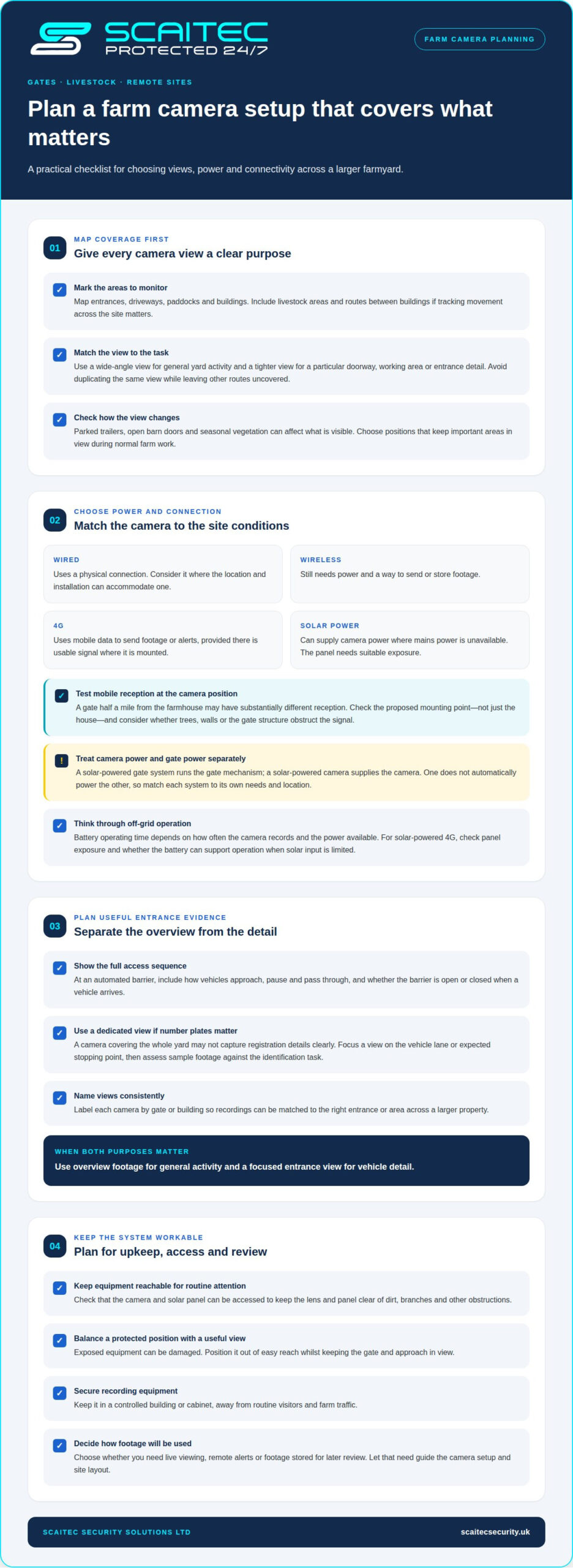
A gate half a mile from the farmhouse may have substantially different mobile reception from the house. Test connectivity at the proposed camera position, not just beside the farmhouse, and consider whether trees, walls or the gate structure obstruct the signal. A solar-powered 4G camera combines off-grid power with mobile connectivity, but the panel needs suitable exposure and the battery must support operation when solar input is limited.
Camera power and gate power are separate decisions. A solar-powered gate system operates the gate mechanism, while a solar-powered camera supplies the camera; one does not automatically power the other. For example, a remote entrance might need a solar panel for the camera and a separate power solution for the gate motor. Match each system to its own power needs and location.
Weather, vandalism and connectivity can all affect reliability. Wind-blown branches or dirt can obscure a lens, exposed equipment can be damaged, and weak mobile reception can interrupt remote access. Position equipment out of easy reach while keeping the gate and approach in view, and plan how the lens and solar panel will be kept clear. For wider site planning, whole-site security planning can account for different areas and access points.
Choose the setup by mapping the entrance, nearby livestock and available power first. Then decide whether you need live viewing, remote alerts or footage stored for later review. If an incident is an emergency in South Yorkshire, call 999 to report it to the police, according to South Yorkshire Police.
Which camera suits a large farmyard?
Choose cameras according to the evidence each location needs to provide, not simply the size of the property. When planning farm gate security cameras in Barnsley, distinguish broad site awareness from detailed views of people or vehicles.
Positioning Cameras Around the Farm
Map the entrance, driveway, paddocks and buildings, then give each camera view a specific purpose. A wide-angle view can show general activity around a yard, while a tighter view can focus on a particular doorway or working area. Avoid pointing every camera at the same space, which can leave other routes uncovered.
Consider how the farm changes throughout the day. A parked trailer, open barn door or seasonal vegetation can alter a camera’s view. Choose mounting positions that keep important areas visible during normal work, and include routes between buildings if tracking movement across the site matters.
Solar-Powered 4G Cameras for Remote Sites
For remote locations, compare camera options against the site’s day-to-day needs. Check whether the intended position leaves the solar panel clear of rooflines, branches and equipment, and whether the camera can be reached for routine attention. These practical details can influence placement as much as the view itself.
Decide what each remote camera needs to show. A paddock boundary, gate approach and isolated store have different monitoring purposes. Choose a view that supports the specific task rather than expecting one camera to provide useful detail across several separate areas.
Farm Gates and Automated Barriers
At an automated barrier, consider how vehicles approach, pause and pass through. The camera view should make the sequence clear, including whether the barrier is open or closed when a vehicle arrives. This can help when reviewing an access event, particularly when delivery vehicles use the entrance.
If the farm has more than one entrance, use consistent names for each camera location. Labelling views by gate or building makes it easier to identify what part of the site a recording shows, especially when several routes look similar.
Capturing Vehicles and Number Plates
If number plates need to be identifiable, plan a dedicated view of the point where vehicles pass or pause. A camera intended to show the whole yard may not capture registration details clearly. Consider the vehicle lane and expected stopping point when setting the view, then assess sample footage against the identification task.
Farm gate security cameras in Barnsley should provide a clear, useful record of arrivals. Use separate overview footage and a focused entrance view when both purposes matter.
Secure Footage Access
Keep recording equipment in a controlled building or cabinet, away from routine visitors and farm traffic. Label cameras by site area so the person reviewing an event can identify the relevant entrance or building. This keeps footage handling orderly across a larger property.
For business entrances, business CCTV planning can help align camera views with access routes and site needs.
Can I monitor livestock as well as farm entrances?
Yes. A planned camera layout can cover livestock areas as well as gates, helping you review activity across both. Use motion detection and remote viewing to focus on useful events rather than checking every camera continuously.
Monitoring Livestock and Entrances Remotely
Position cameras to show specific areas, such as a livestock pen, water trough or farm entrance. A view of a trough can help you check water levels and spot a problem with its filling mechanism. At the gate, motion detection can flag activity for review, while a clear view helps show who arrived and when.
Divide the farm into practical viewing zones. For example, keep the entrance view separate from the livestock area so an alert at one location is easier to interpret. Animals, branches or passing vehicles can trigger activity, so camera angle and detection settings affect how useful alerts are.
Receiving Gate Alarms and Alerts
A gate alarm can draw attention to an opening or movement at an entrance, while a camera provides visual context. For example, an alert may prompt you to view the gate and distinguish a scheduled arrival from unexpected activity. The alert does not identify who is present, so footage should show the approach as well as the barrier.
Remote monitoring lets authorised users view camera feeds away from the farm. Live remote access depends on a suitable connection, and reliability can vary at the camera location. If the gate is far from occupied buildings, plan another way to review recorded footage when live access is unavailable.
Set a clear routine for responding to alerts. Decide who reviews gate notifications, who checks livestock activity and what steps follow an urgent event. For example, a staff member could review the entrance camera before contacting someone on site. CCTV can support awareness, but it does not replace attending to animals that need care.
Use monitoring to check practical farm conditions as well as security. A camera facing a water filling point may reveal a fault before the trough runs low. A view of a livestock enclosure can help identify unusual movement, while a separate gate view records arrivals. Review each camera’s purpose to keep the system useful in daily routines.
UK CCTV that captures public spaces or neighbouring properties must comply with the Data Protection Act and the Information Commissioner’s Office guidance. Make camera use apparent with visible signage. If a camera captures sound, people must be informed.
Control viewing access and limit footage access to people with a work-related need. Assign access according to responsibilities, such as checking livestock or handling entrance alerts. Review who can view recordings when roles change, and follow a consistent routine for checking footage after an alert.
Rural security camera installation and self-install advice
Rural installation needs to account for buildings, open approaches, power and privacy. A self-install may suit a straightforward view, while a larger farm layout may need coordinated coverage.
Planning Rural Camera Installation
Start with a site plan showing the entrance, machinery shed, livestock areas and routes between buildings. Mark the purpose of each camera view, such as covering the shed doors and its main approach to record people and vehicles entering or leaving. This helps avoid blind spots caused by walls, parked machinery or gates.
Next, match each position to its power and connectivity options. A camera beside a building may have different options from one at a remote field entrance. For outdoor views, keep the camera focused on your property and avoid capturing neighbouring land or public areas unless there is a valid reason. In the UK, renters need written permission from their landlord before installing CCTV.
Choosing a Rural CCTV Installer
For a Barnsley farm, look for an installation plan based on the property’s actual layout, rather than treating a yard like a standard home. It should explain how cameras cover the gate, driveway, outbuildings and machinery shed approach, as well as how footage will be viewed and the system will operate at remote positions.
Installation time depends on the site’s scale: a small home CCTV installation in Barnsley can take a few hours, while larger installations may take a full day or more. A farm with several buildings and separate entrances needs more coordination than a single camera overlooking one doorway.
Self-installation can be practical when the camera has a clear view, accessible power and a suitable connection. Before fixing it in place, test the view from the intended position during daylight and after dark. Check that the image shows the relevant entrance or shed doors, not just a wide area where people and vehicles appear indistinct.
For a larger site, plan how equipment and footage will work together across the property. For example, a camera at the machinery shed can record its approach, while an entrance view shows vehicles arriving. These views serve different purposes, so one centrally placed camera may not provide useful detail at both locations.
Privacy should shape the final camera angle. UK CCTV that captures public spaces or neighbouring properties must comply with the Data Protection Act and the Information Commissioner’s Office guidance. Keep views within the farm boundary where possible, and use visible signage where cameras operate. A clear installation plan balances practical coverage with respect for nearby properties.
Which Barnsley CCTV installers specialise in farms and rural properties
Rural CCTV installation involves more than a single building entrance. A Barnsley farm may have a yard, livestock areas, machinery shed and gates spread across the property. An installer experienced in planning rural sites will consider how these areas connect, where people and vehicles travel, and which views need recording.
A useful installation plan links each camera’s purpose to its position. For example, one view might cover the entrance and driveway, while another records the machinery shed’s doors or main approach. Remote gates and paddocks can have different power and connectivity needs. The design should address each location separately rather than relying on one camera to cover the whole farm.
Coverage also depends on the level of detail required. A wide view can show activity across a yard but may not clearly capture a person or vehicle at a distance. A specialist plan considers the camera angle, the subject’s route and possible obstructions such as buildings, parked machinery or vegetation. These decisions help make footage useful for its intended purpose.
Installation time varies with the site’s scale and layout. A small home CCTV installation in Barnsley can take a few hours, while larger installations may take a full day or more. A farm with multiple buildings and remote entrances needs different planning from a single-camera home setup. The number and location of cameras, cable routes and access to each position all affect the work.
Rural installation involves practical details beyond camera placement. Equipment near gates must not obstruct their operation, and views should account for changing vehicle positions. A camera at a machinery shed should show its doors or main approach. For remote areas, plan how footage will be accessed and what to do if power or connectivity is interrupted.
Privacy is another part of a considered layout. Cameras should focus on the farm’s own entrances, buildings and working areas, rather than unnecessarily capturing neighbouring land or public spaces. If CCTV captures public spaces or neighbouring properties, UK rules require compliance with the Data Protection Act and the Information Commissioner’s Office guidance.
For a farm in Barnsley, a rural-focused installation plans around the whole site: entrances, buildings, working routes and remote areas. This helps align camera positions with the farm’s everyday operation instead of treating each camera as an isolated device.
Scaitec Security Solutions
Scaitec Security Solutions can plan CCTV for farm entrances, yards and outbuildings, with camera positions tailored to the property’s layout and monitoring needs. This is a practical next step if you are considering coverage for a gate alongside livestock areas, machinery buildings or remote access points.
Scaitec designs, installs and maintains CCTV systems. Where a site also needs managed entry or additional security, Access Control Systems and Intruder Alarms can form part of a wider plan. The right arrangement depends on the areas you need to monitor and how you will use the system.
For a farm-specific discussion of camera coverage and installation, contact Scaitec Security Solutions.
Plan the next step for your farm
Choosing farm gate security cameras in Barnsley is an opportunity to make security planning part of how your site operates. Start by identifying the decisions the system should support: who can enter, which areas need oversight and who will review footage when activity is flagged. A clear priority list gives the installation plan a practical purpose and keeps camera coverage focused.
Consider how the system will fit into your farm’s daily routines. Staff access, deliveries and movement between buildings all shape what useful coverage looks like. Once priorities are clear, you can discuss a setup designed around the property rather than treating each camera as a separate decision.
A thoughtful plan is a practical step towards a farm security setup that supports your work and gives you greater clarity about activity on site.
Frequently Asked Questions
Can you help plan cameras across several buildings?
Yes. A coordinated plan can assign each building a camera purpose, such as covering an entrance, a machinery shed approach or a shared yard. It can also account for how staff move between buildings and who needs to review recordings. If the wider site plan includes fire protection, fire alarm installations should be planned with appropriate standards in mind.
Gate-contact, PIR or perimeter beam: which should you choose?
Choose a gate-contact sensor to detect when a gate opens, a PIR detector to sense movement within its field, or a perimeter beam to detect someone crossing a defined line. Each has a different role: a contact sensor monitors the gate itself, while a beam can protect a boundary approach. Choose according to the route or event you need to detect, and consider how livestock or passing activity might affect the monitored area.
Where should I start with farm CCTV?
Start by listing the incidents and locations you want the system to help you review. For example, note concerns about unauthorised entry, machinery access or activity around a livestock building. Then identify who will view recordings and what they need to establish from them. Scaitec’s intruder alarm servicing includes a 21-point system check, and non-contract customers receive the same care and attention as Protect-plan customers.
Which security cameras are suitable for farm gates in Barnsley?
Choose a camera according to the detail needed at the gate, its operating conditions and how footage will be accessed. A wide view can show activity across an entrance, while a more focused view can help capture movement along a vehicle route. Scaitec Security Solutions is Insurance Approved and SSAIB Certified, and describes itself as the Best Rated Security Company in Rotherham. Installation is guaranteed within 7 days of acceptance of proposal.
What are the best solar-powered or 4G cameras for remote farm gates in South Yorkshire?
For a remote gate, choose a system that addresses both power and connectivity at the camera’s position. Solar power can support a camera away from mains electricity, while 4G can provide remote access where mobile reception is available. The useful choice depends on exposure for the solar panel, the view required and the mobile signal at the gate. A model name alone cannot establish whether those conditions suit your site.
What internet, power and mobile signal options are available for rural CCTV in Barnsley?
Rural CCTV can use mains power or battery power, with solar panels as an option for remote locations. Footage can be accessed through a network connection, including mobile data for 4G cameras where reception is usable. A gate half a mile from the farmhouse may have substantially different mobile signal. Assess power and connectivity at the camera’s intended position, rather than relying on reception at the house.
How long should farm CCTV footage be stored, and how can it be accessed securely?
The material gives no recommended storage period. Keep recording equipment in a controlled building or cabinet, label cameras by site area, and limit remote viewing to authorised users.
Protect Your Business
Protect Your People
Book Your FREE Site Protection Survey

Since pioneering Scaitec Security Solutions in 2005, Paul Scaife, with his roots in the industry dating back to 1994, has distinguished the firm as a leading provider of bespoke fire and security solutions, servicing clients across Sheffield, Rotherham, and surrounding areas.
His leadership, underpinned by accreditation from the Security Systems and Alarms Inspection Board, ensures that Scaitec surpasses client expectations by blending advanced technology with a deep understanding of their unique needs.
Paul's ethos champions innovation and efficiency, driving Scaitec to deliver tailored, cutting-edge solutions that enhance safety and operational ease.
Discover more about Paul’s commitment to excellence on LinkedIn.