
Table of Contents
A secure equestrian yard needs more than a view of the stable doors. Equestrian centre CCTV in Sheffield can be planned to cover stables, yard areas, paddocks, entrances and boundaries, with camera positions matched to the site layout and priority areas. The cost depends on the cameras, coverage, site layout and installation work. Scaitec Security Solutions provides a tailored quote for CCTV systems in Sheffield, Rotherham and South Yorkshire.
It’s understandable to want clear visibility of horses, people and property without making daily routines more complicated. A thoughtfully designed system can help you review activity around the yard, keep track of deliveries and support staff safety. Remote monitoring can also make camera views accessible away from the site.
This guide explains how to plan coverage across stables, paddocks and boundaries, what affects the cost of a stable CCTV system, and how monitoring can support the protection of people and property. It also covers practical considerations when choosing CCTV for an equestrian centre in Sheffield.
Key Takeaways
- Plan camera positions around the areas that need visibility, from stable interiors and yard activity to paddocks and boundary approaches.
- System costs depend on the site layout, coverage required, equipment and installation work; the article explains what shapes a tailored quote.
- Fixed-lens HD cameras can help monitor individual stables, while camera placement can support oversight of deliveries and staff activity.
- Remote monitoring and night-vision equipment can help maintain visibility beyond daylight hours.
- Explore how CCTV Systems can fit into a wider approach to protecting horses, people and equestrian property.
Yard, paddock and perimeter coverage
Plan cameras around how horses, staff, visitors and deliveries move through the site. CCTV policies at Sheffield riding schools vary, so a clear policy should explain which areas are recorded and why.
Yard and paddock surveillance
Wide-angle external cameras can cover busy yard areas, including stable entrances, walkways and shared spaces. Make sure each view clearly shows its intended route, rather than relying on one camera to capture everything. For paddocks, PTZ cameras can be directed towards different parts of an enclosure. Check that trees, fencing, shelters and changes in ground level won’t obstruct the view.
Give each camera a practical purpose. A gate view, for example, can show when horses or people enter, while a camera covering a water point can help staff review activity there. Compact internal dome cameras may suit a tack room, where the focus is stored equipment and access. A site plan can help identify blind spots between the yard and paddocks.
Perimeter and arena coverage
Perimeter cameras can cover approach routes, gates and boundary areas. Positioning matters: a camera aimed only at a fence may miss movement approaching from a track or entrance. In a covered arena, consider how roof supports and internal lighting affect the view. An outdoor arena needs coverage suited to open space, changing daylight and activity near access points.
One view may not cover both an arena entrance and activity across the riding surface. Map the areas separately, then consider where views overlap. This helps avoid gaps around gates, corners and transitions between buildings and open ground. A business CCTV system can be planned around the site’s layout and the areas requiring visibility.
Covert surveillance is different from visible cameras. Covert surveillance should be considered only in limited circumstances and handled with care. It should not be treated as a routine alternative to clearly positioned cameras. A written CCTV policy should explain the system’s purpose and identify the areas covered, so staff and visitors understand how it is intended to be used.
Use a practical planning sequence: mark stable blocks, yards, paddocks, arena entrances and perimeter gates on a site plan. Then identify what each camera needs to show, such as a doorway, crossing point or section of boundary. Consider obstructions, lighting and direction of travel. This makes coverage decisions specific to the site instead of relying on camera numbers alone.
For equestrian centre CCTV in Sheffield, the final layout should reflect how each area is used. A busy yard may need broad views, while a long paddock or open arena may need different camera positions. Reviewing these locations together helps create useful coverage across buildings, outdoor spaces and access routes.
CCTV costs for stables
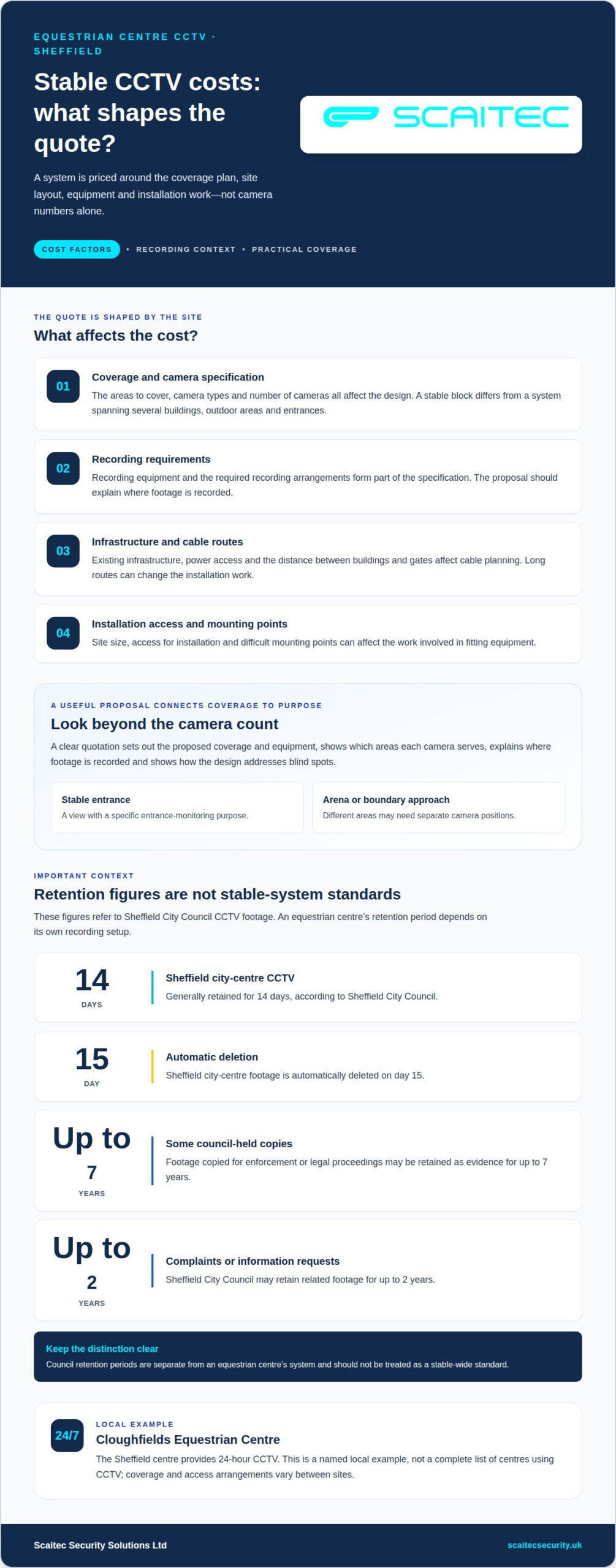
The cost of stable CCTV depends on the coverage plan and installation work. A system for one stable block differs from a layout spanning several buildings, outdoor areas and entrances. Key cost factors include camera types and numbers, recording equipment, cable routes, power access and the complexity of fitting equipment across the site.
The price depends on the project and is provided after a quote request. Site size, camera positions, recording requirements, existing infrastructure and installation access all shape the specification. For example, long distances between a stable and a gate can affect cable planning, while difficult mounting points can change the installation work.
A useful quotation sets out the proposed coverage and equipment, rather than relying on camera numbers alone. It should show which areas each camera serves, where footage is recorded and how the design addresses blind spots. A stable entrance view, for instance, has a different purpose from coverage across an arena or boundary approach.
Cloughfields Equestrian Centre in Sheffield provides 24-hour CCTV. This is a named local example, not a complete list of centres using CCTV. Coverage and access arrangements can differ between equestrian sites, depending on their buildings, outdoor spaces and security priorities.
Customers cannot assume CCTV footage is available for general viewing. Anyone seeking footage should direct the request to the centre’s management; access depends on the recording and its context. For example, yard footage may also show staff, visitors or other customers.
There is no single retention period for all equestrian centres. Each centre’s recording setup determines how long footage is kept before it is overwritten or deleted. Sheffield City Centre CCTV footage is generally retained for 14 days and automatically deleted on day 15, according to Sheffield City Council. That period describes city-centre cameras, not stable systems.
Sheffield City Council may retain footage copied for enforcement or legal proceedings as evidence for up to 7 years. It may retain footage relating to complaints or information requests for up to 2 years. These council retention periods are separate from an equestrian centre’s system and should not be treated as a stable-wide standard.
To understand a proposed stable system, consider the areas needing coverage, the recording arrangements and the site’s existing infrastructure together. A CCTV system design can be tailored to the property and its intended coverage, helping connect the quotation to practical requirements.
Monitoring livestock, deliveries and staff safety
At an equestrian centre, CCTV can help staff review activity around horses, entrances and shared work areas. Fixed-lens HD cameras are recommended for monitoring individual stables. Because the viewing direction is set, position each camera to cover a specific area, such as a stable doorway or feeding space.
A stable camera can show whether someone has entered, how a horse is behaving in its usual surroundings, or when a task took place. It cannot replace hands-on care or assess an animal’s health. Staff still need to carry out routine checks and respond in person. Footage can provide context when reviewing an incident or change in routine.
Deliveries show how camera views can support daily operations. A camera facing an entrance can record a vehicle arriving, while another view may show goods being unloaded. If a delivery is left in the wrong place, footage can help establish where it was placed and who was present. The useful view captures the activity, not just the vehicle.
For staff safety, consider the routes between stable blocks, stores and the yard. A camera covering a poorly visible access point may help clarify who used that route and when. It can also support a review after an accident or disagreement. CCTV records activity; it does not replace clear working procedures, direct communication or appropriate supervision.
Planning can follow three practical steps:
- Identify the activity to review, such as feeding, stable access or delivery handover.
- Choose a camera position that shows the relevant people, animal or movement clearly.
- Review the view from the recorder’s perspective, including obstructions such as doors or stored equipment.
For example, a camera aimed at a stable entrance may capture someone arriving but miss activity inside. A separate fixed-lens HD camera can provide a view of an individual stable. Matching each view to a defined task helps avoid gaps and makes footage more useful during a later review.
Mobile-enabled NVR systems can support remote monitoring, allowing authorised users to review camera views away from the centre. This can help managers keep track of deliveries or check a particular area while off site. The system is most useful when camera views are planned around real routines, rather than simply adding more coverage.
Used thoughtfully, CCTV gives equestrian staff another way to understand what happened at a stable, entrance or delivery point. Clear camera purposes, practical positioning and continued in-person care keep monitoring focused on people, horses and daily work.
Clear communication about recording can help set expectations when staff interact with the public. Sheffield City Council frontline enforcement staff activate body-worn cameras only when they believe they are under threat or facing threatening behaviour. Council staff tell members of the public verbally when they intend to record a conversation. This illustrates the value of explaining when recording begins and making its purpose clear.
Protecting livestock, machinery and equipment
Horses, tractors, feed and tack create different monitoring needs around an equestrian centre. A useful camera plan links each view to a specific asset or route. For example, a camera covering a machinery store entrance can show access activity, while another view may cover a loading area. This helps staff review events without treating one camera angle as complete site coverage.
Start by identifying where valuable or essential items are kept. A tack room, feed store, workshop and machinery shelter may each have different entrances and sightlines. Map the doors, nearby approaches and routes between buildings. Then position cameras to capture relevant movement, not just the stored items. A camera facing a stack of feed bags, for instance, may show little about who entered the store.
Livestock coverage should help show access and movement without replacing routine care. A camera near a stable entrance can help establish when someone entered or left. For a field shelter, consider whether the approach and doorway are visible. Staff still need to check horses directly and assess their condition in person. Footage can provide context when reviewing a specific event or change in routine.
Machinery presents a different planning challenge. A tractor or yard vehicle may be parked in a covered bay, moved between buildings or left near a working area. Consider where it is stored and the routes used to move it. A view of the machinery entrance can help review access, while an open-sided shelter may need a separate view. Stored equipment, parked vehicles and passing staff can otherwise obscure relevant activity.
A practical asset review can help organise camera priorities:
- List key areas, such as the tack room, feed store, workshop and machinery bay.
- Mark the entrances and routes used to reach each area.
- Decide which activity a camera should capture, such as entry, loading or movement.
- Review whether doors, parked vehicles or stored materials block the planned view.
For example, if a wheelbarrow or trailer regularly blocks a store doorway, the view may change as equipment moves. Camera positions should account for normal yard routines, not just an empty building. Reviewing likely obstructions helps ensure footage is useful when staff need to understand an incident involving tack, feed or machinery.
Clear camera purposes also help avoid unnecessary overlap. One view might cover access to a workshop, while another focuses on a vehicle route. This approach brings livestock, equipment and machinery into a considered security plan, with each recorded area linked to a practical need at the equestrian centre.
When implementing equestrian centre CCTV Sheffield projects, Scaitec Security Solutions Ltd ensures that camera planning accounts for privacy where people enter the frame. Sheffield City Council states that its CCTV cameras can capture personal data and must comply with the Data Protection Act 1998. Keep the purpose of each view clear, and consider whether its angle includes areas beyond the asset or route being monitored. This helps balance useful incident records with responsible coverage.
24-Hour CCTV
Night-time coverage needs different planning from daytime monitoring. At an equestrian centre, cameras must produce useful views when yard lighting changes or activity moves indoors. Cloughfields Equestrian Centre in Sheffield provides 24-hour CCTV. Its example shows continuous CCTV provision at one local centre, not a standard arrangement for every yard.
Infrared night-vision cameras are recommended for monitoring after dark. Position them with stable doors, yard entrances and likely movement routes in mind. For example, a camera aimed towards a doorway can show activity around that access point. A post, overhanging roof or parked vehicle may obstruct the view, even when the camera is operating overnight.
Lighting can vary across a single site. An illuminated yard entrance may look different from a dark paddock approach, so assess camera views in their actual surroundings. Consider what each view needs to show: a person approaching a stable, a vehicle entering the yard, or movement near a building. Night vision supports visibility in low light, but positioning remains central to useful footage.
Remote monitoring can make camera views accessible away from the centre. Mobile-enabled NVR systems are recommended for this purpose. An NVR records camera footage, while mobile access lets an authorised user review a relevant view remotely. For example, a manager away from the yard could check an entrance view after receiving a report about a delivery.
Plan an overnight monitoring setup around practical site details:
- Identify which stable doors, entrances or routes need night-time visibility.
- Consider how nearby lighting affects views around buildings and outdoor spaces.
- Position infrared cameras to avoid likely obstructions, such as posts or parked vehicles.
- Decide which remote users need access to camera views and for what purpose.
Remote viewing complements, rather than replaces, staff attendance and direct checks. A camera can show activity at a gate, but it cannot open the gate or assess a horse’s condition. For instance, footage may help establish whether a vehicle arrived after dark; staff still handle the delivery and any necessary follow-up.
These decisions connect night vision, recording and remote access to the routines of the yard. A clear plan defines what each camera should show after dark and who may review its footage. That gives a 24-hour system a practical role across overnight stable activity and site access.
Scaitec Security Solutions: CCTV Systems
Scaitec Security Solutions Ltd designs, installs and maintains CCTV systems for residential and commercial properties. For an equestrian centre, a tailored system can bring stable buildings, yard access and equipment areas into a considered coverage plan. A site-specific discussion is useful when planning a new installation, extending existing coverage or reviewing how cameras support daily security. Scaitec serves Sheffield, Rotherham and South Yorkshire.
Scaitec Security Solutions Ltd also provides intruder alarms, access control and fire alarm systems for related site requirements. Each system has a distinct purpose, so its design should reflect the centre’s buildings, access arrangements and security priorities. Fire alarm installations meet current British Standards, and system maintenance helps support installed equipment over time.
Contact Scaitec Security Solutions Ltd to discuss CCTV for your equestrian centre.
Plan your next security step
The most useful next step is to turn your priorities into a site plan. For equestrian centre CCTV in Sheffield, consider how routines, buildings and equipment needs may change. A practical design can reflect those priorities without treating every area as identical.
Scaitec Security Solutions Ltd provides CCTV Systems, Intruder Alarms and Access Control Systems for centres to consider alongside their camera plan. Identifying where visibility matters most keeps the discussion focused on how the site operates, rather than adding equipment without a clear purpose.
Use your site layout and intended coverage as the starting point for a tailored conversation. This gives you a clear basis for deciding what to address now and what may form part of a later stage. A well-considered plan can also help keep future changes aligned with the centre’s day-to-day needs.
A clear first step can make a more secure, workable plan easier to shape.
Frequently Asked Questions
Do Sheffield riding schools use CCTV in arenas and stables?
Some riding schools use CCTV in arenas or stables, but arrangements vary between centres. Cameras may help a centre review activity, access or an incident after it occurs. Their presence doesn’t mean customers can watch live footage or request unrestricted recordings. For example, a lesson view may include riders, staff and other people, so the centre needs to handle access to footage carefully.
What UK privacy rules apply to CCTV at riding schools and livery yards?
UK data-protection and privacy requirements apply when CCTV records identifiable people. Centres should have a clear reason for recording, explain how cameras are used, limit access to footage and keep recordings only as long as needed for their purpose. For example, a camera aimed at a yard entrance may also capture visitors or staff. A written CCTV policy helps clarify who can view footage and how requests are handled.
What areas should equestrian centre CCTV cover for horse and rider safety?
Prioritise places where horse or rider activity needs oversight, such as arena entrances, mounting areas, wash bays and routes between stables and arenas. A view of an arena entrance, for instance, can help establish who entered before an incident. Consider spectator routes and areas where horses are handled, too. Keep camera views focused on relevant activity, rather than recording private spaces or areas unrelated to the system’s purpose.
Protect Your Business
Protect Your People
Book Your FREE Site Protection Survey

Since pioneering Scaitec Security Solutions in 2005, Paul Scaife, with his roots in the industry dating back to 1994, has distinguished the firm as a leading provider of bespoke fire and security solutions, servicing clients across Sheffield, Rotherham, and surrounding areas.
His leadership, underpinned by accreditation from the Security Systems and Alarms Inspection Board, ensures that Scaitec surpasses client expectations by blending advanced technology with a deep understanding of their unique needs.
Paul's ethos champions innovation and efficiency, driving Scaitec to deliver tailored, cutting-edge solutions that enhance safety and operational ease.
Discover more about Paul’s commitment to excellence on LinkedIn.