
Table of Contents
A secure factory needs more than a locked entrance. For manufacturing site security systems in Rotherham, a joined-up approach brings controlled access, building protection and CCTV together to help safeguard people, equipment and day-to-day operations. Each element has a distinct role, but the best design reflects how the site actually works.
It’s understandable to focus on preventing unauthorised entry, but manufacturing premises also need security suited to deliveries, staff movement and changing shifts. Manufacturing site security systems in Rotherham should protect vulnerable areas without creating unnecessary friction for the people working there.
This guide explains how access control, intruder alarms and CCTV can support site security and operational continuity, what professional installation involves, and which practical considerations shape the design. You’ll also learn how maintenance and remote monitoring can support a dependable security setup for a manufacturing site in Rotherham.
Key Takeaways
- Plan access permissions around staff roles, deliveries and movement between different areas of the site.
- Learn how CCTV, intruder alarms and access control can work together to protect buildings and equipment.
- Understand how camera placement and clear coverage plans support useful surveillance across industrial premises.
- See how CCTV design for commercial and industrial premises relates to BS EN 62676.
- Find out how system maintenance can help keep security equipment working reliably as site needs change.
Access control for industrial premises
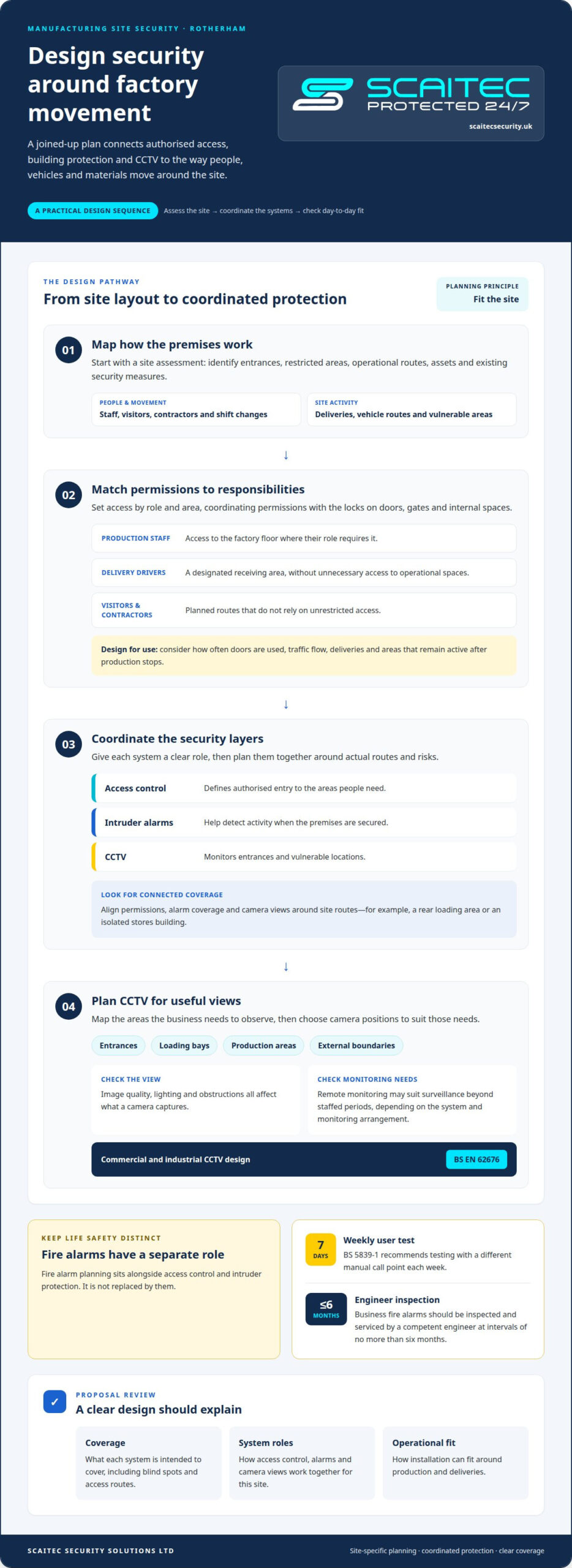
Factory access control should reflect how people, vehicles and materials move through the premises. A professional design starts by identifying entrances, restricted areas and operational routes, then matching access permissions to how each area is used.
Access control and locking mechanisms
Access control combines entry permissions with the locking mechanisms fitted to doors, gates or internal areas. A staff entrance, for example, may need different controls from a delivery gate or a room containing valuable materials. The design should account for how often doors are used, traffic flow and who needs access. An installer can coordinate the controls and locks as one system, rather than treating each entrance separately.
Permissions work best when they reflect people’s responsibilities. A production worker may need access to the factory floor, while a delivery driver may only need a designated receiving area. Separating these routes limits unnecessary movement through the premises and makes it easier to adjust access when roles or site arrangements change. Consider visitors, contractors and temporary workers, too. Their routes should not depend on unrestricted access to operational areas.
Access control can also complement intruder alarms. A controlled staff entrance, for instance, can define an authorised entry point, while an alarm adds protection when the premises are secured. System design should account for shift changes, deliveries and areas that remain in use after production stops. Fire alarms have a separate life-safety role, so access arrangements should be considered alongside the site’s fire safety planning.
Protection from theft, trespassing and vandalism
A layered security plan can help address risks such as metal theft, trespassing and vandalism. Controlled access can restrict entry to storage and production areas, intruder alarms can detect activity when the site is secured, and CCTV can monitor entrances and vulnerable locations. Start by identifying where materials are stored, how trespassers could approach and which areas need closer observation.
Industrial security also depends on how systems fit together. A professional design can align access permissions, alarm coverage and camera views around real site routes, such as a rear loading area or an isolated stores building. That joined-up approach helps avoid gaps between a controlled entrance and less visible parts of the premises. The business security systems should reflect these site-specific movements and risks.
Fire alarms require their own planned checks. BS 5839-1 recommends a weekly user test, using a different manual call point each week. Business fire alarms should also be inspected and serviced by a competent engineer at intervals of no more than six months. These checks support fire safety planning alongside, rather than in place of, access control and intruder protection.
Commercial and industrial building security
Factory security planning should account for the buildings, operations and movement of people and goods. A site assessment helps identify where CCTV, access control and other security measures fit.
Commercial CCTV installation and monitoring
Commercial CCTV systems for Rotherham manufacturing and industrial premises are designed to BS EN 62676. A professional installation begins by mapping entrances, loading bays, production areas and external boundaries. Camera positions should match the areas the business needs to observe, rather than simply adding coverage wherever equipment can be fitted.
Monitoring arrangements also shape the design. A camera covering a goods entrance, for example, can provide visibility of deliveries, while a view of an internal corridor can help oversee movement between areas. Image quality, lighting and obstructions all affect what a camera captures. Remote monitoring may suit sites that need surveillance beyond staffed periods, depending on the system and monitoring arrangement.
Professional site security risk assessments
A professional installer assesses the site by reviewing its layout, operating hours, entrances, assets and existing security measures. A walkthrough might reveal an unobserved stores entrance or a loading area used by staff and visitors. The installer can then recommend measures that address those findings, rather than applying the same design to every factory.
The assessment should also consider how systems fit into daily work. A controlled entrance must support authorised staff access, for example, while camera views should account for vehicle movements and changing light. These details help shape a coordinated plan for the premises.
Choosing a security systems installer
When assessing an installer’s proposal, look at how clearly the design addresses risks at your specific site. A useful proposal explains the intended coverage, the role of each system and how installation will fit around production or deliveries. Ask for the rationale in plain language, including how blind spots and access routes have been considered.
Grant eligibility and insurance conditions depend on the relevant scheme and policy. Review your insurer’s requirements and the terms of any grant before setting project priorities. This helps align the security design with the business’s financial and operational needs.
Rotherham CCTV and access control installers
For factory CCTV and access control in Rotherham, choose an installer who can assess both systems as part of one site design. This allows the plan to address camera coverage and authorised entry together, such as at a staff entrance beside a busy loading area.
Connected CCTV and building security systems also involve digital security considerations. Unauthorised access to system accounts or poorly managed permissions could affect who can view footage or change settings. A professional design should consider account access and how connected equipment fits within the site’s wider technology environment.
For a joined-up approach to commercial premises, explore commercial CCTV systems alongside the site’s access control needs.
Security and operational continuity in manufacturing
At a manufacturing site, security measures need to protect assets without obstructing production. A well-planned system considers staff access, deliveries and working areas alongside the site’s continuity requirements.
Start by considering the operational impact of each area. A restricted stores room may contain materials needed to keep production moving, while a loading bay handles frequent vehicle movements. Security should protect both without causing avoidable delays for authorised staff. Mapping critical routes and work areas helps place controls where they support, rather than interrupt, daily activity.
System planning should fit the factory’s working pattern. A site with shift handovers, shared workspaces and regular deliveries has different access needs from a building that closes after one shift. An installer can consider these routines when planning entry permissions and surveillance coverage. Clear procedures also help staff understand how security measures apply during production and when areas are closed.
Physical security and information security serve different purposes. CCTV and access control protect premises and manage entry, while connected equipment also needs consideration within the wider technology environment. A Rotherham manufacturer maintained Cyber Essentials compliance while strengthening technical security controls. This illustrates why site security planning should sit alongside, not replace, appropriate IT security measures.
Shared equipment can present practical challenges. One Rotherham manufacturer locked down shared kiosk machines to reduce risk and maintain compliance. In a factory, shared terminals may support production information or access to work instructions. Security planning can account for where these devices are located and how staff use nearby areas, while technical controls for the machines remain part of the organisation’s IT arrangements.
Technology changes can affect how a site operates. A Rotherham manufacturer improved technology to support CAD training and CNC-related work, as well as visibility and management across its IT estate. These examples show why security planning should consider evolving workspaces and equipment rather than treating the factory layout as fixed. A new training area or production workflow may change movement patterns and oversight needs.
Operational continuity also depends on clear responsibilities when a system identifies an issue. A planned approach should define who receives alerts, how staff follow site procedures and how access is managed during an investigation. If an alarm event affects a production area, for example, a response process can help protect the location while limiting disruption elsewhere. The arrangements should reflect how the site actually operates.
For Rotherham manufacturers, the practical aim is a coordinated design that accounts for production routes, changing technology and site procedures. Reviewing these factors together keeps security decisions connected to the work the premises supports.
CCTV and remote surveillance
For a manufacturing site, CCTV should provide useful views of relevant areas without disrupting production. Camera positions, lighting and monitoring arrangements all affect how well the system supports security.
Useful factory camera views might include a vehicle entrance, a loading bay or an isolated stores area. Engineers assess sightlines, lighting and obstructions before planning positions. A camera facing a bright doorway, for example, may capture less useful detail than one angled to show people approaching the entrance. The design should reflect what the site needs to see.
Remote surveillance can give authorised users access to camera views when they are away from the premises. Its value depends on the monitoring arrangement and the purpose of each camera. A view of an external gate may help users assess an alert, while cameras inside production areas may serve different operational needs. Clear priorities help avoid monitoring that adds little practical value.
For workplace CCTV in the UK, establish a clear security purpose, use cameras proportionately and explain the monitoring to employees. If cameras may monitor staff activity, consider their purpose and placement carefully. A camera directed at a store entrance, for example, is different from routinely recording an employee’s workstation.
System planning should account for access to images as well as camera coverage. Decide which roles need to view footage and restrict access accordingly. A site manager may need to review an incident near a loading bay, for example, while most production staff do not need access to recorded images. Clear responsibilities support consistent handling of footage.
Installation details matter in active facilities. Engineers can plan cable routes and camera positions around machinery, vehicle paths and equipment that might obstruct a view. A loading bay whose layout changes during the working day may need a different camera angle from a fixed entrance. The final arrangement should suit how the site is used.
Remote monitoring also needs a clear response process. If a monitored view shows activity at a restricted entrance, the people responsible should know how to assess and escalate the event. CCTV can provide visual context, but it does not replace site procedures or staff judgement. Defined roles help prevent confusion when an alert occurs.
Review the system when the premises change. A new production line, relocated stores area or altered vehicle route can affect camera coverage. A planned review helps identify whether views remain useful and whether new obstructions have appeared. This keeps surveillance aligned with the factory’s current layout and security priorities.
CCTV installation and remote surveillance
A dependable CCTV installation starts with a clear purpose for the manufacturing site. The installer translates operational priorities into a technical plan, then installs and tests equipment around the factory’s working arrangements.
First, agree what each camera needs to observe. A site may prioritise confirming activity at an entrance or reviewing an incident near a dispatch area. The installer uses these objectives to plan coverage and equipment positions. Giving each camera a defined role ensures its purpose remains clear after installation.
Next, plan installation around the building and production schedule. Cable routes, mounting positions and equipment locations need to suit the premises without interfering with machinery or routine work. A factory with active loading operations may need installation coordinated around vehicle movements. Discussing site access and production constraints early helps the installer plan a practical sequence.
After installation, test the system against its intended use. The installer can check that each camera provides the planned view, authorised users can access images and the system operates as expected. A camera intended to show activity at a goods entrance, for example, should be reviewed from the user’s viewing position, not only at the camera itself.
Remote surveillance adds another operational layer. Before use, define who is responsible for viewing alerts or footage, what they should do with relevant information and how concerns are escalated. A clear process helps staff distinguish routine activity from events that need attention. Arrange remote access for the people who need it, and make sure responsibilities are understood across the business.
The design should also account for changes after installation. A relocated production line, new partition or altered storage arrangement may change what a camera can see. A new stack of materials, for instance, could obstruct a view intended to cover a route. Planned reviews help identify when adjustments may be needed as factory operations evolve.
A professional installation includes a clear handover. Site users should understand the system’s purpose, how authorised access is managed and who handles operational queries. This is especially useful when facilities staff and production managers have different responsibilities. Clear handover information gives the business a consistent starting point for using CCTV.
For manufacturing site security systems in Rotherham, treat installation, testing, remote monitoring arrangements and future changes as one process. This keeps the technical setup connected to the factory’s actual operating needs.
Commercial fire alarm systems for Rotherham premises are designed, installed and maintained to BS 5839-1 and BAFE SP203-1 standards for those premises.
Scaitec Security Solutions Ltd: System Maintenance
Scaitec Security Solutions Ltd maintains manufacturing security systems as site operations and equipment change. Regular maintenance can help identify issues affecting CCTV, intruder alarms or access control and support reliable day-to-day operation.
Consider maintenance when equipment needs attention, a system has changed or the site layout has shifted. New shelving, for example, could affect camera views, while a changed staff entrance may alter access control requirements. A planned review helps keep systems aligned with how the premises are used.
For Rotherham manufacturers, maintenance is a practical next step after installation, particularly when security equipment needs ongoing attention. Contact Scaitec Security Solutions Ltd to discuss maintenance for your site.
Take the next step towards a site-specific plan
Security planning can adapt as your factory changes. A new production area, revised delivery route or different staff access pattern may alter what the site needs. Treat the system as part of the premises’ ongoing operation, with reviews prompted by meaningful changes rather than assuming the original layout will always remain suitable.
For manufacturing site security systems in Rotherham, discuss your site’s priorities and how security can support daily work. Scaitec Security Solutions Ltd offers CCTV systems, intruder alarms and access control systems, with maintenance to support equipment over time. A conversation about your premises can help shape a practical plan.
A considered plan gives your team a sound starting point for protecting the site while keeping production needs in view.
Frequently Asked Questions
What security systems are suitable for manufacturing sites in Rotherham?
A suitable setup of manufacturing site security systems in Rotherham can combine CCTV, intruder alarms and access control, matched to the site’s layout and working patterns. Access control can manage entry to restricted stores, for example, while CCTV provides views of selected areas. Scaitec Security Solutions Ltd also provides remote monitoring. Its fire alarm installations meet current British Standards.
What access control systems suit industrial sites with multiple entrances and shifts?
The right access control arrangement gives each entrance a clear purpose and aligns access with staff roles and shift patterns. For instance, staff, contractors and delivery drivers may need different permissions or routes. Scaitec Security Solutions Ltd is Insurance Approved and SSAIB Certified. Installation is guaranteed within 7 days of acceptance of proposal, helping manufacturers plan around site operations when arranging a new system.
How can factories integrate intruder alarms, CCTV, gates and access control?
Factories can plan these measures together around entry points and site procedures. For example, access control can manage authorised entry, CCTV can provide views of an entrance, and an intruder alarm can protect the premises when secured. A gate’s role should be considered in the overall site plan. Scaitec Security Solutions Ltd provides CCTV Systems, Intruder Alarms and Access Control Systems; its stated accolade is “Best Rated Security Company in Rotherham”.
What are the benefits of monitored alarms versus keyholder response for manufacturing sites?
With remote monitoring, an alarm trigger is connected to an Alarm Receiving Centre, supporting 24/7 surveillance and automated emergency service dispatch. A keyholder arrangement instead depends on a designated person receiving an alert and responding under the site’s procedures. Manufacturers can consider who handles alerts, how incidents are escalated and whether staff availability changes across shifts. Non-contract customers receive the same care and attention as Protect-plan customers from Scaitec Security Solutions Ltd.
Protect Your Business
Protect Your People
Book Your FREE Site Protection Survey

Since pioneering Scaitec Security Solutions in 2005, Paul Scaife, with his roots in the industry dating back to 1994, has distinguished the firm as a leading provider of bespoke fire and security solutions, servicing clients across Sheffield, Rotherham, and surrounding areas.
His leadership, underpinned by accreditation from the Security Systems and Alarms Inspection Board, ensures that Scaitec surpasses client expectations by blending advanced technology with a deep understanding of their unique needs.
Paul's ethos champions innovation and efficiency, driving Scaitec to deliver tailored, cutting-edge solutions that enhance safety and operational ease.
Discover more about Paul’s commitment to excellence on LinkedIn.