
Table of Contents
A warehouse security system in Sheffield has no single standard price: the cost to install a security system in a warehouse in Sheffield depends on the site and the protection it needs. The price is tailored to the individual case and provided after a quote request, with factors such as the building’s layout, entry points and choice of systems shaping the estimate.
It’s understandable to want a clear budget before committing, especially when a warehouse has several areas and access routes to consider. A useful estimate starts with understanding how the premises operate, rather than choosing equipment by price alone.
This guide explains what can affect installation costs, how a site survey and risk assessment help shape a suitable system, and what to expect from installation, commissioning and staff training. You’ll also see how CCTV, intruder alarms and access control can contribute to a joined-up approach, so you can plan the next step with a clearer picture of the work involved.
Key Takeaways
- Warehouse security costs depend on the site layout, entry points and the systems needed, so an assessment helps shape a relevant quote.
- A site survey and risk assessment help identify vulnerable areas and guide the placement of security equipment.
- Installation schedules vary with the system and building; a warehouse or factory alarm installation may take a full day.
- Commissioning and staff training help ensure the system is ready for use and employees understand its operation.
- Planned maintenance can help keep CCTV, intruder alarms and access control systems working as intended.
How much does a business alarm system cost in Sheffield?
Warehouse installation costs depend on the premises, the equipment selected and the coverage required. A loading bay, staff entrance and remote storage area may each need different protection. A tailored quote accounts for the specific site and proposed system.
Sheffield and national price comparisons
Sheffield alarm installation estimates sit slightly below the national average, but that comparison isn’t a warehouse quotation. A small office and a distribution warehouse have different layouts, access points and installation requirements. London comparisons also need to match the system, building type and work included, rather than rely on a broad regional average. This helps separate local variation from differences in project scope.
For a useful comparison, look at what each estimate covers: equipment, installation, commissioning and any ongoing services. A warehouse with several entrances may require a different design from premises with one controlled access route. A business planning protection across Sheffield and nearby Rotherham should compare like-for-like site requirements. The business security systems page covers commercial protection options.
How to assess business security installation quotes
A professional quote should connect the proposed system to the risks and layout identified at the site. Check that it explains which areas are covered, where equipment will be positioned and how staff access will work. For example, a dispatch door, loading bay and internal stock area may need distinct coverage. Clear descriptions make it easier to understand why proposals differ.
Compare the work included, not just the headline total. Look for details on equipment, installation, system setup and handover. If one quote includes remote monitoring and another doesn’t, they aren’t equivalent. Ask for ongoing services and maintenance to be identified separately, so the full operating commitment is clear. The exact figure depends on the warehouse layout, coverage and selected equipment.
Don’t assume grants or tax allowances will form part of the installation budget. Consider them separately, and include any support only after establishing that the scheme applies to your circumstances and planned expenditure.
Wired and wireless system costs
Wired systems connect equipment to a control point with cabling, so the building’s structure and cable routes affect installation work. Wireless systems avoid much of that cabling and may suit premises where routes are difficult to access. The right choice depends on the warehouse design, coverage and installation conditions, not a universal cost rule.
Reliability also depends on correct placement, commissioning and ongoing maintenance. A wireless system still needs suitable coverage and dependable equipment; a wired system relies on sound cabling and connections. A professional assessment can weigh these needs against the warehouse’s day-to-day operation. Discuss delivery routes, storage areas and staff movement so the proposed system fits the site.
Ongoing system fees
Installation is only part of the overall cost. Remote monitoring may involve a recurring subscription, while maintenance may involve planned visits or corrective work. These costs are separate from the initial installation estimate, so ask how each ongoing service is described and what it covers. If selected, remote monitoring should be considered alongside how alerts are handled.
Maintenance needs depend on the system, how it is used and site conditions. A busy warehouse with frequent deliveries may place different demands on equipment than a quieter storage facility. Include ongoing support when comparing proposals, alongside the initial design and installation. This gives your business a clearer picture of the work involved in keeping its security systems operational.
Installation timeframes
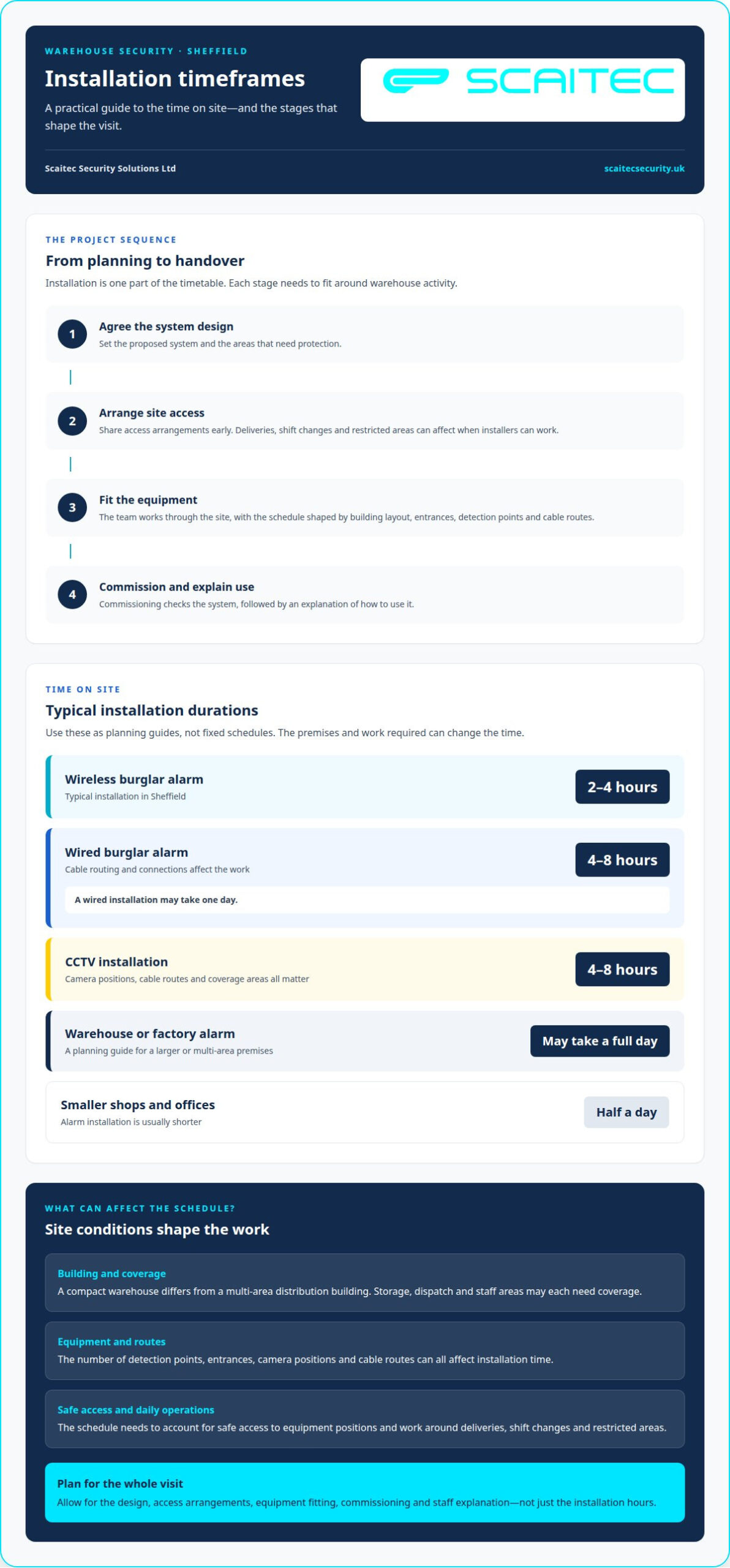
A warehouse or factory alarm installation in Sheffield may take a full day. Treat that as a planning guide, not a fixed schedule: the site’s size and layout affect the work. A compact warehouse with clear access differs from a multi-area distribution building. The number of detection points, cable routes and entrances also shapes the installation schedule.
Smaller shops and offices can usually have an alarm installed in half a day. Warehouse work can take longer because equipment may need to cover storage, dispatch and staff areas. A distribution centre, for example, may need separate coverage around loading bays and internal access routes. The installation team can plan the work around the areas requiring protection.
System type also changes the time on site. A typical wireless burglar alarm installation takes 2-4 hours in Sheffield. A standard wired burglar alarm installation typically takes 4-8 hours, although a wired installation may take one day. The difference reflects the work involved in routing and connecting cables, as well as the premises themselves.
CCTV installation typically takes 4-8 hours. The time depends on camera positions, cable routes and the areas requiring coverage. For a warehouse near Chesterfield, for instance, cameras may need to cover vehicle access, goods handling and internal storage. The installation schedule should account for safe access to each position and the sequence of work across the site.
Installation is only one part of the project timetable. The process usually includes agreeing the system design, arranging access, fitting equipment, commissioning it and explaining how to use it. Each stage needs to fit around warehouse activity. Deliveries, shift changes and restricted areas can affect when installers can work, so share access arrangements early to help organise the visit.
A customer testimonial describes a distribution-centre survey, quote and installation completed within a week in Barnsley. This illustrates one complete project timeline, not a standard duration for every Sheffield warehouse. Site size, equipment choice and access arrangements all influence scheduling. A clear plan helps staff prepare the relevant areas and keep essential warehouse operations organised during installation.
To plan a warehouse installation, map the work around access requirements and operating hours. A dedicated site discussion can help establish the sequence and expected on-site time; plan your security installation around the needs of your premises.
Site surveys and risk assessments
A site survey turns warehouse conditions into a practical security plan. In Sheffield, the assessment should consider how staff, visitors and deliveries move through the building. A ground-level loading bay, rear fire exit and separate stockroom create different security needs. Those details help determine equipment positions and the work required.
The survey starts with the building layout and its daily routines. The installer reviews entrances, internal doors, storage zones and restricted areas. For example, a warehouse may leave its loading doors open during deliveries, then secure them after dispatch. That operating pattern affects where detection equipment can be placed and how staff use the system.
A risk assessment considers what needs protection and where exposure may occur. High-value stock beside an external wall presents a different concern from goods kept in a locked internal cage. The survey also considers whether staff work across separate shifts, whether visitors enter through reception and how deliveries are supervised. These details help distinguish routine access from unusual activity.
Access routes need careful attention. One staff entrance may suit a simple arrangement, while separate loading and pedestrian doors may need different coverage. The assessor can note blind spots, doorways and movement between warehouse sections. These observations help avoid focusing on the main entrance while overlooking less visible areas, such as a side passage or isolated dispatch room.
System requirements also influence the assessment. Commercial intruder alarm design can follow BS EN 50131; according to the British Standards Institution, this is the relevant standard for intruder alarm systems. The survey helps establish the building’s needs before equipment and coverage are proposed. Where fire protection forms part of the wider site plan, its relationship to warehouse routines also merits consideration.
Clear findings make the proposal easier to understand. It should relate equipment and coverage to specific locations, such as the staff entrance, loading bay or stockroom. The assessment can also identify practical installation considerations, including access to equipment positions and ways to avoid disrupting active work areas. This connects the security design to the way the warehouse operates.
Before the survey, explain your operating hours, delivery routines and areas requiring controlled access. The installer can assess those details alongside the building itself. A warehouse with goods stored in several separate zones, for example, may need a different layout from one open storage hall. The assessment gives the installation plan a site-specific basis.
Installation durations
Time on site depends on the system, building layout and installation work. A standard wired burglar alarm installation in Sheffield typically takes one day. Use this as a practical planning guide, not a fixed schedule for every warehouse. Cable routes, access to relevant areas and the number of devices all shape the work involved.
A wireless burglar alarm installation typically takes 2-4 hours. It can involve less cable routing, but the installer still needs to position equipment and test its operation. A warehouse with several separated storage areas may take longer to complete than a compact premises. The layout determines where devices can be placed and how the system covers key areas.
CCTV installation in Sheffield typically takes 4-8 hours. Camera positions and cable routes influence the time required. For example, covering a loading bay, staff entrance and stock area involves different locations across the site. The installer needs to fit equipment, connect it and confirm the intended views. Clear access to each position helps the work proceed in an organised sequence.
These estimates describe installation duration, not the full project timetable. Planning and site access come before fitting equipment; commissioning and handover follow the installation work. Each stage has a distinct purpose: planning sets out the agreed scope, installation puts equipment in place, and commissioning checks system operation before staff receive an explanation.
Warehouse activity can affect how the team organises its work. A live dispatch area, for instance, may require installation to be coordinated around vehicle movements and staff access. The same applies to storage zones that remain in use during the visit. Agreeing access arrangements beforehand helps the installer reach equipment positions and organise work across the premises.
For Yorkshire businesses, the practical schedule should account for both the system and the warehouse routine. An intruder alarm installation involving several entrances may need a different sequence from work in one office area. The installer can plan tasks around the site layout, access and operating needs. This helps staff understand which areas may be affected during installation.
Before work begins, identify restricted spaces, delivery periods and staff routes. For example, if the loading bay remains busy during dispatch, the installation sequence can account for that activity. The team can then coordinate access to equipment locations and explain any operational considerations. This preparation supports an orderly visit while ensuring the planned system work is completed.
When reviewing a schedule, distinguish the time spent fitting equipment from the time needed for commissioning and staff handover. A one-day wired alarm installation, for example, is still part of a wider process. Understanding each stage helps warehouse managers plan site access and staff availability around the work.
Installation, commissioning and staff training
Professional alarm installation involves more than fitting equipment. The process moves from preparing the work area to installing devices, checking system operation and handing it over. In a Sheffield warehouse, the team follows the agreed design, so each device corresponds to a specific entrance, zone or operational need.
During installation, technicians position equipment and connect the system according to the site plan. For example, a warehouse with a staff entrance and separate dispatch door needs each access point addressed as planned. Work can be organised around warehouse activity, including vehicle movements and staff access. Clear communication helps employees understand which areas installers need to reach.
Commissioning follows installation. The technician checks that the system responds as intended, including the relevant detection points and control functions. For an intruder alarm, this means checking operation across the areas included in the design. Adjustments can be made before handover, helping ensure the installed system reflects the agreed coverage.
Testing also gives the installer an opportunity to explain how the system works during normal use. Staff can learn to operate the controls, set or unset the alarm, and follow the agreed process if it activates. A warehouse with separate shifts may need instructions shared with employees who work different hours.
Training should reflect real routines, not just demonstrate the controls. For instance, staff responsible for opening the premises need to understand the setting process, while closing teams need to know how to secure the site. A named person can coordinate questions and share operating information with colleagues across shifts.
For businesses operating between Sheffield and Doncaster, a consistent handover matters when employees move between sites. The same applies within one warehouse with separate teams. Clear operating instructions help staff follow the intended process and avoid confusion about who manages system access or responds to an activation.
Before handover, the installer can explain the controls, demonstrate normal operation and outline the agreed response process. Staff should have time to practise routine actions with guidance. A written record of the system layout and operating instructions can support future staff changes and help managers keep site procedures consistent.
Commissioning and training complete the installation process, rather than serving as optional extras. Businesses planning an intruder alarm installation can consider how staff roles and warehouse routines fit the system design. The result is a clearer handover, with employees better prepared to operate the equipment as intended.
Scaitec Security Solutions: System Maintenance
Scaitec Security Solutions Ltd provides system maintenance for businesses that need ongoing care for warehouse security equipment. Planned maintenance is useful after installation and when a system needs attention to remain suitable for the premises. It can support CCTV systems, intruder alarms and access control systems as warehouse operations or access arrangements change.
If equipment needs servicing or a fault affects normal operation, maintenance helps address the system’s ongoing needs. Reviewing the installed system can also help businesses consider whether it still reflects their site layout and working routines.
Contact Scaitec Security Solutions Ltd to discuss system maintenance for your warehouse.
Plan the next step for your warehouse
As you plan the cost to install a security system in a Sheffield warehouse, consider how the site may change as operations develop. New stock areas, revised staff routes or changes to delivery access can affect which security measures remain useful. Clear priorities help keep your next decision focused on how your premises work.
Scaitec Security can help businesses plan and maintain CCTV systems, intruder alarms and access control systems. Discussing these needs together can clarify how each system supports the warehouse’s day-to-day operation and what to consider as the site evolves.
Whether you’re planning a new installation or reviewing existing equipment, a considered next step can help you move forward with confidence.
A well-planned security approach gives your team a clearer foundation for protecting the premises as business needs change.
Frequently Asked Questions
What affects alarm installer costs in Sheffield?
Costs depend on the warehouse layout, system design and work required for installation. A site with several separate entrances, storage areas and staff zones may need a different setup from a single open space. Existing cabling and access to installation points can also affect the work. Ask for a quote that separates equipment, installation and ongoing services.
Can you fit alarms for warehouses and factories?
Yes. Scaitec Security installs intruder alarms for commercial premises, including warehouses and factories. The proposed system can account for staff entrances, goods storage and delivery routes. For example, a factory with a separate dispatch entrance may need that access point considered alongside staff areas. A site assessment helps shape a design around the premises.
Do you need planning permission or legal approval?
Whether approval is needed depends on the proposed work and the site, not simply on installing an alarm. Fitting equipment inside an existing building differs from work that changes its exterior or structure. Lease terms may also set requirements for alterations. Clarify the project scope and relevant property conditions before installation, particularly if the work involves drilling, external equipment or changes to shared areas.
How long does installation usually take?
Installation time varies with the system and the building. A warehouse or factory alarm installation may take a full day, while other systems have different durations. Fitting equipment is only part of the process: commissioning and staff handover follow. For planning, consider when installers can access work areas and how the installation sequence will fit around deliveries and staff activity.
What is the average cost to install a security system in a warehouse in Sheffield?
There isn’t one reliable average for every warehouse, because each site needs a different design and scope of work. The cost to install a security system in a warehouse in Sheffield depends on factors such as building layout, required coverage, equipment choices and installation conditions. A tailored quote sets out the figure for the premises and helps clarify what the proposed work includes.
How much do warehouse CCTV systems cost in Sheffield, including installation?
The total depends on the number and placement of cameras, the warehouse layout and the installation work required. For example, a design covering entrances, loading areas and internal stock zones differs from one focused on a single access point. The quote should explain the proposed coverage and installation scope, making it easier to understand how the camera plan fits the site’s operating needs.
What are the costs of warehouse intruder alarms and monitoring in the UK?
Alarm installation and monitoring are separate parts of the overall arrangement. Installation costs depend on the premises and chosen system, while remote monitoring is an ongoing service with its own subscription. Scaitec Security Solutions Ltd provides 24/7 remote monitoring. A tailored proposal can distinguish the installation work from recurring monitoring, so businesses can understand the different elements involved.
What factors affect warehouse security system installation costs, such as size and number of cameras?
Building size matters because larger or divided premises may need broader coverage, but camera count alone doesn’t determine the installation scope. Camera positions, cable routes, entrances and areas to be monitored all influence the design. A warehouse with separate loading and storage zones, for instance, may need a different layout from an open-plan site. The assessment connects equipment choices to the areas your business wants covered.
Protect Your Business
Protect Your People
Book Your FREE Site Protection Survey

Since pioneering Scaitec Security Solutions in 2005, Paul Scaife, with his roots in the industry dating back to 1994, has distinguished the firm as a leading provider of bespoke fire and security solutions, servicing clients across Sheffield, Rotherham, and surrounding areas.
His leadership, underpinned by accreditation from the Security Systems and Alarms Inspection Board, ensures that Scaitec surpasses client expectations by blending advanced technology with a deep understanding of their unique needs.
Paul's ethos champions innovation and efficiency, driving Scaitec to deliver tailored, cutting-edge solutions that enhance safety and operational ease.
Discover more about Paul’s commitment to excellence on LinkedIn.