
Table of Contents
If your care home fire alarm system only covers communal areas, you are likely operating outside the law as of 2026. With the implementation of BS 5839-1:2025, the standard for resident safety has shifted significantly, making Category L1 protection a mandatory requirement for residential care settings. We recognise that managing a care facility involves a delicate balance between providing a welcoming home and maintaining the rigours of a high-risk safety environment. It’s understandable if the pressure to keep pace with changing care home fire alarm regulations UK standards feels like a constant challenge, particularly when you are responsible for residents with complex mobility needs.
This guide serves as your dedicated expert partner in understanding these legal complexities, offering a clear route to full compliance and enhanced resident protection. We’ll show you how to move beyond the confusion of new standards to implement a system that minimises false alarms whilst ensuring 24/7 vigilance. By exploring the latest requirements for addressable systems, mandatory sprinkler updates, and the April 2026 enforcement of individualised evacuation plans, we’ll help you secure both your CQC rating and the safety of those in your care.
Key Takeaways
- Understand the 2026 legal landscape and how the latest care home fire alarm regulations UK ensure your facility meets CQC “Safe” standards.
- Learn why addressable fire alarm systems are now essential for complex layouts to reduce search distances and protect vulnerable residents.
- Discover how to integrate fire safety with access control systems to ensure seamless evacuation for residents with limited mobility.
- Establish a rigorous preventative maintenance schedule to remain compliant with BS 5839-1:2025 and ensure your system remains reliable.
- Explore the benefits of 24/7 remote monitoring and how connecting to an Alarm Receiving Centre provides constant protective vigilance.
The Legal Framework: Care Home Fire Alarm Regulations UK
The foundation of all care home fire alarm regulations UK managers must follow is the Regulatory Reform (Fire Safety) Order 2005. This legislation places the legal burden of safety on a designated individual, ensuring that fire protection is a proactive management task rather than a reactive one. Care homes are uniquely high-risk environments. Residents often have limited mobility, cognitive impairments, or complex health needs that make traditional evacuation methods difficult. We see the transition to BS 5839-1:2025 as a vital step in addressing these specific risks, moving towards a more comprehensive life protection standard that caters to the most vulnerable.
The Care Quality Commission (CQC) views fire safety as a fundamental part of their assessment criteria. To achieve a “Safe” or “Well-led” rating, you must demonstrate that your fire alarm systems are not just present, but actively maintained and compliant with the latest standards. As specialists serving South Yorkshire, we recognise that maintaining these standards is about more than just avoiding penalties; it’s about providing a stable, protective environment for your residents and staff.
Understanding the Category L1 Requirement
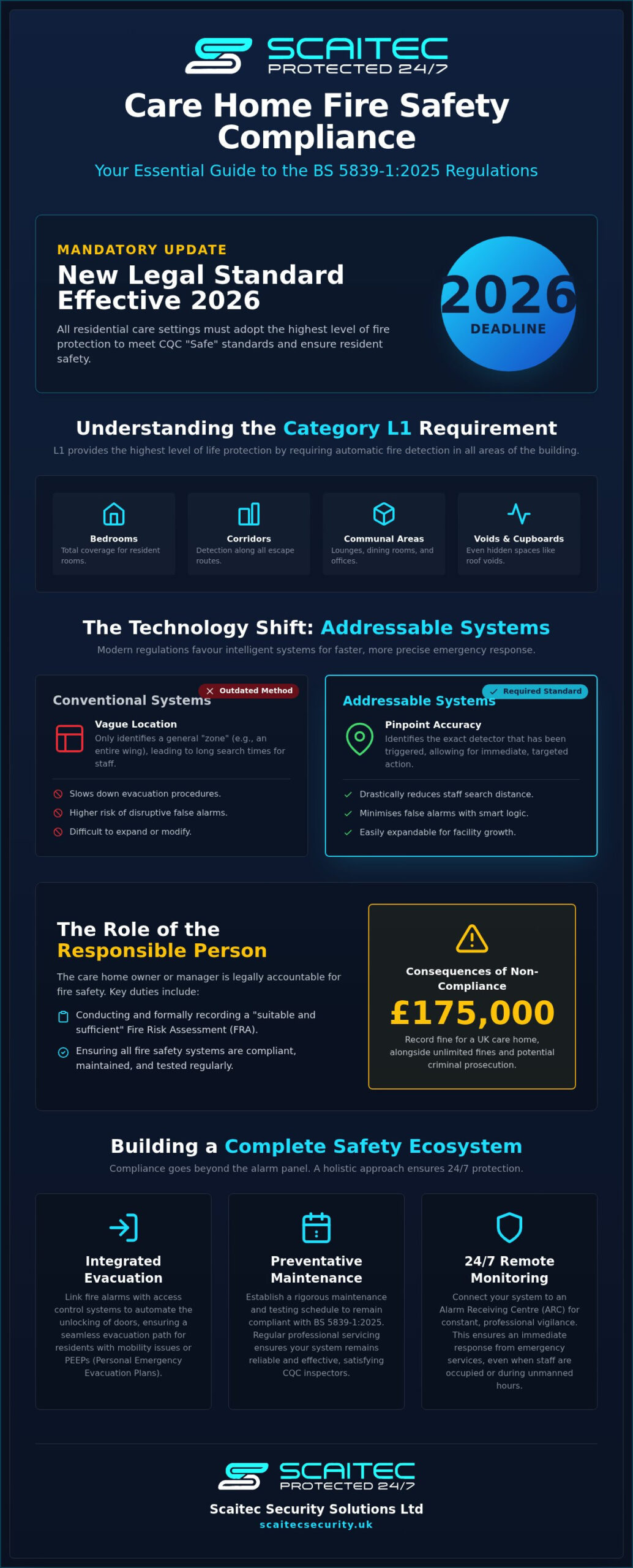
Category L1 provides the highest level of life protection available under British standards. In 2026, this is the expected benchmark for residential care settings. Unlike Category L2 or L3 systems, which might only cover escape routes or specific high-risk rooms, an L1 system requires automatic fire detection in every part of the building. This includes bedrooms, corridors, storage cupboards, and even roof voids. The goal is to provide the earliest possible warning. This gives your team maximum time to coordinate evacuations, which is critical when residents cannot self-evacuate.
The Role of the Responsible Person
Every care home must have a “Responsible Person,” usually the owner or manager, who is legally accountable for fire safety. Your primary duty is to ensure a “suitable and sufficient” Fire Risk Assessment (FRA) is conducted and formally recorded. Under current rules, simply having an assessment isn’t enough. It must be documented along with the identity of the Responsible Person and all specific fire safety arrangements.
Failing to meet these obligations carries severe consequences. Non-compliance can lead to CQC warning notices, unlimited fines, or even criminal prosecution. The largest fine issued to a UK care home for fire safety breaches reached £175,000. We work alongside managers to ensure their systems meet these rigorous standards, providing the documentation and peace of mind needed to satisfy both inspectors and insurers.
Designing for Safety: Addressable Systems and BS 5839-1:2025
Whilst the legal framework sets the rules, the choice of hardware determines how effectively your staff can respond during an emergency. Under the current UK fire safety legislation, your system must be fit for purpose. For most modern care facilities, this means moving away from older conventional setups in favour of addressable technology. Care home fire alarm regulations UK standards now lean heavily towards these intelligent systems because they provide granular data that saves lives when every second counts.
The primary benefit is the drastic reduction in search distance. In a conventional system, an alarm might only indicate a fire somewhere in “Zone 2”. This leaves staff searching an entire wing to find the source. An addressable system identifies the exact room and even the specific detector that triggered. This allows for immediate, targeted action, which is essential for the safety of residents with limited mobility.
Managing sensory impairments is another critical design factor. We integrate visual alarm devices (VADs) alongside audible sounders to ensure residents with hearing loss are alerted instantly. This holistic approach also helps prevent “alarm fatigue” by reducing false triggers. Addressable systems allow us to programme sophisticated logic, such as investigation delays. This ensures a single puff of steam doesn’t trigger a full-building evacuation, protecting residents from the distress of unnecessary movement.
Addressable vs Conventional Systems in Care Settings
Conventional systems are often too blunt an instrument for complex care environments. Addressable loops allow for easy expansion as your facility grows. If you add a new wing, we simply extend the loop rather than rewiring the entire building. Maintenance is also more efficient; the panel tells us exactly which detector needs cleaning or replacement, ensuring your system remains 100% operational at all times.
Hardware Standards and Quality Assurance
Reliability is non-negotiable in a high-risk setting. Every component we install meets the latest BS 5839-1:2025 standards, backed by robust uninterruptible power supplies (UPS). This ensures your panel remains active even during a mains power failure. As SSAIB accredited installers based in South Yorkshire, we provide the rigorous certification required for insurance and CQC compliance. If you are looking to upgrade your facility, our team can help you design a compliant fire alarm system tailored to your specific layout and resident needs.
PEEPs and Evacuation: Integrating Fire Alarms with Access Control
Effective fire protection in a care home is a multi-layered ecosystem where detection triggers immediate, automated physical responses. Under the evolving care home fire alarm regulations UK providers must follow, it’s no longer sufficient for an alarm to simply make noise. It must facilitate a swift, safe exit for everyone, including those with limited mobility. This is where Personal Emergency Evacuation Plans (PEEPs) become critical. From 6 April 2026, these individualised plans are a legal requirement for any resident who cannot self-evacuate, ensuring that their specific needs are documented and actionable.
Integration is the key to making these plans work in practice. We ensure that your access control systems are fully interfaced with the fire panel. In the event of a trigger, all electronically locked doors on escape routes must automatically release. This failsafe mechanism ensures that residents and staff aren’t trapped by security measures during an emergency. It’s a vital part of maintaining a “Safe” CQC rating whilst ensuring the building remains secure during normal operation. A system that works in isolation is a system that presents a risk.
We also need to address the common, dangerous habit of wedging fire doors open. Whilst often done for ventilation or ease of movement, it bypasses the door’s ability to contain smoke and flame. The solution lies in electromagnetic hold-open devices linked to the fire alarm. These allow doors to stay open for daily use but release them instantly when the alarm sounds. To coordinate this movement, every fire panel should be accompanied by an accurate, illuminated zone plan. This map allows emergency services to see exactly where the incident is occurring within the building’s layout at a single glance.
Electronic Door Release and Fire Safety
Linking your fire panel to electromagnetic door holders ensures compliance with BS 7273 Part 4. This integration allows for a seamless transition from a secure environment to an open evacuation route. We recommend regular, documented testing of this interface during your weekly fire drills. It’s not enough for the alarm to ring; you must verify that the doors actually release as intended. This joined-up approach is what provides true peace of mind for managers and families alike.
Evacuation Strategies: Horizontal vs Vertical
Modern official government guidance emphasises progressive horizontal evacuation as the primary strategy for care homes. Instead of immediately moving residents down stairs, which is often impractical, they are moved to an adjacent fire-resisting compartment on the same floor. This buys precious time and reduces the physical strain on both residents and staff. Your fire alarm system supports this by providing phased evacuation signals, ensuring that only the areas at immediate risk are moved first, preventing bottlenecks in corridors.
Maintenance and Testing: Ensuring 2026 Compliance
Even the most advanced L1 system is only effective if it functions perfectly when needed. Establishing a rigorous preventative maintenance schedule is a core requirement of care home fire alarm regulations UK. This isn’t just about technical reliability; it’s about creating a documented audit trail that satisfies the CQC, local fire authorities, and your insurance provider. We view maintenance as an ongoing partnership that protects your investment and, more importantly, your residents.
Your Fire Alarm Logbook is the most important document in your safety arsenal. During any inspection, it’s often the first thing an officer will request. It must contain a chronological record of every test, false alarm, fault, and service visit. If a test isn’t recorded in the logbook, legally, it never happened. This meticulous record-keeping demonstrates that you’re a responsible person who takes resident safety seriously and values protective vigilance.
The Weekly Fire Alarm Test Procedure
Staff should conduct a functional test at the same time every week to familiarise residents with the sound and reduce anxiety. It’s vital to rotate through a different manual call point each time, ensuring every trigger device in the building is tested over a set cycle. During this test, you must verify that the signal successfully reaches your Alarm Receiving Centre and that all auxiliary functions, such as electromagnetic door releases, operate as intended.
Professional Servicing and Corrective Support
Whilst weekly checks are handled by your team, BS 5839-1:2025 mandates a professional inspection at least every six months. Our qualified engineers conduct a deep-system audit, testing battery health, detector sensitivity, and panel integrity. If a fault occurs between these visits, prompt corrective maintenance is essential to restore protection. For homes in South Yorkshire, having local, SSAIB-accredited support ensures that emergency call-outs are handled swiftly, maintaining the protective stability your facility requires.
Arrange your compliant fire system maintenance schedule
24/7 Vigilance: The Power of Remote Monitoring
Local alarms are the first line of defence, but they rely entirely on human intervention to alert the authorities. In a high-occupancy care home, staff are often occupied with high-needs resident care or complex evacuations. Expecting them to immediately contact emergency services whilst managing a crisis is a significant risk. Care home fire alarm regulations UK standards increasingly point towards the necessity of automated response systems to bridge this gap. Remote monitoring ensures that the moment a detector is triggered, a signal is sent to a specialised facility, regardless of what’s happening on-site.
This automated backup is especially critical during the night. With fewer staff members on duty, the time taken to identify a fire, verify its location, and call 999 can be the difference between a controlled incident and a tragedy. A monitored system removes the “human factor” from the initial alert process, ensuring that the professional response begins the second the smoke is detected. It’s a proactive layer of safety that provides a safety net for both your team and your residents.
How Alarm Receiving Centres (ARC) Protect Your Home
When your system is connected to an Alarm Receiving Centre (ARC), you gain a layer of protective vigilance that never sleeps. The process is seamless. Within seconds of an alarm trigger, the ARC receives the data and begins a verification process. This is crucial for filtering out false alarms, which can lead to fire brigade charges and unnecessary distress for residents. If the threat is confirmed, the ARC contacts the emergency services directly and alerts your designated keyholders. This system provides vital peace of mind for managers during night shifts, ensuring that help is on the way even if the building is in the middle of a complex evacuation.
There are also significant commercial benefits to this level of oversight. Many insurance providers now require or heavily incentivise the use of a professionally monitored fire system. It demonstrates a holistic commitment to risk management that goes beyond the bare minimum. By integrating remote monitoring, you’re not just meeting the basic requirements of the law; you’re building a resilient safety infrastructure that protects your business’s reputation and long-term stability.
Choosing Scaitec for Your Care Home Fire Safety
At Scaitec Security Solutions, we act as your “Dedicated Expert Guide” through every stage of the compliance journey. We understand that fire safety in care homes requires a nuanced approach that balances technical precision with genuine care for residents. Our team specialises in the bespoke design and installation of addressable systems across Rotherham, Sheffield, and the wider South Yorkshire region.
We don’t just install a system and leave. We provide comprehensive aftercare and maintenance contracts to ensure your facility remains compliant with BS 5839-1:2025 year after year. From the initial risk assessment to long-term remote monitoring, we are committed to the safety of your clients and the stability of your organisation.
Protect your residents and your business with Scaitec
Securing Compliance and Resident Safety for 2026
Maintaining compliance with the latest care home fire alarm regulations UK standards is an ongoing commitment to the people who call your facility home. By transitioning to Category L1 addressable systems and integrating your fire panel with physical access control, you create a seamless safety environment that protects residents whilst satisfying CQC inspectors. These updates, alongside the mandatory individualised evacuation plans arriving in April 2026, ensure your home remains a stable and secure place for both staff and residents.
We understand that managing these technical requirements can be complex. As an SSAIB accredited firm and South Yorkshire based experts, we are here to simplify the process. From implementing 24/7 ARC monitoring to establishing a rigorous maintenance schedule, our team provides the protective vigilance you need for total peace of mind. Our holistic approach ensures that your system isn’t just a legal necessity, but a reliable life-saving tool that functions perfectly during an emergency.
Get a Professional Fire Safety Audit for Your Care Home
You don’t have to navigate these legal changes alone. We are ready to help you build a safer, fully compliant future for your care home today.
Frequently Asked Questions
What category of fire alarm is required for a care home?
Category L1 is the mandatory standard for residential care homes in 2026. This classification provides the highest level of life protection by requiring automatic fire detection in all areas of the building, including bedrooms, corridors, and storage cupboards. This early warning is essential for facilities in Sheffield and Rotherham where residents may need significant assistance to evacuate safely. It aligns with the latest care home fire alarm regulations UK managers must follow.
How often should care home fire alarms be tested by staff?
Staff must conduct a functional test of the fire alarm system every week. This involves activating a different manual call point each time to ensure the entire circuit is operational. You should record these tests in your logbook to maintain a legal audit trail. For care homes in Barnsley and Doncaster, we recommend performing these tests at a set time to help residents become familiar with the sound without causing unnecessary distress.
Is a Fire Risk Assessment a legal requirement for care homes?
Yes, a Fire Risk Assessment (FRA) is a mandatory legal requirement under the Regulatory Reform (Fire Safety) Order 2005. The assessment must be “suitable and sufficient” and must be formally recorded. It identifies potential hazards and specifies the necessary safety measures for the premises. For care home managers in Chesterfield and Worksop, keeping this document updated is vital for CQC compliance and ensuring the ongoing safety of your vulnerable residents.
Can we use wireless fire alarms in a residential care setting?
Wireless fire alarms are permitted in care settings provided they meet BS 5839-1 standards and the specific needs of the building. These systems are often ideal for older properties in Wakefield or Huddersfield where intrusive wiring might be difficult or disruptive. However, they require regular battery maintenance and a robust signal strength survey during installation to ensure they provide the same reliable protection as a hardwired addressable system.
What is an L1 fire alarm system?
An L1 fire alarm system is designed for the protection of life and offers the most comprehensive coverage available. It requires automatic detectors in every room, hallway, and large void within the building. This level of detection is the gold standard for care home fire alarm regulations UK compliance because it provides the earliest possible warning. This extra time is critical for coordinating the evacuation of residents with limited mobility or cognitive impairments.
Who is the “Responsible Person” in a care home fire safety context?
The “Responsible Person” is typically the owner, manager, or employer who has control over the premises. Legally, this individual is accountable for ensuring the facility meets all fire safety duties, including maintenance and risk assessments. In care homes across South Yorkshire, this person must ensure that staff are trained and that all safety equipment, such as addressable panels and emergency lighting, is kept in full working order at all times.
Do fire alarms in care homes need to be monitored remotely?
Whilst not strictly a universal legal requirement for all buildings, remote monitoring is considered best practice and is often required by insurers for high-occupancy care homes. Connecting your system to an Alarm Receiving Centre (ARC) ensures that emergency services are alerted instantly, even during night shifts with lower staffing levels. We provide 24/7 monitoring for homes in Rotherham and Sheffield to ensure a rapid, professional response to every trigger.
How does BS 5839-1:2025 affect existing care home systems?
The BS 5839-1:2025 update refines the technical standards for fire system design and installation, placing a greater emphasis on addressable technology and early detection. If your existing system was installed under older standards, you should arrange a professional audit to identify any gaps in coverage. Our experts help care homes in Doncaster and Barnsley navigate these changes, ensuring their hardware and maintenance protocols meet the current 2026 legal benchmarks.
Protect Your Business
Protect Your People
Book Your FREE Site Protection Survey

Since pioneering Scaitec Security Solutions in 2005, Paul Scaife, with his roots in the industry dating back to 1994, has distinguished the firm as a leading provider of bespoke fire and security solutions, servicing clients across Sheffield, Rotherham, and surrounding areas.
His leadership, underpinned by accreditation from the Security Systems and Alarms Inspection Board, ensures that Scaitec surpasses client expectations by blending advanced technology with a deep understanding of their unique needs.
Paul's ethos champions innovation and efficiency, driving Scaitec to deliver tailored, cutting-edge solutions that enhance safety and operational ease.
Discover more about Paul’s commitment to excellence on LinkedIn.