
Table of Contents
Did you know that 42% of fire safety audits conducted in the last year identified significant failings? For many business owners, the reality of maintaining a safe premises can feel overwhelming, particularly with the transition to the updated BS 5839-1:2025 standard. We understand that the pressure to protect your staff and assets whilst meeting strict legal requirements is a heavy burden. It’s natural to worry about whether your current setup would stand up to a rigorous inspection or if a minor installation error could invalidate your insurance coverage.
This guide is designed to remove that uncertainty, providing a clear roadmap for commercial fire alarm installation Doncaster that ensures your business remains both safe and fully compliant. We’ll explore the latest 2026 regulations, the benefits of integrating fire detection with your existing CCTV or access control, and how a methodical approach to system design can virtually eliminate the disruption of false alarms. Our goal is to provide you with the professional reassurance you need to focus on running your business, knowing your property is under vigilant, expert protection.
Key Takeaways
- Understand your legal obligations under the Regulatory Reform (Fire Safety) Order 2005 and the specific requirements of the latest BS 5839-1:2025 standards.
- Compare the benefits of addressable versus conventional systems to determine which technology provides the most reliable coverage for your building’s layout.
- Identify the critical steps involved in a professional commercial fire alarm installation Doncaster to ensure your business remains fully protected and insurance-compliant.
- Learn how to integrate fire safety with your wider security infrastructure, including Access Control and CCTV, for visual verification and automated building evacuation.
- Follow the structured path from initial site survey to final commissioning to guarantee a system that is tailored to your unique fire risk profile.
Why Compliant Fire Alarm Installation is Critical for Doncaster Businesses
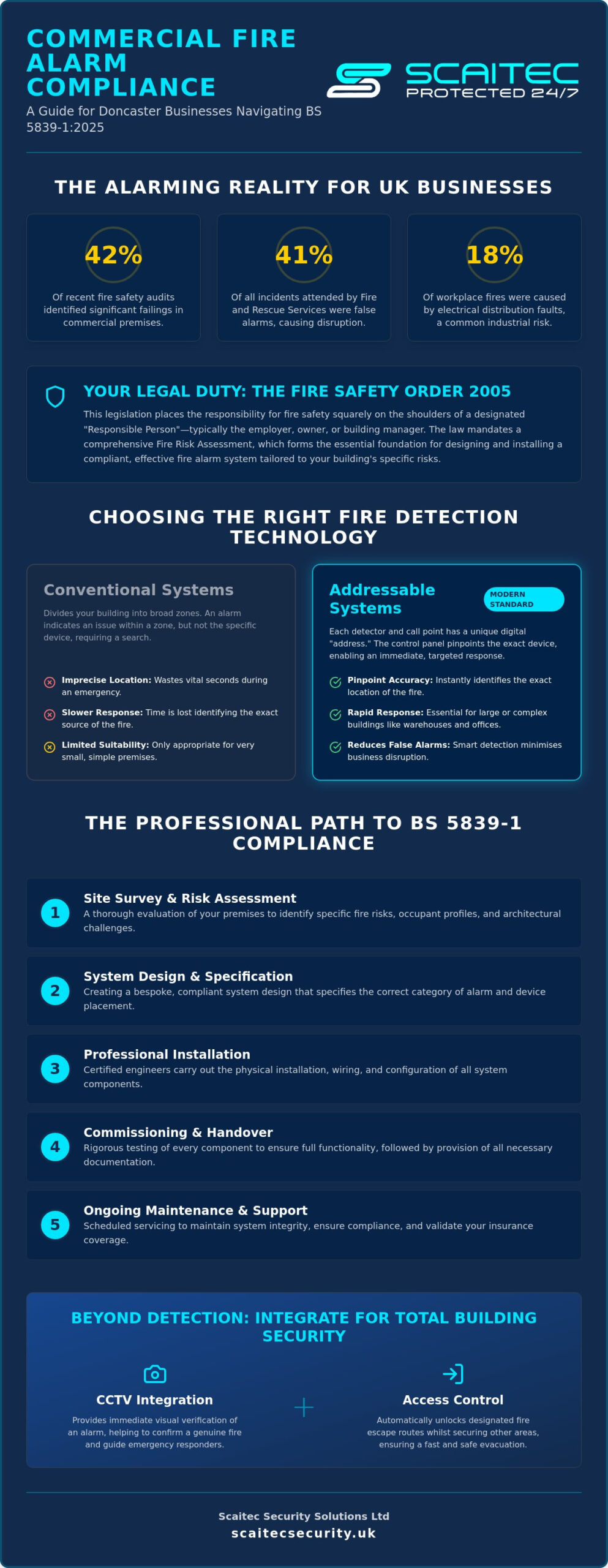
Every business in Doncaster, from the bustling retail units in the town centre to the sprawling distribution hubs in Kirk Sandall, shares a common priority: the safety of people and property. A professional commercial fire alarm installation Doncaster ensures that your system isn’t just a box on the wall, but a certified life-safety asset. Beyond the obvious moral obligation to protect your staff, compliance is a rigid legal requirement that dictates how you operate. In 2024/25 alone, Fire and Rescue Services carried out over 51,000 audits, and 42% of those identified failings. For a local business, these failings can lead to heavy fines, prosecution, or even the forced closure of your premises.
The Legal Landscape: Fire Safety Order 2005
The primary legislation governing your building is the Regulatory Reform (Fire Safety) Order 2005. This law places the burden of safety on a specific individual. Under 2026 UK standards, the “Responsible Person” is the individual or entity, such as an employer or building owner, who holds the legal duty to ensure a sufficient fire risk assessment is conducted and that all safety measures are properly maintained. This assessment is the foundation of any new installation; it identifies the specific hazards within your building and dictates the category of fire alarm system required. Without this document, any equipment you install might fail to meet the necessary life-safety standards, leaving you legally vulnerable.
Doncaster Business Profiles and Specific Risks
Doncaster’s commercial landscape is diverse, and a “one size fits all” approach to fire safety simply doesn’t work. An industrial unit in Kirk Sandall faces different risks, such as electrical distribution faults, which caused 18% of workplace fires last year, compared to a high-street shop. Multi-occupancy office buildings near the railway station present even greater challenges, requiring complex systems that can manage phased evacuations across different floors. We focus on designing systems that reflect these local realities, ensuring that your commercial fire alarm installation Doncaster is tailored to your specific building architecture and occupancy type.
Professional installation also addresses the pervasive issue of false alarms. In the year ending March 2025, Fire and Rescue Services attended over 250,000 false alarms, accounting for 41% of all incidents. This “alarm fatigue” can cause staff to ignore genuine warnings, which is a catastrophic risk. By using modern, addressable technology and smart detection, we help you minimise these disruptions. Furthermore, insurance providers in South Yorkshire are increasingly demanding proof of professional installation and maintenance. A compliant system, backed by rigorous documentation, doesn’t just keep you on the right side of the law; it validates your insurance coverage and can often lead to more favourable premium rates.
Choosing the Right Fire Detection Technology: Addressable vs Conventional Systems
Selecting the right technology for your property is a critical decision during any commercial fire alarm installation Doncaster. It’s not just about meeting UK fire safety regulations; it’s about creating a system that works for your specific operational needs. For many years, businesses relied on analogue systems that provided limited information during an emergency. However, 2026 standards favour smarter, more granular detection that helps emergency services act with speed and precision whilst reducing the likelihood of business downtime.
Addressable Systems: Precision in Large Premises
Addressable systems are now considered the gold standard for most commercial applications in South Yorkshire. Unlike older technology, each individual detector has its own unique “address” on the system. If a fire starts in a specific office on the third floor, the control panel identifies exactly where it is, rather than just indicating a general zone. This precision is invaluable for large Doncaster warehouses or multi-storey complexes where searching a wide area wastes vital seconds. These systems often require less cabling because multiple devices sit on a single loop, which can simplify the installation process in complex structures. They also integrate seamlessly with building management systems, allowing for automated responses such as shutting down ventilation or returning lifts to the ground floor.
Conventional Systems: Cost-Effective for Small Units
Whilst addressable technology offers superior detail, conventional systems remain a practical choice for smaller, simpler layouts. If you manage a small shop or a single-room cafe in the town centre, a zoned system is often the most sensible investment. These systems divide the building into broad areas. If a detector triggers, you’ll know which zone the fire is in, which is usually sufficient for premises with clear sightlines and limited exit routes. You can explore our commercial security options to see how these systems fit into a broader safety plan for your business.
For Doncaster’s heritage buildings, where drilling into walls or running extensive conduits is restricted, wireless fire alarm technology has become a vital solution. These systems offer the same reliability as hardwired versions without compromising the architectural integrity of historic sites. Choosing the right sensor is equally important. We often recommend multi-sensor detectors for modern offices. These use AI-driven logic to distinguish between actual smoke and harmless steam or dust, which is a key factor in reducing false alarms. If you’re unsure which technology fits your building, we can help you organise a detailed system review to ensure your protection is both compliant and reliable.
Navigating British Standards: BS 5839-1 and Insurance Requirements
Adhering to the correct technical framework is the most vital step when planning a commercial fire alarm installation Doncaster. The industry is governed by BS 5839-1, which was updated in 2025 to reflect modern safety requirements and technological advancements. This standard provides the essential code of practice for the design, installation, commissioning, and maintenance of systems in non-domestic premises. Following these guidelines ensures that your life-safety equipment is reliable and capable of providing the early warning necessary to protect your workforce and your building.
Category Ratings: Which One Does Your Business Need?
Systems are classified into different categories based on their specific safety objectives. ‘L’ categories are dedicated to life safety, whilst ‘P’ categories focus on property protection. Your required level of coverage is typically dictated by your professional fire risk assessment, which evaluates the unique hazards of your Doncaster premises. An L1 category system provides the highest level of life protection by ensuring automatic fire detection is installed throughout every area of the building, including cupboards and roof spaces. Other levels, such as L2 or L3, provide targeted detection for escape routes and high-risk rooms. In contrast, P1 and P2 systems are designed to alert the fire service as quickly as possible to minimise damage to stock and the building structure itself.
Accreditation and Insurance Peace of Mind
For many business owners, the relationship between their fire alarm and their insurance policy is a point of concern. UK insurance providers frequently mandate that a commercial fire alarm installation Doncaster must be carried out by a certified professional. Choosing an installer with SSAIB or BAFE accreditation is often a non-negotiable requirement for your policy to remain valid. These certifications offer independent proof that the installation firm meets the highest industry standards and follows the rigorous processes required by law.
Relying on uncertified or “DIY” installations is a significant liability for company directors. If a fire occurs and the system is found to be non-compliant with British Standards, your insurer might refuse to settle the claim. Beyond the initial setup, insurers also require evidence of ongoing care. Most commercial policies include a clause that mandates a formal maintenance contract with a competent person. This ensures that the system is tested and serviced regularly to prevent faults. You can learn about our maintenance and protective services to see how we help South Yorkshire businesses maintain their compliance and protect their insurance standing over the long term.
The Step-by-Step Process of Professional Fire Alarm Installation
A professional commercial fire alarm installation Doncaster isn’t a simple “plug-and-play” task. It’s a methodical journey that begins long before the first cable is laid. Our team acts as your partner throughout this lifecycle, ensuring that every phase of the project adheres to the rigorous requirements of the updated BS 5839-1:2025 standards. By following a structured approach, we ensure that your system is reliable, compliant, and tailored to the unique demands of your business environment.
Site Survey and Bespoke System Design
We start with a comprehensive site survey to map out the unique architecture of your premises. This phase is critical for identifying “dead spaces” where smoke might linger undetected or high-risk zones like server rooms and commercial kitchens. We calculate exact decibel levels to ensure the alarm is audible in every corner of your facility, whilst also planning for Visual Alarm Devices (VADs). These strobe lights are essential for inclusivity, ensuring that staff with hearing impairments or those working in high-noise environments are alerted immediately. This bespoke design phase ensures that your system meets the specific category rating identified in your fire risk assessment.
Once the design is finalised, the physical installation begins. We understand that your business doesn’t stop just because safety upgrades are underway. Whether you’re managing a retail unit in the town centre or a distribution hub in Wheatley, we coordinate our work to minimise operational downtime. Our engineers work tidily and efficiently, ensuring that the structural integrity of your building remains intact whilst the new infrastructure is integrated.
Testing, Commissioning, and Staff Training
The commissioning phase is where many installers cut corners, but it’s arguably the most important step for your legal protection. We test every single device, from smoke detectors to manual call points, to verify that the system operates exactly as designed. Upon completion, we provide a formal commissioning certificate. This document serves as your definitive proof of compliance for fire authorities and insurers alike, confirming that the system was installed by a competent person according to British Standards.
Handover isn’t just about passing over the keys to the control panel. We take the time to train your designated Fire Wardens, ensuring they’re confident in reading the panel and resetting the system after a test or false alarm. We also set up your mandatory fire alarm logbook. This record is a legal requirement for UK businesses; it must be kept up to date with weekly testing notes and details of the bi-annual professional servicing required to maintain your system’s reliability and legal standing.
Book a comprehensive fire safety site survey for your Doncaster business
Integrating Fire Safety with Total Building Security in South Yorkshire
Fire safety is often treated as a separate entity, but for a modern business, it’s most effective when integrated into a wider security network. A commercial fire alarm installation Doncaster offers far more than just audible alerts when it’s linked to your building’s core infrastructure. By synchronising your fire detection with other systems, you create a responsive environment that actively assists in protecting your staff and property. This unified approach eliminates the silos between different safety protocols, ensuring your building reacts intelligently during an emergency.
Access Control and Emergency Egress
In the event of a fire, the speed of evacuation is the most critical factor for life safety. If your building uses electronic locks, maglocks, or turnstiles, these must be configured to “fail-safe” to an open position the moment the fire alarm is triggered. We ensure that your business access control solutions are fully integrated with your fire panel. This prevents dangerous bottlenecks at exits and ensures that every emergency door provides an unobstructed path to safety. This seamless integration streamlines the evacuation process, allowing your fire wardens to focus on accounting for staff rather than struggling with locked doors or manual overrides.
Linking your fire detection system to CCTV provides an additional layer of intelligence. When a smoke detector is activated, your security team or remote monitors can immediately view the live feed from that specific area. This visual verification allows you to confirm the presence of smoke or flames before the fire service is even on-site, which is particularly helpful in identifying accidental triggers or minor incidents that don’t require a full emergency response. It also provides vital information to emergency services regarding the location and scale of the fire before they enter the building.
24/7 Remote Monitoring and Rapid Response
A “bells-only” alarm is only effective if there’s someone on-site to hear it. For businesses that are unoccupied overnight or during weekends, remote monitoring is an essential upgrade. By connecting your commercial fire alarm installation Doncaster to an Alarm Receiving Centre (ARC), you ensure your property is protected 24/7. If an alarm occurs, the ARC is notified instantly and can contact the Fire Brigade and your designated keyholders within seconds. Remote monitoring provides immense peace of mind for Doncaster business owners whilst they are off-site, knowing that a professional team is watching over their premises even in the middle of the night.
At Scaitec, we’ve been refining our holistic approach to security since 2005. We don’t just install devices; we design integrated safety architectures that provide better long-term value and more robust protection. By combining fire detection, access control, and remote monitoring, we help you meet your legal obligations whilst simplifying the complex task of building management. Our goal is to provide a stable, protective environment that allows you to focus on your business with total confidence.
Securing Your Doncaster Business for the Future
Ensuring your premises remain compliant with the latest BS 5839-1 standards is a continuous commitment rather than a one-time task. A professional commercial fire alarm installation Doncaster provides more than just legal safety; it offers a vital foundation for business continuity through reduced false alarms and seamless security integration. By choosing a system tailored to your building’s specific fire risk profile, you protect both your workforce and your long-term insurance standing.
As SSAIB Accredited Installers serving Doncaster and South Yorkshire since 2005, we specialise in delivering these high-standard solutions. Our team provides the technical expertise needed for complex designs, whilst our 24/7 Alarm Receiving Centre (ARC) monitoring ensures your property is never truly left alone. Whether you’re managing a small retail unit or a large industrial site, the right partner makes the path to compliance clear and manageable.
Request a Professional Fire Alarm Survey for Your Doncaster Business
Taking this step today ensures your premises are ready for the challenges of 2026 and beyond. We’re here to help you build a safer, more secure future for your business.
Frequently Asked Questions
Do I legally need a fire alarm for my small business in Doncaster?
Yes, you are legally required to have an appropriate fire detection and warning system under the Regulatory Reform (Fire Safety) Order 2005. Whilst very small, simple premises might rely on manual alerts, the majority of businesses require an electronic system to ensure everyone is alerted in time. We recommend a professional commercial fire alarm installation Doncaster to ensure your specific setup meets the requirements of your mandatory fire risk assessment.
How often should a commercial fire alarm be tested and serviced?
You should perform a user test of your system every week by activating a different manual call point. In addition to these weekly checks, British Standards mandate that a competent person carries out professional servicing at least every six months. These bi-annual visits are essential for checking battery health and detector sensitivity. All tests and service results must be recorded in your fire alarm logbook to maintain legal compliance.
What is the difference between an L1 and an L2 fire alarm system?
An L1 system provides the highest level of protection by placing automatic detectors in every room and area of the building. An L2 system is more targeted, focusing detection on all escape routes and specific high-risk rooms identified during your risk assessment. Whilst L1 offers the earliest possible warning for life safety, an L2 system is often a practical and compliant choice for many medium-sized commercial properties in South Yorkshire.
Can I install my own commercial fire alarm to save costs?
You should not attempt to install a commercial fire safety system yourself. UK law requires that these systems are designed, installed, and commissioned by a “competent person” who possesses the necessary technical qualifications. A “DIY” approach almost certainly results in a system that fails to meet BS 5839-1 standards. This doesn’t just put lives at risk; it can also lead to your insurance being invalidated and leave you facing legal prosecution.
Will my fire alarm automatically call the fire brigade?
A standard fire alarm will only alert the fire service automatically if it is a monitored system connected to an Alarm Receiving Centre (ARC). “Bells-only” systems rely on someone on-site or a passer-by hearing the siren and manually dialling 999. For total protection, especially when your premises are empty overnight, we recommend 24/7 monitoring to ensure the fire brigade is dispatched the moment a fire is detected.
What happens if my business fire alarm has a fault or false alarm?
If your system develops a fault or triggers a false alarm, you must record the details in your logbook and contact your maintenance provider immediately. In 2024/25, false alarms accounted for 41% of all incidents attended by Fire and Rescue Services, leading to stricter enforcement against poorly maintained systems. A professional engineer will identify the cause, whether it’s a faulty sensor or environmental interference, to ensure your commercial fire alarm installation Doncaster remains reliable.
Do fire alarms need to be hardwired or can they be wireless?
Both hardwired and wireless fire alarm systems are fully compliant with current British Standards, provided they are installed correctly. Wireless systems are often the preferred choice for Doncaster’s heritage buildings or sites where extensive cabling would be too disruptive to business operations. Hardwired systems remain a robust and cost-effective solution for many new-build offices and warehouses. We can help you determine the most effective technology for your building’s layout.
What is a fire alarm zone plan and why do I need one?
A zone plan is a framed, easy-to-read diagram installed next to your fire alarm control panel that shows the building’s layout and its detection zones. It is a mandatory requirement under BS 5839-1. This plan is vital for emergency services, as it allows them to immediately see which part of the building has triggered the alarm. Without a clear zone plan, you are technically non-compliant and could face failings during a fire safety audit.
Protect Your Business
Protect Your People
Book Your FREE Site Protection Survey

Since pioneering Scaitec Security Solutions in 2005, Paul Scaife, with his roots in the industry dating back to 1994, has distinguished the firm as a leading provider of bespoke fire and security solutions, servicing clients across Sheffield, Rotherham, and surrounding areas.
His leadership, underpinned by accreditation from the Security Systems and Alarms Inspection Board, ensures that Scaitec surpasses client expectations by blending advanced technology with a deep understanding of their unique needs.
Paul's ethos champions innovation and efficiency, driving Scaitec to deliver tailored, cutting-edge solutions that enhance safety and operational ease.
Discover more about Paul’s commitment to excellence on LinkedIn.