
Table of Contents
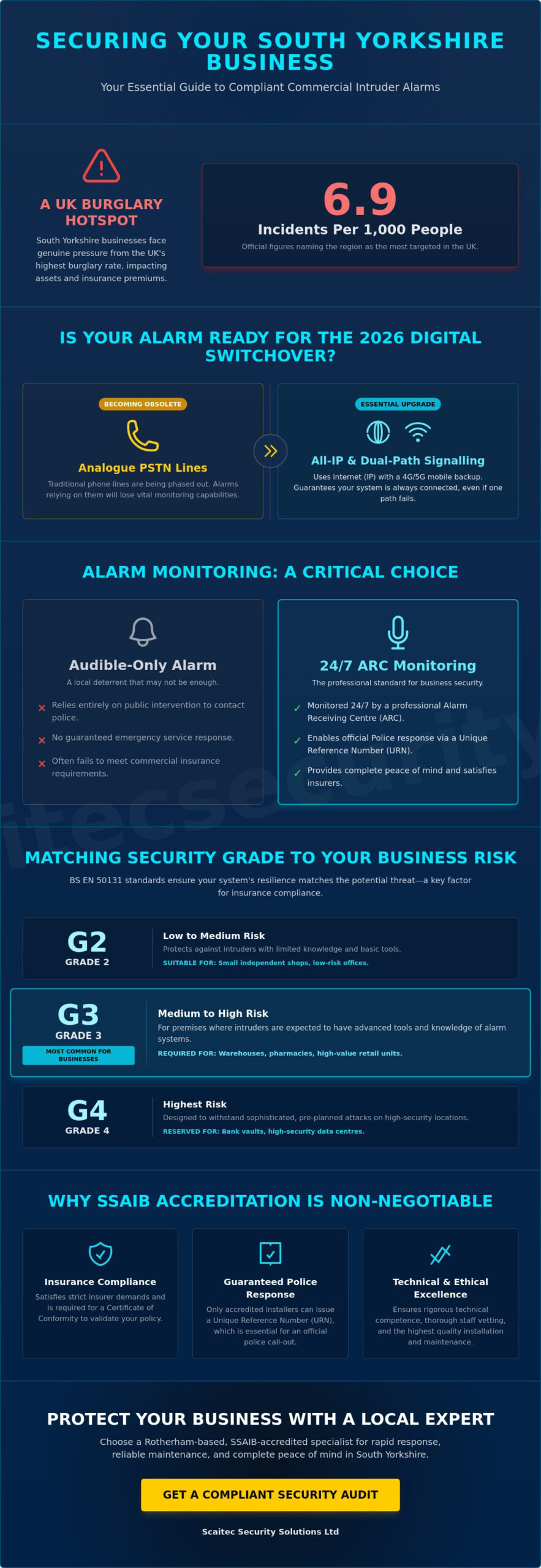
Did you know that South Yorkshire was recently named the UK’s biggest burglary hotspot, with a rate of 6.9 incidents per 1,000 people? For local business owners, these figures represent a genuine pressure to protect physical assets whilst managing rising insurance premiums and the final hurdles of the 2025/2026 digital phone line switch-off. You likely believe that security should provide peace of mind rather than technical confusion or the constant fear of losing police response due to false alarms.
Selecting the right commercial intruder alarm systems is no longer just about fitting a siren to a wall. It’s about building a resilient, compliant infrastructure that satisfies strict UK insurance requirements. We’ll show you how to select, monitor, and maintain a system that offers both robust protection and the convenience of remote smartphone access. This guide explores everything from SSAIB accreditation and the move to digital monitoring to the specific standards required to ensure your business remains a priority for local authorities.
Key Takeaways
- Learn why SSAIB accreditation is essential for satisfying UK insurance requirements and ensuring your technical standards are met.
- Understand the shift from analogue PSTN lines to All-IP digital signalling to keep your commercial intruder alarm systems operational in 2026.
- Discover the critical differences between simple bells-only alarms and 24/7 remote monitoring via a professional Alarm Receiving Centre.
- Find out how to integrate security with Access Control to create a bespoke, effective solution for offices, retail units, or warehouses.
- See how partnering with a Rotherham-based specialist ensures rapid response times and reliable system maintenance for South Yorkshire businesses.
Understanding Modern Commercial Intruder Alarm Systems
Modern commercial intruder alarm systems are far more than just a deterrent for opportunistic thieves. We view these systems as sophisticated, integrated ecosystems designed to detect, notify, and respond to threats in real time. Whilst the visible sirens on your building’s exterior act as a primary warning, the true intelligence of a modern setup lies in its internal sensors and communication modules. Understanding how security alarm systems work is the first step towards building a reliable defence for your premises. These systems now frequently utilise hybrid technology, which combines the steadfast reliability of hardwired connections for core sensors with the flexibility of wireless components for hard-to-reach areas.
Security is not a one-size-fits-all solution. Every business in South Yorkshire faces different risks, which is why we follow the BS EN 50131 standard to categorise systems into specific Security Grades. This ensures that the hardware and installation methods match the value of your assets and the likelihood of a targeted attack. By aligning your security with these recognised standards, you ensure that your protection is both robust and compliant with modern insurance expectations.
The Impact of the Digital Switchover on Legacy Alarms
The UK is currently completing its transition to an All-IP network, meaning traditional analogue PSTN phone lines are being phased out in 2026. If your current alarm relies on an old-fashioned landline to signal an Alarm Receiving Centre, it’s becoming obsolete. We recommend that businesses move towards IP and 4G/5G dual-path signalling. This setup ensures that if your local internet connection fails or a physical cable is cut, the system automatically switches to a cellular network to maintain protection. Future-proofing your hardware now prevents a sudden loss of monitoring and ensures your commercial intruder alarm systems remain fully operational during this nationwide infrastructure shift.
Security Grades 2, 3, and 4: Which Does Your Business Need?
Choosing the correct grade is vital for insurance compliance and operational effectiveness. We categorise these based on the level of risk and the sophistication of potential intruders:
- Grade 2: This is suitable for low to medium-risk environments, such as small independent shops or offices with limited high-value stock. It assumes intruders have limited knowledge and basic tools.
- Grade 3: Most commercial properties in South Yorkshire fall into this category. It’s required for warehouses, pharmacies, and high-value retail units where intruders are expected to have more advanced tools and knowledge of security systems.
- Grade 4: Reserved for the highest-risk premises, such as bank vaults or high-security data centres. These systems are designed to withstand sophisticated, planned attacks.
Selecting the right grade ensures you aren’t under-protected or over-spending on unnecessary features whilst keeping your insurers satisfied.
SSAIB Accreditation: Why Professional Standards Matter for Insurance
When you invest in commercial intruder alarm systems, the hardware is only half of the equation. The quality of the installation and the reliability of the company behind it are what truly protect your business. This is where SSAIB (Security Systems and Alarms Inspection Board) accreditation becomes vital. As a leading UK certification body, the SSAIB ensures that security providers meet rigorous technical and ethical standards. For a business owner, this isn’t just a badge on a website; it’s a guarantee of technical competence and thorough staff vetting.
Accreditation acts as a bridge between your business and the authorities. If you require a police response for your premises, your system must be installed and maintained by an accredited firm. The National Police Chiefs’ Council (NPCC) policy states that only systems with a valid URN (Unique Reference Number), issued through an accredited installer, will receive an official response. Without this, your alarm is simply a local deterrent, relying on passers-by to notice and report an incident. By choosing an accredited partner, you ensure that your commercial intruder alarm systems are part of a wider, officially recognised safety network.
Satisfying Your Insurance Provider
Most commercial insurance policies in the UK contain specific clauses regarding security. If you want to secure a policy or reduce your premiums, your insurer will likely demand a Certificate of Conformity. This document proves your system was installed to recognised British and European standards. Choosing a “DIY” or unaccredited setup might seem cost-effective initially, but it often leads to claims being rejected in the event of a break-in. We find that maintaining a valid maintenance contract with an accredited provider is a non-negotiable requirement for many providers to keep your coverage active. Ensuring your system is professionally maintained is a straightforward way to protect your financial interests.
The SSAIB Inspection Process: What It Guarantees
The SSAIB inspection process is thorough and ongoing. It doesn’t just look at the finished alarm; it audits the entire business. Inspectors verify that all installations meet the PD 6662:2017 standard, which is the UK implementation of European security requirements. They also check that the company has appropriate insurance, sound financial standing, and that all employees have been security screened to BS 7858. This level of scrutiny provides peace of mind that your security partner is a trustworthy authority that values rigorous standards. It ensures that the person entering your premises to install sensitive equipment is fully vetted and technically proficient.
Comparing Commercial Alarm Monitoring: ARC vs Audible Only
When choosing between different commercial intruder alarm systems, the most critical decision involves how the system communicates an alert. A “Bells-Only” or audible system relies entirely on the hope that a passer-by or a neighbouring business owner will hear the siren and contact the authorities. Whilst these can act as a basic deterrent, they offer no guarantee of a response once the intruder is inside. For most South Yorkshire businesses, especially those with high-value stock or specific insurance mandates, a remotely monitored system is the only viable choice for comprehensive protection.
A monitored system doesn’t just make noise; it sends a digital signal to a dedicated facility. We utilise dual-path signalling to ensure these alerts always get through. This technology uses two independent communication methods, typically an IP connection alongside a 4G or 5G cellular link. If a criminal attempts to bypass the system by cutting the external data lines, the alarm instantly switches to the mobile network to report the incident. This level of resilience is essential in 2026 to counter increasingly sophisticated methods of entry.
How Alarm Receiving Centres (ARC) Protect Assets
An Alarm Receiving Centre (ARC) acts as a vigilant guardian for your property 24/7. The moment a sensor is triggered, a signal is transmitted to a team of trained professionals who immediately assess the situation. They follow a strict, pre-agreed protocol which involves contacting your designated keyholders or the emergency services. If your premises also utilises our remote monitoring for CCTV, the ARC staff can visually verify the intrusion in real time. This integration is incredibly powerful. It allows for a “verified alarm” status, which significantly increases the speed and priority of a police response compared to an unverified noise.
Securing a Police Response in South Yorkshire
To receive a police dispatch in our region, your system must be registered with South Yorkshire Police and issued a Unique Reference Number (URN). This URN is only available for systems installed and maintained by an accredited provider like Scaitec Security. It’s also vital to understand the “Two-Strike” rule. If your commercial intruder alarm systems generate two false alarms within a rolling twelve-month period, the police may withdraw their response status. We prevent this through regular, methodical system maintenance. By ensuring sensors are correctly calibrated and hardware is updated, we help you maintain your credibility with the authorities and ensure help arrives when it’s actually needed.
Tailoring Security to Your Sector: Offices, Retail, and Warehouses
A generic approach to security often leaves critical gaps in your business’s defences. We understand that a city-centre office faces entirely different threats compared to an isolated industrial unit. Effective commercial intruder alarm systems must be designed around the specific layout and daily operations of your site. In office environments, for instance, we often integrate intruder detection with Access Control Systems. This allows for a seamless transition where the alarm disarms automatically when the first authorised staff member enters the building, reducing the risk of user-related false alarms whilst maintaining a clear audit trail of who is on-site.
For retail and hospitality sectors, the focus shifts towards protecting both high-value stock and the safety of your personnel. These environments require a blend of visible deterrents and discreet emergency measures. We often recommend the installation of silent panic buttons at till points or reception desks. These allow staff to summon help through the monitoring centre without alerting an aggressor, providing a vital layer of protection during opening hours that a standard burglar alarm cannot offer.
Retail and Hospitality: Protecting Staff and Stock
Shopfronts present unique technical challenges, particularly with temperature fluctuations and draughts that can trigger standard sensors. We address this by using dual-technology sensors, which combine Passive Infrared (PIR) and microwave detection. An alert is only triggered if both technologies agree there is a physical intruder, which virtually eliminates false alarms caused by moving air or heating systems. We also focus on strategic sensor placement in high-value zones, such as stockrooms or jewellery displays, ensuring these areas are protected by independent alarm partitions. Integrating these alerts with your till-point CCTV allows for immediate visual verification of any incident, providing the comprehensive coverage your insurers expect.
Industrial and Warehouse Security
Warehouses often involve large, open-plan storage areas and multiple loading bays that are vulnerable to forced entry. To secure these, we use heavy-duty magnetic contacts on roller shutter doors and vibration sensors on perimeter walls to detect any attempt at drilling or cutting through the building fabric. Large internal spaces are best protected using active infrared beam detectors; these create an invisible “tripwire” across vast distances, covering areas where standard PIR sensors might struggle. For isolated units, we also prioritise the use of high-output external sounders. These serve as a powerful visible deterrent, signalling to any potential intruder that the premises are professionally protected. If you are looking to secure a complex site, we can help you design a bespoke security system tailored to your specific operational risks.
Choosing a Local Partner: The Scaitec Security Approach
Selecting a security provider is a decision that impacts your business for years to come. We believe that local expertise is the foundation of effective protection. Based in Rotherham, our team has spent over 20 years securing businesses across South Yorkshire, from independent retailers to large-scale industrial hubs. This local presence isn’t just about heritage; it’s about response. When an issue arises, having a partner who understands the specific crime trends in Sheffield or the logistical challenges of a Doncaster warehouse ensures that your commercial intruder alarm systems are always managed with urgency and precision.
Our approach is built on a methodical lifecycle of care. We don’t believe in off-the-shelf packages. Instead, we act as a dedicated expert guide, taking you from the initial security audit through to professional installation and long-term maintenance. This ensures every component of your system, whether it’s a Grade 3 sensor or a dual-path signalling module, is correctly specified for your premises and remains fully compliant with SSAIB standards. By choosing a partner with deep roots in the region, you gain a vigilant protector that values the safety of our local business community as much as you do.
Bespoke Design and Professional Installation
Every project begins with a thorough security audit. We examine entry points, high-value zones, and operational workflows to identify vulnerabilities that a generic provider might miss. During the installation phase, we work around your schedule to minimise operational downtime, ensuring your business remains productive whilst we secure it. Once the hardware is in place, we provide comprehensive training for your team. We’ll show you how to manage intruder alarm with app controls and remote monitoring features, giving you total command over your commercial intruder alarm systems from any location.
Long-term Maintenance and South Yorkshire Support
Reliability is born from consistency. Annual testing is a requirement for insurance compliance and police response, but for us, it’s also about ensuring your ongoing peace of mind. We provide 24/7 emergency support for our contract customers across Sheffield, Rotherham, and Doncaster, ensuring that technical help is always available when you need it most. Our commitment to aftercare means we remain your steadfast partner long after the initial installation is complete. If you’re ready to enhance your premises, you can secure your business with a professional audit from Scaitec Security today.
Future-Proofing Your Business Security in South Yorkshire
Securing your premises requires a balance of certified technology and local operational support. We’ve explored how SSAIB accreditation is the key to satisfying UK insurers and maintaining a reliable police response through the 2026 digital switch-off. By moving away from legacy analogue lines and adopting dual-path monitoring, you protect your assets against both physical intrusion and technical failure. Modern commercial intruder alarm systems are most effective when they’re tailored to your specific sector, whether that involves roller shutter contacts for a warehouse or integrated access control for a busy office centre.
Established in 2005, Scaitec Security remains a dedicated partner to the local business community. As an SSAIB Accredited Installer, we provide the technical proficiency and vigilant aftercare required to keep your site safe in Rotherham, Sheffield, Barnsley, and Doncaster. You don’t have to manage these complex safety requirements alone. We invite you to Request a Professional Commercial Security Audit today to ensure your property is fully protected. We look forward to helping you achieve lasting peace of mind for your business.
Frequently Asked Questions
Do I legally need an intruder alarm for my business premises?
There is no universal UK law that mandates every business must have an alarm. However, most commercial insurance policies make a professionally installed and maintained system a condition of coverage. If your business handles high-value stock, sensitive data, or controlled substances, you may also find that specific licensing requirements or local authority regulations make an alarm system effectively compulsory.
How much does a commercial intruder alarm system cost in the UK?
The total investment for commercial intruder alarm systems depends on several variables, including the size of your premises, the required security grade, and the complexity of the installation. A multi-storey office will naturally require more sensors and labour than a small retail unit. We recommend focusing on the long-term value of insurance premium reductions and asset protection rather than just the initial setup cost.
What is the difference between a Grade 2 and Grade 3 alarm system?
The primary difference lies in the level of threat the system is designed to resist. Grade 2 systems are suitable for lower-risk premises where intruders are expected to have limited knowledge and basic tools. Grade 3 systems are built for higher-risk environments, featuring more sophisticated anti-masking technology to detect if a criminal attempts to cover or tamper with a sensor before a break-in occurs.
Will my business alarm still work after the digital phone line switch-off?
If your system relies on an analogue PSTN phone line to signal an alarm centre, it will stop communicating once the switch-off is complete in 2026. To maintain protection, you must upgrade your signalling to a digital All-IP or cellular dual-path connection. This ensures your commercial intruder alarm systems can still send alerts over the internet or mobile networks without relying on obsolete copper wires.
How often should a commercial intruder alarm be serviced?
Most industry standards and insurance providers require a monitored system to be professionally serviced twice a year. One of these visits can often be conducted remotely if your hardware supports it, but at least one physical inspection is necessary to check batteries and sensor alignment. For a bells-only system, an annual service is typically sufficient to ensure the hardware remains reliable and clear of faults.
Can I monitor my business alarm from my smartphone?
Yes, modern systems are designed with app-based integration as a standard feature. You can arm or disarm your system remotely, receive instant push notifications if a sensor is triggered, and even view event logs from your phone. For a detailed overview of what to look for in smart security technology, our guide to choosing an intruder alarm with app control covers the key features and considerations in full. This provides an excellent layer of convenience for business owners, though it should always be used alongside professional 24/7 monitoring for the highest level of security.
What happens if my business alarm goes off and I am not there?
The outcome depends entirely on your monitoring setup. An audible-only system will simply sound a siren, relying on neighbours or passers-by to alert the authorities. If you have a monitored system, a signal is sent to an Alarm Receiving Centre (ARC). The operators there will immediately follow your pre-agreed protocol, which usually involves calling your designated keyholders or dispatching the emergency services if the alarm is verified.
How do I get a police response for my business alarm?
To qualify for a police response, your system must be installed and maintained by an accredited firm, such as one with SSAIB or NSI certification. Your installer will apply to South Yorkshire Police for a Unique Reference Number (URN) for your premises. Only systems with a valid URN and a professional monitoring contract are eligible for a police dispatch when an intruder is detected.
Protect Your Business
Protect Your People
Book Your FREE Site Protection Survey

Since pioneering Scaitec Security Solutions in 2005, Paul Scaife, with his roots in the industry dating back to 1994, has distinguished the firm as a leading provider of bespoke fire and security solutions, servicing clients across Sheffield, Rotherham, and surrounding areas.
His leadership, underpinned by accreditation from the Security Systems and Alarms Inspection Board, ensures that Scaitec surpasses client expectations by blending advanced technology with a deep understanding of their unique needs.
Paul's ethos champions innovation and efficiency, driving Scaitec to deliver tailored, cutting-edge solutions that enhance safety and operational ease.
Discover more about Paul’s commitment to excellence on LinkedIn.