
Table of Contents
Dental practice security in Sheffield is about more than protecting the building. It also means managing access and supporting a calm, safe environment for patients and staff. A practical plan can bring together CCTV, intruder alarms, access control and fire alarms, with the right combination shaped by the premises and its needs.
It’s understandable to want clear guidance on which security measures suit a dental practice and where to get professional support. This guide explains how electronic security systems can help protect your premises, what to consider when planning them and why ongoing maintenance matters. It also distinguishes premises security from clinical safety, so you can choose suitable measures for each.
Key Takeaways
- Separate clinical safety, such as infection control and patient access needs, from measures that protect the premises and equipment.
- Match CCTV, alarms and access controls to the practice layout, entry points and the way staff use different areas.
- Assess security risks around the building and its daily routines rather than relying on general assumptions about local crime.
- Consider how system maintenance supports dependable protection as the practice and its security needs change.
- See how Scaitec Security Solutions can help plan electronic security and fire systems for a dental practice.
Dental practice safety
Safety in a dental practice includes both clinical care and the premises patients enter. These needs overlap, but they call for different measures. Sharrow Vale Dental Care in Sheffield describes cross-infection control and clinical governance as part of patient safety. Alongside these clinical priorities, practices need to consider safe movement through the building, controlled access to staff areas and protection of equipment. A welcoming reception, clear routes and well-managed appointments can help patients feel more comfortable from arrival.
Clinical safety depends on consistent routines in treatment spaces and across patient care. Sharrow Vale Dental Care’s stated focus on infection control and clinical governance shows why practice safety involves more than physical security. Staff need to follow established procedures between appointments, while treatment areas and shared spaces need attention throughout the working day. Clear explanations and an orderly appointment process can make routine dental visits feel more predictable. For restorative treatment, communicating the steps involved can help patients understand what to expect.
Access is another part of a safe visit. Sharrow Vale Dental Care has wheelchair access to its front door and downstairs surgery, as well as a hearing loop and facilities for partially sighted people. These features show how a practice can support different patients before treatment begins. In Sheffield, a practice’s layout, entrance and waiting area all affect how people move through an appointment. A clear arrival process also helps reception staff direct visitors without leading them into staff-only areas.
Digital systems can support clinical work, but they do not replace careful practice routines. Azure Dental Practice has fully computerised treatment rooms and uses digital X-ray technology for diagnosis. This makes it useful to consider how staff access rooms and equipment throughout the day. A practical safety review can map the patient journey from entrance to reception, waiting space and surgery. It can also identify where staff handle sensitive records, store equipment or need to restrict access.
- Before an appointment: Make arrival arrangements clear, including the entrance and any access features. Sharrow Vale Dental Care’s hearing loop and wheelchair access provide specific examples.
- During routine dental care: Keep the patient route distinct from areas used for staff work, records and equipment.
- Between appointments: Follow the practice’s clinical routines for preparing treatment spaces and supporting infection control.
- For an emergency: Make the practice’s response process clear to staff, so clinical concerns are handled separately from a premises security alert.
Patient safety also depends on clear information about the help a practice provides. Sheffield Community and Special Care Dentistry is not an emergency dental service. This distinction matters when a patient needs urgent clinical attention: a security system cannot assess symptoms or provide dental care. Practices should communicate clearly about appointments and emergencies, and ensure staff can distinguish a clinical issue from an incident involving the building.
Premises measures contribute to a safe setting when they fit the practice’s daily routine. A reception area may need a different access arrangement from a treatment room or staff space. For a practice in Sheffield, a site-specific review can consider entrances, movement through the building and the location of valuable equipment. Business security planning can address the premises side of safety, while clinical governance and infection control remain part of patient care.
Accessibility, clinical routines and building security work best as complementary parts of the patient experience. A welcoming centre helps visitors understand where to go; clear staff processes support calm appointments; and appropriate access arrangements separate public and restricted spaces. Whether a patient attends a private dentist or receives routine dental care, these practical details shape the visit. Reviewing them together helps a Sheffield practice see where its safety arrangements support patients and where the premises may need closer attention.
What security services do Sheffield dental practices need?
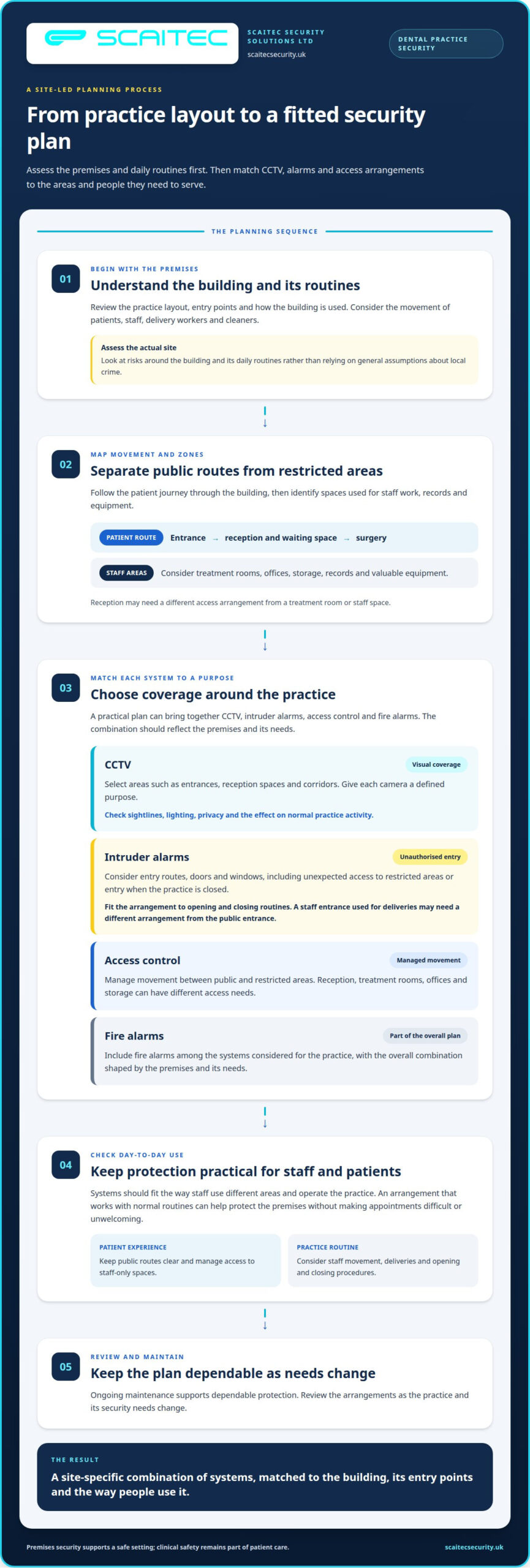
Dental practice security in Sheffield should reflect the building, working routines and equipment. A small ground-floor clinic has different access points from a practice spread across several floors. A professional assessment considers how patients, staff, delivery workers and cleaners move through the premises. It then matches each system to a clear purpose, rather than treating every room or entrance alike. This helps protect the practice without making appointments feel difficult or unwelcoming.
CCTV systems can provide visual coverage of selected areas, such as entrances, reception spaces and corridors. Positioning matters: each camera should serve a defined security purpose without obstructing normal practice activity. A site assessment considers sightlines, lighting, privacy and which areas need coverage. For example, reception may need a view of the main entrance, while a staff-only access point may require separate coverage. System design should reflect the layout, not simply the number of rooms.
Intruder alarms address a different need. They can help detect unauthorised entry when a practice is closed or restricted areas are accessed unexpectedly. A professional assessment considers likely entry routes, doors and windows, as well as how the practice operates. For example, a staff entrance used for deliveries may need a different arrangement from the public entrance. The alarm should fit opening and closing routines so authorised staff can use it consistently without disrupting patient care.
Access control systems help manage movement between public and restricted areas. In a dental practice, reception, treatment rooms, offices and storage areas can have different access needs. A planned system can distinguish patient routes from staff-only spaces while supporting the practice’s normal workflow. For example, staff may need to enter an office without leaving a corridor door open to visitors. The design should account for staff responsibilities and regular movement, not just door locations.
Fire alarm systems are an important part of premises safety, with a role distinct from intrusion detection. An assessment considers the building layout, how people use its rooms and whether an alarm can be heard in relevant areas. Clear arrangements matter in treatment rooms, where staff may be focused on care. The system should support an understandable response for staff and visitors. Its design complements the practice’s fire safety procedures rather than replacing them.
Some practices may also benefit from remote monitoring and system maintenance. Monitoring provides oversight of security signals, while maintenance helps keep equipment working properly. Neither replaces staff procedures or clinical judgement; both support the operation of installed systems. A maintenance plan can take account of equipment condition, system changes and how the premises are used. If the layout or access routines change, security arrangements may need to change too.
Combining systems takes careful planning. CCTV, alarms, access control and fire alarms address different risks, but they should work sensibly together. For example, a practice’s closing routine may involve securing staff access, setting the intruder alarm and confirming public areas are clear. The system plan should account for authorised access and normal working patterns. A clear design also helps staff understand which system responds to a security event and which supports fire safety.
- Map the premises: A professional identifies entrances, public areas, staff spaces and equipment locations.
- Define the risks: The assessment distinguishes unauthorised entry, visibility needs and fire detection requirements.
- Match suitable systems: Each proposed system is linked to a specific purpose and part of the building.
- Plan ongoing support: Maintenance and monitoring arrangements are considered alongside installation and daily use.
For dental practice security in Sheffield, the right combination depends on the building and its routines. A practice with multiple entrances may prioritise controlled access and alarm coverage, while open reception areas may call for carefully planned CCTV. A professional assessment should explain how each measure fits the site and how staff will use it. This keeps the security plan practical, proportionate and suited to the work of a dental practice.
Are there Sheffield-specific crime statistics or security risks for dental practices?
Sheffield crime statistics can describe reported patterns across an area, but they cannot establish a dental practice’s individual exposure. A clinic’s risks depend on its location, layout, access points and operating routine. A practice on a busy road may face different access challenges from one inside a shared building. Treat local figures as context, then assess the premises and how they are used each day.
Security planning starts with the site. An assessment should map public entrances, staff doors, windows, reception and rooms containing valuable equipment. It should also consider when the building is occupied, how deliveries arrive and which areas visitors can enter. For example, an unlocked side entrance used for deliveries creates a different concern from a street-facing reception entrance. These details shape practical protection more directly than a broad citywide crime total.
Risks can vary throughout the day. At opening, staff may arrive before reception is ready for patients. During appointments, visitors use public spaces while staff access treatment rooms and offices. At closing, fewer people may remain inside, with equipment left on site. Each stage brings different access patterns. A clear review considers who needs entry, which doors they use and how authorised access is managed.
Dental equipment and medicines also affect how a practice evaluates its premises. Treatment rooms may contain specialist equipment, while offices can hold records or business materials. The location and visibility of these items matter when planning access and monitoring. A professional assessment can identify areas needing controlled entry, suitable camera coverage or alarm protection. It should also consider how security measures fit patient movement and staff duties.
- Review the building: Record entrances, ground-floor windows, shared corridors and any less visible access routes.
- Map daily routines: Note how staff open and close the practice, receive deliveries and move between public and restricted spaces.
- Identify priority areas: Consider reception, treatment rooms, equipment storage and offices separately.
- Match measures to risks: Link each concern to a suitable security response rather than installing systems without a clear purpose.
For example, a practice with a shared entrance may need a different access plan from a standalone building. A clinic receiving deliveries at the rear should consider how that door is secured during working hours. A site with several treatment rooms may need clear boundaries between patient routes and staff areas. These are premises-specific considerations, not evidence that a particular Sheffield neighbourhood is unsafe.
Crime data also needs careful interpretation. Reported incidents may cover a wider area than the street around a practice, and different offence categories have different relevance to a dental setting. A general total does not show whether a building is vulnerable to unauthorised entry, damage or theft. Use location and building details to guide a professional assessment instead. The outcome should explain which risks matter at that site and why.
Local conditions can inform planning without prompting fear-based decisions. For dental practice security in Sheffield, a measured review connects the building’s actual access points and routines with suitable protection. It distinguishes security risks from clinical emergencies and considers how staff can operate systems consistently. This produces a clearer, more useful plan than relying on a headline statistic alone.
Location and access information can help frame a premises review, but it does not establish crime exposure. Sheffield Dental and Specialist Centre is about a 20-minute walk from Sheffield train station. Castle Dental Practice in Sheffield is a 15-minute walk from Sheffield train station and has a private car park to the rear of the building, but no specific parking bays. These details describe approaches to the sites, not their level of security. A practice should assess its own entrances, visitor routes and daily routines rather than treating travel distance or parking arrangements as evidence of risk.
Service information can also help a practice consider patient movement and reception arrangements. Sheffield Community and Special Care Dentistry considers patients aged 16 years or over for its severe dental anxiety or dental phobia referral pathway. The pathway requires a Modified Dental Anxiety Scale score of 19 or above, and Sheffield Community and Special Care Dentistry has a clinic equipped to treat patients who weigh over 22 stones. These are service details rather than indicators of crime or security exposure. Security decisions should still be based on the specific premises, how access is managed and the practice’s operating routine. A review can account for the needs of patients using the building while keeping controls proportionate to the actual access points and areas requiring protection.
Scaitec Security Solutions
Scaitec Security Solutions Ltd helps Sheffield dental practices plan electronic security around their premises, access points and working routines. Services include CCTV Systems, Intruder Alarms, Access Control Systems and Fire Alarm Systems, with system maintenance to support ongoing performance. A professional review can be useful when moving premises, changing the layout or reassessing how staff and visitors access different areas. The right combination depends on the building and the risks identified, rather than applying the same setup everywhere. Scaitec Security Solutions Ltd designs, installs and maintains security and fire systems for commercial properties. To discuss your dental practice’s security needs, contact Scaitec Security Solutions Ltd.
Take the next step towards a considered security plan
A useful next step is to turn your practice’s priorities into a site-specific plan. Effective dental practice security in Sheffield starts with the decisions that matter to your team: which areas need protection, how staff use the building and how security should fit the patient experience. Keeping those priorities clear makes discussions about system design more focused.
Scaitec Security Solutions can turn those priorities into a practical arrangement. CCTV Systems, Intruder Alarms and Access Control Systems each address different premises needs, with the right combination shaped by the practice. A professional discussion can clarify where these systems fit and how they support day-to-day operations.
A thoughtful plan gives your team a clear starting point for protecting the practice and supporting a calm, welcoming environment.
Frequently Asked Questions
Which Sheffield companies provide dental practice security?
Scaitec Security Solutions provides security system services for dental practices in Sheffield, Rotherham, Barnsley, Doncaster, Chesterfield, Worksop, Wakefield and Huddersfield. Its business security work includes CCTV, intruder alarms and access control. Scaitec describes itself as the “Best Rated Security Company in Rotherham.” Its credentials are Insurance Approved and SSAIB Certified. For a Sheffield practice, the next step is to discuss the premises and the specific security concerns to address.
What are the security requirements for dental practices in England?
There isn’t one fixed security system for every dental practice in England. Suitable arrangements depend on the premises, how they are used and the risks identified, alongside the practice’s clinical and operational responsibilities. For example, a clinic in shared premises may need different access arrangements from a standalone surgery. Fire safety is a separate consideration: all fire alarm installations by Scaitec meet current British Standards. Security systems should complement, not replace, the practice’s procedures.
What physical security measures can a professional install to protect a dental surgery, medicines and equipment?
A professional can assess the site and design CCTV, intruder alarms and access control around its layout and needs. For example, access control can help manage entry to staff-only areas, whilst cameras can cover selected parts of the premises. The assessment should consider where equipment and medicines are kept, without obstructing normal work. Ongoing care also matters: Scaitec’s intruder alarm servicing includes a 21-point system check, supporting system operation and insurance compliance.
How can a security provider help a dental practice prevent theft, burglary and staff or patient violence?
A security provider can help reduce opportunities for theft or unauthorised entry by planning suitable alarms, access controls and CCTV for the premises. These systems can support a practice’s response to incidents, but they do not physically intervene or replace staff training and clinical procedures. For concerns involving staff or patient behaviour, the practice needs clear reporting and escalation arrangements. A provider can account for access routes and system alerts in the premises plan, while the practice manages people-related responses.
Which access control and CCTV systems are suitable for a dental practice, and how can a provider help choose and install them?
Suitable systems depend on the practice layout, access points and operational needs. A provider can assess how patients and staff move through the building, then plan camera coverage and controlled access accordingly. Scaitec is Insurance Approved and SSAIB Certified. Installation is guaranteed within 7 days of acceptance of proposal. The installation plan should also consider how staff will operate the systems as part of opening, closing and everyday practice routines.
How can a security provider help a dental practice assess security risks and create an emergency plan?
A provider can review premises access, system coverage and how security alerts should be handled, then explain how installed systems support the practice’s arrangements. The practice remains responsible for its wider clinical and staff procedures, including decisions about patient care during an emergency. Scaitec offers system maintenance, and non-contract customers receive the same care and attention as Protect-plan customers. This helps practices consider ongoing system upkeep alongside operational planning.
Protect Your Business
Protect Your People
Book Your FREE Site Protection Survey

Since pioneering Scaitec Security Solutions in 2005, Paul Scaife, with his roots in the industry dating back to 1994, has distinguished the firm as a leading provider of bespoke fire and security solutions, servicing clients across Sheffield, Rotherham, and surrounding areas.
His leadership, underpinned by accreditation from the Security Systems and Alarms Inspection Board, ensures that Scaitec surpasses client expectations by blending advanced technology with a deep understanding of their unique needs.
Paul's ethos champions innovation and efficiency, driving Scaitec to deliver tailored, cutting-edge solutions that enhance safety and operational ease.
Discover more about Paul’s commitment to excellence on LinkedIn.