
Table of Contents
If your business premises were tested tonight, would your current systems hold up, or are you relying on outdated assumptions? It’s a question that keeps many directors awake, especially whilst trying to keep pace with evolving legislation like Martyn’s Law and the requirement for a regular commercial security audit. We understand that the pressure from insurance providers to meet specific criteria can feel relentless. It’s often difficult to choose between the confusing array of technical options available for your site.
Following a structured framework is the most effective way to replace that uncertainty with a clear, actionable plan. In this guide, you’ll learn how to identify hidden vulnerabilities in your perimeter and internal systems, ensuring your business remains fully compliant with UK regulations. We’ll show you how to streamline your approach to intruder alarms, CCTV, and access control to protect your assets and lower your premiums. This article provides a step-by-step roadmap designed to bring stability to your operations and genuine peace of mind to your stakeholders.
Key Takeaways
- Understand the vital distinction between a casual site walk-around and a professional, standards-driven assessment of your business’s safety.
- Learn how to prepare for a commercial security audit by gathering essential documentation, such as system maintenance logs and site floorplans.
- Discover a layered approach to assessing your premises, covering everything from perimeter fencing and lighting to internal loading bays and roof hatches.
- Ensure your fire alarm and security systems remain fully compliant with UK standards, including BS 5839-1 and essential fail-safe exit requirements.
- Gain a clear method for categorising risks into priority levels, allowing you to address critical vulnerabilities first whilst identifying immediate low-cost improvements.
What is a Commercial Security Audit and Why is it Essential?
A commercial security audit is far more than a simple tick-box exercise. It’s a comprehensive, methodical examination of your business’s entire safety ecosystem, designed to identify gaps before they’re exploited. Whilst some might consider a quick walk through the building sufficient, a professional assessment follows rigorous technical standards to ensure every vulnerability is accounted for. To understand the broader context of these evaluations, it’s helpful to look at What is a Security Audit? and how these frameworks provide a foundation for protecting both physical assets and procedural integrity.
As we move through 2026, criminal behaviour has become increasingly sophisticated. Simple locks and basic alarms are no longer enough to deter professional theft or coordinated intrusions. We’ve seen a shift towards more calculated efforts that require a more rigorous, data-driven approach to protection. By conducting a formal commercial security audit, you’re not just reacting to threats; you’re building a proactive shield that evolves alongside the risks your business faces.
Beyond mere protection, an audit serves as a vital tool for business continuity. Insurance providers often demand evidence of professional risk management to validate a policy. A documented audit can be the difference between a successful claim and a costly rejection. It also demonstrates that you’re meeting your legal ‘Duty of Care’ to staff and visitors, creating a culture of stability that supports long-term growth and stakeholder confidence.
The Three Pillars of a Business Security Review
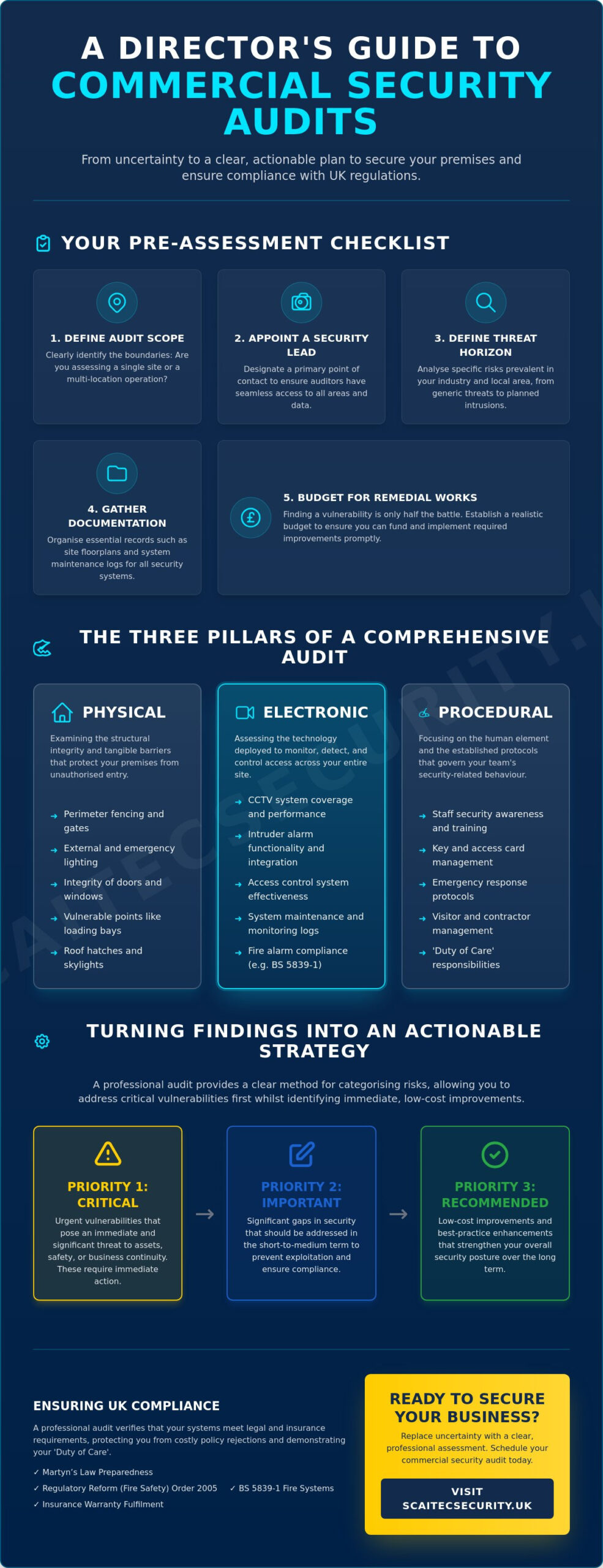
We view security through three distinct lenses to ensure no detail is overlooked. This holistic approach ensures that your protective measures work in harmony rather than as isolated components:
- Physical Security: This examines the perimeter, including fencing, external lighting, and the structural integrity of all entry points; additionally, you may explore Wall Tie Surveys to ensure the masonry and cavity walls of your premises remain sound.
- Electronic Security: We assess the effectiveness of your CCTV Systems, Intruder Alarms, and Access Control Systems, ensuring they’re integrated and functioning at peak performance.
- Procedural Security: This focuses on the human element, such as staff training, key management, and how your team executes emergency response protocols.
The Financial and Legal Rationale for Auditing
Fulfilling insurance warranties is a primary driver for many UK businesses. Most policies require specific standards for fire and security systems; a professional audit confirms you’re in compliance and can often lead to lower premiums. This process also aligns with the Regulatory Reform (Fire Safety) Order 2005, which places legal responsibility on the ‘Responsible Person’ to ensure the premises are safe. Beyond the law, a secure environment bolsters your brand’s reputation and helps retain talented staff who feel protected whilst at work. Regular System Maintenance ensures these standards don’t slip over time, providing ongoing peace of mind for everyone involved.
Preparing for Your Audit: A Step-by-Step Pre-Assessment Checklist
A successful commercial security audit begins long before the physical inspection starts. The first step is to clearly identify the audit scope. Are you assessing a single office in Sheffield, or does the review need to cover a multi-site warehouse operation in Doncaster? Defining these boundaries early prevents vital areas from being overlooked. It’s also wise to appoint a dedicated security lead within your organisation. This person acts as the primary point of contact, ensuring the auditor has seamless access to all areas of the premises and relevant data.
We also recommend defining your ‘Threat Horizon’ by looking at the specific risks prevalent in your industry or local area. Whilst some businesses face generic risks, others might be targets for more sophisticated, planned intrusions. To understand how these physical assessments fit into a broader protective framework, you can refer to this complete guide to cyber safety. Finally, ensure you’ve established a realistic budget for potential remedial works. Finding a vulnerability is only half the battle; having the funds to fix it immediately is what truly secures your business.
Gathering Your Security Documentation
Having your records organised is essential for a smooth process. You’ll need to gather previous incident logs, site floorplans, and current CCTV maintenance records. Auditors will check for valid SSAIB or NSI certification for your existing installations to ensure they meet professional standards. It’s also a legal requirement to keep your fire risk assessments and weekly fire alarm testing logs up to date. This level of organisation doesn’t just help the auditor; it proves to insurance providers that you take your ‘Duty of Care’ seriously.
Defining Your Specific Risk Profile
Every business has a unique risk profile that depends on its location and the nature of its assets. For example, analysing local crime statistics in South Yorkshire can reveal whether criminals in your area prefer forced entry through loading bays or more subtle methods. This data informs your commercial security audit, helping you differentiate between ‘opportunistic’ crime and ‘targeted’ commercial theft. Evaluate the value of all assets, from physical stock and equipment to sensitive paper records kept in back offices. If you’re worried about gaps in your current records, our experts can help you review your System Maintenance logs to ensure your documentation is audit-ready.
Conducting the Physical and Electronic Security Assessment
The physical walkthrough is where theory meets reality. During a commercial security audit, we adopt a layered approach, starting from the outermost boundary and working inwards. This ensures that a failure in one area doesn’t leave your entire operation exposed. We begin with the ‘Perimeter Layer’, examining the height and condition of fencing, the security of gates, and whether external lighting effectively illuminates dark corners where intruders might hide. Next, we move to the ‘Building Layer’. This involves a hands-on test of every entry point. We don’t just look at the front door; we inspect loading bays, ground-floor windows, and even roof hatches, which are frequently overlooked by business owners but targeted by calculated criminals.
As we transition into the ‘Electronic Layer’, we evaluate how your digital and physical defences interact. Whilst our focus is on hardware, it’s essential to consider how your network supports these systems. Aligning your electronic defences with frameworks like the NCSC’s 10 Steps to Cyber Security ensures that your CCTV and access systems are protected from remote interference and unauthorised access. Finally, we assess the ‘Interior Layer’, focusing on high-value areas such as server rooms and stock cupboards. This methodical progression ensures every square metre of your site is accounted for.
While assessing these interior areas, it is also advisable to check for environmental threats; for instance, Panther Pest Control provides professional management to ensure that high-value spaces like server rooms remain free from pests that could damage critical infrastructure.
Testing Your Intruder Alarms and Monitoring
An alarm is only as good as its detection capability and its response speed. We verify sensor placement throughout your premises to ensure no blind spots exist where an intruder could move undetected. It’s equally vital to check the communication link to your Alarm Receiving Centre (ARC). If the link fails, your 24/7 monitoring is rendered useless. We also inspect the age and reliability of your control panel and backup batteries, ensuring the system remains operational during a power cut or deliberate interference.
CCTV System Performance and Coverage Review
A commercial security audit must scrutinise the actual utility of your surveillance. We analyse image quality to ensure it’s high-definition enough to identify faces or number plates for evidential purposes in court. Storage is another critical factor; we verify that your system retains footage for the industry-standard 31 days. We also review remote access capabilities, allowing you to view live feeds or playback whilst off-site, which is essential for modern business management and rapid incident response. For businesses operating retail environments, our dedicated guide to security solutions for retail stores provides further detail on how integrated CCTV and alarm systems can deliver the evidential-quality footage insurers and prosecutors require.
Access Control and Key Management
Electronic fobs have replaced traditional keys for many UK businesses, but they require strict management. We audit your fob entry systems to see who currently holds access and how quickly that access can be revoked if a staff member leaves. We test the physical integrity of electronic locks and magnetic strikes to ensure they can’t be forced or bypassed. Finally, we review your visitor management procedures, ensuring every guest is tracked and verified from the moment they enter the building until they depart.
Compliance, Fire Safety, and UK Regulatory Requirements
UK law places a heavy burden of responsibility on business owners to ensure their premises are both safe and compliant. During a commercial security audit, we pay close attention to the Regulatory Reform (Fire Safety) Order 2005. This legislation mandates that your fire alarm system must align with BS 5839-1 standards. Meeting these requirements isn’t just a legal necessity; it’s a fundamental part of your risk management strategy. If your systems don’t meet these recognised benchmarks, you could face significant fines or find your insurance cover is void in the event of an incident.
We often find a tension between security and fire safety. High-security Access Control Systems are designed to keep unauthorised individuals out, but they must never trap staff inside during an emergency. It’s vital that all electronic locks are integrated with the fire alarm to provide a ‘fail-safe’ exit route. This means that as soon as a fire is detected, the magnetic locks must release automatically. Testing these interfaces is a critical component of any professional safety review to ensure that life safety is never compromised for the sake of site security.
Using an SSAIB-accredited installer is another non-negotiable factor for UK businesses. Most commercial insurance providers specify that security systems must be installed and maintained by a firm with this accreditation to satisfy their policy warranties. Choosing an unaccredited provider might save money in the short term, but it often leads to claim rejections later. Before committing to any new installation following your audit findings, reviewing a commercial security system quote from an SSAIB-accredited provider will help you identify transparent, fixed-price proposals that genuinely meet your insurance requirements. If you’re unsure about your current system’s compliance, you can book a professional assessment with our accredited team to ensure your business remains protected and insurable.
Fire Alarm Integrity and Life Safety
Life safety depends on the precise placement of detection hardware. We verify that heat and smoke detectors are positioned according to your current zone plans, ensuring no partitions or stock shelves obstruct their function. Sounders and visual beacons must also be checked to ensure they’re clearly audible and visible amongst background noise or in high-decibel environments. UK regulations require that fire alarm servicing is conducted at least twice annually by a competent person to maintain system integrity and logbook accuracy.
Data Protection and Surveillance Regulations
GDPR has changed how businesses must manage their CCTV Systems. You’re legally required to display clear signage that informs individuals they’re being recorded and provides contact details for the data controller. We help you draft a clear CCTV policy that outlines the specific purpose of your surveillance, whether it’s for crime prevention or staff safety. It’s also vital to verify that your cameras don’t infringe on the privacy of neighbouring residential properties, as this can lead to legal disputes and ICO investigations. All staff should be aware of their rights regarding recorded footage to ensure your business remains transparent and compliant.
Turning Audit Findings into an Actionable Security Strategy
Once you’ve completed your commercial security audit, you’ll likely have a list of observations and recommendations. It’s essential to categorise these findings into a logical hierarchy of action to avoid feeling overwhelmed. We recommend using a ‘Critical’, ‘High’, and ‘Low’ priority system. Critical items are those that present an immediate risk to life or property, such as a failing fire alarm or a broken perimeter gate. High-priority items might include gaps in CCTV coverage, whilst low-priority findings are often best-practice recommendations like improving external signage.
Focusing on ‘Quick Wins’ first can provide immediate reassurance for your team. Simple, low-cost improvements such as upgrading external lighting or refreshing your staff access protocols can make a noticeable difference to your site’s safety. However, you must also plan for long-term investment. If your audit reveals that you’re still relying on legacy analogue equipment, upgrading to modern commercial security systems Sheffield businesses depend on will provide better image quality and more flexible management. When budgeting for these upgrades, understanding how to evaluate a commercial security system quote against 2026 NSI standards ensures you avoid opaque pricing structures and select a provider whose accreditation will satisfy your insurer. If your premises include a retail element, reviewing the latest security solutions for retail stores can help you address the specific challenges of high-footfall environments where shoplifting and organised theft are growing concerns. Remember that a commercial security audit is a snapshot in time; a continuous System Maintenance programme is essential to ensure your defences remain robust year after year.
Selecting the Right Security Partner
Selecting the right partner is just as important as the audit itself. We suggest looking for independent, SSAIB-accredited firms that offer local technical support. These specialists understand the specific risks in your region and can provide bespoke system designs tailored to your audit findings, rather than ‘one-size-fits-all’ packages. The value of aftercare cannot be overstated. Choosing a partner that offers reliable emergency call-out support ensures that if a fault occurs, your business doesn’t remain vulnerable for long.
Building a Culture of Security amongst Staff
Technology is only half of the solution. You must also build a culture of security amongst your staff. This involves training employees to recognise and report suspicious behaviour or system faults immediately. Establishing clear protocols for opening and closing the premises each day ensures that no door is left unlocked by mistake. By encouraging a ‘security-first’ mindset, you significantly reduce the risk of internal theft or social engineering attempts that bypass even the most expensive hardware.
Next Steps for Your Business
The best way to validate your internal findings is to book a professional site survey. This allows an expert to review your current commercial intruder alarms against the latest threats and ensure your site is fully compliant. Taking these steps today protects your assets, secures your staff, and provides the long-term stability your business deserves. Contact Scaitec Security today for a professional commercial security assessment.
Securing the Future of Your Business Premises
Maintaining a safe commercial environment requires more than just high-quality hardware. It demands a holistic strategy that aligns your daily operations with UK regulatory standards. By following a methodical framework, you can identify hidden vulnerabilities and ensure your fire and security systems remain fully compliant with insurance requirements. A professional commercial security audit serves as the foundation for this stability, transforming vague concerns into a clear, prioritised roadmap for improvement.
We’ve been dedicated fire and security specialists since 2005, providing SSAIB-accredited installations across South Yorkshire and the wider UK. Our team acts as a steadfast partner, helping you navigate the complexities of modern safety regulations whilst protecting your most valuable assets. We focus on providing technical proficiency and genuine care to help you achieve long-term peace of mind. If you’re ready to move from uncertainty to a position of strength, our experts are available to guide you through the process.
Secure Your Business: Request a Professional Security Audit from Scaitec
Taking proactive steps today ensures that your staff, stakeholders, and property remain protected long into the future. We look forward to helping you build a more resilient and secure business environment.
Frequently Asked Questions
How often should a business conduct a commercial security audit?
We recommend conducting a commercial security audit at least once every twelve months to ensure your safety measures remain effective. It’s also vital to trigger a review if you relocate, undergo a significant building layout change, or experience a security breach. Regular reviews help you adapt to evolving criminal methods and ensure your protective technology hasn’t become obsolete over time.
Can I perform a security audit myself or do I need a professional?
Whilst you can conduct a basic internal walkthrough, a professional is essential for meeting insurance and regulatory requirements. We bring the technical expertise required to test the granular functionality of hardware and software that a layperson might miss. Professional auditors also provide the formal documented evidence needed to satisfy SSAIB standards and specific insurance warranties.
What is the difference between a security audit and a risk assessment?
A risk assessment identifies potential threats to your business, whereas a commercial security audit evaluates how well your current systems defend against those threats. Think of the assessment as identifying the “what” and the audit as verifying the “how”. Both are necessary components of a resilient safety strategy that protects your staff and assets.
Will a security audit help reduce my business insurance premiums?
Yes, many UK insurance providers offer lower premiums to businesses that can demonstrate a proactive approach to risk management. By providing a documented audit report from an accredited installer, you prove that your premises meet high safety standards. This reduces the insurer’s perceived risk, which often results in more favourable policy terms and lower annual costs.
What are the most common security vulnerabilities found in UK offices?
Common vulnerabilities include outdated CCTV systems with poor image quality, unmanaged access fobs, and inadequate perimeter lighting. We frequently see businesses failing to monitor ‘tailgating’ at entry points or neglecting the vital maintenance of backup batteries in their intruder alarms. Addressing these gaps is a primary focus of our professional site reviews.
Does a security audit include fire safety and fire alarm systems?
A holistic audit should always include fire safety because security and life safety systems are deeply interconnected. We examine your Fire Alarm Systems to ensure they meet BS 5839-1 standards and verify that electronic locks release automatically during an alarm. This ensures your premises remain secure without ever compromising the emergency evacuation safety of your staff.
What happens if our business fails to meet current security standards?
Failing to meet standards can lead to the invalidation of your insurance policy and significant legal penalties. Under the Regulatory Reform (Fire Safety) Order 2005, the ‘Responsible Person’ can face prosecution for serious non-compliance. Additionally, failing to manage data from CCTV systems correctly can result in heavy fines under UK GDPR and investigations by the ICO.
How long does a professional commercial security audit typically take?
A professional audit for a standard UK office typically takes between half a day and a full day to complete. Larger sites, such as multi-level warehouses or manufacturing facilities in South Yorkshire, may require two days or more for a thorough inspection. We take the time needed to test every entry point and system interface to ensure no vulnerability is missed.
Protect Your Business
Protect Your People
Book Your FREE Site Protection Survey

Since pioneering Scaitec Security Solutions in 2005, Paul Scaife, with his roots in the industry dating back to 1994, has distinguished the firm as a leading provider of bespoke fire and security solutions, servicing clients across Sheffield, Rotherham, and surrounding areas.
His leadership, underpinned by accreditation from the Security Systems and Alarms Inspection Board, ensures that Scaitec surpasses client expectations by blending advanced technology with a deep understanding of their unique needs.
Paul's ethos champions innovation and efficiency, driving Scaitec to deliver tailored, cutting-edge solutions that enhance safety and operational ease.
Discover more about Paul’s commitment to excellence on LinkedIn.