
Table of Contents
A depot’s CCTV is most valuable when it helps people understand what an alarm is signalling, not simply record what happened. For logistics depot CCTV monitoring in Doncaster, cameras can support alarm and fire-safety response by providing visual context, help verify incidents, and maintain oversight of yards, loading areas, stock and staff spaces. The layout should reflect how the site operates, including deliveries, shift workers, contractors and access points.
It’s understandable to want dependable coverage without blind spots or gaps around the areas that matter most. This guide explains how monitored CCTV can support a practical response, what affects image quality and camera placement, and how to plan surveillance for a logistics facility while respecting staff privacy.
You’ll learn what to consider when arranging professional monitoring, how CCTV can work alongside alarm and fire systems, and what information helps shape a depot security solution. The aim is to explain what monitoring can do and how to take the next step with confidence.
Key Takeaways
- Plan camera coverage around how vehicles, deliveries, staff and contractors move through the depot, including yards and loading areas.
- Match image detail to the task, such as detecting movement or recognising activity, rather than relying on camera resolution alone.
- Remote viewing can help verify alarm or fire-system triggers and provide useful context for deciding how an incident should be escalated.
- Prioritise clear surveillance of valuable stock and dispatch areas, while keeping cameras out of private spaces such as bathrooms and changing rooms.
- Consider how CCTV works alongside intruder alarms and access control when planning a monitoring system for a logistics facility.
Need CCTV Monitoring In Doncaster?
For logistics depot CCTV monitoring in Doncaster, coverage should follow the site’s actual movements, from vehicle yards to warehouse aisles. Doncaster warehouse and depot installations are best planned around specific risks, camera views and the purpose of each image.
Fulfilment centre and vehicle yard coverage
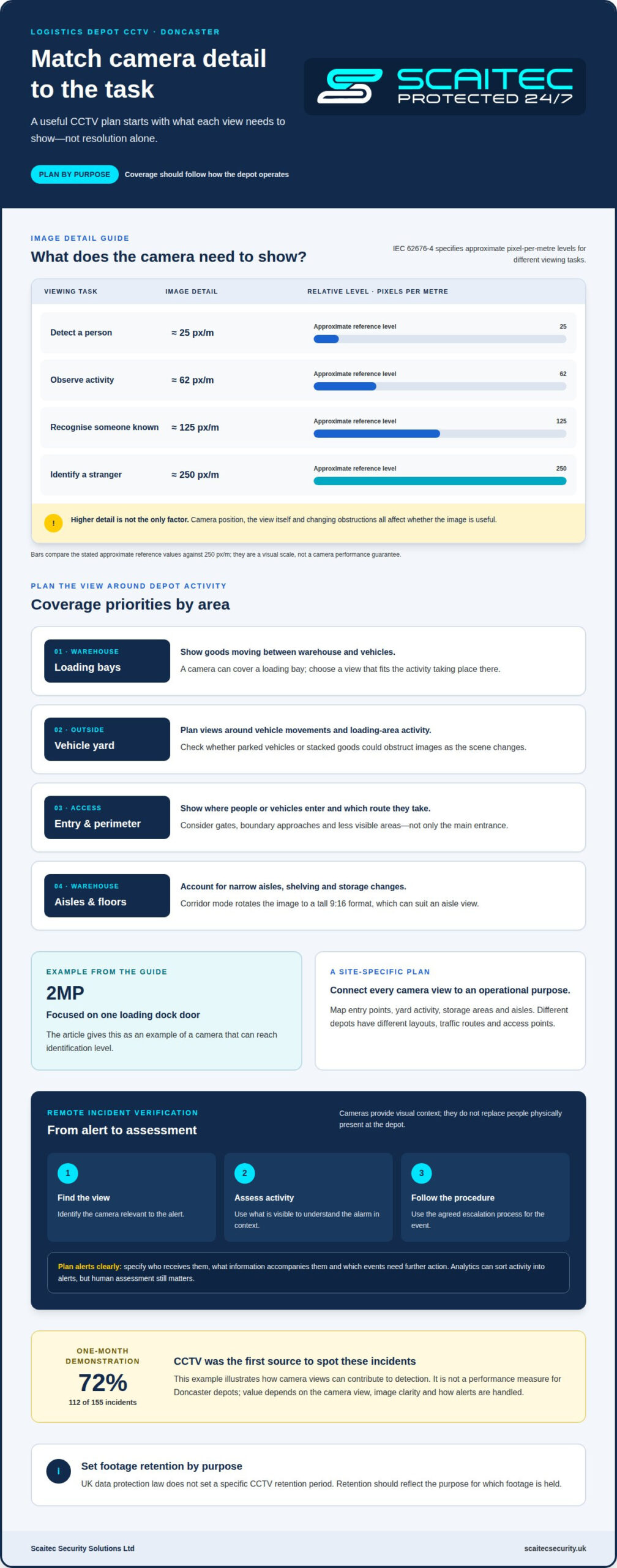
A fulfilment centre combines storage, picking, packing and dispatch, so each activity needs a useful camera view. For example, a camera can cover a loading bay where goods move between the warehouse and vehicles. In the yard, plan views around vehicle movements and activity near loading areas. Check whether parked vehicles or stacked goods could obstruct the images as the scene changes.
Entry, exit and perimeter cameras
Entry and exit cameras can show where vehicles or people enter the site and which route they take. Perimeter coverage should consider gates, boundary approaches and less visible areas, rather than focusing only on the main entrance. The image detail needed depends on the task: IEC 62676-4 specifies approximately 25 pixels per metre to detect a person and 250 pixels per metre to identify a stranger.
Warehouse aisle and floor coverage
Long, narrow warehouse aisles can be difficult to cover with a standard landscape image. Corridor mode rotates the camera image to a tall 9:16 format, which can suit an aisle view. IEC 62676-4 specifies approximately 62 pixels per metre to observe activity and 125 pixels per metre to recognise someone known. Camera placement should account for shelving, obstructions and changes to storage layouts.
Warehouse and depot installation
When assessing CCTV for a warehouse or depot in Doncaster, look for a site-specific plan that connects each camera view to an operational purpose. A written plan can map entry points, yard activity, storage areas and aisles. If your business operates several depots, consistent camera labels and viewing priorities can also help staff review footage across locations.
Nearby South Yorkshire sites can have different layouts, traffic routes and access points, so a design should reflect each depot rather than copy a standard arrangement. A 2MP camera focused on a single loading dock door is an example of a camera that can reach identification level. The business CCTV systems information is relevant when considering camera coverage for a commercial facility.
Purpose matters as much as camera placement. UK data protection law does not set a specific CCTV retention period. Retention should reflect the purpose for which footage is held. Defining that purpose helps determine which views are useful, how footage supports site security and what the monitoring arrangement needs to cover.
Remote incident verification and escalation
Remote CCTV can show whether an alarm corresponds with visible activity, while on-site security staff provide a physical presence. At a logistics depot, cameras support observation and incident verification, but they do not replace people physically present.
When an alert arrives, use a clear response sequence: identify the relevant camera view, assess the visible activity, then follow the agreed escalation procedure. For example, footage near a vehicle gate may help distinguish an authorised delivery from unexpected activity. Images give responders context rather than leaving them to rely on an alarm signal alone.
In a one-month demonstration scheme, CCTV was the first source to spot 112 of 155 incidents, or 72%. That example illustrates how camera views can contribute to detection, but it isn’t a performance measure for Doncaster depots. At a logistics site, the value depends on the camera’s view, image clarity and how alerts are handled.
A 24/7 remote surveillance arrangement can keep camera observation available beyond normal warehouse shifts. Automated emergency service dispatch can follow a system trigger, with the response shaped by the trigger and the agreed escalation process. Clear instructions should identify who receives an alert, what information accompanies it, and which events require further action.
Remote CCTV monitoring also relies on the systems that carry images and alerts. Plan for a suitable power supply and reliable communications so cameras remain useful. If considering autonomous power, account for the site’s operating conditions and the equipment’s power needs. A temporary construction compound, for instance, may have different infrastructure from a permanent distribution warehouse.
Analytics can sort camera activity into alerts, but they do not replace human assessment. A vehicle entering through a marked entrance may be routine, while activity beside a closed loading door may need review. The escalation plan should connect different events to practical next steps, rather than treating every alert alike.
For logistics managers, the key distinction is between seeing an event and responding to it. Remote surveillance provides visual information, while an agreed escalation process determines how that information is used. Linking camera events with business intruder alarm systems can help assess alarm signals alongside relevant footage.
The Road Operations Centre (ROC) was the first source to spot 21 incidents on a one-month demo scheme. A one-month demo scheme recorded 15 IPV dispatches.
Security for Doncaster logistics facilities and distribution centres
A Doncaster distribution centre needs a security plan shaped around its vehicles, buildings, stock and operating hours. CCTV can provide useful evidence, but works best as part of a wider, site-specific approach.
Integration with wider security services
For example, a depot can coordinate CCTV with access control at staff entrances and vehicle gates, helping relate a recorded entry to activity in nearby footage. Fire alarms address a different risk, so their signals and response procedures should remain distinct. A risk assessment can map how each system supports the site without treating cameras as a substitute for other security measures.
Security standards and certifications should be considered carefully. IEC 62676-4 provides guidance on CCTV image performance, but a technical standard is not, by itself, proof that a whole depot security plan is suitable. Assess the system design, installation and maintenance arrangements against the facility’s needs, including how camera images are used during an incident.
Workplace CCTV rules and data protection
For workplace CCTV, start by defining its purpose, such as protecting goods or reviewing an incident at a loading area. UK data protection law sets no specific CCTV retention period; retention should reflect the purpose for which footage is held. This is a practical starting point when considering ICO guidance for business CCTV.
Risks remain: cameras can have obstructed views, footage may not show every detail, and monitoring alone cannot prevent every incident. A review of camera coverage and recorded footage can help identify gaps, while a clear purpose helps keep surveillance focused on the depot’s security needs.
Local commercial CCTV guidance
Doncaster Council’s British Standard Alarm Receiving Centre is based at the Civic Office. The council’s CCTV Suite also monitors CCTV for Rotherham and Barnsley Councils in conjunction with South Yorkshire Police. These are public-sector arrangements, distinct from private commercial installations.
Across the UK, around 41% of cargo theft incidents happen at warehouses. That figure underlines why distribution sites assess stock areas, vehicle movements and access routes together, rather than relying on one camera view.
A tailored risk assessment should record the depot’s operating pattern, access points, valuable goods and quieter periods. Vacant logistics premises need particular attention to unattended entrances, perimeter exposure and the condition of security equipment. Planned maintenance can help keep cameras and related systems working as intended during a long closure. The resulting plan should match the site’s risks, rather than assume every warehouse needs identical coverage.
High-value stock and staff-area surveillance
High-value stock needs camera views that show activity around storage and dispatch, not just a general warehouse scene. A recommendation for these areas is to position cameras to achieve 4K resolution, supporting detailed views of goods handling. The useful result depends on placement, lighting, distance and obstructions, so the design should consider how stock moves from storage to loading.
For example, cameras can cover a high-value storage entrance and the route towards dispatch. A doorway view may show access, while another angle records handling activity near the loading area. Linking these views with access control can provide context about authorised entry and visible activity. The aim is footage that supports a review, not image collection without a clear purpose.
Surveillance in staff areas needs a different balance. Do not install cameras in private areas such as bathrooms and changing rooms. In shared work areas, focus camera positions on a defined security purpose, such as monitoring stock transfer points, rather than routinely observing staff throughout the day. Explain the purpose and areas covered so staff understand how monitoring relates to depot security.
Suspicious activity is not always obvious in a single image. One camera may record a person entering a storage zone, while another shows whether goods moved towards dispatch. Reviewing linked views can give a fuller picture. Account for shelving, pallets and temporary obstructions too, since stock levels and warehouse layouts can change what a camera captures.
Remote storage or yard locations may need a power plan if mains electricity is unavailable or unsuitable. Solar and fuel-cell surveillance systems are options to consider during design, but the right arrangement depends on the location, equipment power requirements and how consistently cameras must operate. Plan for communications, maintenance access and the surrounding environment as well. Without a reliable way to transmit images, a camera cannot support remote surveillance as intended.
At a Doncaster logistics site, review high-value areas alongside staff routes and loading operations. Decide what activity each camera needs to capture, then check that its proposed view serves that purpose without overlooking privacy. This practical approach helps keep CCTV proportionate and useful, with stock protection and staff privacy both in view.
CCTV monitoring services for logistics depots in Doncaster
A monitoring service connects depot cameras with a process for reviewing activity and handling alerts. For a Doncaster logistics site, the arrangement should reflect deliveries, shift patterns and periods when areas are unattended. Start by agreeing which camera views matter and what response each type of alert should prompt.
Remote monitoring can help interpret a system trigger by checking relevant camera views and assessing visible activity. For example, an alert near a vehicle entrance can be reviewed against the scene before staff decide what action follows. A 24/7 surveillance arrangement supports observation beyond standard warehouse shifts, while automated emergency service dispatch can follow a system trigger. The response depends on the trigger and the agreed escalation procedure.
Planning should account for the practical limits of the cameras and communications. A blocked view, poor lighting or unreliable connection can reduce an alert’s usefulness. Map each alert to the camera view that can provide context. For example, a loading bay alert is more useful when the related image shows the surrounding area.
Ongoing maintenance matters because depots change. New shelving, altered vehicle routes or a revised dispatch area can affect what cameras capture. A maintenance plan can include reviewing camera positions, image quality and system operation after site changes. This helps keep coverage aligned with current activity instead of relying on a layout that no longer reflects how the warehouse works.
The service scope also shapes the work involved. A single building with a clearly defined entrance differs from a site with several buildings, yard areas and separate access routes. Key planning details include:
- Which areas need live monitoring, such as vehicle gates, loading bays or stock rooms.
- Which events should create alerts and how each alert is assessed.
- How camera views connect with intruder alarms or access control events.
- Who receives updates and what escalation steps apply during an incident.
These decisions help make monitoring useful for daily depot operations. They also clarify what the system can show and where a physical response may still be needed. A well-defined process connects camera activity with the next operational step, rather than treating every alert as the same event.
Scaitec Security Solutions Ltd: CCTV Systems
Scaitec Security Solutions Ltd can help when a Doncaster depot needs CCTV planned around its operational layout, stock and access points. Its CCTV Systems can be considered alongside Remote Monitoring, Intruder Alarms and Access Control Systems, depending on the site’s security requirements.
For example, a facility with separate vehicle entrances and storage areas may need camera coverage designed to support both daily oversight and incident review. A joined-up discussion can establish which areas matter, how monitoring fits the depot’s procedures, and whether other listed security systems are relevant. Explore business CCTV systems as part of that planning.
To discuss CCTV for your logistics depot, contact Scaitec Security Solutions Ltd.
Plan the next step for your Doncaster depot
A practical next step is to turn your site priorities into a clear brief: which areas need coverage, what monitoring should support and how the system should fit daily operations. This gives the design process a useful starting point and keeps decisions focused on your depot’s needs.
For logistics depot CCTV monitoring in Doncaster, Scaitec Security Solutions Ltd can discuss CCTV Systems alongside Intruder Alarms and Access Control Systems. These options can be considered in relation to how people and vehicles enter the site, how stock areas are managed, and what response procedures the business wants to support. The right combination depends on the facility and its operational requirements.
A considered plan can help your team move forward with greater clarity and a security arrangement shaped around the way your depot works.
Frequently Asked Questions
Do I Need Power or Internet on Site?
CCTV equipment needs power, while remote access depends on a suitable communications connection. Requirements vary with the equipment and depot layout. A loading bay with an existing network connection, for example, presents different design considerations from an isolated yard. During planning, the installer can assess available power and connectivity, then shape the design around the site’s operating conditions and monitoring needs.
Do the units need mains power?
CCTV cameras need a power source, but whether that must be mains power depends on the system design and site conditions. A remote gate without convenient mains access needs different planning from cameras inside a powered warehouse. Discuss the location, intended camera coverage and communications as part of the design. This helps establish a suitable installation approach without assuming every camera location has the same infrastructure.
What areas around Doncaster do you cover?
Scaitec Security Solutions Ltd serves Doncaster and South Yorkshire, with its local focus centred on Rotherham and Sheffield. For a depot near Doncaster, the site’s location and operational needs help shape the discussion about CCTV. Share the facility location and whether coverage is needed for one building, a yard or multiple areas. This gives the team useful context for discussing the security requirements.
What does this service include?
The service can include CCTV system design, installation and maintenance, planned around the depot’s layout and security priorities. Remote Monitoring is also available for installed systems. For intruder and fire alarms, monitoring connects the system to an Alarm Receiving Centre, where a trigger can lead to automated emergency service dispatch. All fire alarm installations meet current British Standards. The scope depends on the selected systems and the response process agreed for the site.
CCTV monitoring response procedures for intruders at depots
When an intruder alarm triggers, the connected system can send the event to an Alarm Receiving Centre for handling under its monitoring procedure. Remote Monitoring includes automated emergency service dispatch following a system trigger. Keep contact details and site instructions current so the response process reflects operational changes, such as a revised entrance route or a temporarily closed loading area.
CCTV camera types and coverage for warehouse yards and loading bays
Camera selection depends on the view needed at each location. A loading bay may need to show vehicle approaches and goods handling, while a yard view may focus on vehicle movement and access routes. During design, consider lighting, obstructions, mounting position and the activity the footage should show. These details help determine appropriate cameras and coverage for each warehouse or yard.
Protect Your Business
Protect Your People
Book Your FREE Site Protection Survey

Since pioneering Scaitec Security Solutions in 2005, Paul Scaife, with his roots in the industry dating back to 1994, has distinguished the firm as a leading provider of bespoke fire and security solutions, servicing clients across Sheffield, Rotherham, and surrounding areas.
His leadership, underpinned by accreditation from the Security Systems and Alarms Inspection Board, ensures that Scaitec surpasses client expectations by blending advanced technology with a deep understanding of their unique needs.
Paul's ethos champions innovation and efficiency, driving Scaitec to deliver tailored, cutting-edge solutions that enhance safety and operational ease.
Discover more about Paul’s commitment to excellence on LinkedIn.