
Table of Contents
What if CCTV captures a suspected theft but still leaves you unable to explain how stock went missing? For businesses searching “preventing employee theft with CCTV Rotherham”, the answer is not simply to add more cameras. Clear, relevant coverage can help document incidents, but it works best alongside sound stock-handling procedures and appropriate access controls.
It’s understandable to want reliable evidence when losses are difficult to trace. It’s just as important to consider where cameras are placed, how staff are informed and whether monitoring is necessary and proportionate. Workplace CCTV must be managed responsibly, with a clear purpose and attention to UK data-protection requirements.
This guide explains how to assess vulnerable areas, choose CCTV coverage that matches documented risks, and combine cameras with practical controls. It also outlines what to consider when communicating with employees and managing footage. For businesses in Rotherham, Sheffield, Barnsley, Doncaster, Chesterfield, Worksop, Wakefield and Huddersfield, Scaitec Security Solutions Ltd is an independent security company based in Rotherham. It provides commercial CCTV design, installation and maintenance, as well as access control systems that may complement a camera system.
Key Takeaways
- Record what’s missing and where losses may occur before proposing security measures, so they address a documented business risk.
- Use CCTV to help clarify events, not to assume responsibility or guarantee theft prevention. Decide who may review footage and how concerns will be handled.
- Match controls to the problem: cameras can record activity, access control can restrict entry, and stock procedures can support accurate reconciliations and handovers.
- For preventing employee theft with CCTV Rotherham, plan coverage around specific risks and communicate clearly with staff about the purpose of monitoring.
- Ask a prospective CCTV partner about site assessment, camera positioning, system handover and maintenance to support dependable operation over time.
Preventing employee theft with CCTV in Rotherham: start with the business risk
Unexplained losses of stock, cash or equipment call for a fair, evidence-led response. Before installing cameras or changing staff arrangements, establish what’s missing, when it may have gone missing, and which records or procedures could help explain the discrepancy. CCTV can form part of a proportionate security plan, but it can’t guarantee theft prevention or prove responsibility on its own.
Keep an open mind about the cause. A stock count may be wrong, a delivery may not match its paperwork, a till entry may have been recorded incorrectly, or a handover process may leave gaps. Checking these possibilities first can help you identify whether the issue is theft, an error or a weakness in the way work is organised. This guide focuses on workplace theft prevention in Rotherham, not CCTV installation in general. For information about commercial CCTV systems, consider how a site-specific system could address the risks you’ve identified.
Which business areas and processes may need attention?
Start with the places where goods, money or valuable equipment are handled or stored, such as stockrooms, goods-in areas, tills and secure storage. Then look at the processes around them. When do discrepancies tend to appear? Which movements, approvals or staff handovers are hardest to verify? This review may reveal a practical gap, such as incomplete delivery checks, as well as a possible need for camera coverage. Assess the actual risk before considering monitoring any staff area.
What CCTV can and cannot do for employee theft prevention
Visible, appropriately positioned cameras may deter misconduct and help authorised reviewers reconstruct an incident or clarify conflicting accounts. Their value depends on whether the relevant activity is in view and the footage is usable. Camera position, lighting, image quality and recording retention all affect whether footage can help answer a specific question.
CCTV is one of several employee monitoring methods, so consider its purpose and privacy implications before deciding where it’s appropriate. Monitoring should be necessary and proportionate, with staff given clear information about its purpose and use in line with UK data-protection requirements. Cameras can’t replace sound procedures, appropriate supervision or a fair investigation. Footage may inform follow-up, but it shouldn’t be treated as proof of guilt without considering the wider evidence and circumstances.
How workplace CCTV can support a fair, evidence-led response
For preventing employee theft with CCTV Rotherham, start with a documented risk, not a hunch about a particular member of staff. Identify what needs protecting, assess how an incident could happen, then plan camera positions to capture relevant activity. Once recording is in place, define who can review footage and how concerns will be followed up. This creates a consistent process rather than ad hoc monitoring.
CCTV is a supporting security control, not proof of intent by itself. Footage may help establish a timeline, show whether goods were moved or clarify a disputed handover. It can’t explain every action or prove why someone acted. Review recordings alongside relevant records and accounts, and document decisions without treating suspicion as a finding of guilt.
Where should workplace cameras be considered?
Map entrances, stock movement routes, loading areas and cash-handling points against the risks you’ve identified. A camera at a goods-in area might help verify when a delivery was received. A view of a till area may help clarify a disputed transaction. Aim to capture useful detail while avoiding unnecessary views into private spaces. A simple site plan can note each camera’s purpose, intended coverage, blind spots and authorised users.
How should managers handle footage and concerns?
Agree a straightforward procedure before an incident occurs. Staff should know how to report a concern, and designated managers should know how to locate and preserve relevant footage promptly in line with the organisation’s policies. Keep a record of what was reviewed, by whom, when and what action followed. Restrict access to people with a genuine operational need, and handle recordings securely.
Set out the system’s purpose, who may view recordings and how long footage is kept. Retention should be linked to that purpose, rather than keeping recordings indefinitely. The Information Commissioner’s Office provides guidance on workplace monitoring. Check its current advice and consider UK data-protection requirements when planning or reviewing a system. If monitoring is high risk, assess whether a Data Protection Impact Assessment is appropriate. For a tailored technical discussion, explore commercial CCTV system options.
Professional design and installation can help align camera positions with documented risks, while regular maintenance supports dependable operation. Keep the site plan and review procedure up to date if layouts, processes or risks change. That way, footage is more likely to be useful when a concern needs a careful, fair response.
CCTV, access control and workplace procedures: compare the prevention options
Preventing employee theft with CCTV Rotherham businesses may involve choosing a combination of controls, not simply adding cameras. Each measure addresses a different weakness: cameras record activity, access control can restrict entry, stock procedures help identify discrepancies, and staff training can make responsibilities and handovers clearer. The right choice depends on the risk you’ve identified.
More cameras don’t automatically create better prevention or fairer investigations. If a loss stems from unclear stock records, poor handovers or shared entry credentials, extra footage may not resolve the underlying problem. Use the comparison below to identify which control could help and what it cannot do alone.
| Control | Best suited to | Limitation |
|---|---|---|
| CCTV | Recording relevant activity around identified locations or processes. | Footage may not show the full context or explain intent. Its usefulness depends on suitable positioning and image quality. |
| Access control | Restricting entry to areas where access should be limited, and helping manage who can enter. | It won’t reconcile stock or establish what happened inside an area after entry. |
| Stock procedures | Reconciling deliveries, sales, returns and stock movements through checks and sign-offs. | Records depend on consistent, accurate completion and may not show who moved an item. |
| Staff training | Clarifying responsibilities, reporting routes and handover expectations. | Training supports good practice but doesn’t physically restrict entry or record events. |
When might CCTV need another control alongside it?
Consider access control if your assessment identifies unauthorised entry, shared credentials or too many people accessing a sensitive area. Role-based permissions can help limit access, while stock checks and signed handovers address gaps cameras can’t resolve. These measures don’t have to form one integrated system. Choose what fits the risk. Explore access control options for businesses if controlling entry is part of the problem.
How can employers balance visibility, privacy and staff trust?
Explain the specific purpose of monitoring, which areas are covered and how recordings will be used. Be transparent with staff and keep the approach proportionate to the concern. Avoid recording areas where people reasonably expect greater privacy unless a clear, justified need has been assessed. Before deployment, check current Information Commissioner’s Office guidance and relevant workplace policies. Data-protection and employment considerations depend on the circumstances, so this practical overview isn’t legal advice.
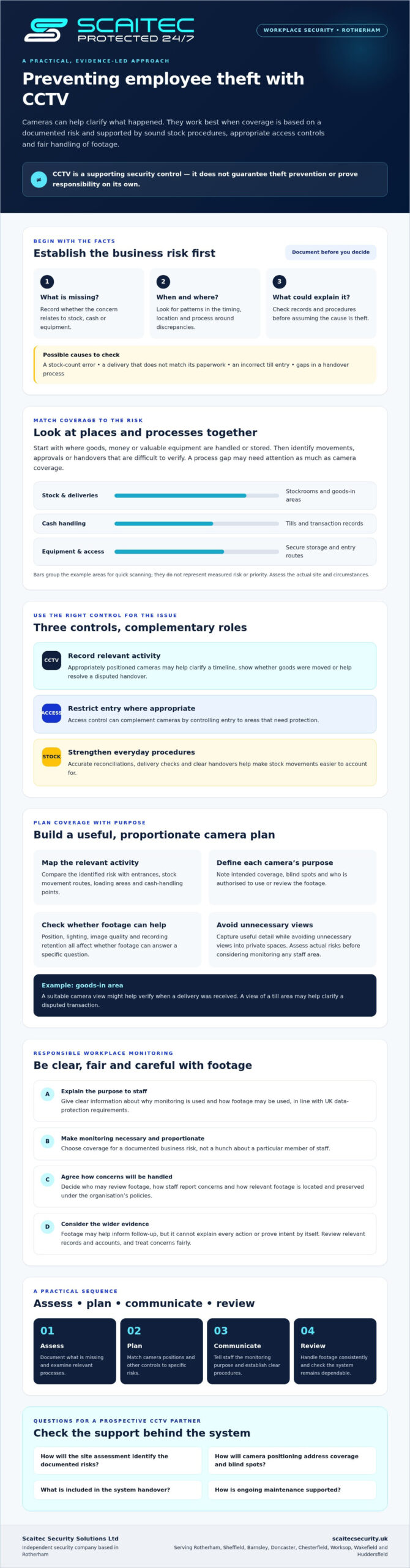
A practical Rotherham workplace CCTV plan: assess, communicate and review
A practical plan helps ensure cameras serve a defined purpose and remain useful as your business changes. For preventing employee theft with CCTV, Rotherham businesses can use this sequence to move from an initial concern to a considered, reviewable system.
- Document the concern. Note what has gone missing, when it was identified and what records have been checked. Separate confirmed facts from assumptions, and consider delivery discrepancies, recording errors or process gaps.
- Assess the site. Map vulnerable assets, staff and visitor routes, relevant handovers, lighting conditions and operating hours. Identify where a camera could provide useful information, as well as any privacy considerations or physical constraints.
- Define each camera’s purpose. Record the risk it addresses, the proposed view and any blind spots. Also document who can access footage, how long it will be kept in line with its purpose, and how a concern will be escalated.
- Communicate the plan. Explain the purpose and coverage to affected staff, and make sure relevant workplace procedures reflect how recordings may be accessed and used. Check current ICO guidance and applicable requirements before deployment.
- Test and review. Check camera views and recording under real operating conditions, including relevant lighting and working activity. Review coverage and system operation periodically, and after changes to the layout, processes or identified risks.
What should a pre-installation risk assessment cover?
Look for patterns in reported incidents and note which stock, cash or equipment is most vulnerable. Map the routes goods take through the premises, including receiving, storage and dispatch, and note where lighting or building layout could affect coverage. A professional installer can assess technical requirements and practical site constraints against your documented risks. For more on planning business coverage, see CCTV installation guidance for Rotherham businesses.
How should the business introduce and maintain the system?
Introduce cameras openly, giving staff clear information about their purpose and where to find relevant internal procedures. Assign responsibility for routine checks: confirm that views remain unobstructed, image quality is usable, time settings are accurate and recordings are available. Record faults and arrange appropriate follow-up rather than assuming the system is working. See preventative security maintenance guidance for more on ongoing system care.
Discuss commercial CCTV for your workplace
Choosing a Rotherham CCTV partner for employee theft prevention
A suitable CCTV proposal should start with your workplace risks, not a standard camera count. For preventing employee theft with CCTV, Rotherham businesses should look for a clear explanation of how proposed coverage relates to identified concerns, what the system may not capture and how it will be operated. A site assessment can help make these decisions specific to your premises and processes.
What should a CCTV proposal explain?
Ask the installer to explain the reasoning behind each proposed camera position. A useful proposal should set out:
- Purpose and coverage: Which identified risk each view addresses, what detail it is intended to capture and any likely blind spots.
- Practical constraints: How lighting, layout, operating conditions or changes to the premises could affect the view.
- System handover: Who will be shown how to use the system, review recordings and follow the agreed procedures for handling concerns.
- Aftercare: What maintenance is available and how faults or changes in coverage can be addressed.
Installation quality matters. Poor positioning or an obstructed view can leave recordings less useful when an incident needs reviewing. Ongoing maintenance also helps support reliable operation, so ask what checks and support are included rather than assuming the system will continue working as intended. Compare proposals by their suitability, clarity and practical handover, not by camera numbers alone.
When is it time to request a local assessment?
Consider an assessment if losses recur, existing camera views miss relevant areas, or a review shows that stock handling and handovers need closer attention. A local installer can consider the site layout and operational requirements, then explain whether CCTV is appropriate and where complementary measures may be relevant. Scaitec Security Solutions Ltd is an independent security company based in Rotherham, established in 2005, offering CCTV design, installation and maintenance. Its local service is relevant to businesses in Rotherham, Sheffield, Barnsley, Doncaster, Chesterfield, Worksop, Wakefield and Huddersfield. You can review its business CCTV design and installation information.
Before proceeding, make sure the proposed plan supports your documented purpose, that affected staff will receive clear communication and that someone in your organisation is responsible for system use and review. A tailored discussion can help you decide what coverage is appropriate for your workplace, without treating cameras as a guarantee against theft.
Build a proportionate security plan for your workplace
Effective theft prevention starts with understanding the risk, then choosing controls that address it. CCTV may help document relevant activity, but it works best alongside clear stock procedures, fair investigations and access controls where entry needs to be restricted. A planned, well-maintained system is more likely to provide useful coverage than simply adding cameras.
For businesses considering preventing employee theft with CCTV Rotherham, Scaitec Security Solutions Ltd offers a local point of contact. The independent Rotherham-based security company provides CCTV design, installation and maintenance for business customers. Access control is also available as a complementary measure where managing entry forms part of the concern.
A site-specific discussion can help you consider your workplace layout, documented risks and suitable coverage before deciding on next steps.
With a considered approach, your business can strengthen security while treating staff fairly and making decisions with greater confidence.
Frequently Asked Questions
Can CCTV prevent employee theft?
CCTV may deter theft and help clarify what happened, but it can’t guarantee prevention or prove intent on its own. For preventing employee theft with CCTV, Rotherham businesses should first identify the risks, then choose camera coverage that serves a clear purpose. Combine recordings with reliable stock checks, defined handovers and fair investigation procedures. If records show unexplained losses, check for process or recording errors as well as considering whether CCTV could help.
Is it legal to use CCTV to monitor employees in the UK?
Workplace CCTV can be lawful in the UK when there’s a lawful purpose and monitoring is necessary and proportionate to it. The Data Protection Act 2018 and UK GDPR apply. Employers should be transparent about the purpose, who can access footage and how long it’s retained. Higher-risk monitoring may call for a Data Protection Impact Assessment. Check current Information Commissioner’s Office guidance and seek appropriate legal advice for your circumstances.
Where should a business place CCTV cameras to reduce theft?
Place cameras where they address documented risks, such as relevant entrances, goods-in areas, stock movement routes or cash-handling points. A camera covering a delivery handover, for example, may help clarify when goods were received. Consider lighting, image detail and blind spots, and avoid capturing private spaces unnecessarily. Map proposed views against actual loss patterns rather than filming every staff area. Review the layout if working practices or site risks change.
Do I need to tell employees that CCTV is being used?
Yes, employees should be informed that CCTV is in use and given clear information about its purpose, who may access recordings and the retention period. Explain which areas are covered and how footage may be used, so staff understand what to expect. Covert monitoring is only appropriate in exceptional circumstances, such as a specific investigation based on strong suspicion of criminal activity. Check current ICO guidance before making decisions about workplace monitoring.
Is CCTV better than access control for preventing employee theft?
Neither is automatically better; each addresses a different risk. CCTV records activity in view, while access control can restrict entry to areas such as a stockroom. If the issue is missing goods after authorised access, stock reconciliation and sign-off procedures may be more relevant. Start by identifying how a loss could occur, then select proportionate controls. Some businesses may benefit from combining measures, but an integrated system isn’t necessary for every workplace.
How often should business CCTV be checked?
There’s no single checking frequency that suits every site. Set a routine based on your system, operating needs and documented risks, and check promptly after faults or changes to camera views. Confirm that image quality, date and time settings, and recording availability are suitable for your purpose. Keep footage only as long as necessary; UK GDPR doesn’t set one universal retention period. Rotherham-based Scaitec Security Solutions Ltd provides system maintenance as part of its security services.
Protect Your Business
Protect Your People
Book Your FREE Site Protection Survey

Since pioneering Scaitec Security Solutions in 2005, Paul Scaife, with his roots in the industry dating back to 1994, has distinguished the firm as a leading provider of bespoke fire and security solutions, servicing clients across Sheffield, Rotherham, and surrounding areas.
His leadership, underpinned by accreditation from the Security Systems and Alarms Inspection Board, ensures that Scaitec surpasses client expectations by blending advanced technology with a deep understanding of their unique needs.
Paul's ethos champions innovation and efficiency, driving Scaitec to deliver tailored, cutting-edge solutions that enhance safety and operational ease.
Discover more about Paul’s commitment to excellence on LinkedIn.