
Table of Contents
The most useful security setup for a sports club isn’t necessarily the one with the most cameras. It’s the one that helps manage who can enter, and when. For clubs considering sports club security systems in Barnsley, access control can work alongside CCTV to oversee entrances and respond to nuisance around gates, car parks and pitches.
It’s understandable to want members, visitors and teams to enter smoothly while keeping unwanted access under control. The right arrangement depends on how your club uses its facilities, which entrances need managing and whether access changes between sessions.
This article explains how CCTV, gates, barriers, intercoms, turnstiles and door entry systems can support your club. You’ll find practical examples of how each option can help manage access, what to consider when combining systems, and how a tailored approach can make security easier to oversee without adding unnecessary complexity.
Key Takeaways
- Match each entry point to how the club uses it, so member access, visitor arrivals and deliveries can be managed appropriately.
- Use CCTV coverage to help oversee gates and entrances, and identify areas where camera views may need updating.
- Consider how gates, barriers and video intercoms can support a clear process for admitting visitors and controlling vehicle access.
- Choose turnstiles or door entry systems around the people using each facility and the level of access control required.
- Include system maintenance in your plans to help keep security equipment working as intended over time.
CCTV monitoring and recording at entrances
At a sports club entrance, CCTV can help staff review who enters and when. A high-definition bullet-camera setup can record footage whenever a gate or barrier opens, with monitoring around the clock. This can give an officer a clearer view of arrivals, vehicle movements and activity on the ground near the entrance. The camera’s position should show the relevant approach without making the entrance difficult to use.
Recording at an access point is most useful when it serves a clear purpose. For example, a club might want to review a reported attempt to enter after a session ends. Footage can help establish what happened and when, while remote monitoring can help staff respond to activity as it occurs. Plan camera positions around the entrance layout, lighting and the club’s opening routine.
For UK sports club CCTV, make camera use clear with signage, focus views on relevant entrance areas, restrict who can view recordings, and set a retention period that reflects the purpose. These practical privacy measures help clubs manage footage carefully while reducing unnecessary capture of nearby private areas.
Situation: a club has an entrance used by members, visitors and evening teams. Action: the club positions CCTV to cover the gate approach and records footage when the barrier opens. Result: staff can review the relevant entry event rather than rely only on recollections. This shows why camera coverage and access procedures should be planned together.
Sports clubs in Barnsley looking for CCTV and intruder alarm installation need a specialist electronic security installer. Planning should start with the venue’s entrances, operating patterns and security priorities, so the proposed equipment addresses the actual site rather than a generic layout.
For a survey, installation and maintenance, the club can share a site plan or explain how members and visitors use each entrance. The installer can then assess camera positions, recording needs and how the system fits the club’s access arrangements. Planned maintenance helps identify faults or changes in coverage as the site and its use evolve.
According to UK legislation, Barnsley Council’s Section 106 funding is based on section 106 of the Town and Country Planning Act 1990, as amended. For a club considering a funded capital project, this is a relevant point when planning security work.
A Barnsley venue can use a site-specific business security approach to connect entrance coverage with its wider operating needs. During planning, the main considerations include:
- Which entrances need to be visible on camera.
- When footage should be recorded, such as when a barrier opens.
- Who needs access to recordings and how long they serve a purpose.
Gates, barriers and video intercoms
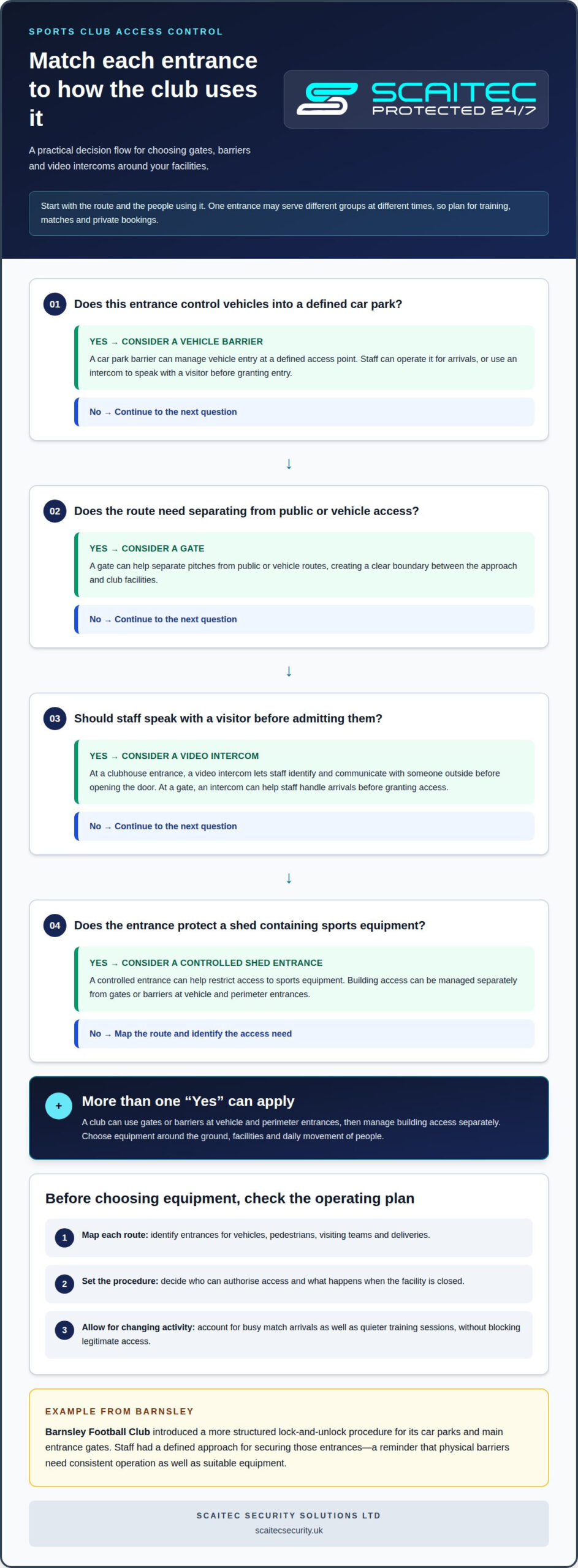
A gate or barrier creates a clear boundary between public approaches and club facilities. At a sports ground, it can separate the car park from pitches or limit vehicle access to delivery and staff areas. The right arrangement depends on the entrance layout, who needs access and how the site operates during training, matches and private bookings. An intercom can let staff speak with visitors before admitting them, while a controlled gate makes entry deliberate rather than open to anyone passing by.
To secure equipment sheds, pitches, car parks and clubhouses, clubs can use gates or barriers at vehicle and perimeter entrances, then manage building access separately. A shed containing sports equipment may need a controlled entrance, while a car park barrier can help distinguish authorised arrivals from general traffic. These measures work best as part of a plan that considers how members, visiting teams, staff and deliveries move around the facilities.
Vehicle barriers can be useful where a club has a defined car park entrance. Staff can operate the barrier for arrivals, or use an intercom to speak with a visitor before granting entry. At a clubhouse entrance, a video intercom gives staff a way to identify and communicate with someone outside before opening the door. Each point should have a clear operating procedure, including who can authorise access and what happens when the facility is closed.
Situation: Barnsley Football Club needed a more detailed process for its car parks and main entrance gates. Action: the club introduced a more structured lock-and-unlock procedure. Result: staff had a defined approach for securing those entrances. This shows that physical barriers need consistent operation as well as suitable equipment. A gate left open after a session can undermine the boundary it is meant to provide.
Before selecting equipment, map each route. Identify which entrances serve vehicles, pedestrians, visiting teams or deliveries. Then decide where an intercom would help staff handle arrivals and which gate or barrier needs controlled operation. One entrance may serve different groups at different times, so procedures should account for busy match arrivals and quieter training sessions without blocking legitimate access.
- A car park barrier can manage vehicle entry at a defined access point.
- A gate can help separate pitches from public or vehicle routes.
- A video intercom can support visitor communication at a clubhouse entrance.
- A controlled shed entrance can help restrict access to sports equipment.
For clubs planning business access-control arrangements, linking the entrance equipment to the site’s routine helps keep procedures consistent. The best choice is the one that fits the club’s ground, facilities and daily movement of people.
CCTV updates and camera coverage
A camera system can leave gaps when a sports club changes its layout or routines. New fencing, temporary structures, parked vehicles and growing foliage can obscure views. A camera that once covered a path may now capture only part of it. Review coverage after changes to entrances, pitches, car parks and clubhouse areas. Also consider activity during daylight and evening sessions, when lighting and movement differ.
A useful review starts with the club’s security priorities, not simply the existing camera positions. Map the routes people use to reach the ground, then identify spaces where incidents could go unseen. Consider whether each camera shows the approach, the access point and the area beyond it. The aim is usable coverage for the intended purpose, while accounting for how people move through the site. A view blocked by a structure or vehicle may need adjusting or additional coverage.
Situation: Barnsley Football Club’s CCTV system had blind spots. Action: the club updated the system and installed additional cameras to cover those areas. Result: the previous gaps received camera coverage. This shows why updates should address identified weaknesses, rather than simply add equipment without a clear objective.
For a club in England, coverage planning should account for the whole journey across the site. An entrance camera may show arrivals, while a separate view could cover the route between the car park and clubhouse. A pitch perimeter may need a different angle from an equipment-store approach. Reviewing these locations together helps reveal whether the system supports the club’s actual layout. A business CCTV system can be planned around those site-specific areas.
During a camera review, consider these practical points:
- Check whether trees, signs or new structures obstruct an existing view.
- Assess entrances and paths used by members, visitors and teams.
- Consider how low light affects views around evening training sessions.
- Identify areas where overlapping views could help clarify movement.
After an update, assess the revised camera views against the intended coverage. For example, moving a camera to include a previously obscured path might remove a doorway from its frame. Reviewing both areas helps avoid solving one blind spot by creating another. The club’s changing use of facilities should inform later reviews, particularly when routes, boundaries or buildings change.
For sports club security systems in Barnsley, plan each camera update around a clear site need. This helps the club understand what each view contributes, where gaps remain and how coverage may need to change as the ground develops.
Sports club gates and barriers can be monitored 24/7 with a high-definition CCTV bullet camera system that records footage whenever they open. Barnsley Athletic Club updates athlete data every year on annual membership forms.
Intruders and youth nuisance
Unwanted access can affect a sports club after training, during closed periods or around isolated areas. Risks include entry to equipment stores, damage to facilities and nuisance near pitches or car parks. Start by mapping where incidents occur and when the site is unattended. This pattern helps shape the response, rather than treating every area as equally exposed.
Common weaknesses include an unsecured entrance, a damaged perimeter, poor visibility around a building or accessible equipment. A club can record reported incidents by location and time, then use that record to identify recurring issues. For example, repeated activity near a clubhouse entrance may call for a review of access arrangements and alarm coverage. Clear opening and closing procedures also reduce the chance of a gate or building being left unsecured.
Sports clubs don’t all need the same alarm response. A monitored alarm may suit a venue with valuable equipment or regular periods without staff. The response should reflect the site, its risks and the club’s procedures. An alarm signal does not, by itself, mean police will attend, so clubs should not assume police response is automatic.
Intruder alarms can complement physical security by alerting people to activity inside protected areas. For a sports venue, the design can consider spaces such as a clubhouse or equipment store, rather than treating every building as one zone. The club’s operating pattern matters: evening training, weekend fixtures and periods when facilities are empty all affect how an alarm is used. An intruder alarm system for business premises can be planned around those needs, installed by Scaitec Security Solutions Ltd to ensure complete reliability.
Situation: a club notices repeated nuisance near a pitch after scheduled activity ends. Action: it records when and where the behaviour occurs, reviews entry procedures and strengthens the relevant security arrangements. Result: the club has a clearer basis for addressing the recurring issue and coordinating a proportionate response utilising professional sports club security systems Barnsley.
A partnership with local community contacts can also help clubs respond constructively to youth nuisance. Staff can distinguish between young people using nearby public areas and conduct that involves trespass, damage or a threat. Clear site boundaries and consistent reporting help avoid treating ordinary presence as wrongdoing. Where an incident involves immediate danger, call 999.
For each reported event, note the location, what happened and whether anyone faced an immediate risk. This information helps the club assess patterns and decide whether to review alarms, access arrangements or staff procedures. A calm, consistent response supports safety without unnecessarily escalating minor nuisance.
Proper documentation can help the club compare reports by location and timing and distinguish nuisance from an imminent threat. An imminent threat should be reported by calling 999. Keeping each account focused on what happened and whether anyone faced immediate risk can help staff assess recurring incidents consistently.
Turnstiles and door entry systems
Turnstiles can organise entry at a busy sports ground by directing people through a controlled point. Door entry systems suit clubhouses, changing rooms or other buildings where access needs differ from pitch access. The choice depends on the venue’s layout, visitor flow, staff procedures and which areas need separate access arrangements.
For a smaller club, a focused system may centre on controlling a clubhouse entrance and keeping other access procedures straightforward. A larger venue with several buildings, pitches and visitor routes may need distinct arrangements for different entrances. There’s no fixed package for each club size: the system should match how members, teams, staff and visitors use the facilities.
A turnstile can help manage pedestrian entry at a match or event, while a door entry system can control access to an internal area. For example, a club could direct spectators through the main entrance and keep changing-room access separate. Planning should consider queues, accessible routes, staff oversight and how authorised people enter when the venue is quieter.
Situation: evening users need access to car parks and training pitches while other parts of a venue remain closed. Action: separate entry arrangements can direct booked users to the facilities they need without opening every building. Result: the club can manage access by area and session, with procedures that reflect how the site is used.
Funding may help with a Barnsley club’s security project if it meets the relevant scheme requirements. Barnsley Section 106 funding is for capital projects, and applicants must not start work before the funding agreement is signed. Where project work is valued at over £20,000, applicants must submit three quotes. An agreed project must commence within 12 months of the agreement.
For organisations on Barnsley’s boundary with another borough, at least 80% of users or beneficiaries must live in Barnsley to be eligible for a Section 106 grant. The funding panel meets every two months. These conditions make it important to plan the security project, its scope and funding application together, rather than beginning installation before the agreement is signed.
When choosing access arrangements, consider the people, routes and spaces involved:
- Use a turnstile where controlled pedestrian flow is important.
- Use door entry to manage access to selected buildings or rooms.
- Plan separate routes for spectators, teams and staff where needed.
- Allow for accessible movement and staff procedures at each entrance.
A project combining access control systems with turnstiles should account for each entrance’s purpose and daily use. This keeps the design practical for ordinary training as well as busier match days.
Plan access control for your club
Scaitec Security Solutions: System Maintenance
Scaitec Security Solutions Ltd provides system maintenance for sports clubs whose CCTV, intruder alarms or access control systems need ongoing attention. Arrange maintenance when equipment needs routine care, a fault needs addressing or changes to the venue affect how the system works. Regular servicing helps clubs manage security as their facilities and access needs evolve.
For a joined-up approach, maintenance can consider how cameras, alarms and access controls support the club’s daily routines. Regular system maintenance helps keep security arrangements in view over time.
Contact Scaitec Security Solutions Ltd to discuss system maintenance for your club.
Make your club’s next security decision count
A useful next step is to turn your club’s security priorities into a practical plan. Consider which areas need attention first, how people use the site during different activities and where maintenance fits into the club’s routine. This gives a security professional a clearer picture of your venue and helps shape a suitable approach to sports club security systems in Barnsley.
Scaitec Security Solutions Ltd can support clubs with CCTV Systems, Intruder Alarms and Access Control Systems, alongside system maintenance. Whether you’re planning new equipment or reviewing an existing setup, these services can be considered in light of your facilities and the way your members use them.
Start a conversation about the security arrangements that could work for your club.
A clear, considered plan can help your club move forward with greater confidence.
Frequently Asked Questions
What are the key benefits of sports club and sports pitch access control systems?
Access control helps a club manage who can enter particular spaces, supporting smoother use of shared facilities. For example, a visiting team may need access to changing areas and a pitch while administrative rooms remain restricted. Clear entry arrangements can also help staff handle different activities without relying on an open-access approach. The system should reflect the club’s users, routines and the areas it needs to manage.
What security systems are available for sports clubs in Barnsley?
Sports club security systems in Barnsley can include CCTV Systems, Intruder Alarms, Access Control Systems, Fire Alarm Systems, Remote Monitoring and System Maintenance from Scaitec Security Solutions Ltd. Its service area includes Rotherham, Sheffield, Barnsley, Doncaster, Chesterfield, Worksop, Wakefield and Huddersfield. Scaitec Security Solutions Ltd is Insurance Approved and SSAIB Certified, and is the Best Rated Security Company in Rotherham. Installation is guaranteed within 7 days of acceptance of proposal.
What CCTV coverage and camera features suit sports grounds and clubhouses?
Suitable CCTV depends on what the club needs to see and review. For a clubhouse, camera views can focus on relevant activity around selected entrances or shared areas rather than capture broad, unfocused scenes. An installer can assess sightlines, lighting and mounting positions against the site layout. The club should also consider how authorised staff will review recordings and ensure the planned coverage serves a clear purpose.
What access control systems work for sports clubs, changing rooms and grounds?
Access control can be planned around the different users and spaces at a club, such as a clubhouse, changing rooms or pitch-side facilities. A tailored arrangement helps separate areas with different access needs. Clubs considering wider safety upgrades can also plan fire alarm installation, with all installations meeting current British Standards. For servicing, non-contract customers receive the same care and attention as Protect-plan customers.
Protect Your Business
Protect Your People
Book Your FREE Site Protection Survey

Since pioneering Scaitec Security Solutions in 2005, Paul Scaife, with his roots in the industry dating back to 1994, has distinguished the firm as a leading provider of bespoke fire and security solutions, servicing clients across Sheffield, Rotherham, and surrounding areas.
His leadership, underpinned by accreditation from the Security Systems and Alarms Inspection Board, ensures that Scaitec surpasses client expectations by blending advanced technology with a deep understanding of their unique needs.
Paul's ethos champions innovation and efficiency, driving Scaitec to deliver tailored, cutting-edge solutions that enhance safety and operational ease.
Discover more about Paul’s commitment to excellence on LinkedIn.