
Table of Contents
What happens when an alarm sounds at your holiday home and you’re several hours away? An empty property between bookings can be difficult to oversee, while security measures must still respect guests’ privacy during their stay. The holiday home security systems UK owners choose should do more than detect possible intrusion. They should help make relevant areas visible and ensure there’s a clear plan for handling alerts.
Reliable protection doesn’t have to add unnecessary complexity or make guests feel watched. Start by considering the building, its access points and how it’s used. Then decide what should happen when the property is vacant, during changeovers and while guests are staying. This guide explains how CCTV, intruder alarms, access control and remote monitoring can work together, and what to consider when managing guest access, privacy and maintenance. It also covers how professional design, installation and support can help reduce security gaps over time, including for owners who can’t respond to alerts in person.
Key Takeaways
- Plan for the different security needs of vacant periods, changeover days and guest stays.
- Understand how CCTV, intruder alarms and remote monitoring can work together, and where each has limits.
- Choose holiday home security systems UK properties need by considering the building layout, access points and occupancy.
- Use a consistent handover routine to check system status, manage access permissions and agree who receives alerts.
- See how tailored design, installation and maintenance can support a security plan over time.
Why holiday home security systems in the UK need to cover both empty periods and guest stays
A holiday property changes how it’s used as bookings come and go. During a vacancy, the owner may want to detect activity and know who will respond to an alert. On changeover day, cleaners or other authorised people may need access. During a guest’s stay, security should support the property without making the accommodation feel intrusive. A practical plan accounts for each stage and makes it clear who is responsible for access and alerts.
A holiday-home security system is a coordinated set of measures for detecting activity, making relevant areas visible and arranging a suitable response, planned around whether the property is vacant or occupied. CCTV, an intruder alarm and a clear alert process can each contribute, but no single measure guarantees that an incident will be prevented or dealt with immediately. For a general overview of how different measures can work together, see Home Security Overview.
That distinction matters when choosing holiday home security systems UK owners can manage from a distance. The objective is to reduce avoidable gaps and make alerts useful, not to promise complete protection. Start with the building and its routine: list the entrances, note which people need access at different times, and decide who should receive an alert. The same principle of tailoring measures to how a site operates informs Scaitec’s business security systems, while a holiday home needs a plan shaped around guest occupancy.
Where security gaps can arise between bookings
When a property is empty, a fault or unexpected entry may go unnoticed until an owner, cleaner or neighbour visits. Longer closures can make regular checks less practical, while short gaps between bookings still leave periods when nobody is on site. Assess the main house alongside side entrances, shared access routes and outbuildings. A detached store or garage may have different visibility and access patterns from the accommodation, so include it in the assessment rather than assuming the house tells the whole story.
Consider both the normal booking cycle and the longest planned closure. Who checks the property, how often, and who can act on an alert? Write down the answers and identify any point where nobody is responsible. This helps clarify where detection, visibility or a response arrangement may be useful.
Balancing owner oversight with a welcoming guest experience
Distinguish external areas, such as approaches and entrances, from the accommodation guests use privately. Avoid placing cameras in private indoor spaces. Explain relevant security arrangements clearly to guests, including any cameras and how access is managed. A straightforward handover should also confirm that access permissions and alert contacts are appropriate for the period of occupancy.
Keep the arrangement proportionate. Owners need enough oversight to manage an empty property, but guests should be able to understand the setup and enjoy their stay without feeling monitored. Review the plan when the property, booking routine or access arrangements change. Consistent design, installation and maintenance help keep it practical over time.
How CCTV, intruder alarms and remote monitoring work together in a holiday home
CCTV, an intruder alarm and remote monitoring have different jobs. Cameras provide visibility of selected areas; an alarm detects activity that matches its configured settings; monitoring determines how an alarm signal is handled. They can form a coordinated plan, but none should be treated as a substitute for the others. Cameras help show what is happening, alarms detect specified activity, and monitoring connects an alert to an agreed response process.
For holiday home security systems UK owners can manage reliably, start with the building rather than a standard equipment list. Note the position of external doors, windows, shared entrances, driveways and separate outbuildings. Then factor in how access changes between guests, cleaners and longer periods when the property is empty. System design should reflect these patterns of use, with clear decisions about what is monitored and who is responsible for acting on an alert.
What CCTV contributes when a holiday property is unattended
Camera placement can provide visibility of relevant external approaches, such as a driveway, entrance or route towards a side door. Aim for useful coverage rather than simply installing cameras in as many places as possible. Sightlines, lighting and areas beyond the property can affect what a camera captures. Scaitec designs home CCTV systems around a property’s layout. Image review and remote access depend on the system selected and configured, so don’t assume every camera provides the same features.
How intruder alarms and monitoring support the response
An intruder alarm detects specified activity, such as a sensor being triggered, and generates an alert through the configured system. Depending on the arrangement, that alert may be sent to an owner or agreed contact, or the alarm may be connected to an Alarm Receiving Centre (ARC). These routes differ: self-notification relies on someone receiving and acting on the alert, while ARC monitoring routes alarm signals to the centre under the agreed arrangement. Scaitec designs and installs home intruder alarm systems around the property and its use.
Remote monitoring is not another name for CCTV. It describes how signals from a connected alarm are received and handled. Scaitec’s remote monitoring connects intruder and fire alarms to an ARC; the specific signals and procedures depend on the system configured. Owners should understand who receives notifications, which contacts are authorised and what the agreed next steps are. A notification alone doesn’t establish what has happened on site.
For example, an external camera may help provide context around an approach, while an alarm can signal configured activity inside the property. If monitoring is part of the plan, define its role alongside those devices. Scaitec designs, installs and maintains security systems, helping owners plan these layers as a joined-up arrangement rather than separate purchases. A practical starting point is to review the property’s entrances, occupancy pattern and alert-handling needs.
Comparing holiday home security systems: what each option can and cannot do
The right setup depends on what you need to know, detect and do when the property is empty. A visible camera may be useful, but it doesn’t automatically cover every entrance or ensure that anyone responds. Compare each option by its purpose and limits before deciding whether one measure is enough or a coordinated system makes more sense.
| Option | What it can contribute | What it cannot do on its own |
|---|---|---|
| CCTV | Shows or records activity in areas covered by the cameras, subject to system features and configuration. | Doesn’t itself guarantee that someone will review footage or respond to an incident. A camera’s view may not include every entrance. |
| Intruder alarm | Detects activity specified by its configuration and generates an alert. | Doesn’t provide visual context in the way a camera may, and an alert needs an agreed route for handling. |
| Monitored alarm | Connects alarm signals to an Alarm Receiving Centre (ARC) under the monitoring arrangement. | Doesn’t mean every event is covered in the same way or guarantee a particular outcome. Scope and response depend on the system and agreed procedures. |
These options address different needs rather than forming a simple ranking. CCTV may help show activity around a selected approach; an alarm can alert to configured activity; monitoring adds a defined route for alarm signals. A single device doesn’t automatically protect every access point. For example, a camera facing the main entrance may not show a side door or detached outbuilding. Assess each area separately, then decide where detection, visibility or an alert-handling arrangement would add value.
Standalone devices versus a professionally designed system
A standalone device can address one defined need, but it may leave blind spots or unclear handover steps if it’s added without considering the rest of the property. A designed system can account for layout, access points, camera views and alarm configuration together. Professional installation also allows the system to be set up for its intended use, with a handover that explains operation and relevant procedures. Scaitec’s holiday-property and business security support is relevant to owners managing a let as an operating property.
When remote monitoring may suit a holiday property
Monitoring may be useful when an owner is too far away to manage every alert personally, provided the arrangement has a clear scope and escalation process. The ARC receives connected alarm signals, while agreed procedures determine what happens next. Owners should understand which signals are covered and who is responsible for follow-up. For further context on alarm planning, see this intruder alarm guide for Sheffield properties.
Use these distinctions to shape holiday home security systems UK owners can operate confidently: match the measures to the property, understand their limitations and make alert handling part of the design. Scaitec designs, installs and maintains coordinated security systems around a property’s requirements.
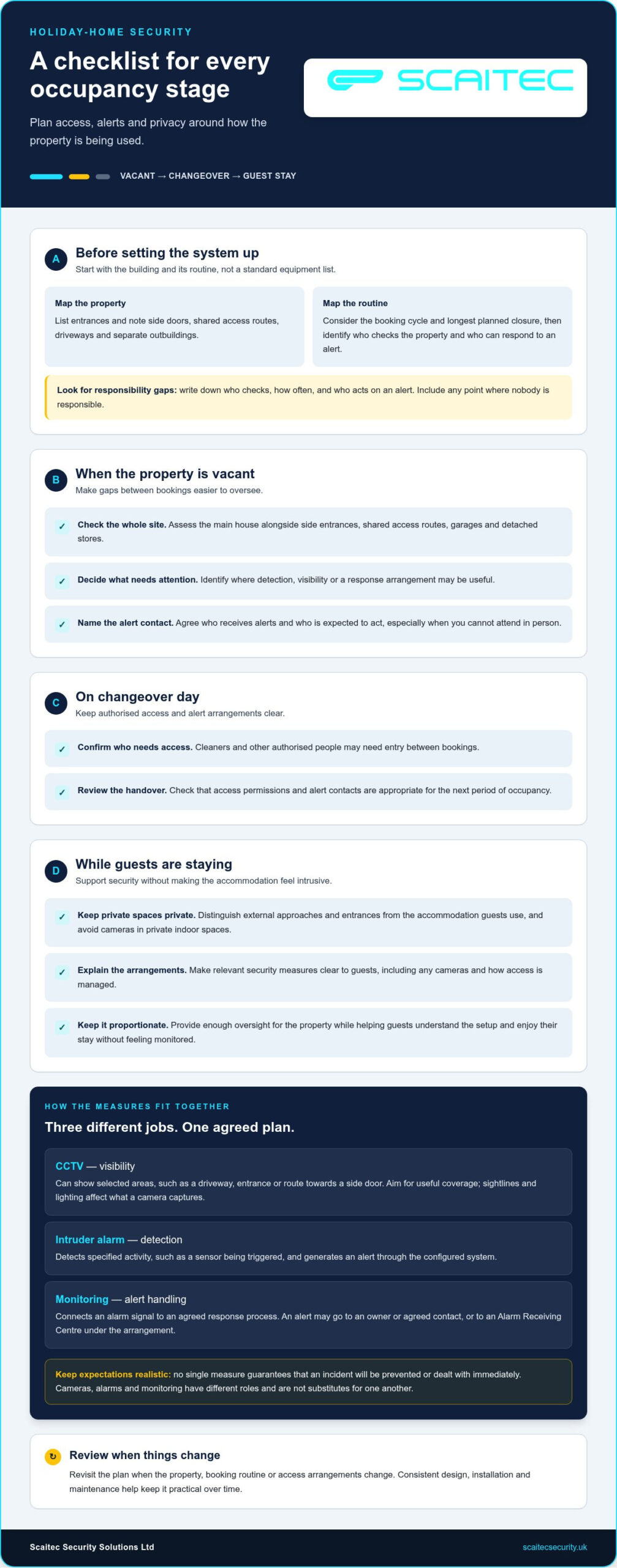
A practical holiday-home security checklist for vacancies, changeovers and guest privacy
A repeatable routine helps keep security arrangements clear as the property moves from owner use to guest stays and back again. Adapt this checklist to your property: verify the system, confirm who has access and who receives alerts, then review the setup at every handover. Keep the instructions somewhere accessible to the people responsible for managing the let.
Preparing the property before it is left empty
Before a vacancy, confirm that the system is in the intended mode and alerts reach the agreed recipient. Note who is responsible for responding, and include routine inspections and maintenance in the closure plan. Keep a simple record of the system status, contact person and any relevant access permissions. This helps avoid assumptions, particularly when the owner isn’t nearby.
- Before guests arrive: Check the system’s status and confirm that the appropriate settings are in place for an occupied property. Make sure the agreed owner or manager can receive relevant alerts and knows what action to take.
- At guest handover: Explain relevant security arrangements in plain language, including any external cameras or alarm controls guests may encounter. Confirm which access permissions apply during their stay and who they should contact if a system issue arises.
- After departure: Review the handover record, remove or update access permissions as appropriate, and return the alarm to the agreed vacant-property settings. Confirm that the designated alert contacts are current for the period ahead.
- During a vacancy: Record who is responsible for receiving and acting on alerts. Schedule property checks in line with your management routine, and include the system in those checks rather than assuming it remains operational without attention.
- For a longer closure: Review the arrangements before leaving the property unused for an extended period. Check that inspection and maintenance plans remain practical, and that the people named as contacts still have the information and permissions they need.
Managing access and privacy during guest stays
Keep access arrangements controlled and understandable. Share only the permissions needed for each role, and include a clear step for reviewing them when a booking ends. If access control is used, align its permissions with the same handover routine as the alarm, so cleaners or managers aren’t left with access beyond their task.
Be deliberate about CCTV. Keep the guest experience in mind, explain relevant arrangements before arrival and avoid placing cameras in private indoor spaces. CCTV may involve personal-data considerations, so check current UK guidance, including relevant Information Commissioner’s Office advice, and review how your own setup is used. Don’t assume that one approach applies to every property or camera arrangement.
Build system checks into ongoing property care rather than treating installation as the final step. Scaitec provides security system maintenance to support the system lifecycle. A written routine, updated when occupancy or access arrangements change, helps owners and managers follow the same process between bookings.
Planning a tailored holiday home security system with Scaitec
A holiday let has its own pattern of use, from guest arrivals and changeovers to quieter periods when nobody is on site. Scaitec designs, installs and maintains CCTV and intruder alarm systems around the property’s requirements, with remote monitoring and ongoing maintenance considered as parts of the wider plan. The aim is a practical arrangement that fits the building and its management routine, rather than a standard set of devices.
What to expect from a property-specific security plan
Planning starts with how the property is used and what needs attention: its layout, access points, occupancy patterns and periods of vacancy. Those details help shape which system components are appropriate, where they should be positioned and how they should be configured. For CCTV, professional design considers the views needed around relevant areas. Scaitec’s CCTV systems information is relevant when thinking about camera coverage.
Share practical details during planning, such as which entrances guests use, whether there are separate outbuildings and who manages changeovers. These details affect how the system should operate when the property is occupied versus empty. Installation should be followed by a clear handover, so owners or managers understand how to use the system and how its arrangements fit the property’s routine.
Scaitec has been established since 2005 and serves South Yorkshire and the wider UK. For owners in Rotherham, Sheffield, Barnsley, Doncaster, Chesterfield, Worksop, Wakefield and Huddersfield, local support can be a practical consideration when planning installation and ongoing care. Holiday lets also operate as managed properties, so a tailored plan should account for both the building’s security needs and the people responsible for running it. Scaitec’s business security support is relevant to that operational side of a holiday let.
Keeping the system dependable over time
Security arrangements need attention after installation. Scheduled maintenance and checks can help identify issues with system operation and keep equipment aligned with how the property is used. For example, changes to entrances, room use or booking routines may mean owners need to review settings, permissions or alert contacts. Scaitec provides maintenance across its security systems, supporting owners as needs evolve.
Remote monitoring can also form part of an ongoing plan. Scaitec connects intruder and fire alarms to an Alarm Receiving Centre; the signals covered and procedures followed depend on the system and agreed arrangement. Owners should understand how monitoring fits with their handover process, including who manages guest access and who receives relevant information. Maintenance and monitoring serve distinct roles, but both can contribute to a security plan that remains considered over time.
Choosing holiday home security systems UK owners can manage confidently means connecting design, installation and aftercare to the property’s real use. Scaitec can help plan a system around your holiday property and its needs.
Make your next security decision with confidence
Before choosing holiday home security systems UK owners can rely on, decide what a successful arrangement needs to achieve for your property. Is your priority clearer oversight during longer closures, a more manageable process for changeover days, or a system that fits smoothly around guest stays? Identifying the outcome helps keep planning focused on practical needs rather than equipment for its own sake.
Think about how your requirements may change as the property is used differently. A considered plan should suit the property now and be straightforward to review if your booking routine, access arrangements or management responsibilities evolve. That gives you a useful starting point for discussing design, installation and ongoing support tailored to the property.
A clear plan can make caring for your holiday property feel more manageable, whether you’re preparing for the next booking or planning ahead for a quieter period.
Frequently Asked Questions
Do holiday homes need CCTV in the UK?
No, UK holiday homes don’t automatically need CCTV; suitability depends on the property and how it’s let. Before choosing cameras, map the areas where visibility would be useful and consider whether another measure could meet the same need. Holiday home security systems UK owners select should also fit guest privacy arrangements and the practical task of reviewing footage. Check current Information Commissioner’s Office guidance for your circumstances rather than assuming a camera is required.
Can I install CCTV inside a holiday let?
Indoor CCTV can be especially intrusive in guest accommodation, so consider alternatives before using it. If there’s a specific reason to monitor an area, assess whether it can be addressed without recording private living or sleeping spaces, and explain relevant arrangements before a booking. Don’t assume ownership alone settles privacy or data-protection questions. Check current UK guidance, including Information Commissioner’s Office advice, and seek appropriate guidance for your particular setup.
Will a holiday home security system work without broadband?
Some alarm functions may continue locally without broadband, but remote viewing, app notifications and internet-based signalling may stop or change. The answer depends on the equipment, its communication route and configuration. During system handover, establish which functions remain available and which require a connection, including whether an interruption creates a fault indication. This helps you plan an alternative contact or property-check routine while connectivity is unavailable.
Can an intruder alarm be monitored when I am away?
Yes, an intruder alarm can be connected to an Alarm Receiving Centre (ARC) if the system and monitoring arrangement are configured for it. That differs from app alerts sent directly to an owner, who needs to see and act on notifications. Before relying on monitoring, understand which signals reach the ARC, what information is provided and what action the owner or nominated contact is expected to take under the agreed procedures.
Does holiday home insurance require a particular alarm or CCTV system?
There’s no universal alarm or CCTV condition for every holiday-let insurance policy. Requirements, if any, depend on the wording and circumstances of the individual cover. Review the security conditions, declarations and any endorsements, then ask your insurer or broker how a proposed change affects your policy. Keep a note of the guidance you receive, and don’t rely on general claims that a particular device or monitoring arrangement automatically satisfies insurance terms.
How often should a holiday home security system be maintained?
There isn’t one maintenance interval that suits every system. Follow the guidance for the installed equipment and arrange checks that reflect its use and service arrangements. Keep a record of checks, faults and any changes, such as building work affecting a sensor or camera view. Owners in Rotherham, Sheffield, Barnsley, Doncaster, Chesterfield, Worksop, Wakefield and Huddersfield can include professional system maintenance in their ongoing property-care planning.
What should I do if a holiday home alarm is triggered while I am away?
Follow the property’s agreed alarm procedure rather than assuming the alert confirms an intrusion. Check the information provided by the system or monitoring arrangement, then follow the next step set out for you, such as contacting the nominated local keyholder. Keep that person’s details current and make sure they know how to reach you. If the alert may indicate an immediate danger, use the appropriate emergency service.
Protect Your Business
Protect Your People
Book Your FREE Site Protection Survey

Since pioneering Scaitec Security Solutions in 2005, Paul Scaife, with his roots in the industry dating back to 1994, has distinguished the firm as a leading provider of bespoke fire and security solutions, servicing clients across Sheffield, Rotherham, and surrounding areas.
His leadership, underpinned by accreditation from the Security Systems and Alarms Inspection Board, ensures that Scaitec surpasses client expectations by blending advanced technology with a deep understanding of their unique needs.
Paul's ethos champions innovation and efficiency, driving Scaitec to deliver tailored, cutting-edge solutions that enhance safety and operational ease.
Discover more about Paul’s commitment to excellence on LinkedIn.