
Table of Contents
What if checking your clinic from your phone depends as much on the system setup as on the cameras themselves? Veterinary clinic security cameras in Rotherham can support remote viewing when the system is connected and configured for access through a compatible app. Cameras may be able to record without Wi-Fi, though remote access depends on the system setup.
It’s understandable to want a clear view of key areas when you’re away from the clinic, while protecting the privacy of staff, clients and patients. A professional installation considers how the premises are used, where cameras can provide useful coverage and how footage will be accessed.
This guide explains what affects smartphone access, camera placement, night vision and resolution, as well as wired and wireless installation options. You’ll also learn how a tailored CCTV plan can help your clinic choose a practical setup for its rooms, entrances and everyday security needs.
Key Takeaways
- Remote viewing depends on the system’s connectivity and setup; a camera can still record locally without Wi-Fi.
- Thoughtful camera placement can cover important clinic areas whilst respecting privacy and using clear signage.
- Resolution and night vision should be chosen around the detail needed and the lighting conditions on site.
- Wired and wireless systems suit different premises, so camera positions and cable routes help shape the installation plan.
- A professional system plan can bring camera coverage, recording and viewing arrangements together around the clinic’s needs.
Can I view my CCTV on my Smartphone ?
Yes. Smartphone viewing is possible when the CCTV system has a network connection and remote access is configured. Depending on the system, recordings may be stored locally when Wi-Fi is unavailable, so remote viewing may not be possible.
For a veterinary clinic, remote access can help staff review an entrance or reception area when they’re away. Cameras may also deter unauthorised access and provide footage for reviewing an incident. However, poorly controlled viewing access can expose private images.
Remote Viewing Connectivity
Remote viewing depends on the connection between the recorder, the clinic’s network and the viewing device. If the clinic’s internet connection is interrupted, live smartphone access may be unavailable, even if cameras continue recording to a DVR, NVR or memory card.
During planning, a professional considers where the recorder will sit, how it connects to the network and which authorised users need access. For example, a practice manager might need to view reception, whilst other staff need no access. A business security system can be planned around the premises and its working needs.
Smartphone Alerts
Mobile app access can let authorised users view camera footage remotely. Some systems also offer motion-activated recording. Whether a phone receives an alert depends on the system’s features and configuration.
For example, activity near a clinic entrance outside opening hours may be useful to review. A professional can discuss which areas warrant attention, so routine movement in a busy treatment area doesn’t distract from more relevant events. Limit access to those who need it, and use individual accounts where the system supports them.
Smart detection can help identify movement in selected camera views, but settings need to suit each area. A corridor used by staff and animal patients may register frequent movement, while an external entrance has a different pattern. Settings affect what is recorded or highlighted, so the installer should consider each camera’s view and the clinic’s usual activity.
Remote access also makes privacy and account control important. Footage may show employees, clients and visitors, so viewing permissions should reflect their roles. In the UK, the Information Commissioner’s Office explains that CCTV capturing people beyond the camera owner’s property boundary can bring obligations under UK GDPR and the Data Protection Act 2018.
Before installation, map who needs smartphone access and which areas they need to view. Test the app using the clinic’s network and a mobile connection, confirming authorised users can open the intended camera views. Remote access supports oversight, while local recording provides a separate way to store footage when internet access is unavailable.
Camera locations and signage
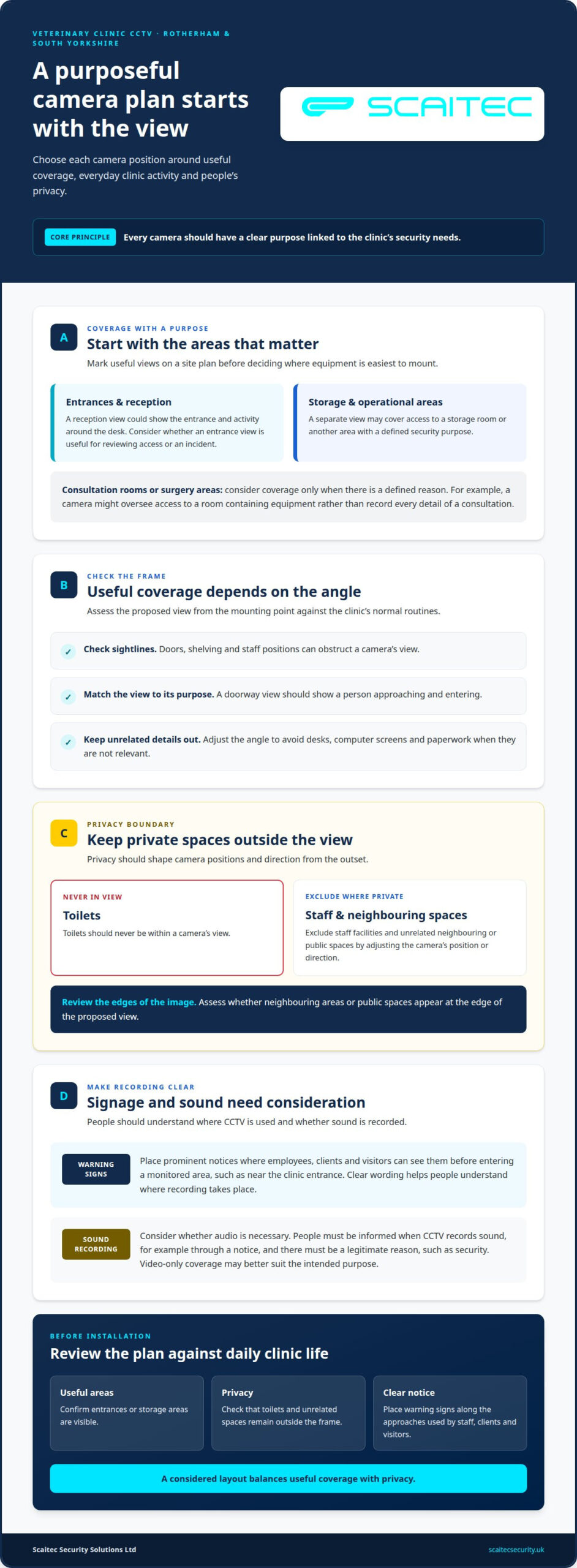
Camera positions should reflect how a veterinary clinic operates, not simply where equipment is easiest to mount. For clinics in Rotherham, Sheffield and South Yorkshire, a site plan can identify useful views around entrances, reception and operational areas while excluding private spaces. Each proposed camera should have a clear purpose linked to the clinic’s security needs.
Consultation rooms and surgery areas may be considered when there is a defined reason for coverage. For example, a camera might oversee access to a room containing equipment rather than record every detail of a consultation. The installer can assess sightlines and adjust the angle to keep desks, computer screens and paperwork out of view when they are not relevant.
Start the layout by marking the areas that matter. A view of reception could show the entrance and activity around the desk, while another camera may cover access to a storage room. Doors, shelving and staff positions can obstruct a camera’s view, so assess the proposed angle against normal clinic routines before installation.
Privacy should shape the plan. Toilets should never be within a camera’s view. Staff facilities and other private spaces can be excluded by adjusting the camera’s position or direction. A professional can assess the view from the proposed mounting point and consider whether neighbouring areas or public spaces appear at the edge of the image.
Prominent signs should tell employees, clients and visitors that they are entering an area covered by CCTV. Commercial installations in Rotherham include warning signage. Place notices where people can see them before entering a monitored area, such as near the clinic entrance. Clear wording helps people understand where recording takes place.
Sound recording needs separate consideration. People must be informed when CCTV records sound, for example through a notice, and there must be a legitimate reason, such as security. A camera near reception could capture conversations, so consider whether audio is necessary. Video-only coverage may be more appropriate for the intended purpose.
Before installation, review the proposed views against the clinic’s daily workflow. Confirm that entrances or storage areas are visible, while toilets and unrelated neighbouring spaces remain outside the frame. Place warning signs along the approaches used by staff, clients and visitors. These checks help make the layout clear and purposeful.
A considered camera plan balances useful coverage with privacy. In a veterinary clinic, every camera and sign should make sense to the people who work in or visit the premises.
Camera resolution and night vision
Resolution affects how much detail a camera captures, but the highest setting isn’t automatically best for every clinic. A camera covering a nearby reception desk has different demands from one monitoring a long corridor. The installer should match image detail to the distance, lighting and activity in each view.
For example, a view of a doorway should show a person approaching and entering. A wide shot of a treatment room may need to show activity across the space rather than small details in one spot. Camera angle, subject distance and obstructions all affect the final image. Reviewing a sample view on a monitor helps assess whether the intended detail is clear.
Resolution also affects how much recorded data the CCTV system handles. Higher-detail footage can use more storage and network capacity, depending on settings and recording activity. The recorder’s hard drive must support the chosen cameras and the clinic’s recording needs. The installer can balance image quality and storage use rather than choosing a setting in isolation.
Lighting matters just as much. Reception may be well lit during opening hours, whilst a rear entrance could be dark overnight. Full-colour night vision is included in CCTV kits described for homes in Rotherham. For a clinic, the appropriate night-time image depends on the camera’s position and the light available in that specific area.
At night, assess what the camera can see when the clinic’s lights are off. Bright lights facing the lens, reflective surfaces or glass can affect the image. For example, a camera aimed through a glazed entrance may show reflections instead of clear activity outside. A professional can assess the scene and position the camera to limit these problems.
Motion-activated recording is also included in the described home CCTV kits for Rotherham. It can help focus recordings on activity, but a camera facing a busy corridor may register frequent movement. The recording approach should suit each view, such as continuous recording for a key entrance or event-based recording where activity is occasional.
During planning, assess each view in daylight and darkness. Confirm the intended subject is visible, then review a recording rather than relying only on the live view. Check that important areas remain clear when doors open or staff move through the frame. These practical checks help set resolution and night vision for the clinic’s actual conditions.
The goal is usable footage, not simply a high specification on paper. Matching image detail, night-time visibility and recording settings helps a veterinary clinic make its CCTV system work for its premises and routine.
Camera types and installation options
Camera choice and installation method depend on the clinic’s layout, the areas to cover and how the system will be used. Planning veterinary clinic security cameras in Rotherham means considering both the equipment and the building.
Camera Types
Select cameras according to the view needed at each location, rather than applying one approach throughout the clinic. An entrance camera may need to show people approaching, while a larger room may benefit from a broader view. Lens choice, mounting position and available light all affect the image. A trained installer can assess these conditions and plan suitable coverage.
Camera numbers also depend on the property. A two-camera system covering a property’s front door and driveway is described as a straightforward Rotherham installation. Larger properties may use six to eight cameras, depending on camera specifications and cable runs. These examples show how coverage shapes equipment selection, rather than setting a standard camera count for veterinary practices.
Installation Options
Wired systems are generally more reliable and secure, while wireless systems are easier to install and move. The right choice depends on the building, intended camera positions and practical cable routes. A professional survey can assess where connections can run and whether a wireless arrangement better suits areas where installation access is limited.
Installation planning also covers the recorder’s location and how it connects to the cameras. For example, equipment may be placed in a staff-only area, with connections routed to the planned camera views. Cable routes and camera specifications influence the work involved, particularly across larger premises.
Recording needs should inform camera selection. The system must capture useful footage from its chosen views, and the recorder must support the selected cameras. For example, a clinic may want continuous recording at an entrance but a different approach in a quieter area. The installer can design settings around these distinct requirements.
Before fitting, the professional maps camera positions, reviews proposed views and plans connections. This helps identify obstacles such as doors, shelving or partitions before equipment is installed. For a clinic with several rooms, the plan can show how each camera connects to the recorder and what it will cover.
Wireless equipment can offer flexibility if the clinic’s layout changes, while wired connections may suit fixed camera positions. Either approach needs to account for the building structure, cable runs and recording requirements. A camera plan for a veterinary clinic in Rotherham should weigh these factors together, rather than focusing on camera count alone.
A clear installation proposal explains camera positions, the connection method and the recording arrangement. This gives the practice a practical view of how the equipment will work across its premises.
What CCTV systems do Rotherham veterinary clinics use?
There isn’t one standard setup for every veterinary clinic in Rotherham. The system should fit the rooms, entrances, recording needs and viewing arrangements of the individual practice. CCTV can monitor and protect property, according to the Information Commissioner’s Office, but camera coverage needs to serve a clear purpose.
Systems available in Rotherham include network video recorder (NVR) setups with 2TB or 8TB of storage. An NVR records footage from connected cameras, giving the clinic a central place to review recordings. The suitable storage capacity depends on the number of cameras, image settings and recording pattern. Continuous recording uses storage differently from recording triggered by activity.
For example, a clinic may want views of its entrance, reception and equipment areas. The installer can consider how many cameras those views need and whether the recorder can support them. Camera resolution and recording settings also affect storage use. A system plan should explain how each camera connects and where recorded footage can be accessed.
Remote access is another practical consideration. If authorised staff need to view footage on a smartphone, the system must be configured for remote viewing and connected appropriately. Cameras can record without Wi-Fi, but remote access to footage is unavailable in that setup. This distinction helps clinics balance local recording with off-site viewing.
Recording arrangements should reflect the clinic’s activity. A camera covering a quiet entrance may capture fewer events than one overlooking a busy reception. The installer can plan settings around these different patterns, while ensuring the chosen recorder and storage support the intended approach. Staff should also understand how to access relevant footage when an incident needs review.
System choice includes more than the recorder. Wired cameras may suit fixed positions and planned cable routes; wireless cameras can be easier to install and move. The building layout, room use and camera positions help determine which arrangement is practical. The installation plan should show how the equipment works together, rather than treating each camera as a separate purchase.
Before installation, map the required views and decide who needs access. Then match camera coverage, recorder capacity and connectivity to those needs. This gives the practice a clear basis for choosing a system without assuming every clinic needs identical equipment or storage.
Scaitec Security Solutions Ltd
Scaitec Security Solutions can help clinics turn their security needs into a practical CCTV plan, from camera coverage and recording to smartphone viewing. If you’re planning an installation or reviewing an existing setup, the system can be designed around your rooms, access points and daily routines.
Scaitec also provides Intruder Alarms, Access Control Systems and Fire Alarm Systems. This lets a practice consider its electronic security needs together, while keeping each system suited to its purpose. All fire alarm installations meet current British Standards.
Contact Scaitec Security Solutions Ltd to discuss CCTV planning for your veterinary clinic.
Plan for your clinic’s next stage
A plan for veterinary clinic security cameras in Rotherham should account for how the practice may change. A new consultation room, altered reception layout or revised staff access can affect what the system needs to cover. Treat the design as part of clinic planning, rather than a fixed list of cameras.
Before moving ahead, consider who will manage footage access, what operational changes may be coming and what staff need when reviewing an incident. Sharing these priorities helps shape a plan around the clinic’s working needs and makes future adjustments more considered.
Scaitec Security Solutions can discuss the clinic’s requirements and help identify a practical next step. A clear conversation about the premises, daily routines and future plans gives the project a useful starting point.
With a considered plan, your clinic can move forward with a security setup suited to its needs.
Frequently Asked Questions
Can the CCTV cameras see at night?
Yes, cameras with night vision can capture images in low-light conditions. The result depends on the camera’s position, available light and what needs to be visible. For example, a clinic may need to distinguish activity around an exterior entrance after closing. Discuss that viewing purpose during system planning, so the selected equipment and placement suit the actual night-time scene.
Does my CCTV system need to comply with the Data Protection Act?
Yes, business CCTV needs to comply with the Data Protection Act when it records people. If cameras capture areas beyond the clinic’s boundary, UK GDPR and the Data Protection Act 2018 may apply. The Information Commissioner’s Office provides guidance for CCTV operators. For a practical example, a camera covering an entrance should be positioned with neighbouring areas and public space in mind.
How do I know what type of CCTV system is best for me?
The best fit depends on the clinic’s security priorities and how its premises operate. Start by identifying the main concern, such as monitoring property, reviewing access to a storage area or recording activity around an entrance. The Information Commissioner’s Office recognises CCTV as a way to monitor and protect property. A professional can then match the system design to those priorities and the building.
What does CCTV installation cost in Rotherham?
The price depends on the clinic’s requirements and is provided after a quote request. Installation costs are affected by the number and type of cameras, recorder requirements, cable routes and the layout of the premises. For example, routing connections through several rooms may involve different work from fitting cameras near an accessible recorder. A site-specific quote is the practical way to understand the project cost.
Do Rotherham veterinary clinics use CCTV inside, outside, or both?
A veterinary clinic can use CCTV inside, outside or in both settings, depending on what it needs to monitor. An exterior camera might cover an entrance, while internal cameras could monitor reception or selected operational areas. Each camera should have a clear purpose and avoid unnecessary views of private spaces. The individual practice’s layout and security priorities determine the coverage plan.
What are the installation and equipment costs for veterinary clinic CCTV in Rotherham?
Equipment and installation are priced for the individual project, with a quote provided after a request. Equipment choices, camera numbers, recording requirements and the building’s cable routes affect the overall cost. A clinic replacing existing equipment may have different requirements from one planning a new system across several areas. The quote should clearly set out the proposed equipment and installation work.
Which Rotherham security companies install CCTV for veterinary clinics?
Scaitec Security Solutions installs CCTV for business premises in Rotherham and nearby areas, including Sheffield, Barnsley, Doncaster, Chesterfield, Worksop, Wakefield and Huddersfield. It is Insurance Approved and SSAIB Certified, and describes itself as the Best Rated Security Company in Rotherham. Installation is guaranteed within 7 days of acceptance of proposal. Non-contract customers receive the same care and attention as Protect-plan customers. All fire alarm installations meet current British Standards.
What UK privacy and data protection rules apply to CCTV in veterinary clinics?
UK clinics should consider privacy when CCTV records employees, clients or visitors. If footage captures people outside the clinic’s property boundary, UK GDPR and the Data Protection Act 2018 can create obligations. The Information Commissioner’s Office provides guidance for CCTV operators. For example, clinics should consider camera views, visible notices and whether audio recording is genuinely needed for security.
Protect Your Business
Protect Your People
Book Your FREE Site Protection Survey

Since pioneering Scaitec Security Solutions in 2005, Paul Scaife, with his roots in the industry dating back to 1994, has distinguished the firm as a leading provider of bespoke fire and security solutions, servicing clients across Sheffield, Rotherham, and surrounding areas.
His leadership, underpinned by accreditation from the Security Systems and Alarms Inspection Board, ensures that Scaitec surpasses client expectations by blending advanced technology with a deep understanding of their unique needs.
Paul's ethos champions innovation and efficiency, driving Scaitec to deliver tailored, cutting-edge solutions that enhance safety and operational ease.
Discover more about Paul’s commitment to excellence on LinkedIn.