
Table of Contents
Darkness need not leave a listed building unprotected. High-resolution CCTV cameras with low-light capability can work effectively in dimly lit areas. A security system for a listed building in South Yorkshire should protect the property while avoiding unnecessary disruption to its historic features.
It is understandable to want reliable security without intrusive wiring, fixings or equipment that detracts from a building’s character. A careful survey helps shape the right approach, from discreet camera positions and access control to fire safety suited to the property and its use. This guide explains how these elements can work together, why existing systems and building needs should be assessed before choosing equipment, and how tailored design can help safeguard people and heritage.
Key Takeaways
- Plan security around the building’s historic fabric, favouring discreet, reversible installation methods and avoiding unnecessary cabling through walls and ceilings.
- Low-light CCTV can help monitor dim areas; careful camera placement helps protect historic features while maintaining useful coverage.
- Survey existing equipment and assess the building’s risks and use before choosing new systems.
- Access control can restrict entry to sensitive areas, while fire alarm and access-control design should support safe escape.
- For non-domestic premises, BS 5839-1 is an important reference for fire alarm design, according to the British Standards Institution.
How can Sheffield’s heritage and listed buildings be protected sensitively?
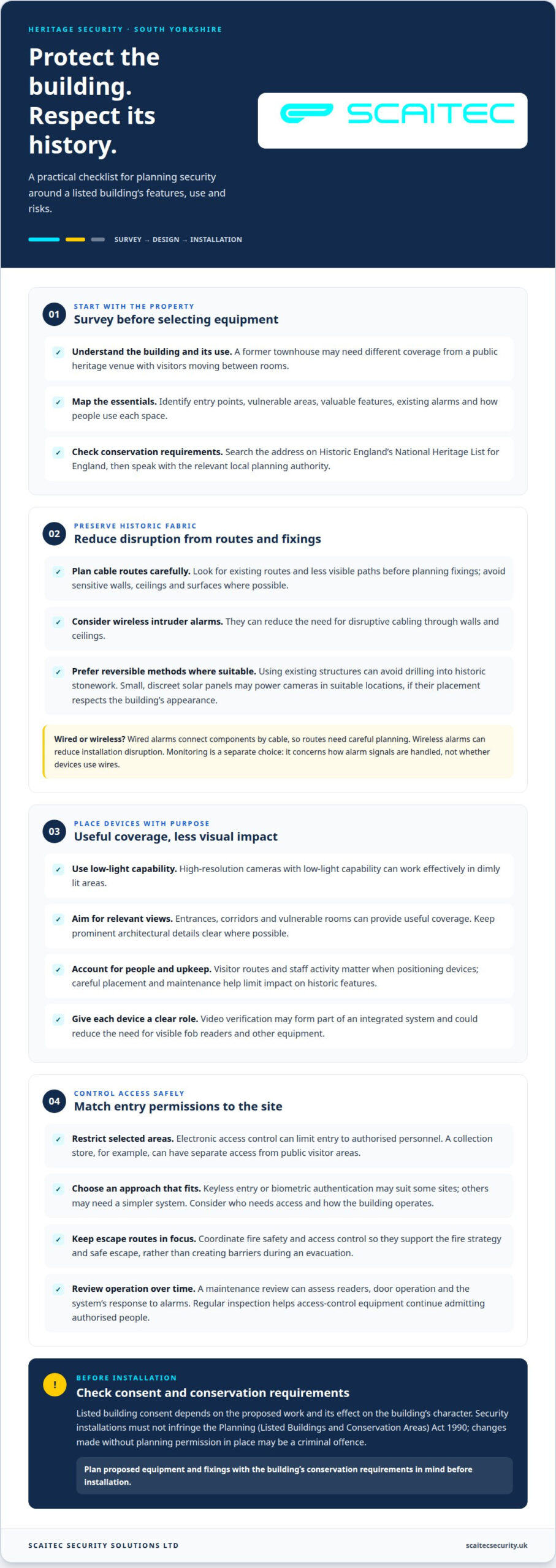
Protecting a historic property starts with understanding its structure, use and security risks. A careful survey can guide equipment choices and installation routes before work begins.
Bespoke security for historic properties
A tailored plan should reflect the building’s layout, historic features and daily activity. A former townhouse, for example, may need different coverage from a public heritage venue with visitors moving between rooms. The survey should map entry points, vulnerable areas, valuable features and existing alarms. This gives the design team a practical basis for choosing device locations and avoiding unnecessary equipment.
For a security system for a listed building in South Yorkshire, the priority is to match protection to the property rather than apply a standard layout. The plan can consider discreet camera positions, alarm coverage and how people use each space. This helps address the challenges of securing historic buildings without treating their original features as obstacles.
Balancing protection with preservation
Security measures should provide useful coverage without drawing attention away from historic details. Position cameras to monitor entrances and circulation routes, keeping prominent architectural features clear where possible. A camera aimed at a doorway, for instance, may capture relevant footage without dominating a decorative interior. Visitor routes and staff activity also matter when deciding where devices belong.
To find a property’s listing grade, search its address on Historic England’s National Heritage List for England. Then speak with the relevant local planning authority about conservation requirements for the site. These steps help identify features that need particular care before the installation plan is finalised.
Minimising impact on historic fabric
Start by identifying routes that avoid walls, ceilings and other sensitive surfaces. Where cabling is needed, a survey can look for existing routes and less visible paths before planning fixings. Wireless intruder alarm technology can reduce the need for disruptive wiring. Because wireless systems do not require cabling through walls and ceilings, they can help preserve original finishes.
Reversible installation methods are also worth considering. For example, placing equipment on existing structures can avoid drilling into historic stonework. Cameras need careful positioning and maintenance to limit their impact on historic features over time. Small, discreet solar panels may power cameras in suitable locations and reduce cabling needs, though their placement must still respect the building’s appearance.
Comparing alarm system options
Wired alarms use cables between system components, so routes need careful planning around historic fabric. Wireless alarms can reduce installation disruption by avoiding cables through walls and ceilings. Monitoring is a separate consideration: it concerns how alarm signals are handled, not whether devices use wires. The right design depends on the building’s layout, risks and conservation constraints.
South Yorkshire property owners can look for an electronic security company that considers listed-building fabric during its survey and installation planning. For commercial properties, a business security systems approach can address the site’s particular layout and use. A specialist assessment helps bring the building’s preservation needs and security requirements into the same plan.
CCTV/VSS and access control for heritage sites
At a heritage site, CCTV and access control should protect people and property without overwhelming historic interiors. The design needs to account for camera coverage, authorised entry, visitors and safe movement during an emergency. Consider each device by its purpose and position rather than adding equipment without a clear role.
Low-light, high-resolution cameras can operate effectively in dimly lit areas. Positioning them towards entrances, corridors or vulnerable rooms can provide useful views while keeping important architectural details unobstructed. Careful placement and maintenance help minimise the impact of surveillance equipment on historic features. Video verification can also form part of an integrated system, potentially reducing the need for visible fob readers and other equipment.
Electronic access control can limit entry to selected areas for authorised personnel. Keyless entry or biometric authentication may suit some sites, while others need a simpler approach. For example, staff access to a collection store can be restricted separately from public visitor areas. The design should reflect how the building operates, who needs access and which doors must remain available for escape.
Fire safety and access control need careful coordination. Both should support the building’s fire strategy and safe escape, rather than create barriers during an evacuation. An integrated system can also let owners remotely lock or unlock doors and view live video streams. These functions can help manage a site, but the design must suit its layout and emergency procedures.
Listed building consent depends on the proposed work and its effect on the building’s character. Security installations must not infringe the Planning (Listed Buildings and Conservation Areas) Act 1990; changes made without planning permission in place may be a criminal offence. Plan proposed equipment and fixings with the building’s conservation requirements in mind before installation.
Regular inspection after installation helps access-control equipment continue admitting authorised people. A maintenance review can assess readers, door operation and the system’s response to alarms. Before upgrading, review the existing equipment to see whether its coverage and permissions still match current use. This is particularly useful when room functions or staff access have changed.
For a listed site in South Yorkshire, CCTV and access control work best when their roles are coordinated. A burglar alarm can complement cameras by detecting an intrusion, while access permissions help manage who can enter sensitive areas. Explore how access control systems can support a considered entry plan for your property.
Surveying existing systems before equipment selection
A survey should establish what is already installed, how the building is used and where its main risks lie. This evidence helps shape recommendations before new equipment is selected.
Security surveys and recommendations
An in-depth risk assessment should come before choosing security equipment. The survey considers entry points, vulnerable rooms, existing devices and the building’s daily use. At a public site, the responsible building team can explain visitor routes, staff areas and periods when rooms are unoccupied. This practical input helps distinguish essential coverage from equipment that adds little value.
Existing systems need attention too. Some listed buildings have outdated alarms that may be unreliable in an emergency or fail to sound. A survey should record the intruder alarm’s condition, device locations and known gaps. Recommendations can then address specific weaknesses rather than replace equipment without understanding its role.
Strategic camera placement
Camera positions should follow the risks identified during the survey. Entrances, access routes and vulnerable external areas may need different views from public rooms or staff-only spaces. The survey should consider what each camera needs to capture, the lighting conditions and whether visitors or routine activity could obstruct the view. This turns coverage into a deliberate plan, not a collection of isolated devices.
Historic details also affect equipment placement. A camera can sometimes cover a doorway from an existing fixing point, avoiding a prominent wall or decorative feature. The survey should note where cables might run and how they could affect the building’s appearance. It should also identify how equipment can be accessed for maintenance without disrupting public areas.
Assessing risks and insurance requirements
Owners should weigh burglary, fire, unauthorised entry and risks linked to the building’s use. A museum, for example, may need to consider collection rooms and visitor circulation separately. The survey should also account for existing alarms, occupancy and areas left vacant. These factors help determine what protection is proportionate to the property and its operation.
Insurance requirements depend on the policy wording and the risks it covers. Identify any security conditions, such as alarm operation, maintenance records or access restrictions, then ensure the proposed system supports them. The survey can document existing measures and planned changes. Clear records help owners understand how system choices relate to the property’s risks and policy terms.
Fire and security provision for heritage and listed buildings
Fire and security planning for a heritage building must consider its occupants, historic fabric and emergency arrangements. A coordinated survey can identify where detection is needed and how equipment and cabling can be installed with minimal visual impact. For example, a vacant upper floor may need a different detection layout from a busy ground-floor visitor area.
For non-domestic premises in the UK, BS 5839-1 is an important reference for fire alarm design, according to the British Standards Institution. In a listed building, the design should also account for conservation requirements and restrictions on drilling or fixing. Wireless equipment can reduce intrusive cabling, but its positioning and operation still need to fit the building’s layout and fire strategy.
Fire detection should reflect how each part of a property is used. A heritage venue with public rooms, staff offices and storage areas needs a plan that considers these different activities. Wireless alarms can be checked remotely, including when a listed building is vacant or its owner is travelling. Sensors can also monitor smoke, temperature and humidity, helping identify potential fire or environmental risks.
Occupancy affects how fire and security measures work together. Listed buildings open to the public may have restrictions on visible wiring and may be more prone to false alarms because of visitors. A plan should consider visitor routes, staff areas and how people leave the building. Fire alarms and access control should support safe escape and the site’s fire strategy, not obstruct exit routes.
The Regulatory Reform (Fire Safety) Order 2005 requires employers to provide employees with training on actions to take in the event of a fire, according to UK legislation. The UK Government says the responsible person for workplace fire safety must arrange a suitable fire risk assessment, maintain appropriate fire safety measures, and provide staff with information and training. A PAS-79-format assessment document can record relevant risks and proposed measures.
Security installations in listed buildings should not infringe the terms of the Planning (Listed Buildings and Conservation Areas) Act 1990, according to UK legislation. Early planning should therefore identify proposed equipment, fixings and cable routes. A fire risk assessment should reflect the property’s actual use, including combustible materials, dust or flammable substances where relevant.
For a vacant heritage property, remote alarm checks can help keep its systems under observation. A coordinated plan can also define how fire detection, intruder alarms and access arrangements relate to occupancy. This gives owners a clearer basis for protecting the building, its people and its historic contents.
Tailored security solutions for listed buildings
Suitable protection combines systems to suit the building’s use, risks and conservation needs. In South Yorkshire, a tailored design can coordinate detection, access and monitoring without treating every room alike.
Tailored security planning
A useful plan starts by matching each security measure to a clear task. CCTV can cover key approaches, access control can manage restricted rooms, and intruder detection can protect areas when unoccupied. Fire safety should be considered alongside these measures, so security arrangements support the building’s emergency procedures.
For example, a public heritage site may need different arrangements for visitor spaces, offices and collection storage. A private historic property may prioritise external approaches and rooms containing valuable items. A security system for a listed building in South Yorkshire should reflect these differences, with equipment and coverage chosen for the property rather than a standard package.
Choosing suitable listed-building systems
Wireless intruder alarms can reduce the need for disruptive cabling, while carefully positioned CCTV can monitor entrances and vulnerable areas. Access control can restrict selected spaces to authorised people. The deciding factors include the building’s layout, occupancy, existing equipment and the impact of installation on historic features.
Remote monitoring can help manage system signals when a building is vacant. Wireless perimeter detection may also protect external areas, potentially reducing the need for intrusive security inside. These options are not interchangeable: each addresses a different risk, so the design should specify what each device detects and how its coverage relates to the site.
A tailored solution should also consider how systems work together. For instance, cameras can provide visual information around an alarm event, while access control records authorised entry to restricted areas. Fire and security provision must account for safe escape and the building’s fire strategy. Assess each proposed measure by asking what risk it addresses, where it operates and whether it affects daily use.
Maintenance is part of the long-term design, not an afterthought. Accessible equipment positions can make inspection and servicing more straightforward, while planned reviews can identify changes in occupancy, access needs or coverage. If a room becomes publicly accessible, for example, its protection may need to be reconsidered alongside visitor movement and emergency routes.
For a listed property, the key is to combine appropriate systems around its particular risks, historic fabric and use. A coordinated plan can connect CCTV, alarms, access control, fire provision and remote monitoring, while keeping each device’s purpose clear.
Discuss a tailored security approach
Scaitec Security Solutions: System Maintenance
Scaitec Security Solutions Ltd provides system maintenance to help keep security equipment suited to a listed property’s needs. Turn to maintenance when an existing system needs attention or when changes in building use affect CCTV, intruder alarms or access control.
For a heritage site, maintenance can review whether equipment remains appropriately positioned and its coverage still matches the property’s layout. If rooms have changed purpose or access arrangements have been updated, reviewing the system can help identify necessary adjustments. Ongoing care supports the practical use of security measures while keeping the building’s sensitive features in view.
Contact Scaitec Security Solutions Ltd to discuss system maintenance for your listed building.
Plan the next step for your historic property
Before changing equipment, set out how the building is expected to be used in the coming years. A change from private use to public access, for example, can alter who needs entry and which areas need protection. Recording these priorities gives the security plan a clear reference point as the property’s needs evolve.
For a security system for a listed building in South Yorkshire, connect those priorities with the building’s layout and conservation needs. Scaitec Security Solutions Ltd provides CCTV, Intruder Alarms and Access Control, which can be considered as part of a coordinated approach. Start with a conversation about the building and what you need its systems to do.
A considered plan can help you move forward with greater clarity while keeping the property’s character central to decisions.
Frequently Asked Questions
Do the surveillance cameras work in the dark?
Yes. High-resolution cameras with low-light capability can operate effectively in dimly lit areas. The view still depends on available light, camera position and anything blocking the lens. For example, a camera facing a dark corridor may provide a different image from one covering a lit entrance. When designing the system, identify which areas need night-time coverage and whether existing lighting affects the view.
How do I know the right level of security for my property?
Match the system to the property’s use, access patterns and potential risks. A home with an unoccupied wing may need a different arrangement from a public building with staff, visitors and restricted rooms. Consider which areas hold valuable or sensitive items, who enters them and when the building is empty. These details help determine what to monitor and who needs authorised access.
Which planning and conservation rules apply to security installations in South Yorkshire?
The Planning (Listed Buildings and Conservation Areas) Act 1990 is relevant to security work on listed buildings. Whether consent is needed depends on the proposed work and its effect on the building. Before fixing cameras, readers or other equipment, provide the local planning authority with a clear description of locations, fixings and cable routes. This gives conservation considerations a place in the decision before installation.
How can security equipment be installed without damaging historic fabric?
Ask for the installation plan to show each device, fixing and cable route before work begins. For example, an existing opening or discreet route may avoid cutting into a decorated surface. Reversible methods can also help limit lasting alterations. Keep a record of agreed positions, particularly where equipment sits near significant features, so future maintenance can be planned without unnecessary disturbance.
What security measures are recommended for listed homes and commercial buildings?
Listed homes and commercial premises can use a combination of CCTV, intruder alarms and access control, selected to address their different risks. A home may prioritise entrances and periods when it is vacant; a public building may need controlled access to staff-only rooms. Commercial sites should also consider fire provision and safe escape arrangements. A survey can help establish which measures suit the property’s layout and use.
Protect Your Business
Protect Your People
Book Your FREE Site Protection Survey

Since pioneering Scaitec Security Solutions in 2005, Paul Scaife, with his roots in the industry dating back to 1994, has distinguished the firm as a leading provider of bespoke fire and security solutions, servicing clients across Sheffield, Rotherham, and surrounding areas.
His leadership, underpinned by accreditation from the Security Systems and Alarms Inspection Board, ensures that Scaitec surpasses client expectations by blending advanced technology with a deep understanding of their unique needs.
Paul's ethos champions innovation and efficiency, driving Scaitec to deliver tailored, cutting-edge solutions that enhance safety and operational ease.
Discover more about Paul’s commitment to excellence on LinkedIn.