
Table of Contents
A wireless fire alarm can meet UK fire safety requirements; a cable connection isn’t what determines compliance. The right choice between wireless vs wired fire alarm systems depends on the building, its use and how the system is designed, installed and maintained. The Regulatory Reform (Fire Safety) Order 2005 requires the responsible person to ensure appropriate fire detection is in place, according to The National Archives.
It’s understandable to favour a wired system for reliability, or a wireless one to avoid disruption during installation. In the UK, both can be suitable when they meet the building’s needs and relevant standards. The British Standards Institution identifies BS 5839 as the recognised standard for fire alarm system design, installation and maintenance.
This guide explains how each system communicates, compares practical considerations such as installation, flexibility and ongoing maintenance, and outlines when a hybrid approach may be useful. You’ll also learn what affects wireless signal coverage and how to make an informed choice for your property.
Key Takeaways
- Both system types can meet UK fire safety requirements when they’re properly designed, installed and maintained for the building.
- Understand what can affect wireless signal reliability and why a site survey matters before choosing a system.
- See when wireless placement flexibility can help, and how a hybrid setup can support future changes.
- Compare cabling, power supplies and ongoing maintenance to identify the practical trade-offs for your premises.
- Use the building’s layout, use and plans for expansion to guide your choice, rather than assuming one system suits every site.
Are Wireless Fire Alarms Legal in the UK?
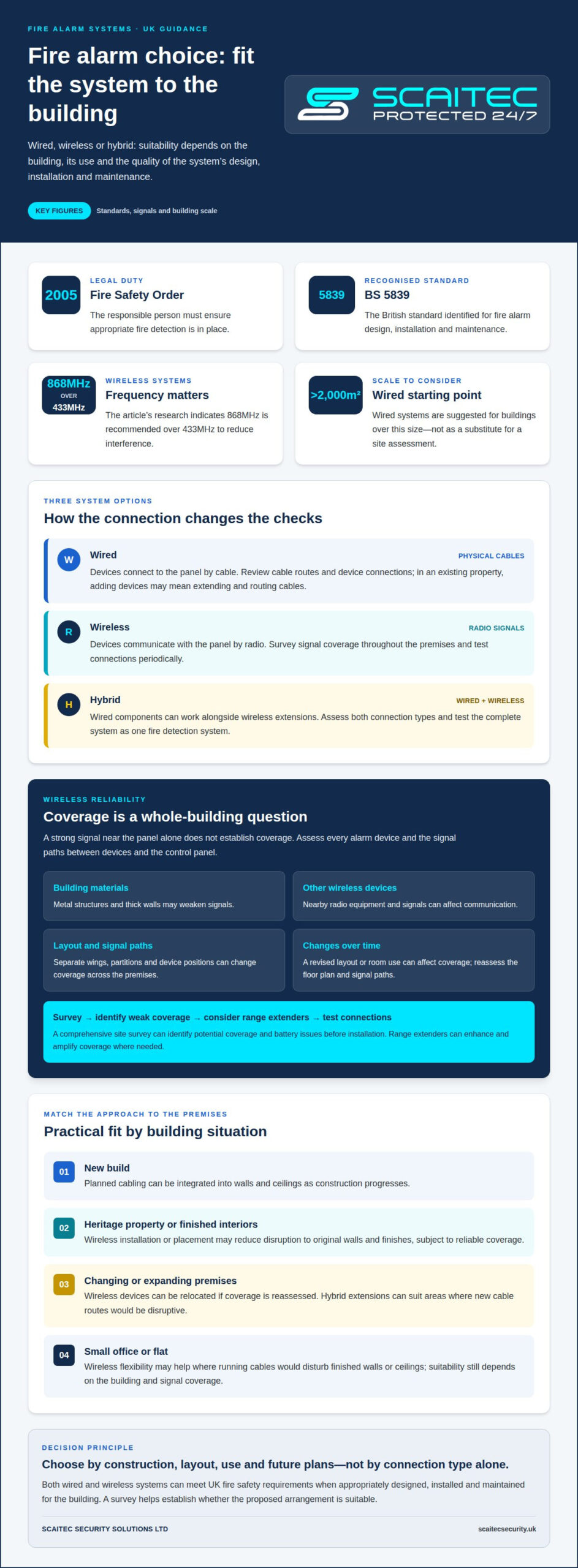
Yes. A wireless fire alarm can meet UK fire safety requirements when designed, installed and maintained for the building. Wired and wireless devices can also be combined in a hybrid system, with wireless extensions alongside wired components.
In the UK, the Regulatory Reform (Fire Safety) Order 2005 requires the responsible person to ensure appropriate fire detection systems are in place, according to The National Archives. The British Standards Institution identifies BS 5839 as the recognised British standard for fire alarm system design, installation and maintenance. The choice of connection type alone does not establish whether a system is suitable.
Reliability depends on how devices communicate and the conditions throughout the premises. In a wired system, cables connect devices to a control panel. This provides a physical connection, but the design must account for cable routes and connections. A wireless system sends radio signals between devices and the panel, so coverage throughout the building is essential.
Radio performance can be affected by metal structures, thick walls and other wireless devices. A dedicated frequency band is allocated to the fire and security industry to reduce widespread interference. The research indicates that 868MHz is recommended over 433MHz for wireless alarm systems to reduce interference. However, the building itself still matters: materials, layout and nearby signals can affect communication.
A wireless survey assesses whether signals reach the required areas. A comprehensive site survey can identify potential coverage and battery issues before installation. Range extenders can enhance and amplify wireless coverage where the survey identifies a need. Connections should also be tested periodically to confirm devices are still communicating. The same radio-path assessment can matter for intruder alarm systems, although fire detection has its own design requirements.
| System option | Connection | Reliability consideration | Practical check |
|---|---|---|---|
| Wired | Physical cables to the panel | Cable routes and device connections | Review the installation and connections |
| Wireless | Radio signals to the panel | Building materials and interference | Survey and test signal coverage |
| Hybrid | Wired components with wireless extensions | Both connection types need assessment | Test the complete system |
Base your choice on the building’s construction and layout, then assess device connections and overall coverage.
Wireless suitability cannot be judged by signal strength in just one spot. A survey should consider every alarm device and the signal paths between devices and the control panel. Metal partitions, thick walls or other radio equipment may weaken signals in some areas. Changes to the building layout can also affect coverage, so assess performance throughout the premises, not only near the panel.
Both systems rely on appropriate design, installation and maintenance. Wireless systems need communication tests, while wired installations depend on sound physical connections. A hybrid system combines both types, but its components must work together as one fire detection system. Assessing the building layout and signal coverage helps determine which arrangement is suitable.
Flexibility and system expansion
Building size, layout and construction all influence the choice. Large premises may need extensive coverage, while thick walls, separate wings and changes in room use affect device placement. New builds can incorporate cabling during construction; wireless installation may reduce disruption in a listed building.
Wireless devices offer flexibility in placement, provided coverage is reliable. This can suit a small office or flat where running cables would disturb finished walls or ceilings. Devices may also be relocated if a building’s use changes. The new layout still needs assessment because signal paths and device positions will differ.
Expansion requires planning, not simply adding detectors. If a business adds rooms or changes internal partitions, device positions may need to change to maintain suitable coverage. Layout or use changes can affect a wireless system, so assess the revised floor plan, intended room use and any changes to walls or building materials.
Wired systems can suit new buildings because cables can be incorporated into walls and ceilings during construction. In an existing property, adding a device may require extending cables and routing them through the building. Wireless extensions can help where new cable routes would be disruptive. A hybrid system combines wired components with wireless extensions to accommodate different areas of the same site.
- New build: planned cabling can be integrated as construction progresses.
- Heritage property: wireless placement can reduce changes to original walls and finishes.
- Changing premises: wireless devices can be relocated, subject to coverage assessment at the new site.
- Expansion: hybrid arrangements can add wireless extensions to wired components.
Scale is another factor. Buildings over 2,000m² are a situation where wired systems are suggested, while small offices and flats may benefit from wireless flexibility. These are starting points, not substitutes for assessing how rooms connect, where people work and how the premises may change.
Plan battery upkeep alongside any expansion. Additional wireless devices mean more batteries to monitor, while wired extensions need suitable cable routes. Consider device placement and system coverage together so future changes do not leave areas inadequately protected.
Before adding or moving devices, reassess the whole layout rather than treating each change in isolation. For help planning a suitable arrangement around your building’s structure and future use, explore fire safety planning.
How wired and wireless fire alarms operate
Installation, testing and maintenance differ mainly in how devices connect and receive power. Both systems use detectors, call points and sounders to alert people through a control panel. Commercial fire alarms should be tested weekly, and a qualified professional should inspect systems at least every six months under BS 5839.
In a wired system, physical cables connect each device to the central control panel. The panel connects to the mains supply and has a backup battery in case the primary supply fails. Cables carry signals between components, allowing the panel to register alarms or faults from connected detectors. Call points and sounders are also connected according to the system design.
Installation involves placing devices according to the system design and routing cables between them and the panel. In an existing building, cables may need to pass through walls, ceilings or other parts of the structure, causing disruption. In a new build, cabling can be incorporated as construction progresses, making routes easier to plan.
Wireless devices communicate with the control panel by radio rather than through cables. Detectors and other devices are typically battery-powered, although some wireless equipment can also use mains power. The control panel and any boosters need mains power cabling. A wireless panel should alert users when device batteries are low, helping maintenance teams identify batteries that need attention.
Wireless installation depends on device placement and radio communication. A survey assesses whether signals can reach the panel from the required locations. The installer then tests communication and checks that alerts operate as intended. Thick walls and metal structures can affect signal paths, so account for them when positioning devices.
Both arrangements need a primary and a backup power source. For wireless devices, check and replace batteries in line with the manufacturer’s guidance. For wired systems, include the panel and connected devices in routine maintenance. Service records help track tests and inspections and show whether faults have been addressed.
- Wired: inspect cable connections, panel status and backup power.
- Wireless: test device communication and respond to low-battery alerts.
- Both: record weekly commercial tests and scheduled professional inspections.
A fire alarm can combine wired components with wireless extensions. This allows devices to be placed where new cabling would be disruptive while retaining wired connections elsewhere. Test the complete system as one arrangement, including how detectors signal the panel and how sounders respond to an alarm.
Regular fire alarm maintenance helps keep a system reliable by identifying faults, checking connections and scheduling battery-related tasks.
UK legality and British Standards compliance
Wireless and wired fire alarms can both meet UK requirements when designed, installed and maintained for the building. The relevant standard depends in part on whether the premises are domestic or commercial.
BS 5839 compliance requirements
BS 5839 is the recognised British standard for fire alarm system design, installation and maintenance, according to the British Standards Institution. For domestic fire alarm systems, the relevant standard is BS 5839-6, according to the British Standards Institution. Commercial systems should meet BS 5839-1. These standards address the system’s suitability and lifecycle, rather than making cable or radio communication the deciding factor.
BS 5839-1:2017 recognises wireless fire alarm systems as a valid fire detection option. A wireless design still needs suitable signal coverage, while a wired design depends on appropriate cable routes and connections. For either option, the design should reflect the building’s layout and use. This differs from the legal duty, which sets the responsible person’s obligation rather than the technical design standard.
UK fire safety compliance
In the UK, the Regulatory Reform (Fire Safety) Order 2005 requires the responsible person to ensure appropriate fire detection systems are in place, according to The National Archives. The duty concerns providing suitable detection, not selecting wired technology over wireless technology. A fire risk assessment helps identify the premises’ needs, while the system design translates those needs into device locations and connections.
Compliance also involves keeping the system operational after installation. Commercial fire alarms should be tested weekly, and a qualified professional should inspect fire alarm systems at least every six months under BS 5839. These checks apply to the system’s functioning, not just its control panel or wiring. Wireless installations also need periodic checks that devices continue communicating.
Power arrangements are another part of system planning. Fire alarm systems need two independent power sources: a primary supply and a backup supply. A wired system commonly uses mains power with battery backup. Wireless devices are typically battery-powered, while a wireless control panel and boosters need mains power cabling. The design should account for both supplies and how faults will be identified.
In practice, a compliance review connects the building assessment to the installed system. It considers the premises’ use, the required detection and whether devices communicate with the control panel. For a commercial property, this means applying BS 5839-1 alongside the responsible person’s duty. For a home, BS 5839-6 is the relevant domestic standard.
- Identify the premises: distinguish domestic from commercial use.
- Apply the relevant standard: BS 5839-6 for domestic systems or BS 5839-1 for commercial systems.
- Plan and maintain: match system design to the building, then complete testing and inspections.
Neither wiring nor radio communication proves compliance on its own. The system must be suitable for the building, correctly installed and maintained to meet its needs and the relevant UK requirements.
Wireless and wired fire alarm system comparison
The practical difference is how each system fits the building during installation, future changes and routine maintenance. Compare the three common approaches against the premises’ construction, detector locations and plans for expansion.
| System option | Installation | Future changes | Ongoing consideration |
|---|---|---|---|
| Wired | Cables connect devices to the control panel | New cable routes may be needed | Inspect connections and backup power |
| Wireless | Devices communicate with the panel by radio | Devices can be repositioned if coverage allows | Test communication and manage batteries |
| Hybrid | Combines wired components and wireless extensions | Can suit areas with different installation needs | Test both connection types together |
Wired systems can suit new buildings, where cables can be planned during construction and concealed in walls or ceilings. This avoids altering finished surfaces later. In an existing property, routing cables may require work through floors, ceilings or walls. That disruption matters when the building remains in use during installation.
Wireless systems avoid running cables to each detector, which can make installation less disruptive in an existing building. Devices communicate with the control panel by radio, so layout and construction still matter. A survey checks whether coverage reaches the required locations. If internal walls or the building layout change, reassess coverage.
Consider the full period of ownership, not just the initial installation. Wired devices generally need fewer battery replacements and less frequent servicing after installation than wireless systems. Wireless systems need routine communication tests and battery checks, with replacements following the manufacturer’s guidance. Include this work in maintenance planning, especially where detectors are difficult to access.
Expansion also affects the comparison. Adding a detector to a wired system requires a suitable cable route and connection. Wireless devices offer more placement options, but each must communicate reliably with the panel. A hybrid system combines wired components with wireless extensions, which can suit a site with accessible cable routes in some areas and disruptive routes in others.
A new build with planned cable routes may suit wired installation. A listed property or retrofit may favour wireless devices to reduce disturbance to walls and décor. A large commercial site may suit wired infrastructure, while a smaller office may benefit from wireless flexibility. These are starting points, not substitutes for designing coverage around the premises.
Weigh construction, installation disruption, future layout changes and maintenance needs together. If the premises may change, consider how additional detectors can be connected and tested. If you want to avoid disturbing the building’s fabric, wireless placement may help, provided coverage is suitable.
Scaitec Security Solutions: Intruder Alarms
Scaitec Security Solutions Ltd can help turn the comparison into a practical fire alarm plan for your building. Its fire alarm installation and maintenance service supports your system from design and installation through ongoing care.
Whether you are planning a new installation or reviewing an existing system, consider the building’s layout, use and preferred installation approach. A considered design aligns device placement and system operation with the premises’ needs, whether wired, wireless or a combination is suitable.
For support with a fire alarm system or its maintenance, contact Scaitec Security Solutions Ltd.
Plan your next fire safety step
Your decision about wireless vs wired fire alarm systems should suit how the building operates now and may be used in future. Before choosing an installation, consider whether planned alterations, changes in occupancy or new internal spaces could affect device positions and coverage. Looking ahead helps avoid designing only for today’s floor plan.
Fire detection is one part of a wider security plan. Scaitec Security Solutions provides CCTV, Intruder Alarms and Access Control alongside Fire Alarm installation and maintenance. If you are reviewing several systems together, consider how their requirements fit the way people use the premises.
For a tailored discussion of your building’s fire alarm requirements, contact Scaitec Security Solutions Ltd.
A considered next step can help you plan a system that fits your building with confidence.
Frequently Asked Questions
What is a wired fire alarm system?
A wired fire alarm system uses cables to connect detectors, call points and sounders to a control panel. For example, when a detector senses smoke, it sends a signal through the cabling so the panel can activate the alarm. The system also has a primary power supply and backup power. Its design determines which devices are connected and how the alarm responds throughout the premises.
How long does it take to install?
Installation time depends on the building and the work involved. A straightforward layout with accessible cable routes differs from a retrofit requiring cables to pass through finished walls or ceilings. Wireless installation also takes time to position devices and test communication with the panel. Device numbers and locations, access to work areas and commissioning all affect the schedule.
How much does it cost?
The price depends on the building and is provided after a quote request. Cost factors include the number and type of devices, system design, installation method and the work needed to route cables or assess wireless coverage. Existing equipment and access to installation areas can also affect the project. A site-specific quotation is more useful than a generic figure.
What are the running costs?
Running costs include routine testing, professional inspections, repairs and replacement parts. Wireless systems also need battery checks and replacements, with timing guided by the manufacturer. Wired systems still require maintenance of backup power and connections. For budgeting, consider device access, the number of devices and whether the building’s use creates additional maintenance needs.
What’s the difference?
The main difference between wireless vs wired fire alarm systems is how devices communicate with the control panel. A wired system uses physical cables; a wireless system uses radio signals. This affects installation, device placement and ongoing maintenance. For example, avoiding new cable routes may favour wireless in a finished interior, while planned cabling may suit construction. Both require a design suited to the premises.
Which one is right for you?
Choosing between wireless vs wired fire alarm systems starts with the building’s construction, planned use and tolerance for installation work. A new build with cable routes incorporated into the design may suit a wired arrangement. A property where altering walls is undesirable may benefit from wireless devices if coverage is suitable. Also consider future room changes and access for maintenance. The right fit supports the premises throughout its use.
Which is easier to extend or add to?
Wireless systems can make adding or moving devices simpler when radio coverage reaches the new location. For example, a changed office layout may allow a detector to be repositioned without extending a cable route. Wired additions need a suitable physical connection to the system. Either way, design and test changes so new devices work as part of the complete alarm arrangement.
Which is more secure?
Neither connection type is automatically more reliable for fire detection. The essential question is whether the complete system can detect a fire and alert occupants in the spaces it protects. A wireless system relies on communication between devices and the panel; a wired system relies on sound connections. Appropriate design, installation, testing and maintenance matter more than connection method alone.
Protect Your Business
Protect Your People
Book Your FREE Site Protection Survey

Since pioneering Scaitec Security Solutions in 2005, Paul Scaife, with his roots in the industry dating back to 1994, has distinguished the firm as a leading provider of bespoke fire and security solutions, servicing clients across Sheffield, Rotherham, and surrounding areas.
His leadership, underpinned by accreditation from the Security Systems and Alarms Inspection Board, ensures that Scaitec surpasses client expectations by blending advanced technology with a deep understanding of their unique needs.
Paul's ethos champions innovation and efficiency, driving Scaitec to deliver tailored, cutting-edge solutions that enhance safety and operational ease.
Discover more about Paul’s commitment to excellence on LinkedIn.