
Table of Contents
A barrier is only as effective as the access system controlling it. For car park access control in Sheffield, the basic process is simple: an authorised vehicle triggers the barrier, which closes after the vehicle passes. Access can be managed with credentials such as fobs or through automatic number plate recognition (ANPR), depending on the site’s needs.
Controlling vehicle entry helps secure a car park, but the system also needs to suit how the site operates. Consider who needs access, how vehicles move through the entrance and how staff will manage exceptions or faults.
This guide explains how barriers and gates operate, how remote controls and ANPR manage access, and what affects the choice of system. It also outlines the car park security services available across Sheffield and wider Yorkshire, so you can understand the options and the professional support that may fit your site.
Key Takeaways
- Understand how a parking barrier controls vehicle entry and why monitoring helps identify access-control faults.
- See how sliding gates, remote controls and ANPR manage access in different ways.
- Learn how car park security systems can be planned for Sheffield and wider Yorkshire sites.
- Explore the considerations that shape security coverage for multi-storey, retail and commercial car parks.
- Find out which access-control options may suit your site and when professional system support can help.
How do Parking Barriers Work?
A parking barrier controls vehicle entry by raising an arm when an authorised driver approaches. For a Sheffield site, the design should suit the entrance layout, traffic flow and access requirements.
Automatic and Manual Rising-Arm Barriers
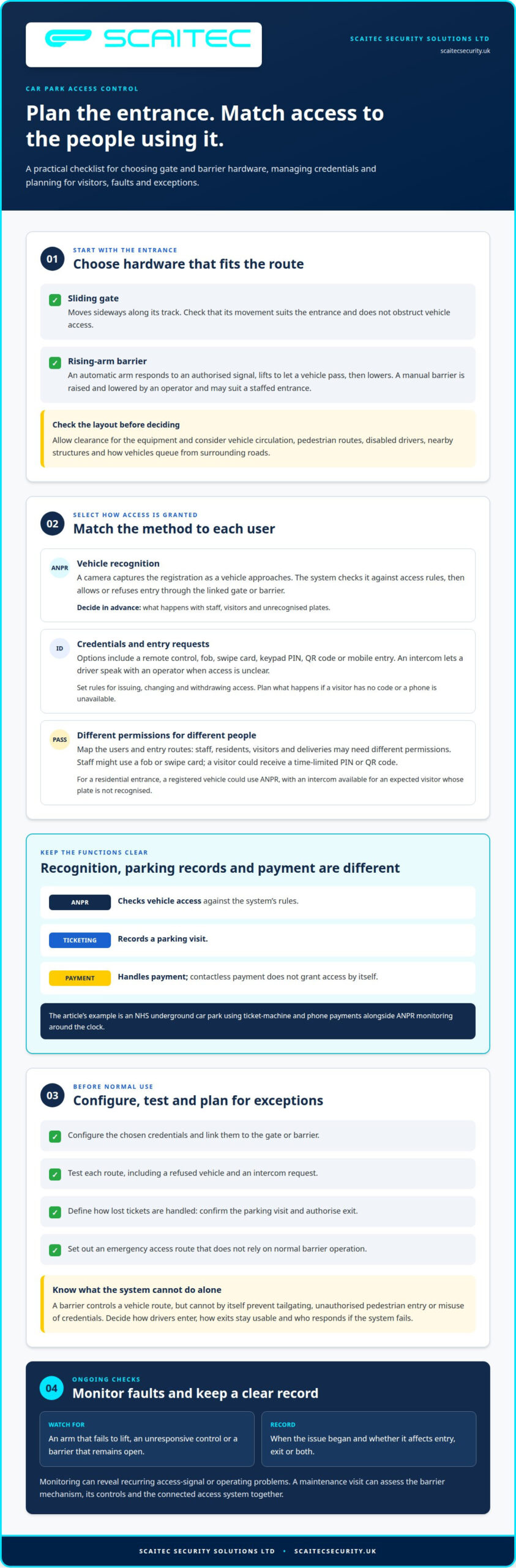
An automatic rising-arm barrier responds to an authorised signal, such as a fob or another access control system. The arm lifts to let a vehicle pass, then lowers to secure the entrance. A manual barrier requires an operator to raise and lower it, which may suit a staffed entrance. The choice depends on vehicle movements and how access will be managed.
Planning should account for safe vehicle circulation, pedestrian routes and suitable access for disabled drivers. Allow enough clearance for the barrier to operate without obstructing the route, and consider nearby structures that could affect its placement.
Local access design should consider how vehicles enter from surrounding roads and whether queues could affect traffic. At a venue such as Sheffield United FC, for example, planning would need to account for busy arrival periods, pedestrian routes and entry-point locations. This is a planning example, not a claim about a particular installation.
Barrier Access Monitoring and Defects
Monitoring can help operators spot problems, such as an arm that fails to lift, an unresponsive control or a barrier that remains open. Keeping a clear fault record helps show when an issue began and whether it affects entry, exit or both. A maintenance visit can assess the barrier, its controls and the connected access system together.
Monitoring can also reveal recurring problems, such as unreliable access signals or inconsistent operation at a busy entrance. Operators can use these observations to plan maintenance and limit disruption. The Scottish Government describes access control as limiting entry and exit points through measures such as security personnel, locks and bolts. A barrier provides a mechanical way to manage vehicle access.
Faults, Security and Emergency Access
A barrier controls a vehicle route, but cannot by itself prevent tailgating, unauthorised pedestrian entry or misuse of credentials. Consider how drivers enter, how exits remain usable and who responds if the system fails. These limits matter at sites shared by visitors, staff and delivery drivers.
When a fault occurs, a professional can assess whether the cause lies in the barrier mechanism, its control signal or the wider access system. Lost tickets require a process for confirming the parking visit and authorising exit. Emergency access also needs a defined route that does not rely on normal barrier operation. Regular maintenance can help identify faults before they repeatedly disrupt access.
Retrofitting an existing gate or barrier starts with assessing its condition, movement and current controls. The new access arrangement must work with the existing entrance and allow vehicles to pass without creating an obstruction. For professional access-control planning, business access-control systems can form part of a site’s wider approach to managing entry.
Sliding gates, remote controls and ANPR systems
Sliding gates, remote controls and ANPR provide different ways to manage vehicle entry. The right combination depends on who needs access and how the car park operates.
ANPR recognises a vehicle’s number plate and can trigger an authorised entry process. A ticketing system records a parking visit, while a barrier physically controls the entrance. Contactless payment handles payment, but does not grant permission by itself. An NHS underground car park combines ticket-machine and phone payments with ANPR monitoring around the clock, showing how these separate functions can work together.
ANPR and Vehicle Recognition
At an ANPR entrance, a camera captures a vehicle’s registration as it approaches. The system compares that plate with its access rules, then allows or refuses entry through the linked gate or barrier. Operators need to decide how the system should handle visitors, staff vehicles and unrecognised plates. This helps reduce reliance on shared remotes, but a vehicle that is not authorised still needs a clear route for requesting access.
A sliding gate moves sideways along its track, so its movement differs from a rising-arm barrier. A remote control can give an approved driver a direct way to request entry, whilst a keypad, fob or swipe card gives another credential-based option. For example, a staff member might use a fob, while a visitor enters a PIN supplied for their visit. Each method needs rules for issuing, changing and withdrawing access.
QR codes and mobile entry can give visitors a digital credential instead of a physical card. A keypad accepts a PIN at the gate, while an intercom lets a driver speak with an operator if access is unclear. These options can complement ANPR rather than replace vehicle recognition. The operator’s process should explain what happens if a phone is unavailable or a visitor arrives without a code.
Permits, Visitors and Staff Access
For permit access, an operator can associate an approved registration or credential with the relevant parking permission. Staff may use a fob or swipe card, while visitors receive a time-limited PIN or QR code. At a residential entrance, a resident’s registered vehicle could use ANPR, with an intercom available for an expected visitor whose plate is not recognised.
Implementation starts by mapping the users and entry routes: staff, residents, visitors and deliveries may need different permissions. The installer then configures the chosen credentials and links them to the gate or barrier. A test should cover each route, including a refused vehicle and an intercom request, before normal use. For home sites, access-control systems can support a planned approach to managing entry.
Car park security services in Sheffield and wider Yorkshire
Car park security combines controlled vehicle access with systems that help operators monitor the site. In Sheffield and wider Yorkshire, the arrangement can include barriers, access credentials, CCTV, remote monitoring and planned maintenance. Each part has a different role: an access system manages authorised entry, CCTV provides visual coverage, and maintenance helps address faults that could interrupt normal operation.
Specialist electronic security providers design, install and maintain car park access control. The work can include assessing entry points, selecting suitable controls, connecting equipment and maintaining the installed system. Scaitec Security Solutions Ltd provides access control systems, alongside CCTV and system maintenance. A joined-up plan should cover the entrance, user permissions and fault response, rather than treating a barrier as a standalone device.
At the planning stage, identify who uses the car park and how vehicles should enter. A retail site, for example, may need different processes for staff, customers and deliveries. The installer can match permissions to the chosen controls and consider whether CCTV or remote monitoring would support oversight. This helps protect the site while keeping entry clear for authorised users.
Payment and access are related, but serve different purposes. An NHS underground car park combines ticket-machine and phone payments with ANPR monitoring around the clock. This example shows how payment methods can sit alongside vehicle monitoring; payment itself is not access permission. Operators can define how entry, payment and exit work together for their parking arrangements.
The Scottish Government describes access control as limiting entry and exit points, including through mechanical measures such as locks and bolts. In a car park, operators can apply this principle by controlling vehicle routes and deciding how exceptions are handled. For example, a delivery driver arriving at a closed entrance needs a clear process to request access without bypassing normal controls.
Installation planning should account for existing gates, barriers, vehicle routes and control equipment. A professional assessment can establish which components need connecting or replacing and how the system should respond to an authorised credential. Planned maintenance after installation helps identify faults, such as a failed reader or unreliable barrier response, before they repeatedly disrupt entry.
For sites across Sheffield and South Yorkshire, start by mapping the entrance, user groups and required security functions. This gives the installer a clear basis for designing the system, coordinating access and monitoring, and planning maintenance. The result is a more coherent arrangement for daily parking, from staff entry to visitor access and fault handling.
Coverage for multi-storey, retail and commercial car parks
Multi-storey, retail and commercial car parks have different vehicle flows, entry arrangements and user groups. Before selecting equipment, map the entrances, exits and parking operations. A single entrance may need a different layout from a site with separate staff and visitor routes. This helps shape effective security without making ordinary access unnecessarily complicated.
In Sheffield, Atkinson’s car park has 433 spaces, including 6 electric car charging spaces. The Moor car park has 670 spaces and five electric car charging spaces. These examples show why a car park’s scale and internal layout matter. An access plan needs to consider how drivers reach the entrance, where queues could form, and how movements connect with different parking areas.
For a multi-storey site, plan access around the vehicle entrance and routes between levels. An entrance barrier can control vehicles, while clear permissions distinguish staff, visitors and other authorised users. CCTV can complement access control by giving operators visibility of relevant areas. Also decide what happens if a reader, barrier or credential stops working, so drivers have a defined way to seek assistance.
A retail car park needs to accommodate changing visitor patterns. Customers may arrive alongside delivery drivers and staff, each needing a suitable route or access process. Make those differences clear rather than relying on one credential for every user. Where parking payments and access controls operate together, keep their roles distinct: payment records a parking transaction, while access control manages entry permission.
Commercial sites often have more consistent staff access, but still need processes for visitors and deliveries. Assign credentials according to user type, then review permissions when access needs change. A delivery driver arriving at a controlled gate, for example, may need an intercom route rather than a staff credential. Clear processes help maintain vehicle flow and prevent unauthorised entry.
Across Sheffield, opening hours and vehicle activity can also shape the design. Atkinson’s allows vehicle entry and exit from 06:00 to 23:00 Monday to Saturday, and from 08:30 to 23:00 on Sundays. The Moor is open 24/7. These different operating patterns illustrate why access arrangements should reflect each site’s actual hours, users and entrances.
For any car park, map access points, identify user groups, select the control method and plan ongoing maintenance. This gives multi-storey, retail and commercial operators a practical basis for integrating vehicle access with site security and daily operations.
What car park access control systems are available in Sheffield?
Sheffield sites can use standalone controls or combine several systems at the entrance. Options include rising-arm barriers, sliding gates, ANPR, keypads, fobs, swipe cards and intercoms. Each manages access differently, so choose according to vehicle flow, user groups and how the operator will handle exceptions.
A barrier paired with a keypad or fob reader gives drivers a clear, credential-based way to enter. For example, a workplace can issue staff fobs and provide visitors with PINs. A sliding gate may suit an entrance where a moving arm does not fit the layout. An installer can consider vehicle routes, available space and existing equipment when designing the configuration.
ANPR reads vehicle registration plates and can match them against access permissions. It may suit a site where approved vehicles arrive regularly, such as a staff car park. A visitor whose registration is not recognised needs another route, such as an intercom or temporary code. Plan this exception process as part of the system design.
Public car parks may combine vehicle access controls with ticketing and payment processes. The NHS describes an underground car park using ticket-machine and phone payments alongside ANPR monitoring around the clock. This illustrates how separate functions work together: payment records a parking transaction, while access equipment manages vehicle movement.
For a residential car park, a fob or registered vehicle may provide convenient resident access, with an intercom for visitors. A commercial site may distinguish staff, contractors and delivery drivers through separate credentials or permissions. Make sure roles can be updated when access changes, such as when a staff member leaves or a visitor’s booking ends.
Start by assessing the entrance and the people who use it. An installer can consider whether existing gates or barriers can be incorporated, where readers or cameras could go, and how the system should respond to an access request. The design should also explain how authorised entry will be managed during a fault, without leaving security procedures unclear.
Monitoring and maintenance also matter. Operators need to know how faults will be identified, recorded and addressed, particularly when a reader or barrier affects entry. At a multi-user site, clear permissions and an exception process can make daily operation more orderly. The final configuration should suit the car park, with every component serving a defined purpose.
Scaitec Security Solutions: Access Control Systems
Scaitec Security Solutions Ltd can design, install and maintain access control for car parks serving homes and businesses. Turn to the team when you need to control vehicle entry, replace an existing arrangement or plan access permissions for staff and visitors. The system can be considered alongside CCTV, intruder alarms or fire alarm systems where these support the site’s wider security needs.
For a Sheffield car park, start with the entrance layout, user groups and how access should work during normal operation. These details help shape a suitable system and show how it fits the property. Ongoing maintenance supports the system after installation and helps address faults that affect access.
Contact Scaitec Security Solutions Ltd to discuss access control for your car park.
Plan the next step for your car park
A well-planned car park access control system in Sheffield starts with how people use the site. Consider who needs entry, how permissions should change and what operators need to see when access is requested. These decisions give a professional a practical brief for designing a system around your entrances and daily operations.
Scaitec Security Solutions Ltd provides access control systems, CCTV systems and intruder alarms. Considering these together can help you plan vehicle access alongside your property’s wider security needs. Start with a conversation about your site, its users and the access issues you want to resolve.
A clear plan makes the next stage more straightforward and helps you move towards an access system that suits your car park.
Frequently Asked Questions
What are the benefits of car park security?
Car park security helps operators manage who can enter and gives them clearer oversight of site activity. Access control can limit entry to authorised users, while CCTV can support review of relevant areas after an incident. For example, a Sheffield business can distinguish staff access from visitor entry. Scaitec Security Solutions Ltd is Insurance Approved and SSAIB Certified, and describes itself as the “Best Rated Security Company in Rotherham.”
Are there Sheffield council or local transport requirements for car park access?
Access planning should account for safe vehicle circulation, pedestrian routes, suitable access for disabled drivers, clearance around the barrier and the risk of queues affecting traffic on surrounding roads.
Protect Your Business
Protect Your People
Book Your FREE Site Protection Survey

Since pioneering Scaitec Security Solutions in 2005, Paul Scaife, with his roots in the industry dating back to 1994, has distinguished the firm as a leading provider of bespoke fire and security solutions, servicing clients across Sheffield, Rotherham, and surrounding areas.
His leadership, underpinned by accreditation from the Security Systems and Alarms Inspection Board, ensures that Scaitec surpasses client expectations by blending advanced technology with a deep understanding of their unique needs.
Paul's ethos champions innovation and efficiency, driving Scaitec to deliver tailored, cutting-edge solutions that enhance safety and operational ease.
Discover more about Paul’s commitment to excellence on LinkedIn.