
Table of Contents
A monitored alarm does not come with a fixed police arrival time. The average police response time for alarms in the UK depends on whether the signal is verified, whether the alarm meets the requirements for police notification, and the circumstances facing the local force when it is alerted.
It is understandable to want a clear estimate when a security system is triggered. However, the time between an alarm activating and police attending is different from the time an alarm receiving centre (ARC) takes to assess a signal and notify police. False activations can also affect the level of response available to an alarm system.
This article explains what happens after a monitored alarm is triggered, how verification and false activations affect police notification, and what response levels mean in practice. You will get a clearer picture of what to expect and why an alarm’s setup matters as much as the time it sounds.
Key Takeaways
- There isn’t one fixed police arrival time after an alarm; the outcome depends on what happens between activation, verification and police notification.
- Alarm Receiving Centres help assess signals and pass qualifying activations to the relevant police force.
- False activations can affect an alarm’s police response level, so reliable system operation matters.
- Understand what each response level means, including when police attendance is not part of the response.
- Historical response-time figures vary between forces and periods, so they’re context rather than a prediction for a particular alarm.
Alarm Receiving Centre verification and police notification
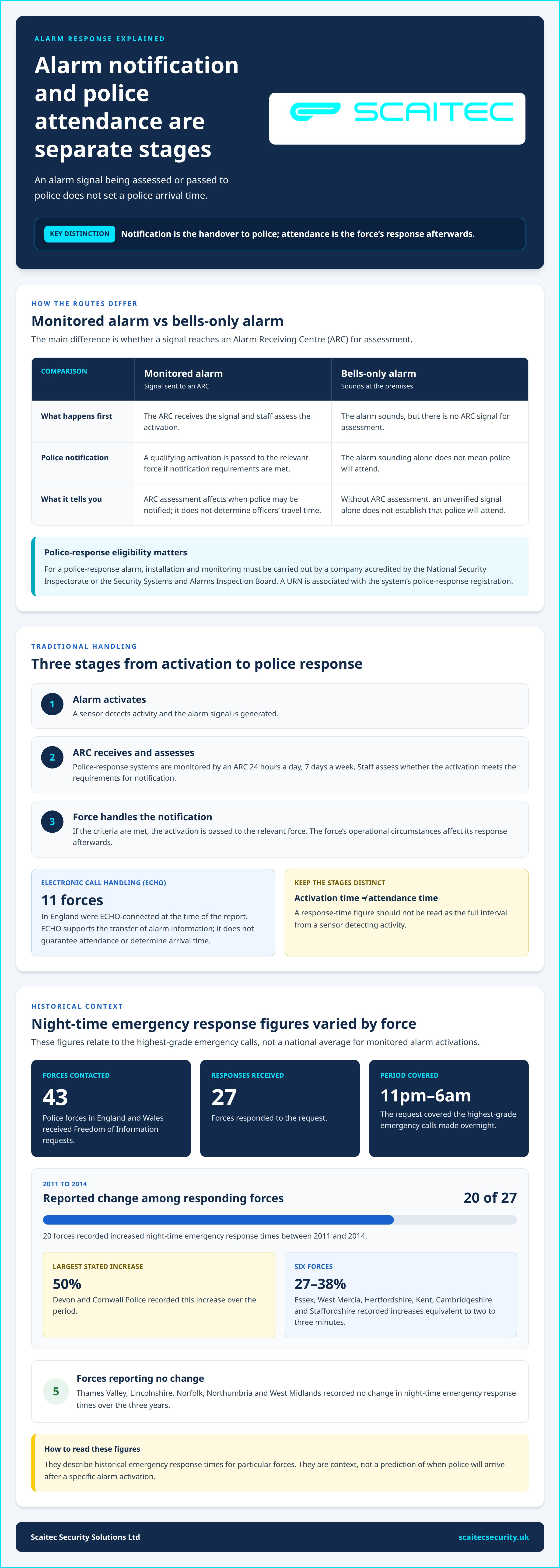
An Alarm Receiving Centre (ARC) is the link between a monitored alarm and the relevant police force. Police-response systems are monitored by an ARC 24 hours a day, 7 days a week. When an alarm signal arrives, ARC staff assess the activation and determine whether it meets the requirements for police notification. This assessment is distinct from police attendance: it concerns whether and when an alert is passed on, not how quickly officers can reach the premises.
In traditional handling, specialist ARC staff received intruder or hold-up alarm activations and passed them to the relevant force. The process has separate stages: the alarm activates, the ARC receives and assesses the signal, and the force is notified if the required criteria are met. A delay or decision during assessment affects when police are notified, but does not set an arrival time. The force’s response then depends on its operational circumstances.
Do UK police respond to unverified or bells-only alarms? A bells-only alarm sounds at the premises but does not send a signal to an ARC for assessment. An unverified signal alone does not mean police will attend. Their response depends on whether the system meets the applicable notification requirements.
What are UK police URN requirements for alarm systems and monitoring companies? For a police-response alarm, installation and monitoring must be carried out by a company accredited by the National Security Inspectorate or the Security Systems and Alarms Inspection Board. The URN is associated with the system’s police-response registration, and accreditation is a key condition for qualifying for that response.
What is a confirmed alarm under UK police alarm response rules? It is an activation supported by verification, rather than just an alarm sound or an unassessed signal. The ARC assesses whether the activation can be passed to police under the system’s response arrangements. This explains why an alarm sounding does not automatically mean the force has been notified.
For example, a signal reaching an ARC does not by itself confirm an incident. ARC staff first handle the activation and, if the requirements are met, pass it to the relevant force. A bells-only alarm has no equivalent ARC assessment stage, while a monitored system sends the centre a signal to process. These differences affect how police are notified, not how long officers take to travel.
When considering the average police response time for alarms in the UK, distinguish the time before notification from the force’s response afterwards. ARC verification, system eligibility and local force circumstances all shape what happens after an activation. That is why one alarm-trigger-to-arrival figure cannot describe every monitored alarm.
Traditional police-monitored alarm handling
Traditionally, specialist staff at an ARC received intruder or hold-up alarm activations and passed them to the relevant police force. This created a handover between the monitoring centre and police control room before officers could be dispatched. The alarm’s activation time and the force’s recorded attendance time therefore describe different stages. A police response-time figure should not be read as the full interval from a sensor detecting activity.
Electronic Call Handling (ECHO) is intended to support the transfer of alarm information between ARCs and police forces. At the time of the report, eleven police forces in England were ECHO-connected. That figure describes the forces connected at that time, not the proportion of alarm calls handled electronically across the UK. ECHO concerns the notification route; it does not guarantee police attendance or determine officers’ arrival time.
Historical figures also need careful interpretation. The Labour Party sent Freedom of Information requests about night-time emergency response times to all 43 police forces in England and Wales, and 27 forces responded. The request covered the highest-grade emergency calls made between 11pm and 6am. These figures concern emergency response times, not a national average for police-monitored alarm activations.
Among those 27 responding forces, 20 recorded increased night-time emergency response times between 2011 and 2014. Devon and Cornwall Police recorded an increase of 50 per cent over that period. Essex, West Mercia, Hertfordshire, Kent, Cambridgeshire and Staffordshire recorded increases between 27 and 38 per cent, equivalent to two to three minutes. Those comparisons show variation between forces, rather than a single predictable response time for an alarm.
By contrast, Thames Valley, Lincolnshire, Norfolk, Northumbria and West Midlands recorded no change in night-time emergency response times over the three years. These differences matter because police response is determined locally, while an alarm centre’s notification method is only one part of the process. Emergency-call figures alone cannot establish the average police response time for alarms in the UK.
For an alarm activation, the traditional sequence is straightforward: the centre receives the signal, staff assess and pass on a qualifying activation, then police control handles the notification. ECHO changes the electronic call-handling connection for forces using it, but does not remove the distinction between notification and attendance. The 11pm to 6am figures offer historical context, not a current forecast for a particular property or alarm.
Electronic call handling affects how a notification is transferred, while the response figures measure emergency-call attendance, not alarm handling directly. Night-time emergency response times increased by two to three minutes at Essex, West Mercia, Hertfordshire, Kent, Cambridgeshire and Staffordshire police forces. This gives context for the reported change, but does not show how quickly a particular alarm activation would lead to attendance. Notification and local response are distinct stages, so neither the electronic route nor emergency-call comparisons provide a universal alarm response time.
False alarm management
A false activation is an alarm signal that does not represent a genuine intrusion or emergency. For example, a user might accidentally trigger a system while entering a protected area. Repeated false signals matter because they can affect the police response assigned to an alarm. Treat an activation as useful information about how the system is operating, rather than simply dismissing it as noise.
Under the response arrangements described for UK intruder alarms, a Level 2 police response may be assigned after multiple false activations within 12 months. This is a possible outcome, rather than an automatic change after one incident. The number of activations and the relevant police response process matter. If a system’s response level changes, the practical consequence can be different handling of later activations.
Installation standards are also part of eligibility. Intruder alarm systems installed after June 2019 must comply with PD 6662:2017 and BS 8243 to qualify for police response. These requirements relate to qualifying for police response; they don’t provide a police arrival-time estimate. A system’s installation, ongoing operation and false activation history each have a part in its response arrangements.
Managing false alarms starts with understanding the activation, then addressing the cause. A useful review can distinguish an accidental user trigger from a recurring technical issue. For example, if the same entry point repeatedly generates signals, that pattern deserves attention rather than being treated as an isolated event. Keeping a clear record of activations helps identify repetition across the 12-month period relevant to a possible Level 2 assignment.
- Identify the event: record what happened when the alarm activated, such as an accidental entry or a repeated signal from one area.
- Look for a pattern: compare later activations with earlier incidents, including their location and circumstances.
- Address the cause: arrange suitable attention for a recurring issue instead of simply resetting the system each time.
These steps help clarify whether an activation was isolated or part of a repeated pattern. They don’t replace the applicable response rules, including PD 6662:2017 and BS 8243 for qualifying systems installed after June 2019. Accurate records also make it easier to explain the sequence of events when an alarm is reviewed.
False alarm management is therefore directly relevant to what happens after a monitored alarm triggers. Repeated activations within 12 months may affect police response status, while compliance with the named standards is required for qualifying systems installed after June 2019. Treating each signal as information to assess and learn from supports a clearer understanding of system behaviour and its response arrangements.
Police response levels
Police response levels describe the attendance arrangements for a monitored alarm. The level matters because it determines whether the expected responder is police or a keyholder.
Police alarm response levels
Level 1 receives an immediate or urgent police response, while Level 3 receives no police response and requires a keyholder to attend. These labels describe the response arrangement, not a guaranteed arrival time. For a property owner, that distinction affects who is expected to deal with an activation and whether police attendance forms part of the system’s response.
For example, a Level 3 alarm can alert people locally, but attendance depends on the keyholder. A Level 1 alarm is eligible for an immediate or urgent police response. Neither label means officers arrive at a fixed time after the alarm sounds. The response level clarifies the intended route after activation, rather than measuring travel time.
Police and keyholder response times
With police response, a force is notified and may attend. With keyholder response, a designated person travels to the premises. The processes differ: police attendance follows the force’s handling of an alert, while keyholder attendance depends on that person receiving the notification and reaching the site.
A keyholder may need to travel from elsewhere, gain access and assess the premises on arrival. The relevant force decides what action to take after receiving a qualifying alarm notification. Neither route has one arrival time that applies to every property. Consider who can attend and what the alarm arrangement expects them to do.
Regional response variation
Police response times differ between forces, so a figure from one area cannot represent the whole UK. Historical night-time figures illustrate this variation: Bedfordshire Police’s average emergency response time rose from seven minutes in 2011 to 11 minutes in 2014. That measure concerns emergency response, not a direct forecast for a monitored alarm.
Devon and Cornwall Police recorded a different pattern, while several other forces showed increases or no change over the period. These comparisons show why location matters, but they do not provide a reliable arrival estimate for an individual activation. Police forces operate locally, and the response to an alarm depends on the force handling the notification.
Factors affecting response times
Several stages shape what happens after a monitored alarm activates: the signal must be assessed, the required police notification criteria must be met, and the force must then handle the call. Response level also matters. A Level 3 system requires keyholder attendance rather than police response, while Level 1 receives an immediate or urgent police response.
False activations can affect a system’s response arrangements, and local force circumstances influence police attendance. This is why the time from alarm activation to arrival is not one fixed measure. To understand the expected response, distinguish the system’s response level, the notification process and the time taken by whoever is expected to attend.
Reported improvement in police response times
Some forces recorded shorter night-time emergency response times over the period covered. These historical figures provide context, but they are not a current arrival estimate for an alarm.
Reported changes in response times
Lancashire Constabulary’s night-time emergency response times fell by 11 per cent over the three years covered. Sussex Police recorded a fall of nine per cent over the same period. These reductions show that response times did not move in the same direction across every force. They are measures of night-time emergency response, not a dedicated average for monitored alarm calls.
That distinction matters when interpreting the average police response time for alarms in the UK. An emergency response-time trend can describe a force’s broader performance, but it does not establish how quickly officers will attend a particular alarm. Alarm handling has its own notification and assessment stages, while the reported improvements concern police emergency response times.
Compare like with like: note the force, period, time of day and call type behind each figure. For example, Lancashire’s reported reduction concerns night-time emergency response over the three years covered. Do not compare it directly with an alarm-specific figure unless both measures use the same definitions and time period.
Official alarm response data
The reported figures discussed here came from a Labour Party request for information about night-time emergency response times. The request went to all 43 police forces in England and Wales, and 27 forces responded. It covered the highest-grade emergency calls made between 11pm and 6am, rather than monitored alarm attendance specifically.
For a force-specific view, look for police performance information and responses to Freedom of Information requests. The Labour Party request provides a historical comparison across responding forces. Read its figures alongside the stated call grade and night-time period, rather than treating them as a current national measure of alarm response.
When reviewing a published figure, identify whether it describes emergency calls, alarm notifications or officer attendance. Note the force and dates covered, too. Without those details, figures can appear comparable while measuring different stages. An emergency response-time change, for example, cannot tell you how long an ARC took to process an activation.
These reported improvements show variation, not a guaranteed trend for every force or alarm. Lancashire Constabulary and Sussex Police recorded reductions, while other forces had different results. Use historical force data as context, then distinguish it from an individual alarm’s response level and notification process.
Across the police forces covered, the average increase in night-time emergency response times was 17 per cent, showing that reductions in some areas sat alongside a broader rise.
Scaitec Security Solutions: Intruder Alarms
Scaitec Security Solutions Ltd designs, installs and maintains intruder alarm systems for homes and businesses in Rotherham, Sheffield and South Yorkshire. If you are reviewing how an activation is handled, start with the system’s design and condition. An alarm should suit the property and its security needs, and regular maintenance helps keep the equipment in working order.
Scaitec Security Solutions Ltd can also consider how an intruder alarm fits alongside CCTV, access control or fire alarm systems. This can be useful when you’re planning security for a property or updating existing equipment. Explore intruder alarm systems to see how this offering relates to your needs.
Contact Scaitec Security Solutions Ltd to discuss an intruder alarm for your property.
Make your next security decision with confidence
The average police response time for alarms in the UK is not a dependable measure of how well a property is protected. Instead, consider how your security arrangements work together, who receives an alert and what happens when an alarm activates.
Consider your home or business’s needs, including whether you need an intruder alarm, CCTV or access control. Each addresses a different part of security, and the right combination depends on the property and the risks you want to manage. Scaitec Security can help you plan practical security measures for your property.
Understanding your setup makes it easier to decide what to improve next. Consider which protection best fits your property.
A considered security plan is a practical step towards feeling better prepared.
Frequently Asked Questions
What is the average UK police response time to a burglar alarm?
The figures discussed here do not provide a national average for police attendance at burglar alarms. They relate to high-priority emergency calls during specified night-time hours, not alarm attendances. For a particular activation, the relevant force, the alarm’s response level and the notification process all matter. Treat broader emergency response statistics as background, not as an estimate of when officers will reach a property.
How quickly must police respond to a confirmed intruder alarm in the UK?
There is no fixed number of minutes stated for police attendance at a confirmed intruder alarm. Level 1 means an immediate or urgent police response, but that describes the response category, not a set arrival deadline. For example, confirmation can affect whether an alarm is eligible for police notification; it doesn’t set the force’s travel time. The attendance interval depends on the force’s handling of the notification and circumstances at the time.
Protect Your Business
Protect Your People
Book Your FREE Site Protection Survey

Since pioneering Scaitec Security Solutions in 2005, Paul Scaife, with his roots in the industry dating back to 1994, has distinguished the firm as a leading provider of bespoke fire and security solutions, servicing clients across Sheffield, Rotherham, and surrounding areas.
His leadership, underpinned by accreditation from the Security Systems and Alarms Inspection Board, ensures that Scaitec surpasses client expectations by blending advanced technology with a deep understanding of their unique needs.
Paul's ethos champions innovation and efficiency, driving Scaitec to deliver tailored, cutting-edge solutions that enhance safety and operational ease.
Discover more about Paul’s commitment to excellence on LinkedIn.