
Table of Contents
Replacing an existing system isn’t always the first step. Fire and security systems can be maintained through planned preventative maintenance, including routine inspection, testing and servicing. For churches considering church security and fire alarm systems in Doncaster, commercial fire alarms should typically be serviced every six months, while church systems should normally be tested every week.
It’s understandable to want clear guidance on whether existing equipment can continue to protect your building safely. Regular maintenance helps identify faults and keep systems operational, while the right approach depends on the building and the equipment already in place.
This article explains how existing fire and security systems can be maintained, how alarms need attention, and how monitoring can support churches and other commercial premises. It also considers the needs of places of worship, where building layout and activities shape fire detection and security requirements.
Key Takeaways
- Existing fire and security equipment may be maintained through planned inspection, testing and servicing rather than replaced outright.
- Learn how monitoring can support a fire alarm system and what to consider when linking alarms to monitoring.
- Church buildings and other commercial settings have different layouts and uses, which can shape their fire detection needs.
- Understand how maintenance support can help identify faults and keep systems operational over time.
How Often Should Commercial Fire Alarms Be Serviced?
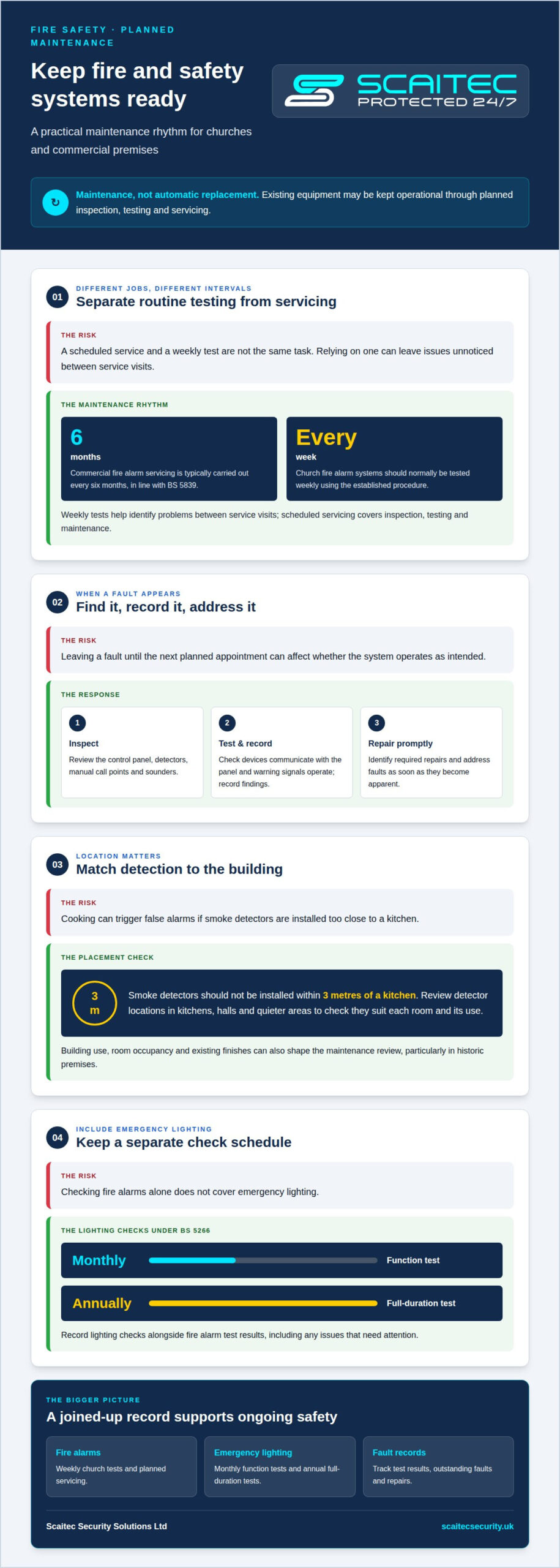
Commercial fire alarm systems should typically be serviced every six months in line with British Standard BS 5839. Churches should normally test their fire alarm systems every week. These are separate tasks: scheduled servicing involves inspection, testing and maintenance, while weekly testing helps identify problems between service visits. Electrical fire alarm systems should be serviced regularly, and faults repaired as soon as they become apparent.
Electrical fire alarm systems in buildings should normally be designed to meet British Standard 5839, Part 1, according to the British Standards Institution. The Regulatory Reform (Fire Safety) Order 2005 is the legal framework cited for responsible persons’ fire safety responsibilities in the UK, according to The National Archives. Together, these points make routine testing and maintenance important parts of managing fire safety in commercial premises.
A service visit can review the fire alarm control panel, detectors, manual call points and sounders. The engineer tests whether devices communicate with the panel and warning signals operate as intended. The visit should also identify faults, record findings and establish what repairs are needed. Address faults promptly rather than leaving them until the next planned appointment.
For churches and other premises in Doncaster, a maintenance schedule should reflect how the building is used. A church may host services, community activities and events, with different rooms occupied at different times. Staff or volunteers can carry out weekly tests using the established procedure, while planned servicing covers the wider system. Keeping test records helps those responsible track results and outstanding faults.
Detector placement also affects reliable operation. Smoke detectors should not be installed within 3 metres of a kitchen because cooking can trigger false alarms. A service review can identify whether detector locations suit the rooms and their use, including kitchens, halls and quieter areas. For historic buildings, installation choices may also need to account for the structure and existing finishes.
Suitable church security systems can include intruder alarms, CCTV and access control, chosen around the building’s entrances, spaces and patterns of use. A business intruder alarm system is one option to consider alongside fire detection, rather than as a replacement for it.
Grant availability depends on the funding programme and its eligibility criteria. Match proposed improvements to the grant’s stated purpose, and outline the fire safety or security need, the work proposed and how it supports the premises.
Churches using smoke alarms should choose mains-powered units with a suitable backup battery or power source. The Health and Safety (Safety Signs and Signals) Regulations are identified as requiring two power sources for church smoke alarms. This helps ensure operation does not depend on a single source if the main supply is interrupted.
Emergency lighting should also be included in the building’s safety checks. Under BS 5266, it should undergo a monthly function test and a full-duration annual test. Recording these checks alongside fire alarm test results can help those responsible keep track of whether equipment is operating correctly and whether any issues need attention. Regular attention to alarms, lighting and recorded faults supports a joined-up approach to maintaining safety in church premises.
Can fire alarms be linked to monitoring?
Yes. A fire alarm can connect to a monitoring service that relays alarm signals beyond the building. The connection and response process depend on the system and monitoring arrangements. For a church in Doncaster, a survey can assess how the existing panel, detectors and communications equipment work together before installation or changes begin.
Church security alarm installers in Doncaster should consider entrances, occupied areas and how the building is used. A fire alarm installer should assess the building and its existing detection before planning an installation. These assessments help determine suitable equipment positions, how signals travel across the premises and whether existing systems can be retained.
A survey starts with the building’s layout, existing equipment and day-to-day activities. For example, a church may have a main worship space, meeting rooms and areas used less often. The installer can identify where detection and warning devices are needed and how system components should communicate. In historic buildings, wireless equipment may avoid running cables through significant structures.
Installation planning should also account for the people using the premises. Work near a meeting room, office or worship space may affect access or scheduled activities. Agreeing work areas and sequencing tasks can help limit disruption. For example, installers can plan around room use and explain when equipment or routes may be temporarily affected.
After installation, commissioning checks that system components work together as intended. This can include testing detectors, call points, sounders and the panel, then confirming that the monitoring connection receives the relevant signal. The responsible person should receive clear information about system operation, testing and any outstanding work. Commissioning records provide a reference for future servicing.
For an existing alarm, a survey can establish whether the system supports monitoring and what changes may be needed. Equipment condition, panel compatibility and the available communications route all affect the connection. If checks reveal a fault, address it rather than treating it as a monitoring issue alone. Monitoring relays signals, but it does not replace functioning detection, sounders or routine maintenance.
Monitoring arrangements should define what happens after a signal is received. The church should understand who receives it and what response process applies, including how contact details are kept up to date. Clear arrangements make monitoring useful in practice, rather than simply adding another system component.
When a church plans new equipment or reviews an existing setup, support with fire safety systems can bring installation, commissioning and ongoing servicing into one considered plan.
Fire alarm monitoring
Monitoring adds a communication step after an alarm detects an event. A signal can be relayed beyond the church, where agreed arrangements determine who receives it and what happens next. Fire and intruder alarm signals relate to different risks, so the response process should distinguish clearly between them.
For fire alarms, monitoring can alert designated contacts when the system sends a signal. It does not replace detectors, sounders, maintenance or the actions required inside the building. It can pass on information when a church is empty, such as overnight or between services. Clear contact details and response procedures help make that signal actionable.
Monitored alarms, CCTV, access control and intruder alarms serve different but complementary purposes. Fire and intruder alarms detect specific events; CCTV provides visual security coverage, while access control manages who can enter designated areas. Monitoring can relay relevant alerts, but these systems are not interchangeable.
An intruder alarm uses detectors to identify activity in protected areas, such as a side entrance or vestry. If activated, the alarm can send a signal to monitoring, according to the agreed setup. This can help alert contacts to an event when no one is on site. Intruder alarm systems can form one part of a church’s wider security arrangements.
CCTV monitoring has a different role. Cameras can provide visual context around entrances, car parks or shared spaces, while an intruder alarm detects possible intrusion. When both are used, the church should understand how footage and alarm signals are accessed, who reviews them and how privacy is managed.
Access control manages entry, rather than detecting fire or intrusion. For example, it can help manage access to an office or equipment room separately from the main worship space. Coordinating access arrangements with alarm procedures can reduce confusion when authorised people enter or leave outside regular services.
Before choosing monitoring, map each system to a practical scenario: a fire signal outside service hours, movement near a restricted entrance or activity captured by CCTV. Then define who receives each alert and what action follows. This joined-up review helps churches choose monitoring that supports their premises and security priorities.
Can You Maintain Existing Fire and Security Systems?
Existing systems can often be maintained through planned inspections, testing and servicing rather than replaced automatically. The right approach depends on equipment condition, how the premises are used and whether faults need corrective work.
Planned maintenance and testing
Planned preventative maintenance involves routine inspection, testing and servicing of fire and security systems to help keep them safe, compliant and operational. A maintenance plan should identify the equipment covered, the checks performed and how faults are recorded and addressed. This may include a fire alarm panel, detectors, sounders, intruder alarm components, CCTV and access control.
For a church in Doncaster, the schedule should account for building use and the systems installed. Regular servicing complements routine alarm testing; it does not replace it. A review can also identify changes that affect equipment, such as a room being repurposed or an entrance altered. Planned maintenance helps organise these checks as ongoing work.
Maintenance records and compliance
Records give those responsible for a church a practical history of system checks and faults. Include service dates, equipment tested, results, identified defects, completed repairs and outstanding actions. This makes it easier to track recurring issues, such as a detector repeatedly triggering a false alarm, and see whether corrective work has resolved them.
Keep records together with the fire safety arrangements for the premises, so relevant information is accessible to those managing the building. Electrical fire alarm systems should normally be designed to meet British Standard 5839, Part 1, according to the British Standards Institution. Records can help show how inspection and maintenance support the system’s ongoing operation.
Church fire safety maintenance decisions
Churches should choose a system suited to the building’s layout, use and fire risks, then maintain it through planned checks and prompt fault repairs. The applicable design reference is British Standard 5839, Part 1 for electrical fire alarm systems, according to the British Standards Institution. A fire risk assessment identifies hazards, evaluates risks to occupants, reviews existing safety measures and recommends improvements.
The Regulatory Reform (Fire Safety) Order 2005 is the legal framework cited for responsible persons’ fire safety responsibilities in the UK, according to The National Archives. Review the assessment when a change to the building, activities or safety arrangements could affect the identified risks. False alarms can disrupt church activities and may weaken confidence in warnings; poor maintenance can leave faults undetected or prevent a system operating as intended. Records and corrective action help address both concerns.
Fire alarm support for different commercial sectors
A fire alarm plan should reflect how each building is occupied, divided and used. Churches, offices and warehouses have different layouts, routines and access arrangements. For church security and fire alarm systems in Doncaster, start by mapping the premises, identifying how people use each area, and matching detection and warnings to those conditions. A standard layout may not suit every site.
In a church, the main worship space may sit alongside meeting rooms, kitchens and quieter areas. Smoke alarms should be interconnected so every unit sounds when any one detects a fire. Smoke detectors should normally be optical type in churches and places of worship. Wireless fire alarm systems can avoid running cables through historically significant buildings, helping account for sensitive structures.
Offices present different considerations. Staff may work across enclosed rooms, shared spaces and reception areas, while visitors may not know the warning arrangements. A system review can consider where people spend time, how they hear an alarm and how staff communicate its meaning. Trained personnel need clear procedures for responding to alerts and guiding occupants towards safe exits.
In a warehouse, storage areas, loading spaces and changing stock layouts can affect system performance. A survey should consider these features alongside normal activities. Retail premises may require planning around customer areas and staff-only rooms. In every setting, detection and warning arrangements should reflect actual use, not assumptions based on another type of building.
Access control can manage entry to offices, storerooms or plant spaces. It serves a different purpose from fire detection, so consider both systems and their procedures together. Staff, for example, need to understand authorised entry and how an alarm changes their response. Clear instructions distinguish everyday access from emergency procedures.
Across sectors, a useful review considers the building’s layout, occupants and any changes to rooms or activities. It also checks whether warnings can be heard in occupied areas and relevant staff understand the response procedure. Church security and fire alarm systems in Doncaster should suit each premises’ specific use, with installation and maintenance planned around its needs.
For churches, historic buildings and other commercial premises, a tailored fire alarm review can help identify an approach suited to the building’s use and structure.
Scaitec Security Solutions: Intruder Alarms
Scaitec Security Solutions Ltd can help churches in Doncaster protect their premises with intruder alarm systems, fire alarm systems, CCTV and system maintenance. This support is useful when a church needs a new system, wants to maintain existing equipment, or is reviewing how its security measures work together.
For example, an intruder alarm can address unauthorised entry, while CCTV provides visual security coverage. Fire alarm systems serve a separate purpose by detecting and warning about fire risks. Planned maintenance helps keep installed systems operational and highlights faults that need attention. The right combination depends on the church building, its use and the equipment already in place.
Contact Scaitec Security Solutions Ltd to discuss your church’s security and alarm maintenance needs.
Make your next security decision with confidence
A practical next step is to decide what the church needs its systems to achieve, during services and when the building is empty. Consider which areas need protection, how authorised people should enter and whether existing equipment still suits the premises. This gives discussions about church security and fire alarm systems in Doncaster a clear focus.
Scaitec Security Solutions Ltd can support churches with CCTV Systems, Intruder Alarms and Access Control Systems. These can be considered alongside the building’s fire and security needs, helping shape a joined-up plan around its spaces and routines. Whether you’re planning an improvement or reviewing existing arrangements, a focused conversation can help identify a sensible way forward.
A well-considered plan starts with your building’s needs and grows from there.
Frequently Asked Questions
Can you help with fire alarm remedials after an inspection?
Yes. Scaitec Security Solutions provides corrective repairs and system maintenance for fire and security equipment. If an inspection identifies a fault, the findings can clarify which components need attention, such as a detector, alarm panel or sounder. Non-contract customers receive the same care and attention as Protect-plan customers, so support is available without a maintenance contract.
Need a trusted fire alarm company in Doncaster?
Scaitec Security Solutions provides fire alarm installation and maintenance in Doncaster, as well as Sheffield, Rotherham, Barnsley, Chesterfield, Worksop, Wakefield and Huddersfield. The company is Insurance Approved and SSAIB Certified, and describes itself as the “Best Rated Security Company in Rotherham”. Its fire alarm installations meet current British Standards. Installation is guaranteed within 7 days of acceptance of proposal.
Protect Your Business
Protect Your People
Book Your FREE Site Protection Survey

Since pioneering Scaitec Security Solutions in 2005, Paul Scaife, with his roots in the industry dating back to 1994, has distinguished the firm as a leading provider of bespoke fire and security solutions, servicing clients across Sheffield, Rotherham, and surrounding areas.
His leadership, underpinned by accreditation from the Security Systems and Alarms Inspection Board, ensures that Scaitec surpasses client expectations by blending advanced technology with a deep understanding of their unique needs.
Paul's ethos champions innovation and efficiency, driving Scaitec to deliver tailored, cutting-edge solutions that enhance safety and operational ease.
Discover more about Paul’s commitment to excellence on LinkedIn.