
Table of Contents
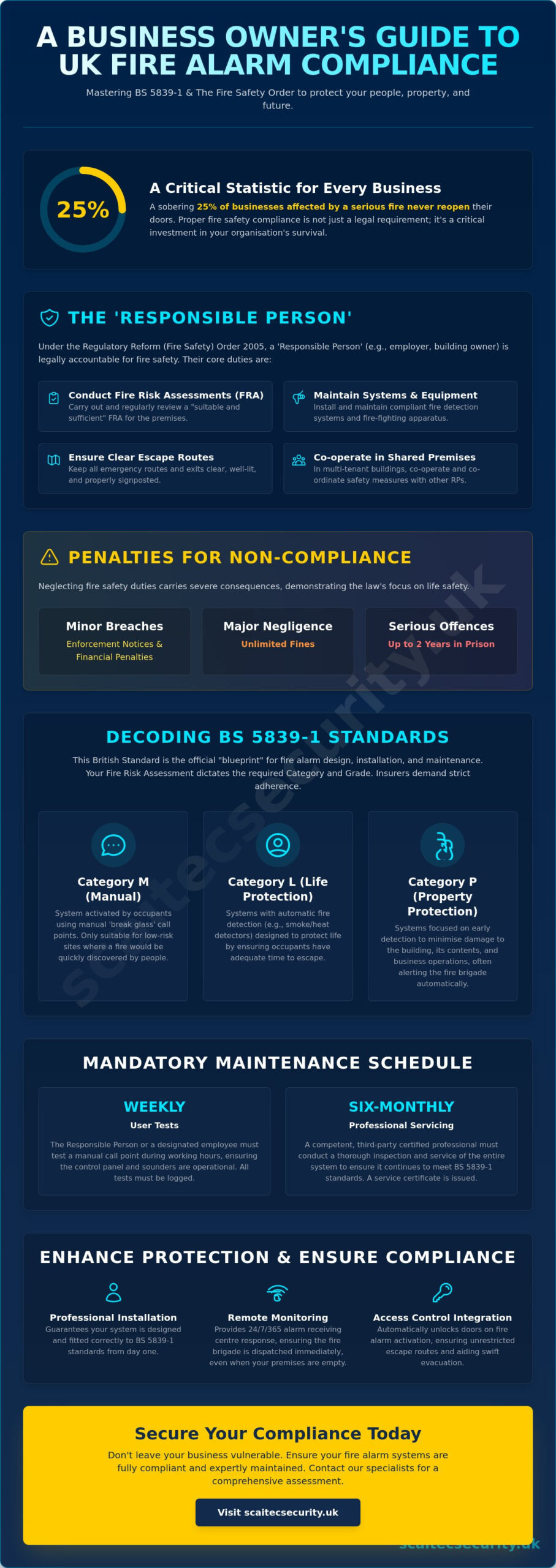
Did you know that 25% of businesses affected by a serious fire never reopen their doors? It is a sobering statistic that highlights why understanding the fire alarm regulations uk business owners must follow is about much more than just avoiding a fine. We know that the pressure of staying compliant can feel overwhelming, especially whilst you’re trying to manage daily operations and multiple safety contractors. You want the peace of mind that comes from knowing your premises are secure and your legal obligations are met without any hidden surprises.
This 2026 compliance guide will help you master the complexities of UK fire safety law, ensuring your business remains fully protected and your insurance premiums stay as low as possible. We will walk you through the essential updates in BS 5839-1:2025, explain the mandatory recording requirements for fire risk assessments, and outline the specific steps the Responsible Person must take to maintain a safe environment. By the end of this article, you’ll have a clear roadmap to achieving total compliance and protecting the future of your organisation.
Key Takeaways
- Identify the legal obligations of the ‘Responsible Person’ under the Regulatory Reform (Fire Safety) Order 2005 to ensure your organisation remains fully compliant.
- Understand the essential fire alarm regulations uk business owners must follow by decoding the specific British Standard categories and grades required for your premises.
- Establish a robust maintenance schedule that distinguishes between mandatory weekly user tests and the professional six-monthly servicing required by law.
- Master the process of conducting a thorough Fire Risk Assessment and learn when you are legally required to record your findings to protect your staff and visitors.
- Discover how professional installation and remote monitoring can enhance your security, including the benefits of integrating fire systems with access control for automatic door release.
The Legal Framework: Understanding the Regulatory Reform (Fire Safety) Order 2005
The bedrock of fire safety for any commercial premises in England and Wales is the Regulatory Reform (Fire Safety) Order 2005. This legislation fundamentally changed how safety is managed, shifting the focus from government-issued fire certificates to a system of self-assessment and proactive management. It applies to almost all non-domestic premises, including offices, shops, factories, and the common parts of multi-occupied residential buildings. Understanding the fire alarm regulations uk business owners must adhere to starts with recognising that the law prioritises life safety above all else. Recent legislative shifts, such as the Fire Safety Act 2021 and the Building Safety Act 2022, have further clarified that external walls and flat entrance doors must be included in safety assessments, making the regulatory environment more comprehensive than ever before.
The Role and Duties of the ‘Responsible Person’
Every organisation must identify its “Responsible Person” (RP). This title usually falls to the employer, the building owner, or a facilities manager who has control over the premises. The RP is legally accountable for the safety of everyone on-site. Their core duties include ensuring a “suitable and sufficient” fire risk assessment is carried out and regularly reviewed. They must also arrange for the installation and maintenance of fire alarm regulations uk business compliant systems, clear emergency routes, and appropriate fire-fighting equipment. In shared business parks or multi-tenant office blocks, the law requires multiple RPs to cooperate and coordinate their safety measures. This ensures that a fire detection event in one unit properly alerts the entire building, preventing confusion during an evacuation.
Penalties for Non-Compliance in 2026
The consequences of neglecting these duties are severe and go beyond simple administrative errors. For minor local safety breaches, authorities can issue enforcement notices or financial penalties. However, major instances of non-compliance or serious negligence can lead to unlimited fines and prison sentences of up to two years. Local enforcement bodies, such as the South Yorkshire Fire and Rescue Service, have increased their audit frequency in recent years. They specifically look for recorded evidence of system testing and competent risk assessments. We’ve seen that a proactive approach to compliance doesn’t just avoid legal trouble; it builds a culture of safety that protects your most valuable assets: your people and your property. Taking these regulations seriously is a mark of a stable, well-managed business.
BS 5839 Standards: Decoding Fire Alarm Categories and Grades
Whilst the legislation we discussed previously sets the legal mandate, the BS 5839-1 standards provide the actual blueprint for your system’s design and installation. For any fire alarm regulations uk business must follow, these standards are the industry benchmark used by fire services and insurers alike. They ensure that your system is not only fit for purpose but reliable enough to function when it matters most. To get your compliance right, you need to understand the two distinct ways systems are classified: by their ‘Category’ and their ‘Grade’. Your Fire Risk Assessment (FRA) will dictate which combination is necessary for your specific building layout and occupancy type.
Insurers often insist on strict adherence to these standards before they will provide cover. A system that doesn’t meet the specified BS 5839-1:2025 requirements could potentially invalidate your policy in the event of a claim. We believe that choosing the right system is about balancing safety objectives with practical business needs, ensuring you don’t over-specify for a low-risk site or, conversely, leave your staff vulnerable in a complex environment. Understanding the full scope of fire alarm system design requirements is essential to making the right choice for your premises.
System Categories: Protecting Life (L) vs Property (P)
Categories define the objective of the fire alarm system. They are split into three main groups:
- Category M: These are manual systems where occupants must physically trigger a ‘break glass’ point. These are only suitable for low-risk environments where fire is likely to be detected quickly by people.
- Category L (Life Protection): These range from L1 (detectors in all areas of the building) to L5 (detectors in specific high-risk areas identified by your FRA). Most offices typically require an L2 or L3 system to protect escape routes.
- Category P (Property Protection): These systems (P1 and P2) are designed to alert the fire service as quickly as possible to minimise damage to the building and its contents, even when it is unoccupied.
System Grades: From Grade A to Grade F
While categories tell us where the detectors go, ‘Grades’ tell us what the equipment actually is. For most fire alarm regulations uk business requirements, a Grade A system is the standard. This involves a professional setup with a central control panel, sounders, and detectors, all supported by a dedicated backup power supply. In contrast, Grades C through F refer to residential-style smoke alarms, which are mains or battery-powered. These are rarely sufficient for commercial premises and lack the robust monitoring capabilities found in commercial security systems Sheffield businesses rely on for total protection. Selecting the correct grade ensures your system remains operational during a power cut and provides the longevity required for commercial use. For complex commercial sites in particular, addressable fire alarm systems offer pinpoint device identification that conventional Grade A panels cannot match, making them an increasingly popular choice for multi-zone buildings. If you are unsure which grade your premises requires, our team can help you navigate professional system design to ensure you meet every standard.
Mandatory Testing and Maintenance Schedules for UK Businesses
Having a high-quality fire alarm system is only the first step toward compliance. Under Article 17 of the Regulatory Reform (Fire Safety) Order 2005, the law requires that all fire safety equipment is subject to a suitable system of maintenance. This means that a “fit and forget” approach isn’t just dangerous; it’s illegal. To stay on the right side of fire alarm regulations uk business owners must implement a dual-layered maintenance schedule that combines simple internal checks with expert technical inspections. We believe that a well-maintained system is the most effective way to ensure the longevity of your equipment and the safety of your people.
Your Fire Alarm Log Book is perhaps your most vital piece of documentation. It serves as a living record of every test, fault, and service. If a fire officer visits your premises, this is the first document they’ll request. An incomplete log book suggests a lack of protective vigilance, which can lead to enforcement action even if your system appears to be working. In line with the “golden thread” principle introduced by the Building Safety Act 2022, we encourage businesses to maintain these records digitally to ensure they’re never lost and are easily accessible during an audit.
False alarms are more than just a nuisance; they drain emergency resources and can lead to “alarm fatigue” amongst your staff. Many fire and rescue services now have strict policies regarding unwanted fire signals. If your system triggers too many false alerts due to poor maintenance, you may find that the fire service no longer provides an automatic response to your building. This makes regular servicing not just a legal requirement, but a practical necessity for operational continuity.
The Weekly Fire Alarm Test Procedure
We recommend conducting a weekly test at a set time so employees know when to expect the siren. During this test, you should use a test key to trigger at least one manual call point. It’s essential to rotate through different call points each week to ensure the entire system’s integrity. Always record the date, time, and the specific call point tested in your log book. If the sounders don’t activate or the panel shows a fault, you must contact your maintenance provider immediately.
Six-Monthly Professional Servicing Requirements
Whilst your weekly tests confirm the system triggers, only a professional service can verify it will function correctly during a real fire. The current fire alarm regulations uk business standard, BS 5839-1:2025, requires a competent person to inspect the system at least every six months. During these visits, a technician will check battery health, sensor sensitivity to prevent false alarms, and signal strength across the network. This professional certification is often a mandatory requirement for your business insurance to remain valid.
Conducting and Updating Your Fire Risk Assessment (FRA)
The Fire Risk Assessment (FRA) is the cornerstone of your entire safety strategy. It’s the process by which you identify potential hazards and determine the necessary precautions to keep your premises safe. Under the latest fire alarm regulations uk business owners must follow, this is no longer a task reserved for larger companies. Since 1 October 2023, the law requires every business, regardless of size or employee count, to record their fire risk assessment in full. This shift ensures that even the smallest startups maintain a digital record of their safety protocols, aligning with the “golden thread” of information required by modern legislation. We believe that a thorough FRA is not just a legal hurdle; it’s a vital tool for protective vigilance that ensures your staff return home safely every day.
When conducting your assessment, you must look for the three elements of the “fire triangle”: ignition sources, fuel, and oxygen. Identifying these hazards allows you to remove or reduce risks before they escalate. For instance, electrical distribution faults account for approximately 18% of workplace fires, making regular checks of wiring and appliances a priority. You must also evaluate who is at risk, paying particular attention to visitors, contractors, and individuals with disabilities or limited mobility who may require specific assistance during an evacuation.
The Five Steps of a Commercial Fire Risk Assessment
- Step 1: Identify fire hazards. Look for sources of heat and combustible materials, such as accumulated packaging waste or faulty electrical equipment.
- Step 2: Identify people at risk. Consider everyone who enters the building, especially those working alone or those who may not be familiar with your escape routes.
- Step 3: Evaluate, remove, or reduce the risks. This might involve installing professional fire alarm systems or improving the storage of flammable liquids.
- Step 4: Record your findings. Prepare a clear emergency plan, provide staff training, and keep a digital record of your assessment.
- Step 5: Review and update. An assessment is a living document that must evolve alongside your business.
When Should You Review Your FRA?
Whilst an annual review is considered best practice for businesses in Rotherham and Sheffield, certain “trigger events” demand an immediate update. If you’ve made structural changes to your building, seen a significant shift in staff numbers, or changed the primary use of a room, your current assessment may be obsolete. An outdated FRA doesn’t just endanger lives; it can also invalidate your insurance policy, leaving you unprotected in the event of a claim. We recommend reviewing your assessment whenever you implement new equipment or change your internal layout to ensure your safety measures remain “suitable and sufficient” under the law.
Professional Installation and Remote Monitoring in South Yorkshire
Selecting the right equipment is only half the battle. To truly meet the fire alarm regulations uk business owners face, the quality of your installation must be beyond reproach. We’ve seen that systems installed by non-specialists often suffer from ‘dead spots’ or frequent false triggers that undermine the entire safety strategy. In South Yorkshire, businesses often prefer working with independent specialists who understand the local enforcement landscape and can provide tailored, responsive support throughout the system’s lifecycle. This local expertise ensures that your safety measures aren’t just a box-ticking exercise but a robust shield for your organisation.
The Importance of SSAIB Accreditation
SSAIB accreditation serves as a badge of technical proficiency and integrity. When you choose an accredited installer, you’re guaranteed that the company has undergone rigorous vetting of its processes and staff qualifications. This level of scrutiny is vital for maintaining the “golden thread” of safety information mentioned in previous sections. Professional design prevents common issues like over-signalling, which can lead to unnecessary evacuations and business downtime. By ensuring your fire system meets the same high standards as expert CCTV installation in Rotherham, you create a holistic safety environment that protects your assets from every angle.
A significant advantage of professional installation is the ability to integrate different security layers. For example, connecting your fire alarm to access control Yorkshire systems allows for automatic door release during an emergency. This ensures that escape routes are instantly cleared, which is a critical requirement for any fire alarm regulations uk business compliance audit. We believe that these integrated solutions offer the highest level of protection by removing the risk of human error during a high-stress evacuation.
Remote Monitoring and Alarm Receiving Centres (ARC)
Remote monitoring transforms your fire alarm from a simple local sounder into a proactive emergency response tool. When your system is linked to an Alarm Receiving Centre (ARC), it’s monitored 24/7, even whilst your building is empty. If a detector is triggered, the ARC immediately verifies the signal and can dispatch the emergency services automatically. This rapid response is often the difference between a minor incident and a total property loss. For many insurers, a monitored system is a non-negotiable requirement for commercial cover, as it significantly reduces the potential for extensive fire damage. This active response provides the ultimate peace of mind, knowing that your premises are never truly alone.
Future-Proofing Your Business Safety
Managing a commercial premises involves balancing operational efficiency with protective vigilance. By implementing the fire alarm regulations uk business owners must observe, you’re doing more than avoiding penalties; you’re building a foundation of stability. We’ve explored how the right equipment, rigorous maintenance, and a recorded Fire Risk Assessment work together to create a safe environment for your staff and visitors. These measures ensure your organisation remains resilient and fully compliant throughout 2026 and beyond.
As independent South Yorkshire specialists since 2005, we’re here to help you navigate these technical requirements with confidence. Our SSAIB Accredited Installers provide the expertise needed to design and maintain systems that stand the test of time, supported by 24/7 Remote Monitoring via our ARC. Secure your business with a professional fire alarm consultation from Scaitec Security Solutions Ltd today. Let us be your dedicated partner in long-term safety and compliance.
Frequently Asked Questions
Do I legally need a fire alarm for my small business?
Most small businesses legally require an electronic fire alarm system unless the premises are so small that a shout of “Fire!” would be heard by everyone instantly. Under the Regulatory Reform (Fire Safety) Order 2005, your Fire Risk Assessment will determine if manual detection is insufficient. We find that even for the smallest shops, a professional system is the only way to ensure 24/7 protection and satisfy insurance providers.
How often should a commercial fire alarm be serviced by a professional?
A commercial fire alarm must be serviced by a competent professional at least every six months to comply with BS 5839-1:2025. These inspections ensure that internal components, such as backup batteries and smoke sensors, are functioning correctly. Whilst you carry out weekly internal tests, these bi-annual professional visits provide the certification needed to prove your ongoing commitment to fire safety and legal compliance.
Can I carry out my own fire risk assessment for my business?
You can legally carry out your own Fire Risk Assessment if you have the necessary knowledge and experience to be considered a “competent person.” However, the Responsible Person remains legally liable for any oversights. Given that you must now record your full assessment regardless of your staff count, many business owners prefer to partner with a specialist to ensure no hazards are missed and all documentation is legally robust.
What is the difference between a Grade A and a Grade D fire alarm system?
The primary difference lies in the complexity and reliability of the hardware. A Grade A system uses a central control panel, sounders, and detectors with a dedicated backup power supply, which is the standard for fire alarm regulations uk business compliance. In contrast, Grade D systems consist of mains-powered detectors with battery backups, which are typically designed for residential use and often lack the monitoring capabilities required for commercial premises.
Do fire alarm regulations differ for warehouses versus office buildings?
Whilst the foundational legislation remains the same, the specific “Category” of system required will differ based on the building’s use and risk profile. Warehouses often prioritise Category P (Property Protection) to minimise business interruption and satisfy insurers, whereas office buildings focus on Category L (Life Protection) to ensure safe evacuation through complex corridors. Your Fire Risk Assessment will specify exactly which level of coverage your specific site needs.
What should be included in a fire alarm log book?
Your log book should contain a comprehensive record of every event related to your system. This includes the dates and results of weekly call point tests, details of six-monthly professional services, and a log of any faults or false alarms. It’s essential to record the specific actions taken to resolve any issues. We recommend keeping this as a digital record to ensure it remains accessible for fire service audits.
Is it a legal requirement to have my fire alarm monitored remotely?
Remote monitoring is not a universal legal requirement under the RRO, but it is often a mandatory condition set by business insurance providers. If your premises are unoccupied at night or contain high-value assets, monitoring ensures an active emergency response even when no one is on-site. This proactive approach significantly reduces the risk of total property loss and ensures that fire alarm regulations uk business objectives for life safety are met.
What are the common reasons for fire alarm system failure in 2026?
The most frequent causes of system failure include depleted backup batteries and sensors that have become desensitised by dust or environmental contaminants. Neglecting the mandatory weekly testing schedule also means that simple faults, such as a disconnected sounder, go unnoticed until an actual emergency occurs. We prevent these issues through structured maintenance programmes that identify and resolve technical weaknesses before they can compromise your safety.
Protect Your Business
Protect Your People
Book Your FREE Site Protection Survey

Since pioneering Scaitec Security Solutions in 2005, Paul Scaife, with his roots in the industry dating back to 1994, has distinguished the firm as a leading provider of bespoke fire and security solutions, servicing clients across Sheffield, Rotherham, and surrounding areas.
His leadership, underpinned by accreditation from the Security Systems and Alarms Inspection Board, ensures that Scaitec surpasses client expectations by blending advanced technology with a deep understanding of their unique needs.
Paul's ethos champions innovation and efficiency, driving Scaitec to deliver tailored, cutting-edge solutions that enhance safety and operational ease.
Discover more about Paul’s commitment to excellence on LinkedIn.