
Table of Contents
A practice panic alarm and an urgent medical contact serve different purposes. For GP surgery panic alarm systems in Doncaster, a commercial security installer can assess the premises and plan a suitable security response. For a medical emergency, call 999, as advised by NHS England; when a GP practice is closed and you need advice, NHS 111 is available 24 hours a day, 365 days a year.
It’s important to have clear procedures for each situation, whether you’re planning staff safety measures or seeking urgent medical advice outside normal surgery hours. Well-defined arrangements help staff know what to do when a concern arises.
This guide explains what to consider when arranging a panic alarm system for a GP surgery in Doncaster, what information helps shape the installation, and how to find the right local contact for urgent or out-of-hours care. It also outlines the security systems and ongoing support available from Scaitec Security Solutions Ltd, so you can understand the next step for your premises.
Key Takeaways
- Separate staff security alarms from medical emergency contacts so each situation has a clear response.
- Consider how different alarm options fit the surgery’s rooms, staff routines and communication needs.
- See what a professional assessment considers when planning panic button locations.
- Understand the response arrangements to plan for when an alarm is activated.
- For medical emergencies call 999; for advice when a GP practice is closed, NHS 111 is available 24 hours a day, 365 days a year.
Directory listings for panic alarm service suppliers
When researching security installers for GP premises in Doncaster, compare their services and contact details rather than relying on a directory listing title alone. A listing is only a starting point: it does not establish whether a system suits your surgery. Keep security suppliers’ roles distinct from medical contacts, as each addresses different needs.
Use a consistent shortlist for each supplier. Record their stated Doncaster coverage, the systems they describe, and whether they explain installation and ongoing maintenance. A listing for commercial intruder alarm systems may be relevant, but the surgery’s needs determine the appropriate design. Note unanswered practical details for a professional discussion.
To compare wired, wireless, wearable and app-based alarms, a professional considers the building layout, staff routines, how the alarm will communicate and the maintenance it may need. The right option depends on how staff can activate it discreetly and how the signal reaches the agreed response point.
A professional begins by reviewing the surgery’s layout, access arrangements and staff requirements, then assesses the premises. The installer can explain the proposed system and show staff how to activate it and follow the response procedure.
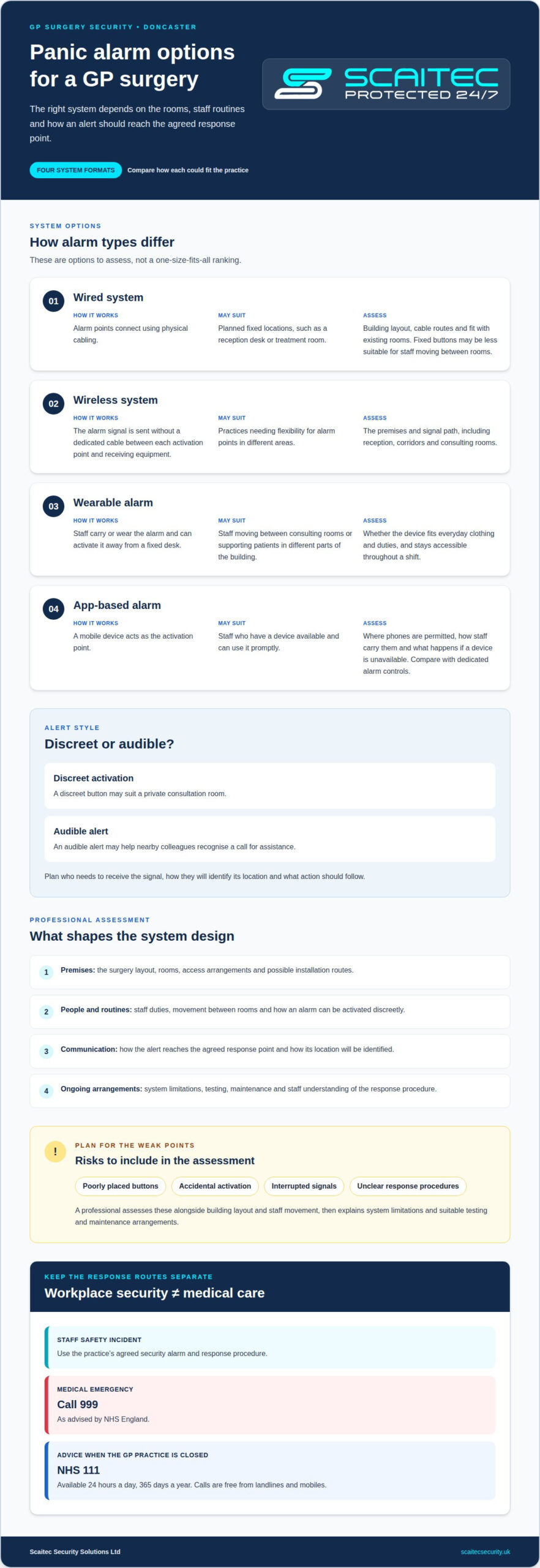
Key risks include poorly placed buttons, accidental activation, interrupted signals and unclear response procedures. A professional assesses these factors alongside the building layout and staff movement, then explains system limitations and suitable testing and maintenance arrangements.
For GP surgery contact and online services, start with the practice’s own telephone or patient service channels. Denaby Medical Practice can be contacted on 01709 514443. The Flying Scotsman Health Centre’s telephone number is 01302 587 999, and it lists an NHS email contact.
When a GP practice is closed, patients can call 111 or use NHS 111 online for advice. NHS 111 is available 24 hours a day, 365 days a year, and calls are free from landlines and mobiles. For a medical emergency, call 999, according to NHS England.
Doncaster GP practices normally open Monday to Friday, from 8.00am to 6.30pm. Bank and public holiday hours may differ. The out-of-hours period runs from 6.30pm to 8.00am on weekdays, and covers weekends and bank holidays.
Out-of-hours services can provide support for urgent medical problems, but are not a substitute for emergency care. It provides care for urgent medical problems outside normal surgery hours, but not emergencies. For wounds needing stitching or dressing, attend an Emergency Department or Minor Injury Unit; call 999 if it is an emergency.
GP practices and alarm suppliers serve different needs. A practice supports patients with healthcare appointments and advice; a security installer assesses premises and alarm arrangements. Keeping these contacts distinct helps staff choose the right route for an urgent patient concern or a workplace safety incident.
Doncaster’s GP Out Of Hours service is located on the Doncaster Royal Infirmary site and is provided by Doncaster Clinical Commissioning Group. Denaby Medical Practice has 10+ doctors across its four practices and says urgent issues are dealt with on the same day. It reported an average call-back time of 2 minutes in August 2026.
What types of panic alarm systems are suitable for GP surgeries?
A GP surgery may need fixed alarm points, portable triggers or a combination. The right arrangement depends on the rooms, staff duties and how an alert should reach colleagues. For example, reception and consulting rooms may need different activation methods. A professional maps these needs before recommending equipment, rather than assuming one design suits every practice. This assessment helps determine which panic alarm systems are suitable for GP surgeries in Doncaster.
Wired systems connect alarm points using physical cabling. They may suit planned locations such as a reception desk or treatment room. A survey considers the building layout and cable routes, including how installation would fit around existing rooms. Fixed buttons may be less suitable for staff who move between rooms during appointments.
Wireless systems send an alarm signal without a dedicated cable between each activation point and the receiving equipment. They may offer flexibility when staff need alarm points in different areas. A professional assesses the premises and signal path, as a reception area, corridor and consulting room each present different conditions.
Wearable alarms are carried or worn by staff, allowing activation away from a fixed desk. They may suit staff moving between consulting rooms or supporting patients in different parts of the building. An assessment considers whether the device fits everyday clothing and duties, and how staff will keep it accessible throughout their shift.
App-based alarms use a mobile device as the activation point. Their practical value depends on staff having the device available and being able to use it promptly. A professional considers where phones are permitted, how staff carry them and what happens if a device is unavailable. Compare this option carefully with dedicated alarm controls.
Activation can be discreet or audible. A discreet button may suit a private consultation room, while an audible alert may help nearby colleagues recognise a call for assistance. A professional considers who needs to receive the signal, how they will identify its location and what action should follow. For panic alarm systems in Doncaster GP surgeries, the alert method should fit the practice’s working arrangements.
For a Doncaster practice, the choice should reflect staff movement, room use and agreed response arrangements. A professional can assess whether fixed points, portable triggers or a combination best suits these conditions. The recommendation should also explain system limitations, routine testing and maintenance, so staff understand how the arrangement works in practice.
What UK regulations and NHS guidance apply to panic alarms in GP surgeries?
Security alarms and NHS clinical advice serve different purposes. A surgery should define each route clearly in its staff procedures. A panic alarm signals a security concern inside the premises. NHS England advises people facing a medical emergency to call 999. An alarm activation must not replace emergency medical contact or clinical decision-making.
No single alarm arrangement suits every practice. A proportionate assessment starts with the surgery’s rooms, staff roles and foreseeable risks. Reception staff, for example, may face different situations from clinicians conducting appointments. The assessment should record why alarm points are proposed, who receives each signal and what action follows.
Keep the security procedure separate from patient-care instructions. NHS 111 provides advice when GP practices are closed, whilst 999 is for emergencies. Staff guidance should make clear that an internal alarm does not contact either NHS service automatically. If someone needs urgent medical help, staff should follow the relevant clinical route.
Written procedures make alarm responses easier to follow. They can identify who receives an alert, which colleague checks the location and who is responsible for contacting emergency services when needed. For example, a consulting-room activation should prompt a defined response that protects staff and patients without delaying appropriate care.
Staff instruction should cover the controls installed at the practice. Explain how to activate and reset the alarm, how staff will recognise an alert and what happens next. A controlled test can familiarise staff with the signal. Make sure they know how to report accidental activation and escalate faults.
Keep records of the system design, staff instruction, tests and maintenance visits. A practice manager can use them to identify changes, such as a reception refurbishment or altered room use. After a layout change, review whether alarm points remain accessible and the response procedure still reflects staff movements.
Fire arrangements should also remain distinct. A fire alarm warns of fire, while a panic alarm raises a different type of alert. Staff procedures should distinguish their sounds, indicators and required actions. Clear signage or briefings can help prevent confusion during a busy clinic, especially when several alert systems are in use.
For a Doncaster GP surgery, the practical aim is a documented arrangement suited to its premises and clinical work. A professional assessment can inform decisions about equipment, positioning, signalling and staff training. The surgery manager can then maintain consistent instructions for employees, locums and other relevant workers, while keeping NHS emergency contacts clear for patient care.
How should a professional assess where to place panic buttons and alarms in a GP surgery?
A professional starts by reviewing the surgery’s floor plan and daily routines, identifying public areas, staff-only rooms and routes between them. At reception, staff may need discreet access during patient conversations. In a consulting room, clinicians may need a reachable control while seated. These examples help shape a placement plan around actual tasks.
The assessment considers where staff work alone or have limited visibility. A clinician speaking with a patient behind a closed door may need a different arrangement from reception colleagues. Discuss these situations with surgery management and staff to identify locations where an alarm can be activated without searching or interrupting care.
Access matters as much as the room itself. The installer considers whether a button can be reached from normal working positions, such as a reception chair or consultation desk. Furniture, storage and door swings can affect access. The plan should account for these features, rather than relying on a point that could be blocked during ordinary use.
A site assessment can map the following details:
- Staff positions: Where receptionists, clinicians and support staff spend their working time.
- Room use: Whether a space serves appointments, treatment, reception or staff work.
- Movement routes: How colleagues can reach an alert location from nearby rooms.
- Alert visibility: Whether staff need discreet activation or a signal colleagues can readily recognise.
Next, the professional considers how each proposed point connects to the response arrangement. A button in a treatment room should alert the designated recipient clearly and provide enough location detail to guide colleagues. The installer records how each activation point relates to the response plan, so staff know which area needs attention.
For wireless equipment, signal coverage and building materials also matter. The professional assesses the route between each proposed control and the receiving equipment, taking account of walls, doors and changes between rooms. A survey can identify locations that need adjustment before installation, followed by operational testing throughout the intended areas.
Staff input can reveal practical issues that a floor plan cannot show. A receptionist may explain where paperwork or screens restrict movement, while a clinician may identify the position used during examinations. The professional can then adjust the proposed locations and explain why each point suits its intended users.
Finally, the installer documents the agreed layout, tests the installed points and demonstrates how they work to staff. If room use changes later, such as after a reception redesign, review the placement plan. This keeps the arrangement aligned with the surgery’s working environment and response procedures.
What response options are available when a GP surgery panic alarm is activated
A panic alarm is only one part of a surgery’s response. The practice should decide who receives an alert, how they identify its location and what action follows. For example, reception staff may alert a designated colleague when a consulting-room control is activated. A clear sequence helps staff respond consistently without confusing a security alert with routine patient care.
An alert may notify colleagues inside the building through an audible signal or another agreed indicator. A discreet signal may suit a consultation room, while a visible or audible alert may help nearby staff recognise the need for assistance. The installer can explain which signal applies in each area and how staff can distinguish it from other building alarms.
The practice can set a response procedure around staff roles. One colleague might attend the location while another remains at reception or supports other patients. Staff should know when to avoid entering a room alone and how to summon further assistance. Procedures should reflect the surgery’s layout, staffing arrangements and the nature of the incident.
For a serious medical emergency, staff should contact emergency services directly. NHS England advises people facing a medical emergency to call 999. A panic alarm should not be treated as an automatic call to the ambulance service. The practice’s procedure should make clear who calls, what information they provide and who stays with the patient or colleague.
Security incidents need a distinct response. If an alarm signals threatening behaviour, staff may alert colleagues, move patients away from the area and contact emergency services when appropriate. Instructions should identify a safe place and explain how to communicate without escalating the situation. The practice can adapt these steps for reception, consulting rooms or corridors.
Plan how to handle false or accidental activations too. Staff should know how to report an activation and confirm whether assistance is needed. The procedure should explain how to reset the system, who records the event and who reports a fault. Records can help the practice identify recurring issues, such as accidental button presses or unclear instructions.
Testing and staff briefings help keep the response familiar. A controlled test can show staff what the alarm sounds or looks like, while a short briefing clarifies the roles of receptionists, clinicians and temporary staff. Review the procedure after changes to room use or staffing so written instructions still match daily practice.
An alarm response should remain separate from arrangements for routine clinical advice. Denaby Medical Practice says a doctor will contact a patient the next day if no doctor is available when the patient requests one. This describes follow-up to a request, not an emergency response. People living outside the practice’s area can register if they can attend for blood tests and face-to-face appointments when needed. These details distinguish routine contact and registration arrangements from the steps staff follow when a panic alarm calls for immediate attention.
Scaitec Security Solutions Ltd: Intruder Alarms
Scaitec Security Solutions Ltd can help GP practices plan intruder alarm protection around their premises and staff routines. If you’re considering a panic alarm, we can discuss how it fits the surgery’s wider security arrangements, including access points and the areas where staff need to raise an alert. The right design starts with understanding how the building is used, then selecting and installing a suitable system. Ongoing system maintenance can help keep the installed equipment in working order and support consistent operation. This is a practical next step when a practice is planning new security measures or reviewing its existing arrangements.
Contact Scaitec Security Solutions Ltd to discuss intruder alarms for your GP surgery.
Plan the next step for your surgery
Use your practice’s identified needs to shape a clear project brief. Describe how staff use the premises, which areas need protection and what should happen when an alert is raised. This gives a professional installer a practical starting point for discussing suitable GP surgery panic alarm systems in Doncaster.
Scaitec Security Solutions Ltd can help practices consider intruder alarms alongside CCTV systems and access control systems. These measures address different aspects of premises security, so consider how each relates to your surgery’s requirements. A considered plan can help turn general concerns into a system designed around the way your practice operates.
Taking the next step can be straightforward: share your premises’ security priorities and discuss the appropriate approach with the team.
With a clear plan, your practice can make informed decisions about its security arrangements organisation-wide.
Frequently Asked Questions
Which Doncaster security companies install GP surgery panic alarms?
Scaitec Security Solutions serves Doncaster with electronic security installations, including intruder alarms, CCTV and access control. For a GP practice, the system should be designed around the premises and the intended alert response. Panic alarms have a specific purpose and are not interchangeable with standard intruder alarms. A professional assessment helps define the right arrangement for the surgery.
Protect Your Business
Protect Your People
Book Your FREE Site Protection Survey

Since pioneering Scaitec Security Solutions in 2005, Paul Scaife, with his roots in the industry dating back to 1994, has distinguished the firm as a leading provider of bespoke fire and security solutions, servicing clients across Sheffield, Rotherham, and surrounding areas.
His leadership, underpinned by accreditation from the Security Systems and Alarms Inspection Board, ensures that Scaitec surpasses client expectations by blending advanced technology with a deep understanding of their unique needs.
Paul's ethos champions innovation and efficiency, driving Scaitec to deliver tailored, cutting-edge solutions that enhance safety and operational ease.
Discover more about Paul’s commitment to excellence on LinkedIn.