
Table of Contents
“Insurance approved” doesn’t refer to one universal type of alarm. If you’re comparing insurance approved alarm systems Sheffield insurers may accept, start with the conditions in your own policy. Requirements can vary, and an alarm that appears suitable may not match what your insurer specifies for its grade, installation or monitoring.
It’s understandable to want a clear answer when policy wording is technical and you’re unsure what evidence to keep. “Insurance approved” is shorthand for meeting an individual insurer’s requirements, not a universal designation. This guide explains what to clarify, how alarm grades and Alarm Receiving Centre monitoring may fit into policy conditions, and which installation and maintenance records to retain.
Scaitec Security Solutions designs, installs and maintains intruder alarms for homes and businesses in Sheffield. We can discuss your property and the requirements set out in your policy, including how monitoring and maintenance may fit into the system. Read on to prepare useful questions, organise your records and plan an alarm installation with greater confidence.
Key Takeaways
- “Insurance approved” isn’t a universal alarm certification. Compare your policy’s exact conditions with the system being considered.
- Check whether your insurer specifies an alarm grade, professional installation, monitoring or ongoing maintenance before choosing an arrangement.
- Compare wired and wireless options against the property layout and policy requirements, and have an existing system assessed before relying on it.
- For insurance approved alarm systems Sheffield property owners should keep written clarification from their insurer, installation details and maintenance records together.
- Sharing your policy requirements can help Scaitec tailor an intruder alarm design and installation for your Sheffield property.
What does ‘insurance approved alarm system’ mean in Sheffield?
“Insurance approved” can sound like a formal status attached to a particular alarm. In practice, interpret it against your own insurer’s conditions. Your policy may set requirements for system features, who installs it, whether it must be monitored and how it should be maintained. Those details can differ between policies, even for similar properties in Sheffield.
A product label or sales description alone doesn’t show that an alarm meets your policy wording. An installer’s credentials and an alarm’s technical specification are separate considerations. Either may be relevant, but neither automatically confirms that every condition of your cover has been met. For background on one UK security installer certification body, see the National Security Inspectorate (NSI).
An alarm meets an insurer’s requirements only when its documented specification, installation and ongoing arrangements match the conditions in that particular policy.
Why ‘approved’ does not always mean the same thing
Insurers may describe a required alarm by its features, installation arrangements or monitoring. A certification associated with an installer isn’t the same as an insurer’s decision about a specific property and policy. The property’s use, the cover selected and the insurer’s terms can all affect what’s required. Use your policy wording as the reference point, rather than relying on a general “approved” label.
If a condition mentions a standard, grade, monitoring service or installer approval, note the exact wording. Don’t assume a similar phrase on an alarm’s packaging or website means the condition is satisfied. If the wording is unclear, ask your insurer for written clarification and keep its response with your policy documents.
Which properties may have alarm conditions?
Alarm conditions can apply to a home, shop, office or other premises, but they aren’t automatic for every property or policy. An insurer may set a condition based on the property, the type of cover or particular risks it has assessed. Some policies require monitoring, while others specify a different arrangement or no alarm condition at all.
Check more than the main policy booklet. Review the policy schedule, any endorsements and renewal documents, as these can contain property-specific terms or changes to your cover. For example, a renewal may state an alarm condition that wasn’t present in the previous documents. If you’re planning an upgrade, compare the proposed system with the current written requirement first.
Scaitec designs and installs intruder alarms for homes around the property’s needs and the insurer requirements you provide. We also install and maintain business intruder alarms, so policy conditions can be considered as part of the security plan. Sharing the relevant wording helps give the system discussion a clear starting point.
Alarm grades, installation and monitoring: what might an insurer specify?
An insurer’s alarm condition may refer to several parts of a system, not just the control panel or sensors. It might name a grade or technical standard, specify how the system is installed, or require monitoring or routine maintenance. Read these details in context: a higher specification isn’t automatically right for every property, and a particular grade doesn’t guarantee acceptance by an insurer.
For insurance approved alarm systems Sheffield property owners are considering, the practical task is to match the policy’s stated conditions with the system design and its ongoing care. A house with a straightforward layout may have different design needs from a shop with several access points or an office with areas used at different times.
What do alarm grades and standards indicate?
Grades and standards describe aspects of an alarm system’s technical specification. If your policy names a grade or standard, use the exact wording and reference in the policy, then establish how the proposed system and its installation relate to it. A grade alone doesn’t settle the question: equipment specification, installation quality and the system’s condition over time are separate considerations.
Insurer conditions may also refer to installer approval. For general information about one UK certification body, the Security Systems and Alarms Inspection Board (SSAIB) explains its role in the security systems sector. This is distinct from the system itself, so compare any policy requirement with the insurer’s precise wording.
| Feature | Purpose | Policy-dependent requirement |
|---|---|---|
| Alarm grade or standard | Describes a system’s technical specification | Check whether the policy names a grade or standard |
| Audible-only alarm | Sounds an alert at the premises | May be suitable only if it meets the policy’s stated conditions |
| Monitored alarm | Sends alarm signals to an Alarm Receiving Centre (ARC) | Use monitoring if required by the policy; don’t assume it is always necessary |
| Installation and maintenance | Support correct operation and ongoing system condition | Check for requirements covering installer arrangements or servicing records |
When might monitoring or maintenance matter?
An audible-only alarm alerts people nearby, whereas an ARC-monitored system sends signals to a centre that receives alarm information. Monitoring describes how signals are handled; it doesn’t, by itself, promise a particular response. Whether monitoring is required depends on the policy. Read the wording before deciding that one arrangement is enough or that another is essential.
Maintenance can matter when a policy sets ongoing conditions or asks for evidence that the system is kept in working order. Keep service records and note relevant changes or faults, so you can refer to a clear history if asked. Scaitec maintains intruder alarm systems, helping Sheffield property owners plan ongoing upkeep alongside installation.
Before settling on a design, consider the building’s layout, access points and use, then compare those needs with the insurer’s written conditions. A tailored alarm discussion can account for both without treating a grade, audible alert or monitoring option as a universal answer.
How to compare alarm options against your Sheffield insurance policy
Once you know what your policy says, compare each alarm option with those conditions and the realities of the building. Wired and wireless systems can both be considered, but the right design depends on the property layout, installation needs and any insurer-stated requirements. Don’t choose on convenience or a product description alone.
A wired design uses cabling between system components, so the building’s layout and installation work need to be considered. A wireless design avoids running the same type of cabling, which can affect how installation is planned. Neither approach is automatically more suitable for insurance. Check whether the policy specifies a particular system arrangement, then consider how each option would cover the property and suit its use.
Should you upgrade an existing alarm or install a new one?
Don’t assume a new alarm will automatically satisfy your insurer, or that an existing system is unsuitable simply because it has been in place for years. Start with the written conditions, then consider the system’s current condition, available documentation and any changes to the property. An extension, altered entrances or a change in how rooms are used may affect the original design.
An assessment can help identify whether the existing arrangement still suits the building and what may need attention. That could mean considering an upgrade or a new design, depending on the system and policy conditions. An assessment can’t guarantee insurer acceptance, so keep the insurer’s requirements as the reference point throughout.
What should Sheffield homes and businesses consider?
For a home, map the main access points and consider how the property is occupied. A household with a frequently used side entrance, for example, should consider how that access is covered alongside any alarm conditions in the policy. For a business, consider what the premises are used for, which areas are occupied and when, and what protection the insurer has specified. A shop and an office can have different layouts and operating patterns, so the design should reflect the actual premises rather than assume one arrangement fits all.
For insurance approved alarm systems Sheffield homeowners and businesses are comparing, place the policy wording beside a simple plan of the property. Mark entrances, changes to the building and areas used at different times. This creates a clearer basis for discussing coverage, installation approach and insurer conditions together.
Scaitec designs and installs intruder alarms for Sheffield properties, taking account of the building and the insurer requirements you provide. A discussion about Sheffield intruder alarm installation can help you explore a suitable design for your home or business without assuming that a particular system type will meet every policy.
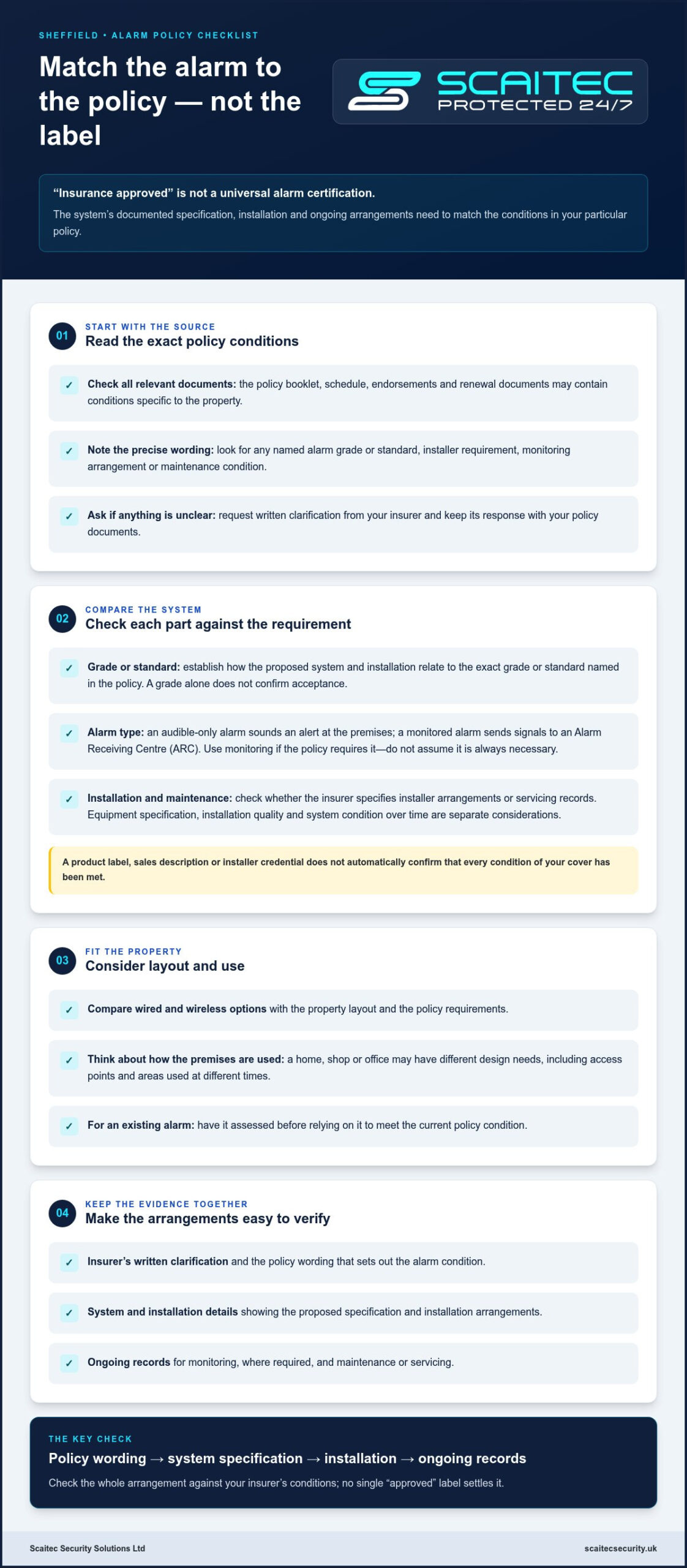
A practical checklist for meeting your insurer’s alarm conditions
A clear process can help you avoid choosing an alarm before you understand what your policy asks for. For insurance approved alarm systems Sheffield property owners can plan with confidence, keep the insurer’s written conditions at the centre of the conversation, then collect the relevant system documents as the work progresses.
Before arranging installation
Start with the documents that define your cover. Check the policy wording, schedule, endorsements and renewal terms for alarm conditions. If a phrase is unclear, ask your insurer to explain it in writing before making decisions. Keep the reply with your policy paperwork so you can refer to the same confirmed requirements during the design discussion and later if the insurer asks for evidence.
- Gather the policy documents. Find any reference to an alarm type, grade, installation arrangement, monitoring or servicing. Note which document contains each condition and whether it applies to the property or a particular part of the cover.
- List questions for your insurer. Ask for clarification on ambiguous terms, including whether the policy specifies an alarm grade, ARC monitoring, maintenance or particular installation arrangements. Request a written response and keep it with the relevant policy documents.
- Prepare property information. Note the building’s use, layout, access points and any recent changes that could affect the system design. This gives the alarm discussion practical context beyond the policy wording alone.
- Share the requirements during design. Provide Scaitec with the relevant policy wording and your insurer’s written clarification. We can use these details to inform a system discussion tailored to the property and the conditions you’ve shared.
After installation: keep useful records
Once installation is complete, keep the documents supplied for the project together and easy to retrieve. Record the system details, installation information and any monitoring arrangement in place. These records describe the work and system; they’re separate from the insurer’s confirmation of how its policy conditions apply. Follow your insurer’s instructions on how to submit evidence and whether it needs updates at renewal.
- File the installation information. Retain relevant system documentation and installation details supplied for the project. Make a note of the installation date and where the documents are stored, so you can find them when needed.
- Maintain a clear history. Keep maintenance records and note reported faults, repairs or changes to the system, including any change to monitoring arrangements. If the insurer asks for evidence, provide the documents in the format it requests.
Insurer confirmation explains how a policy condition applies; installer documentation records the system and work completed. Keep both, along with maintenance and monitoring details, so the evidence is clear and organised.
Plan an insurance-conscious alarm system with Scaitec in Sheffield
Choosing an alarm is easier when the policy conditions and the property are considered together. Scaitec Security Solutions designs, installs and maintains intruder alarm systems for homes and businesses in Sheffield and across South Yorkshire. We can use the details you share about your insurer’s requirements to inform a practical system discussion, rather than treating one arrangement as suitable for every building.
From property needs to a considered installation
System planning starts with how the premises are used and laid out. A home, shop and office can have different access points, occupancy patterns and protection needs. We consider these alongside the insurer’s stated conditions to shape an installation suited to the property. If the policy refers to monitoring or maintenance, those arrangements can form part of the discussion too.
Our role is to design and install the alarm system, then support its upkeep through maintenance and, where appropriate, remote monitoring via an Alarm Receiving Centre. The insurer remains responsible for deciding whether the system meets its policy conditions. An installation isn’t a guarantee of acceptance or of any change to cover.
Discuss your Sheffield alarm requirements
Homeowners and businesses can bring the relevant policy wording, schedule or written clarification from their insurer to a discussion with Scaitec. Identify the specific condition, such as a named system feature or ongoing arrangement, and share details about the building that could affect the design. This gives the conversation a clear starting point and helps align the proposed installation with the requirements you’ve provided.
If the insurer’s wording is ambiguous, get its explanation before relying on an interpretation. Keep the response with your records and use it to guide the project discussion. System design, installation and ongoing support can then be considered against the same written information, while the final decision on policy acceptance stays with the insurer.
For property owners researching insurance approved alarm systems Sheffield, a step-by-step approach makes the decision more manageable. Share what the building needs and what the policy states, then consider the appropriate alarm design, installation and any relevant monitoring or maintenance. There’s no need to assume a particular grade or system type is right before those details are understood.
Scaitec provides intruder alarm support for Sheffield properties, from initial design through installation and ongoing maintenance. We also serve properties in Rotherham, Barnsley, Doncaster, Chesterfield, Worksop, Wakefield and Huddersfield. Bring your insurer’s relevant requirements into the conversation to help shape an alarm plan for your home or business.
Move forward with a clear alarm brief
Turn your insurer’s wording into a concise brief for your property. Note which conditions are clear, any points the insurer has explained in writing and any questions still awaiting an answer. This gives your discussion a practical focus and keeps decisions about insurance approved alarm systems Sheffield grounded in your policy, rather than assumptions about what “approved” means.
Bring that brief, together with relevant property details, to a conversation with Scaitec. We can use it to discuss an alarm system suited to your premises and the requirements you’ve shared. Your insurer remains the authority on how its conditions apply, so keep its written guidance alongside the system documentation as you move ahead.
With the right information in hand, planning can feel more straightforward. Take the next step with a clear basis for making decisions about your property’s security.
Frequently Asked Questions
What does an insurance approved alarm system mean in the UK?
It usually means an alarm arrangement that meets conditions set by a particular insurer, rather than a universal approval that applies to every policy. Requirements might cover the system, its installation or how it’s maintained. A policy could, for example, specify a particular arrangement for a property. A product description alone can’t establish that the condition is met, so compare the exact policy wording with the system details.
Do all home insurance policies require a burglar alarm?
No, a burglar alarm isn’t a standard requirement in every home insurance policy. Conditions can depend on the insurer, the cover and the circumstances of the property. Check the schedule and any endorsements, especially if your cover has changed at renewal. If a clause is unclear, ask the insurer to explain it in writing before arranging an installation or assuming your current security arrangements affect the cover.
Can a wireless alarm meet an insurer’s requirements?
It may, if the proposed system meets the conditions in your policy. Wireless equipment isn’t automatically accepted or ruled out because of how it connects. For insurance approved alarm systems Sheffield residents are considering, compare the system’s documented details with any policy requirements for installation, monitoring or upkeep. Ask your insurer for clarification if needed, rather than relying on a general claim that wireless alarms are suitable.
Does my insurer require a monitored alarm?
Not necessarily. Some policies may specify monitoring through an Alarm Receiving Centre (ARC), while others set different conditions or none relating to monitoring. Look for explicit wording about an ARC or monitored system, and check what type of arrangement the insurer means. If monitoring is required, ask what evidence it expects, such as details confirming the system’s monitoring arrangements, and keep that information with your policy records.
Will installing an alarm reduce my home insurance premium?
Installing an alarm doesn’t guarantee a lower premium. An insurer may take its own approach, and in some cases an alarm condition relates to the cover rather than a possible saving. Before budgeting around an expected reduction, ask your insurer whether the proposed system affects your premium or policy terms. Keep any written answer, and don’t treat an advertised discount or general estimate as a promise about your individual policy.
What evidence should I keep after an alarm installation?
Keep the system documentation and installation details supplied for the project, plus any relevant information about monitoring. Add maintenance records when the system is serviced, and note faults, repairs or changes so the file reflects its current state. If monitoring arrangements change, update your records and ask the insurer whether it needs revised evidence. Its instructions determine which documents to submit and how to provide them.
Can an existing alarm satisfy a new insurance policy?
It may, but an alarm’s age alone doesn’t show whether it meets a new policy’s conditions. Compare available system documents with the new wording, and note any changes to the property or system since installation. An assessment can help establish the alarm’s features and current condition. Ask the insurer what evidence it requires before relying on the existing installation, particularly if the policy introduces a condition you haven’t had before.
Protect Your Business
Protect Your People
Book Your FREE Site Protection Survey

Since pioneering Scaitec Security Solutions in 2005, Paul Scaife, with his roots in the industry dating back to 1994, has distinguished the firm as a leading provider of bespoke fire and security solutions, servicing clients across Sheffield, Rotherham, and surrounding areas.
His leadership, underpinned by accreditation from the Security Systems and Alarms Inspection Board, ensures that Scaitec surpasses client expectations by blending advanced technology with a deep understanding of their unique needs.
Paul's ethos champions innovation and efficiency, driving Scaitec to deliver tailored, cutting-edge solutions that enhance safety and operational ease.
Discover more about Paul’s commitment to excellence on LinkedIn.