
Table of Contents
A fire alarm certificate is only useful when it shows what was tested, what worked and what needs attention. A landlord fire alarm certificate in Rotherham records the professional checks carried out on a property’s alarms, their results and any faults or recommended actions. It’s a record of the system’s condition, not a substitute for fitting the alarms required by law.
In England, landlords must fit at least one smoke alarm on every storey used as living accommodation. For HMOs, the stated testing interval for fire alarm systems is every six months, while the appropriate system and standard depend on the property and its use.
This guide explains what a certificate should cover, when smoke alarms are required and how BS 5839 systems differ. It also sets out the HMO testing interval and the checks a professional carries out, so you can understand what the record tells you and what may need attention next.
Key Takeaways
- A useful fire alarm certificate records the system checks, test results, faults identified and any recommended action.
- BS 5839 covers fire detection and alarm systems, while BS 5839-6 applies to residential properties.
- HMO requirements depend on the property and its use, so the alarm system and its records need to match the building’s fire safety arrangements.
- Regular alarm tests, battery care and professional servicing each play a part in keeping a system dependable.
- A change to the property can affect fire safety arrangements, making it important to keep assessments and system records up to date.
What is a Fire Alarm Certificate?
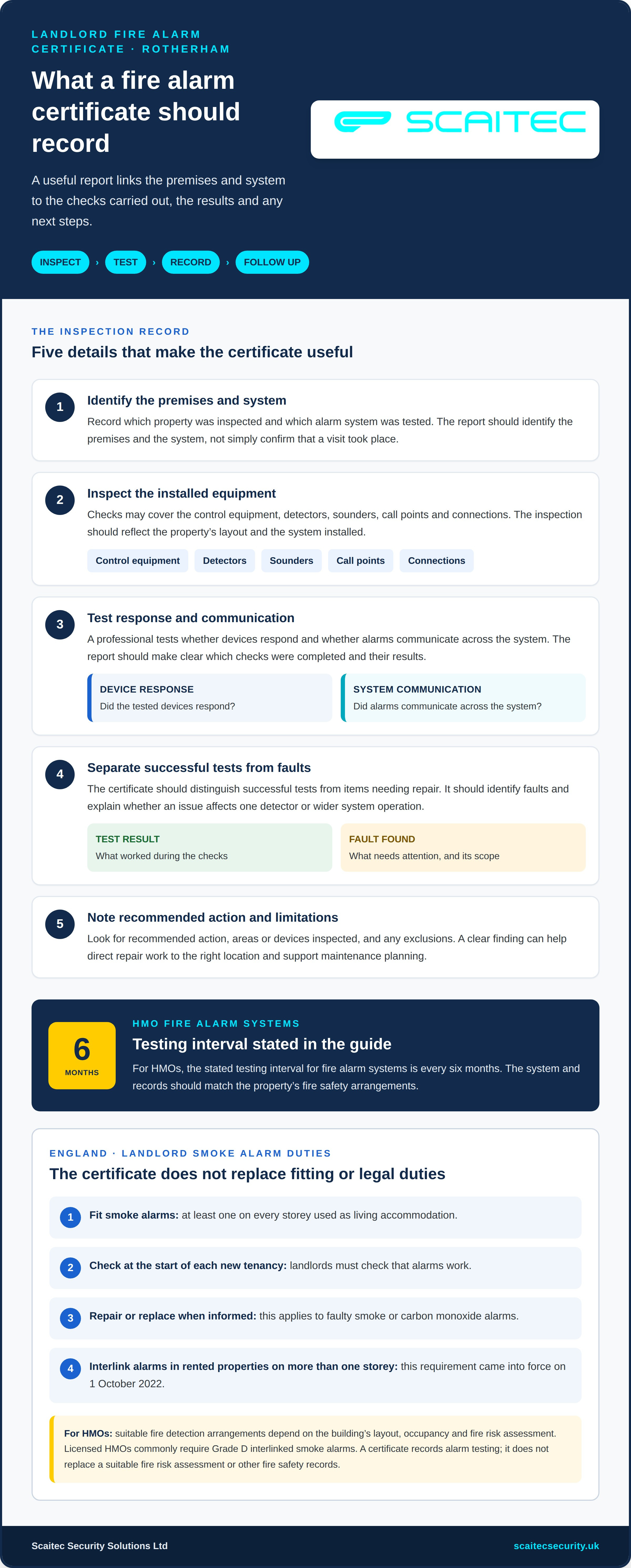
A fire alarm certificate is a written record of a professional inspection and test. For a landlord fire alarm certificate in Rotherham, the report should describe the system examined, the checks completed, their results and any faults requiring attention. It records the system’s condition at the time of testing and helps the landlord plan repairs or follow-up work.
Checks should reflect the property’s layout and installed system. A professional may examine control equipment, detectors, sounders, call points and connections, then test whether devices respond and alarms communicate across the system. The certificate should distinguish successful tests from items needing repair, and identify whether a fault affects one detector or wider system operation.
Rotherham companies providing landlord fire alarm inspections and certification include contractors that test, install and maintain systems. The appropriate contractor depends on the property, its alarm type and whether it is a home, HMO or commercial premises. A landlord should receive a record identifying the premises, the system tested and the inspection findings. That information makes the report useful beyond simply confirming a visit took place.
There is no single price for every property. The cost depends on the case and is provided after a quote request. Factors include the system type, property layout, number of devices, access and any faults found. A basic domestic alarm test differs from inspecting a larger or more complex system. Installation costs also depend on detector positions, wiring requirements and whether existing equipment can be used.
For a landlord fire alarm certificate in Rotherham, consider what the professional visit includes, rather than treating the certificate as a standalone document. Testing may uncover faults that need separate repairs, while an installation quote covers the equipment and work needed to provide a system. These are distinct tasks, so the agreed scope should explain what the inspection covers and what work may follow.
Regulations and building use shape the required system. A rented home, an HMO and commercial premises can have different fire safety arrangements. The test record should identify the system and its limitations, not imply that one certificate proves every requirement has been met. A useful record names the areas or devices inspected, notes exclusions and gives the landlord clear information for planning maintenance.
When reviewing the report, look for the property and system identification, inspection date, results, faults and recommended action. These details link the test to the correct premises and clarify next steps. If a detector needs attention, a clear finding can direct repair work to the right location and support consistent oversight of the alarm system.
Depending on the premises, regulations may require separate fire safety records. A certificate documents alarm testing, but does not replace other assessments or safety duties. Keeping inspection reports with maintenance records makes it easier to track completed work and address outstanding actions.
Are smoke alarms a legal requirement?
Yes. In England, landlords have smoke alarm duties, while HMOs and shared areas can involve additional fire safety requirements. The property’s use and layout affect which arrangements apply.
UK landlord certificate requirements
A certificate records professional alarm testing, but it does not replace the landlord’s legal duties. The Regulatory Reform (Fire Safety) Order 2005 sets out fire safety duties for a responsible person, according to the UK legislation register. For HMOs and commercial premises, fire risk assessments are required under this Order. The assessment should reflect the premises and its fire precautions.
Smoke alarm rules in England
Landlords in England must fit at least one smoke alarm on every storey used as living accommodation. They must check alarms work at the start of each new tenancy and repair or replace faulty smoke or carbon monoxide alarms when informed. Under the 2022 amendment, rented properties on more than one storey require interlinked alarms. That amendment came into force on 1 October 2022.
HMO alarm requirements
HMOs need suitable fire detection arrangements, and licensed HMOs commonly require Grade D interlinked smoke alarms. The appropriate provision depends on the building’s layout, occupancy and fire risk assessment. Local HMO fire risk assessment requirements vary, so the system and documented precautions should fit the property rather than follow a generic template.
Fire risk assessment duties depend on the premises. A single private dwelling is not subject to fire risk assessment legislation, whereas an HMO has different considerations. In blocks of flats, including houses converted into flats, landlords are responsible for assessing communal areas and individual flat entrance doors. Shared corridors and stairs form part of the escape routes and should feature in the assessment.
The Regulatory Reform (Fire Safety) Order 2005 also places duties on a responsible person to manage fire safety risks in relevant premises. The UK Government says failure to comply with smoke alarm requirements can attract a civil penalty of up to £5,000. A landlord’s fire safety records should distinguish between alarms inside a domestic dwelling and precautions for shared areas.
For an HMO, the assessment considers how residents would be alerted and leave safely. Interlinked alarms can alert occupants in different areas when one activates. The assessment should also account for the building’s routes, shared spaces and intended evacuation arrangements. A certificate supports the testing record, but does not replace a suitable fire risk assessment.
HMO fire alarm testing frequency
HMO fire alarm systems need regular testing, with the interval depending on the system and applicable fire safety arrangements. BS 5839 provides the framework for understanding system design, testing and maintenance.
Compliance testing
BS 5839 is the British Standard for fire detection and alarm systems. For residential properties, BS 5839-6 covers system design and maintenance. HMO and commercial premises are stated to require fire alarm testing every six months. This interval helps identify faults affecting alarms, detectors and connections, rather than relying only on a visual check.
During a professional test, the engineer assesses whether the installed system operates as intended. They can check devices throughout the property, including shared areas and escape routes, and record faults or required action. For example, if a detector fails to activate the alarm, the result should be recorded and followed up. The landlord can use the report to track findings between visits.
Testing should reflect the building’s actual layout and alarm arrangements. A system serving bedrooms, kitchens and communal corridors needs checks that account for these different areas. Tenants also need to know how to report a fault between scheduled visits. In Rotherham, the property’s use and fire risk assessment help shape its overall fire safety arrangements.
Professional fire alarm testing and servicing for landlords
Professional servicing of UK residential fire alarm systems is recommended at least once every 12 months under BS 5839-6. This annual visit is separate from the stated six-month testing interval for HMO and commercial systems. The engineer’s work can include checking sensor response and system operation, then recording the results and any faults requiring attention.
Annual sensor testing matters because a detector that appears intact may not respond correctly during an alarm condition. A professional test checks the device’s response within the connected system, including whether activation reaches the expected sounders. The report records the work and helps landlords identify recurring faults across visits.
Landlords can arrange visits around tenancy and maintenance schedules, while ensuring that tenants receive notice of access arrangements. If a fault is reported between planned tests, it should be addressed promptly rather than left until the next scheduled visit. Fire alarm system maintenance can support ongoing checks and help keep the inspection history organised.
Keep each report with the property’s fire safety records. Compare the latest findings with earlier reports to see whether the same detector, sounder or circuit has needed repeated attention. For an HMO in Rotherham, this evidence connects scheduled testing to the building’s actual risks and safety arrangements.
What a fire alarm certificate should include
A useful certificate lets a landlord identify exactly what a professional tested and what happened. It should name the property, describe the system and record the inspection date. It should also clarify whether the report covers the whole installation or selected devices. For example, a report covering communal corridors should not imply that alarms inside individual flats were tested.
The system description should connect the findings with the building’s layout. It can identify the alarm type, control equipment and relevant detectors or sounders. For an HMO, the record should clarify which shared areas and escape routes were included. Naming the inspected locations makes follow-up work easier to plan and helps distinguish one device from another.
Look for clear results, not just a statement that the system was inspected. A useful report records whether each relevant test passed, failed or needs attention. It should identify the affected component and explain the issue plainly. For instance, “detector in first-floor landing did not activate the alarm” is more actionable than “fault found”. The record should also state recommended corrective work, where needed.
- Property and system details: the address, system type and inspection scope.
- Test findings: the devices or areas tested and their results.
- Faults and action: affected equipment, required repairs and any follow-up test.
- Traceability: inspection date and the person or organisation responsible for the report.
These details help landlords maintain consistent records across visits. If the same detector fails during a later inspection, previous findings show the fault’s history. Keep repair records with the test report. This creates a clear sequence: inspection, identified fault, corrective work and confirmation of the system’s later condition.
BS 5839 provides context for fire detection and alarm systems, but a certificate should identify what standard or system basis the inspection refers to. For a residential system, BS 5839-6 is relevant. The report should not imply that an inspection alone proves every fire safety duty has been met. The council, licensing conditions and property-specific assessment may involve other records.
Check the scope carefully for linked devices. If interlinked smoke alarms are installed, the report should clarify whether testing covered their connection and operation together. Carbon monoxide alarms may also be present, but their checks should not be confused with fire alarm testing. A well-structured certificate separates these findings, records exclusions and makes the next maintenance step clear.
How often should landlords arrange professional testing and servicing of fire alarm systems?
Set a planned schedule that separates routine alarm checks from professional servicing. Residential fire alarm systems should receive professional servicing at least once every 12 months under BS 5839-6. HMO and commercial systems have a stated six-month testing interval, so landlords should organise visits around the system and premises type.
Regular checks serve different purposes. A monthly smoke alarm test helps identify a unit that no longer responds. Professional servicing examines the system more fully, including detector response and whether connected alarms operate as intended. A technician can record faults and explain which components need repair, helping landlords distinguish a routine test from a service visit.
Battery care also belongs in the maintenance plan. Replace smoke alarm batteries yearly, or sooner if the unit chirps. Clean smoke alarms every six months using a vacuum brush to remove dust. These routine measures do not replace professional servicing, particularly where the property has a linked system or several devices serving shared areas.
For a rented home, keep planned servicing dates alongside tenancy and maintenance records. When a new tenancy begins, the landlord must check that smoke alarms work. Record the result and any follow-up work, so the property file shows when the check took place and how faults were handled.
HMO records need to reflect the wider system. A professional visit can cover detectors, sounders, control equipment and connections, with findings recorded by location. For example, a fault in a communal hallway should be traceable to that device, rather than recorded only as a general system issue. This makes repair arrangements clearer and helps compare findings across inspections.
Do not wait for the next scheduled service if an alarm is reported faulty. Landlords in England must repair or replace smoke and carbon monoxide alarms once informed of a fault. A prompt professional response can establish whether the issue affects one device or the connected system. Keep the repair record with the latest service report.
Annual servicing under BS 5839-6 gives residential landlords a recurring opportunity to review system condition. Where an HMO’s six-month testing schedule applies, keep those testing visits distinct from the annual service recommendation. A calendar with separate dates for each task reduces the chance of treating one visit as a substitute for another.
Scaitec Security Solutions Ltd: Intruder Alarms
Scaitec Security Solutions Ltd can help landlords maintain fire protection through fire alarm systems and system maintenance. If testing identifies a fault or an existing system needs attention, professional maintenance is a practical next step. The work depends on the system installed and the property’s layout.
For landlords planning a new system or reviewing existing provision, professional support can help clarify equipment and maintenance needs. Scaitec Security Solutions Ltd also provides fire alarm systems, intruder alarms, CCTV systems and access control systems. Contact Scaitec Security Solutions Ltd to discuss fire alarm system maintenance for your property in Rotherham.
Keep your property’s fire safety plan moving forward
Use your next maintenance visit to consider whether the property or its use has changed. A new layout, altered shared spaces or a change in occupancy can affect how well the existing alarm arrangements serve residents. Keeping system records alongside property updates makes it easier to plan follow-up work and maintain a clear history.
For landlords arranging a landlord fire alarm certificate in Rotherham, connect the inspection findings with a practical maintenance plan. Scaitec Security Solutions can support fire alarm system maintenance, while CCTV systems, intruder alarms and access control systems can address other security needs across a property in Rotherham, Sheffield or South Yorkshire.
A clear plan helps organise safety responsibilities and gives you a confident basis for the next stage of property care.
Frequently Asked Questions
What fire alarm requirements apply to landlords in Rotherham?
Landlords in Rotherham must fit smoke alarms on every storey used as living accommodation and keep them working. At the start of each new tenancy, check that the alarms operate; repair or replace faulty smoke or carbon monoxide alarms when notified. HMOs have additional fire safety considerations, including suitable detection and a fire risk assessment. The property’s use, shared areas and escape arrangements help determine the appropriate system.
Is a landlord legally required to provide a fire alarm certificate in England?
England’s requirements focus on providing and maintaining the required alarms; a standalone certificate is not the core duty for every rented home. A test report can document an inspection and help demonstrate maintenance, but it does not replace the landlord’s legal responsibilities. For properties with shared areas or HMO use, keep relevant fire safety records alongside the alarm report so the evidence reflects the building’s arrangements.
What fire alarm checks and maintenance are required in a rented property?
Landlords must check smoke alarms work at the start of each new tenancy and repair or replace faulty smoke and carbon monoxide alarms once informed. Routine care also matters: test smoke alarms every month, replace batteries yearly or sooner if a unit chirps, and clean alarms every six months with a vacuum brush. Professional residential servicing is recommended at least once every 12 months under BS 5839-6.
What fire alarms are required in each room and on each storey of a rental property?
In England, at least one smoke alarm is required on every storey used as living accommodation. The rule is based on storeys, not a universal smoke alarm requirement in every room. A carbon monoxide alarm is required in each room containing a fixed combustion appliance. For rented properties on more than one storey, interlinked smoke alarms are required under the 2022 amendment. The system should reflect the property’s layout.
Do HMOs in Rotherham need a fire alarm system or fire risk assessment?
HMOs need suitable fire detection arrangements and a fire risk assessment. Licensed HMOs commonly use Grade D interlinked smoke alarms, but the property’s layout, shared spaces and evacuation arrangements affect the appropriate provision. HMO assessment requirements vary by locality. In Rotherham, the assessment should consider how tenants will be alerted and how escape routes are protected, rather than relying on a standard system description alone.
How much does a landlord fire alarm inspection or certificate cost in Rotherham?
The price depends on the case and is provided after a quote request. Main cost factors include the property’s size and layout, the type and number of alarm devices, system complexity, access requirements and whether faults need repair. A test visit and new system installation involve different work, so the scope matters. Ask for a clear description of what the inspection covers and which follow-up work is separate.
What documents should a landlord provide to tenants for fire alarm compliance?
Landlords must provide the relevant fire alarm report to the tenant within 28 days. Keep a copy of the report with records of alarm checks, repairs and replacement work. For example, if a tenant reports a faulty detector, recording the report and the repair helps show how the issue was addressed. In an HMO, keep relevant fire safety assessment documents with the alarm records for a coherent property file.
What are the penalties for failing to meet fire safety requirements in a rental property?
Failure to comply with smoke alarm requirements can attract a civil penalty of up to £5,000, according to UK Government. The penalty relates to failing to meet the applicable requirements, so landlords should keep alarms working and act when faults are reported. Fire safety duties can also apply to HMOs and relevant shared premises under the Regulatory Reform (Fire Safety) Order 2005, according to the UK legislation register.
Protect Your Business
Protect Your People
Book Your FREE Site Protection Survey

Since pioneering Scaitec Security Solutions in 2005, Paul Scaife, with his roots in the industry dating back to 1994, has distinguished the firm as a leading provider of bespoke fire and security solutions, servicing clients across Sheffield, Rotherham, and surrounding areas.
His leadership, underpinned by accreditation from the Security Systems and Alarms Inspection Board, ensures that Scaitec surpasses client expectations by blending advanced technology with a deep understanding of their unique needs.
Paul's ethos champions innovation and efficiency, driving Scaitec to deliver tailored, cutting-edge solutions that enhance safety and operational ease.
Discover more about Paul’s commitment to excellence on LinkedIn.