
Table of Contents
It’s 2:00 AM, and a persistent, rhythmic chirp echoes through your hallway, leaving you staring at a glowing keypad of cryptic symbols. We understand that few things are as frustrating as a repetitive noise you cannot quite identify, especially when it involves your home’s primary line of defence. You’re likely asking, “why is my burglar alarm beeping,” whilst simultaneously worrying if the system will suddenly trigger a full-scale siren or if your property is even protected. It’s a common concern that can cause genuine anxiety for any homeowner.
This guide provides the professional reassurance you need to silence that annoying sound immediately without compromising your security. We’ll help you decode those confusing keypad alerts and determine whether your system is still effectively monitoring your premises. By following our structured approach, you’ll discover the most common reasons behind these alerts, from low batteries to communication faults. We’ll walk you through the quick fixes to restore peace to your home and explain how professional maintenance ensures your system remains in peak condition, providing the steadfast reliability you deserve.
Key Takeaways
- Learn the immediate steps to silence your keypad using your user code whilst ensuring your property remains fully protected.
- Understand exactly why is my burglar alarm beeping by decoding common fault messages like “Tamper” or “Comm Fail” on your control panel.
- Distinguish between simple DIY tasks, such as replacing wireless sensor batteries, and complex repairs that require an expert engineer.
- Recognise the importance of SSAIB-standard maintenance in preventing unexpected system chirps and ensuring your insurance remains valid.
Immediate Steps to Silence a Beeping Burglar Alarm
When that rhythmic chirp begins, it is natural to feel a sense of urgency. That sound is technically known as a “trouble signal”. It is your system’s way of communicating that a specific component requires attention. To understand why is my burglar alarm beeping, you must first gain control of the control panel. Start by locating your primary keypad, which serves as the brain of your security network. This is where the diagnostic information is stored and where you can restore quiet to your home.
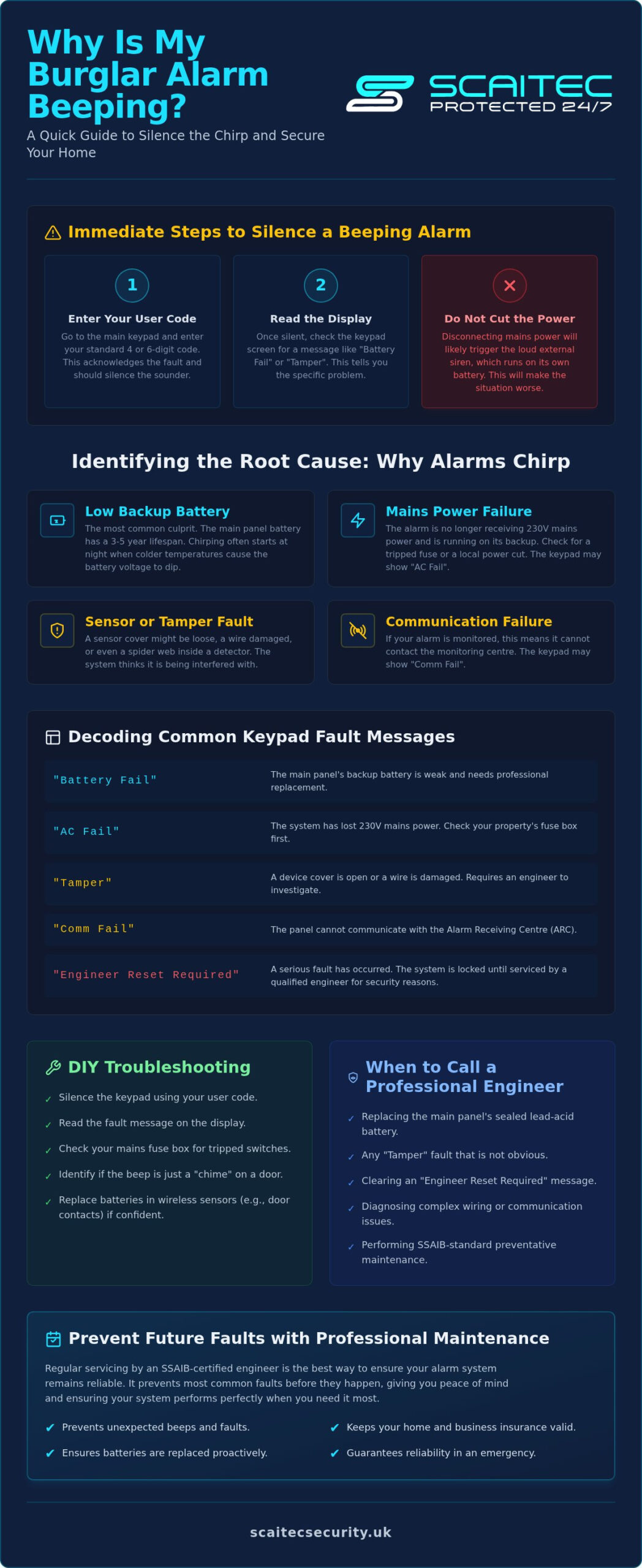
Your first action should be to enter your standard four or six-digit user code. In most instances, this will acknowledge the alert and temporarily silence the internal sounder. Once the noise stops, examine the display screen closely. Modern systems provide clear text alerts such as “Battery Fail”, “Power Loss”, or “Tamper”. These messages are vital for troubleshooting. We strongly advise that you do not attempt to cut power cables or remove the main fuse in an attempt to stop the noise. Most UK systems utilise an “active-low” trigger. This means if you disconnect the power, the external siren will interpret this as a line cut and activate its own internal battery, resulting in a much louder and more disruptive situation.
The “Double-Tap” Method for Common Panels
Many popular UK alarm systems require a second confirmation to clear a fault from the active memory. If entering your code once silences the noise but the “Service” or “Fault” light remains lit, try entering your code a second time. You may also need to press a “Reset” or “Clear” button after your code to fully acknowledge the event. If the screen displays “Engineer Reset Required”, the system has detected a significant issue that prevents the user from clearing the alert. This is often a requirement for SSAIB standards and insurance compliance, meaning you will likely need to book a corrective maintenance visit to restore the system to its secure state.
Finding the Secret “Mute” Function
On modern touchscreen or digital panels, there is often a specific “Hush” or “Mute” sequence. Look for a “Function” or “Star” (*) key. Some systems allow you to bypass the alert temporarily if you are waiting for a technician. It is also worth checking if the noise is actually a “Trouble Beep” or simply an “Entry/Exit Chime” that someone accidentally enabled. If the beep only occurs when a specific door is opened, you have likely turned on the chime feature. This can usually be toggled off by holding the “Chime” button or the “No” key for several seconds. If the origin of the sound remains a mystery, consulting your user manual for your specific brand is the most reliable way to find the exact button sequence.
Identifying the Root Cause: Why Alarms Chirp and Beep
A beeping alarm is rarely a sign of a total system failure. Instead, it is a “Trouble Signal”, a deliberate safety feature designed to highlight vulnerabilities before they become critical security risks. When you ask why is my burglar alarm beeping, you are usually hearing a diagnostic alert from the control panel’s internal monitoring software. This system constantly checks the health of its sensors, the integrity of the wiring, and the status of its power supply to ensure your property remains protected.
In South Yorkshire, we often find that environmental factors play a significant role in these alerts. The damp conditions common in older masonry or the arrival of spiders in autumn can cause havoc with sensitive PIR (Passive Infrared) sensors. A spider spinning a web inside a detector housing can trigger a tamper alert or a false alarm. Similarly, a sudden power cut or local grid fluctuation can desynchronise the system’s internal memory or time settings. If your system hasn’t been serviced recently, it might struggle to recover from these brief interruptions without professional protective maintenance.
Low Battery Alerts: The Most Frequent Culprit
The most common reason for a persistent chirp is a declining backup battery. Most UK intruder alarms use a sealed lead-acid battery within the main control panel, which typically has a lifespan of three to five years. As the battery nears the end of its life, its voltage fluctuates. You might notice the beeping starts in the middle of the night. This happens because temperatures drop after dark, causing the chemical reaction inside the battery to slow down and the voltage to dip below the system’s “trouble” threshold. It is a predictable cycle that usually requires a professional replacement to ensure your property remains secure during a genuine power loss.
Power Failures and Mains Issues
If your keypad displays “AC Fail” or a similar message, it means the system is no longer receiving 230V mains power and is running solely on its backup battery. Before panic sets in, check your home’s consumer unit. A tripped circuit breaker is often the simple cause. However, if your household power is fine but the alarm still reports a mains failure, the issue may be a blown internal fuse or a fault with the alarm’s transformer. Because this involves working with high-voltage components inside the panel, it is a task that must be handled by a qualified security engineer rather than a DIY attempt.
Interpreting Your Keypad: Common Fault Codes and Messages
Keypads act as the primary communication bridge between you and your security network. Understanding the specific language of your panel is the most effective way to address the question, why is my burglar alarm beeping, without feeling overwhelmed. Most modern displays utilise a simple text-based system to indicate where the issue lies. For instance, a “Tamper” alert does not necessarily mean an intruder has tried to break in. It simply indicates that the physical housing of a component, such as a sensor or the keypad itself, has been disturbed.
For homeowners with remote monitoring, messages like “Comm Fail” or “Phone Line Cut” are critical. These indicate that the system has lost its path to the monitoring centre, whether via Wi-Fi, GSM, or a physical phone line. If you see “Zone Fault”, it means a specific detector is currently in an abnormal state. This could be as simple as a window being left slightly ajar or a PIR sensor being blocked by a new piece of furniture. It is also important to distinguish between a current “Fault” and “Alarm Memory”. Memory merely informs you that a trigger occurred whilst you were out; it is a historical record rather than an active issue, and it can usually be cleared by entering your code and pressing “Reset”.
Sensor and Perimeter Issues
Environmental factors often manifest as intermittent zone faults. Dust or a spider web amongst the lens of a PIR sensor can cause the system to chirp as the detector struggles to calibrate its infrared field. Similarly, property settling in South Yorkshire masonry can cause door frames to shift slightly. This movement may pull magnetic contacts out of alignment, leading to a fault message. If an engineer is investigating an intermittent issue, they may place a specific zone on a “Soak Test”. This allows the system to monitor the sensor’s behaviour without triggering a full siren, ensuring the root cause is identified before the system is fully reinstated.
Tamper Switches and Housing Faults
Every professional alarm component contains a small, spring-loaded tamper switch. This switch must remain fully depressed by the component’s cover to stay silent. If a screw on a keypad vibrates loose or a bell box is buffeted by high winds, the switch may release, triggering a persistent alert. You should never attempt to tighten or open these housings yourself without first putting the system into “Test Mode” or “Engineer Mode”. Opening a tamper-protected device whilst the system is live will immediately trigger the external siren as a security precaution. For these hardware issues, a professional corrective maintenance visit is the safest way to ensure the integrity of the housing is restored.
DIY Troubleshooting vs. Professional Security Repair
Deciding between a quick home fix and a professional call-out is essential for maintaining your property’s security. While some tasks are straightforward, others carry risks that could leave your home vulnerable or void your insurance policy. If you are wondering why is my burglar alarm beeping, start by identifying the component. Wireless sensors often use CR123A lithium batteries. Replacing these is usually a safe DIY task that doesn’t require opening the main control box. Similarly, toggling off a “chime” feature that has been accidentally enabled is a simple user-level adjustment that restores quiet without needing an engineer.
More complex issues demand specialist attention. Replacing the large lead-acid battery inside the main control panel or handling internal fuse work should never be a DIY project. These components are connected to the mains power supply and require specific technical knowledge to handle safely. For those with a monitored system, opening any housing without first notifying your provider will trigger a tamper alert at the Alarm Receiving Centre (ARC). This could result in an unnecessary emergency response. Maintaining SSAIB-accredited service records is often a non-negotiable requirement for UK home insurance providers. If you perform your own repairs, you may find your cover is invalidated in the event of a claim.
Book a Professional Alarm Repair
When to Call a Scaitec Engineer
There are specific scenarios where professional intervention is the only safe path forward. If the beeping persists even after you have entered your code and checked for obvious obstructions like open windows, the system has a deeper electronic fault. You should also seek help if your keypad is completely unresponsive or “frozen”. This often indicates a software crash or a failed motherboard. Additionally, if you have recently moved into a property in Sheffield or Rotherham and inherited an unknown system, a professional takeover is vital. We can reset the system, provide new codes, and ensure the previous owners no longer have access to your security settings.
The Dangers of “Google-ing” a Master Code
It is tempting to search for “default engineer codes” online to silence a stubborn panel. However, this is a risky strategy. Trying codes like 1234 or 9999 can trigger a security lockout, permanently disabling the keypad as a defence against brute-force attacks. Modern systems are designed to track “unauthorised access” attempts in their internal logs. If an insurance investigator sees multiple failed engineer code attempts, it may raise questions about the system’s integrity. To ensure your system is handled correctly and remains compliant with safety standards, it is always better to utilise Scaitec Corrective Maintenance Services rather than risking a permanent system failure.
Preventing Future Faults with Professional Alarm Maintenance
The most effective way to address the question of why is my burglar alarm beeping is to ensure the question never needs to be asked. Proactive care is the cornerstone of a reliable security strategy. During an annual service, our engineers perform a battery load test. This allows us to identify a declining battery months before its voltage drops low enough to trigger that infamous 3 AM chirp. By replacing components on a scheduled basis, we eliminate the stress of emergency faults and ensure your system remains a silent, vigilant protector.
Sensor calibration is another vital aspect of maintenance. Over time, PIR sensors can become less accurate due to dust accumulation or environmental changes in your home. We meticulously clean and re-align every detector, significantly reducing the likelihood of false alarms. This process also ensures your system is fully compliant with UK security standards, which is a key requirement for many insurance providers. When you understand why is my burglar alarm beeping, you realise that most issues are predictable. Beyond hardware, maintenance visits provide a chance to customise your system. We can help you organise new user codes or test your remote monitoring links to ensure your property is always connected to a response centre.
The Benefits of a Maintenance Contract
Security needs don’t follow a 9-to-5 schedule. A Scaitec Preventative Maintenance Contract offers more than just a yearly check-up. Contract holders receive priority response for emergency call-outs across Barnsley, Doncaster, and the wider South Yorkshire region. Should a fault occur, you will also benefit from discounted replacement parts and reduced labour rates. It is a cost-effective way to guarantee that professional support is always available when you need it most.
Upgrading to Smart Security
If you are tired of cryptic keypad symbols, it may be time to consider a modern upgrade. Contemporary Home Intruder Alarm Systems have transitioned from traditional phone line monitoring to digital IP-based communication. Instead of a loud, persistent beep from a hallway panel, these systems send detailed fault notifications directly to your smartphone. You can see exactly which sensor has a low battery or which door is open from anywhere in the world. This transition from reactive noise to proactive data provides a level of control and peace of mind that traditional systems simply cannot match.
Restore Peace and Security to Your Home
A beeping alarm is more than just an annoyance; it’s a vital communication from your security system about its overall health. By identifying the specific fault code and understanding the role of your backup battery, you can take control of the situation. Remember that maintaining SSAIB standards is essential for your insurance compliance and long-term property protection. Understanding exactly why is my burglar alarm beeping is the first step toward a quieter, more secure household.
Since 2005, our SSAIB-accredited team has specialised in providing steadfast reliability to homeowners across South Yorkshire. Our local engineers, based in Rotherham, offer comprehensive maintenance for all major brands, ensuring your system remains fully functional without the stress of unexpected noise. We’re here to help you move from reactive troubleshooting to proactive security management.
Don’t let a technical chirp compromise your peace of mind. With the right professional support, you can ensure your home remains the safe haven it’s meant to be.
Frequently Asked Questions
How do I stop my alarm beeping after a power cut?
You can usually silence the alert by entering your standard user code twice on the keypad. The first entry acknowledges the “AC Fail” or “Power Loss” message, whilst the second entry resets the system status. If the beeping persists after the mains electricity returns, it suggests the internal backup battery has been drained too low to recover. In this scenario, you’ll need a professional engineer to test the battery’s health and ensure your property remains secure.
Why is my alarm beeping every 30 seconds?
A repetitive chirp at 30-second intervals is a classic “trouble signal” indicating a low battery or a communication fault. This specific rhythm is designed to alert you to a system vulnerability without triggering a full-scale siren. If you are asking why is my burglar alarm beeping in this persistent pattern, check your display for a “Low Bat” or “Comm Fail” message. These diagnostic warnings require prompt attention to ensure your security system stays fully operational during an emergency.
Can I change the battery in my burglar alarm myself?
You can safely replace batteries in wireless sensors, such as door contacts or PIR detectors, which typically use standard lithium cells. However, you shouldn’t attempt to replace the large lead-acid battery inside the main control panel. Opening the master panel on a monitored system triggers a tamper alarm and can invalidate your home insurance. For these complex tasks, it’s best to use an SSAIB-accredited engineer to maintain your system’s compliance with UK safety regulations.
Will my alarm still work if it is beeping?
Your alarm will generally continue to function, but its reliability is compromised. The beeping is a warning that a specific component, like a backup battery or a sensor, is no longer performing at 100 per cent. If a genuine power cut occurs whilst the battery is weak, your system will likely shut down entirely, leaving your home in Sheffield or Rotherham unprotected. Addressing the noise promptly ensures your security network remains dependable when you need it most.
How do I silence a tamper fault on my keypad?
Enter your user code to silence the noise, then check that all sensor covers and the keypad housing are firmly closed. A tamper fault occurs when a spring-loaded safety switch inside a component is released. If a cover has shifted, simply re-seating it might resolve the issue. If the message remains on the screen, there may be a wiring fault. We don’t recommend opening the equipment yourself; instead, contact a specialist to reset the tamper circuit professionally.
Why does my alarm beep when I open the front door?
This sound is likely the “Chime” feature rather than a system fault. It is a user-selectable setting that provides an audible notification whenever a specific door or window is opened. You can typically toggle this feature off by pressing the “Chime” button or holding the “No” key on your keypad for three seconds. If the beep sounds different than your usual chime, check the display to ensure it isn’t actually a “Zone Fault” caused by a misaligned contact.
What should I do if my alarm keypad is blank and beeping?
A blank screen combined with beeping usually indicates a total loss of mains power and a critically low backup battery. The system is essentially losing power and can no longer light the display. Check your consumer unit for tripped breakers immediately. If your home has power but the keypad remains dark, an internal fuse or transformer has likely failed. This situation requires an urgent visit from a qualified engineer to prevent a total system blackout and loss of protection.
How often should I have my intruder alarm serviced to prevent beeping?
We recommend a professional service at least once every twelve months to maintain peak performance. During these visits, engineers calibrate sensors and test battery voltages to prevent the “midnight beeps” caused by declining components. For monitored systems or those required for insurance purposes, annual servicing is often a mandatory condition of your policy. Regular maintenance across Barnsley and Doncaster ensures your system stays compliant with SSAIB standards and provides consistent, long-term peace of mind.
Protect Your Business
Protect Your People
Book Your FREE Site Protection Survey

Since pioneering Scaitec Security Solutions in 2005, Paul Scaife, with his roots in the industry dating back to 1994, has distinguished the firm as a leading provider of bespoke fire and security solutions, servicing clients across Sheffield, Rotherham, and surrounding areas.
His leadership, underpinned by accreditation from the Security Systems and Alarms Inspection Board, ensures that Scaitec surpasses client expectations by blending advanced technology with a deep understanding of their unique needs.
Paul's ethos champions innovation and efficiency, driving Scaitec to deliver tailored, cutting-edge solutions that enhance safety and operational ease.
Discover more about Paul’s commitment to excellence on LinkedIn.