
Table of Contents
Did you know that false alarms cost the UK economy approximately £1 billion every year in lost productivity and emergency service call-outs? We understand that standing in front of a complex fire panel to perform a fire alarm weekly test procedure can feel daunting, especially when the stakes include both life safety and legal compliance. You likely worry about accidentally triggering a full-scale evacuation or, worse, finding your insurance invalidated because of a simple oversight in your documentation.
It’s our mission to replace that anxiety with professional reassurance and steadfast reliability. By following a structured routine, you can ensure your system remains a vigilant guardian for your staff and property. This guide provides a definitive checklist based on the BS 5839-1:2025 standard to help you meet your legal obligations with confidence. We’ll walk you through the essential steps to conduct these checks correctly, whilst helping you build the robust records needed to avoid the maintenance failures that currently account for over 40% of fire safety prosecutions.
Key Takeaways
- Understand your legal responsibilities under the Regulatory Reform (Fire Safety) Order 2005 and the specific requirements of the BS 5839-1:2025 standard.
- Learn a step-by-step fire alarm weekly test procedure that ensures every manual call point is functional whilst preventing accidental emergency service call-outs.
- Gain confidence in maintaining your fire logbook, ensuring you have the robust documentation required by enforcement officers and insurance providers.
- Identify the essential differences between your internal weekly checks and the comprehensive six-monthly servicing required from an accredited professional.
Understanding Your Legal Obligations for Fire Alarm Testing
A fire alarm system isn’t a “fit and forget” solution. It’s a sophisticated network of life-safety components that requires consistent verification to ensure it performs when needed most. The fire alarm weekly test procedure is a mandatory safety check designed to confirm that the control panel successfully receives a signal from a manual call point and subsequently triggers the sounders. This isn’t just a recommendation; it’s a core requirement of the BS 5839-1:2025 standard, which governs fire detection and fire alarm systems for non-domestic premises in the UK.
We’ve seen how South Yorkshire fire authorities and enforcement officers across the country have increased their focus on logbook accuracy during routine inspections. They aren’t just checking if the lights are on; they’re looking for a consistent history of testing. Statistics show that over 40% of fire safety prosecutions involve a failure to maintain equipment or keep adequate records. If a fire occurs and you can’t produce a logbook showing a completed fire alarm weekly test procedure, you face severe consequences. These range from the immediate rejection of insurance claims to heavy fines and legal prosecution under the Regulatory Reform (Fire Safety) Order 2005.
The Role of the “Responsible Person”
Under UK law, every business must have a designated “Responsible Person” who is legally accountable for fire safety. This is typically the employer, building owner, or a facilities manager. While this individual carries the ultimate legal burden, they can safely delegate the actual testing to trained staff members. It’s vital that whoever conducts the test understands the specific layout of the premises and how to operate the panel. We recommend that the Responsible Person ensures all testers are competent and feel confident in their ability to identify faults without panic.
Commercial vs Residential Requirements
It’s a common misconception that all buildings follow the same rules. In reality, commercial premises must adhere to the rigorous BS 5839-1 standard, whereas residential blocks usually fall under BS 5839-6. Business environments require a much more frequent and documented testing cycle because of higher occupancy levels and complex layouts. If you’re unsure how these fire alarm regulations uk business apply to your specific site, it’s worth remembering that commercial standards are designed to protect both life and the continuity of your operations. A failure in a commercial setting often has far wider-reaching implications than in a single domestic dwelling.
Essential Preparation Before Activating the Alarm
Before you even touch a call point, you need a plan. Rushing into a fire alarm weekly test procedure without proper preparation often leads to unnecessary stress, workplace disruption, and the risk of accidental emergency service call-outs. Preparation ensures that the test remains a controlled safety check rather than a cause for panic. We recommend starting with a quick audit of your hardware. Ensure you have the correct test keys for your specific panel and call points; using makeshift tools like screwdrivers can damage the units and lead to costly repairs.
You should also have a clear site map or a list identifying the location of all manual call points (MCPs) on your premises. The goal is to rotate the test through every single call point over several months. Before starting, check for any linked plant equipment that might be affected. Many commercial systems are integrated with building management hardware. This means your test could inadvertently drop magnetic door holders, bring lifts to the ground floor, or shut off kitchen gas valves. Understanding these links allows you to manage the test without shutting down your entire operation. If your system requires a more detailed review to identify these links, our experts can assist through regular system maintenance visits.
Communicating with Your Alarm Receiving Centre (ARC)
If your system is monitored, notifying your provider is the most critical step of the preparation phase. Call the ARC and provide your security credentials to put the system into “test” mode. This protocol usually lasts for 30 to 60 minutes, during which time the centre will ignore incoming fire signals from your site. If you skip this, you risk the fire brigade arriving at your door, which can result in significant “false alarm” fines. Once the test is complete, it’s equally important to call them back. Verify that they successfully received the test signal and confirm that your system is back in “live” monitoring status.
Informing Staff, Visitors, and Neighbours
Consistency is the best way to reduce anxiety amongst building occupants. We suggest setting a fixed day and time for your weekly check, such as every Wednesday at 9:30 AM. Use internal emails or signage at your main entrance to announce the imminent sounder check. This is particularly vital for multi-tenanted buildings in areas like Sheffield or Rotherham, where several different businesses operate under one roof. Clear communication ensures that visitors don’t mistake your routine maintenance for a real emergency, keeping everyone calm and focused whilst you verify your building’s safety. For businesses operating in the region, understanding the full scope of fire alarm systems Rotherham requirements under the latest BS 5839-1:2025 standard can help you build a more robust and compliant safety culture.
Step-by-Step Fire Alarm Weekly Test Procedure Checklist
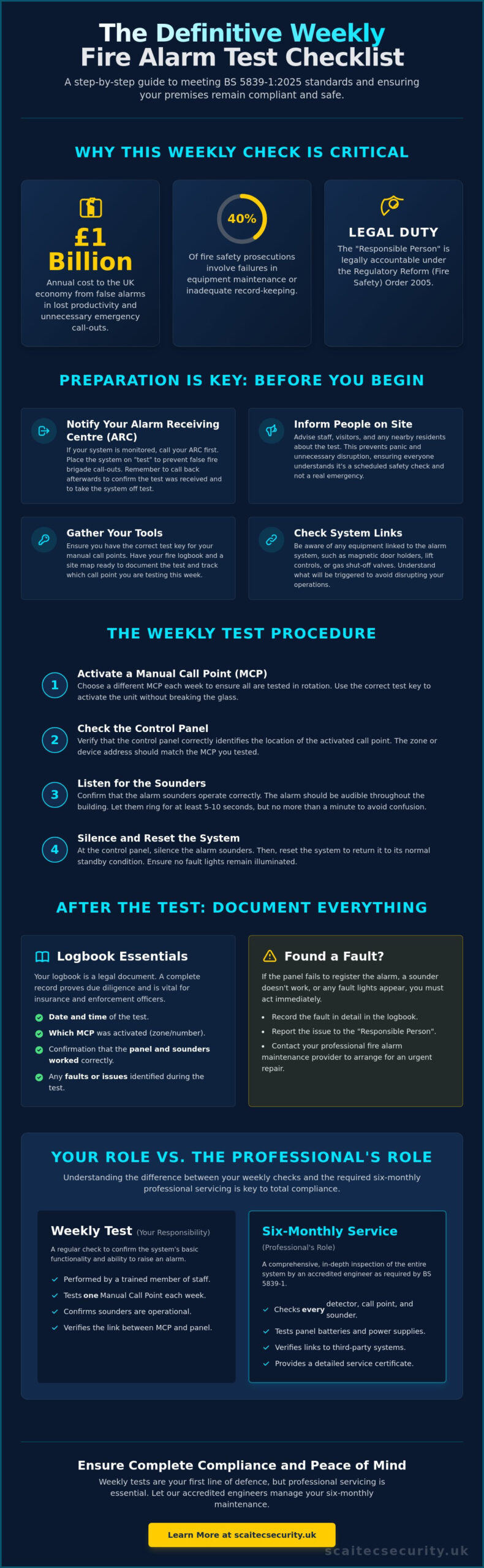
Once you’ve notified your ARC and informed your staff, it’s time to begin the physical check. A common mistake is testing the same call point every week because it’s convenient. Instead, you must select a different manual call point (MCP) for each fire alarm weekly test procedure. This rotation ensures that over a cycle of several months, every device on your premises is confirmed to be operational. We recommend numbering your call points and following a simple sequence to ensure none are missed.
At the chosen MCP, insert your test key into the slot, which is usually located at the bottom of the unit. This action mimics a glass break by dropping the internal plastic element, triggering the alarm signal without actually damaging the unit. Once the alarm sounds, don’t rush back to the panel immediately. Take a moment to confirm that the sounders are clearly audible in that area and that any visual beacons are flashing. This is particularly vital in noisy environments or areas where occupants may have hearing impairments. If the sounders seem quieter than usual, it may indicate a battery issue or a fault in the wiring.
After verifying the local output, return to the control panel. You need to ensure the display correctly identifies the zone or the specific device address of the MCP you just activated. If the panel shows Zone 4 but you’re standing in Zone 1, you’ve identified a significant fault that requires professional attention. This verification is the only way to be certain that the system will guide emergency responders to the correct location during a real fire.
Operating the Control Panel Safely
To stop the noise, you’ll first need to enter your access code or turn the enable key. Press the “Silence Alarms” button to stop the sounders, then “Reset” to return the system to its “Normal” or “Healthy” state. A green power light should be the only indicator visible. If a yellow “Fault” light remains, it suggests the system hasn’t cleared correctly or there’s an underlying issue with the circuit. Always wait a full minute after resetting to ensure no “Fire” signals return to the display.
Testing Conventional vs Addressable Systems
The complexity of your check depends on your hardware. In a conventional system, the panel only identifies a broad zone, so you’ll need a clear log to track which specific MCPs you’ve tested within that area. Conversely, addressable fire alarm systems provide intelligent data, showing the exact room and device number on the screen. This level of detail makes it much easier to ensure all fire alarm system design requirements are being met across the entire building. Regardless of the system type, the goal is a methodical, repeatable process that leaves no room for doubt.
Recording Results and Managing System Failures
Completing the physical activation of a call point is only half of your responsibility. The legal validity of your safety efforts relies entirely on how you document the results. Every fire alarm weekly test procedure must be meticulously recorded in a dedicated fire logbook to provide a clear audit trail for authorities. It isn’t enough to simply write “test complete”; you must specify the exact manual call point (MCP) tested by its unique identification number. This level of detail proves to inspectors that you’re rotating through all devices rather than just testing the one most convenient to reach.
Whilst the sounders are the most obvious indicator of success, you must also look for “hidden” failures during your check. This includes verifying that magnetic door retainers have released and that any linked plant equipment, such as kitchen gas valves or air conditioning shutdowns, has responded correctly. If a fire door fails to close because a retainer didn’t release, your building’s fire compartmentalisation is compromised. In 2026, many businesses are moving away from traditional paper logbooks in favour of digital systems. These provide time-stamped, tamper-proof records that are easily accessible during a fire risk assessment or an unannounced inspection.
Maintaining a Compliant Fire Alarm Logbook
Your logbook is a critical legal document. For every test, you must record the date, the precise time, the location of the MCP used, and the name of the person who conducted the check. Fire officers will request this document first during any visit because it’s the most reliable indicator of your building’s safety culture. Ensure these records are stored securely and kept for a minimum of five years, as they serve as your primary defence in the event of an insurance claim or a safety audit.
What to Do if the Test Fails
If your test identifies a fault, you must act immediately. A failure might mean the sounders didn’t activate, the panel display showed an incorrect zone, or a “Fault” light remained after a reset. You should record the failure in your logbook and report it to your maintenance provider in South Yorkshire without delay. If the system is significantly compromised, you may need to implement temporary “fire watch” measures, such as increased staff patrols, until a professional can rectify the issue. If your test reveals a fault you can’t clear, our team is ready to help with expert fire alarm system maintenance to ensure your premises remain fully protected and compliant.
Beyond the Weekly Test: Professional Maintenance and Support
While your internal fire alarm weekly test procedure keeps you compliant on a day-to-day basis, it isn’t a substitute for comprehensive technical maintenance. Your weekly check confirms the system can still trigger an alarm, but it doesn’t verify the underlying health of the hardware or its communication links. We view the weekly test as a vital pulse check, whereas the six-monthly service is a full medical examination. Partnering with an SSAIB-accredited provider like Scaitec Security Solutions Ltd ensures your system is managed by experts who meet the highest industry standards. Integrating these checks with your preventative security maintenance plan streamlines your compliance across all safety systems, ensuring your fire alarms, CCTV, and intruder alerts are all working in harmony.
The Importance of Periodic Professional Servicing
During a professional six-monthly inspection, a qualified engineer explores the components that a standard user test cannot reach. We verify the battery backup capacity to ensure protection during power outages and calibrate detector sensitivity to prevent future false alarms. This technical scrutiny is essential for maintaining alignment with BS 5839-1:2025 and ensures that all components remain fully functional under current UK legislation. Beyond the call points, we examine the control panel’s internal circuitry and software, identifying potential issues before they develop into system-wide failures that could compromise your premises.
Why Local Expertise Matters in South Yorkshire
Choosing a partner with local roots provides practical advantages that national providers often struggle to match. Scaitec Security Solutions Ltd supports businesses throughout Rotherham, Sheffield, and Barnsley with rapid response times for emergency call-outs. If a fault occurs in Doncaster on a Friday afternoon, you need a team that is nearby, not hours away. Our local knowledge of building types and fire authority preferences in South Yorkshire allows us to act as a vigilant protector for your site. Furthermore, having a dedicated account manager who understands your specific site history ensures that our support is always tailored to your unique operational needs.
Securing Your Premises for the Future
Moving from a place of uncertainty to one of structured safety is a significant achievement for any business owner or manager. By implementing a reliable fire alarm weekly test procedure, you’ve transformed a legal necessity into a robust shield for your property and personnel. You now have the knowledge to navigate call point rotations, manage panel resets, and maintain the precise records that regulatory bodies demand. These consistent habits form the bedrock of a safe working environment, ensuring that your life-safety infrastructure is never left to chance.
We are here to support that journey with authoritative expertise and steadfast reliability. With over 20 years of experience across South Yorkshire and the reassurance of being SSAIB Accredited Installers, Scaitec Security Solutions Ltd provides the comprehensive care your system requires. Whether you need 24/7 Remote Monitoring via our ARC or a structured maintenance plan, we offer the technical proficiency you can depend on. Ensure your business remains compliant with a Scaitec Security Solutions Ltd Fire Alarm Maintenance Contract. Protecting your premises is a collective responsibility, and we’re proud to be your dedicated partner in safety.
Frequently Asked Questions
Do I need to test every single fire alarm call point every week?
No, you don’t need to activate every device during a single session. The standard requirement is to test at least one manual call point during each fire alarm weekly test procedure, provided you rotate through all points on a cyclical basis. This methodical approach ensures that every device on your premises is eventually verified without causing excessive disruption to your daily operations.
What is the best time of day to perform a fire alarm weekly test?
The best time is a consistent, pre-announced slot when the building is occupied but disruption to critical tasks remains low. Many businesses in South Yorkshire choose Tuesday or Wednesday mornings around 10:00 AM. Setting a fixed schedule helps staff and visitors distinguish between a routine check and a genuine emergency, which significantly reduces the risk of unnecessary panic.
Can I perform the weekly test myself, or do I need a professional?
You can certainly perform the weekly test yourself or delegate it to a trained member of your team. Whilst the six-monthly service requires a competent professional with specialised tools, the weekly check is designed to be a straightforward user task. We recommend that any designated tester receives basic training on the specific control panel installed at your premises to ensure they feel confident.
What happens if I forget to record a weekly test in the logbook?
If you forget to record a test, enforcement officers and insurance investigators will assume the check was never performed. Legally, an unrecorded test is a non-existent test. Given that over 40% of fire safety prosecutions involve poor record-keeping, an empty logbook is a significant liability. If you miss an entry, perform a fresh test immediately and record it to maintain your safety history.
How long should the fire alarm sound during a weekly test?
The alarm should typically sound for between 5 and 10 seconds. This is long enough to verify that the sounders are functioning and audible throughout the building, but short enough to avoid a full-scale evacuation. If you’re using a monitored system, ensure your ARC understands the expected duration to prevent them from escalating the signal to the emergency services.
Why is my fire alarm panel showing a “fault” light after a test?
A “fault” light usually indicates that the system hasn’t cleared correctly or a genuine issue was identified during the activation. First, try to perform the reset procedure again. If the light persists, it may signal a battery failure, a wiring issue, or a communication fault. You should record the specific fault in your logbook and contact your maintenance provider to investigate the cause.
Do I need to notify the fire brigade before my weekly test?
You don’t need to contact the fire brigade directly, but you must notify your Alarm Receiving Centre (ARC) if your system is monitored. Failing to do so is a common cause of false alarms, which contribute to the £1 billion annual cost to the UK economy. Always confirm with your ARC that the system is in “test” mode before you insert your test key.
What should I do if the fire alarm sounds at a different time than the scheduled test?
You must treat any unscheduled alarm as a genuine fire and follow your full evacuation procedure immediately. Never assume an alarm is a false one or a late test just because it’s near your usual slot. Once the building is confirmed safe by the fire warden or emergency services, you can investigate the cause, but life safety must always take precedence.
Protect Your Business
Protect Your People
Book Your FREE Site Protection Survey

Since pioneering Scaitec Security Solutions in 2005, Paul Scaife, with his roots in the industry dating back to 1994, has distinguished the firm as a leading provider of bespoke fire and security solutions, servicing clients across Sheffield, Rotherham, and surrounding areas.
His leadership, underpinned by accreditation from the Security Systems and Alarms Inspection Board, ensures that Scaitec surpasses client expectations by blending advanced technology with a deep understanding of their unique needs.
Paul's ethos champions innovation and efficiency, driving Scaitec to deliver tailored, cutting-edge solutions that enhance safety and operational ease.
Discover more about Paul’s commitment to excellence on LinkedIn.