
Table of Contents
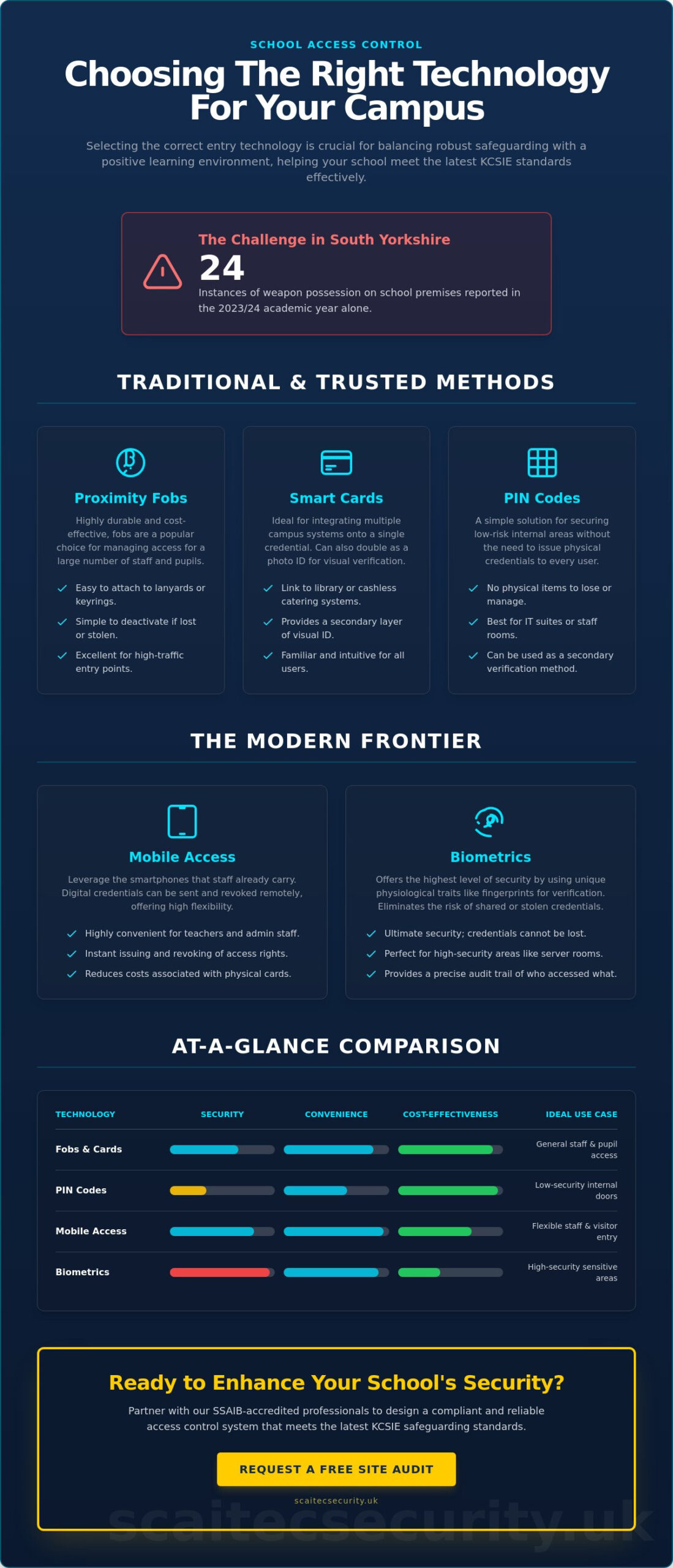
With South Yorkshire Police reporting 24 instances of weapon possession on school premises in the 2023/24 academic year, how can you ensure your campus remains a sanctuary without making it feel like a fortress? It’s a difficult balance to strike. We understand that managing high-traffic entry points whilst ensuring total student safety is a constant pressure, especially when you’re working to meet the latest “Keeping Children Safe in Education” (KCSIE) guidelines. Implementing robust school access control systems is no longer just about locking doors; it’s about creating a managed environment where pupils feel safe and site managers stay in control.
In this guide, we’ll show you how to balance rigorous safeguarding with a positive learning environment using modern technology. We’ll explore how these automated solutions provide seamless tracking of everyone on-site and significantly improve your emergency response capabilities during a lockdown. From complying with the upcoming requirements of Martyn’s Law to addressing local challenges like the “School Wars” social media trend seen in March 2026, we’ll preview the essential technology and local support needed to keep your South Yorkshire school secure and efficient for the long term.
Key Takeaways
- Learn how modern school access control systems go beyond simple locks to help your institution meet the latest KCSIE safeguarding standards.
- Compare various entry technologies, from traditional fobs to biometric and mobile-based credentials, to find the best fit for your staff and pupils.
- Understand the critical role of system integration, ensuring your access points work in harmony with fire safety protocols for immediate, safe evacuation.
- Discover how a strategic site audit allows you to zone your campus effectively, balancing high-security areas with accessible public spaces.
- Identify why partnering with SSAIB-accredited professionals for installation and maintenance is essential for long-term reliability and regulatory compliance.
Navigating Safeguarding: Why Modern School Access Control Systems Are Essential
Access control in schools is often misunderstood as simply keeping people out. In reality, modern school access control systems function as a sophisticated management tool that regulates movement across the entire campus. It’s about ensuring the right people are in the right places at the right times, creating a flow that supports education rather than hindering it. We view these systems as the foundation of a protective environment, where technology works silently in the background to maintain order and safety. A well-designed system allows pupils to move freely between lessons whilst preventing unauthorised individuals from entering sensitive areas.
Meeting KCSIE and Ofsted Standards
Safeguarding requirements have become increasingly stringent over the last few years. The “Keeping Children Safe in Education” (KCSIE) guidelines demand robust visitor management protocols that traditional locks simply cannot provide. Physical keys are a significant liability; they’re easily lost, expensive to replace, and offer no data on who used them or when. In contrast, electronic systems create a transparent, time-stamped audit trail that is invaluable during an inspection. When Ofsted inspectors arrive, having an instant, digital record of every visitor on-site demonstrates a proactive and organised approach to safety. Electronic access logs provide a digital verification of visitor presence that directly supports the accuracy of the Single Central Record.
The Shift from Passive to Proactive Security
Transitioning to modern school security measures means moving from passive barriers to proactive monitoring. For site managers in South Yorkshire, particularly those overseeing multi-building campuses or split-site schools, the challenge is visibility. It’s difficult to be everywhere at once. Automated systems solve this by providing a real-time overview of the site through a centralised interface. You can see precisely who is accessing specific zones, such as science labs, IT suites, or staff rooms, at any given moment. This level of control is vital for balancing a welcoming school culture with a secure perimeter. We believe that a school should feel open to its community while remaining impenetrable to those who shouldn’t be there. This strategic approach ensures that your security doesn’t just react to incidents but prevents them from occurring in the first place, providing long-term peace of mind for staff, parents, and pupils alike.
Key Technologies: Choosing the Right Entry Methods for Your Campus
Selecting the right hardware for school access control systems requires a careful assessment of your daily operational needs. It’s not just about the lock; it’s about the credential that opens it. Every school has a unique layout and population density, which means the “best” technology often depends on the specific demands of your site. We focus on providing solutions that are robust enough for heavy use whilst remaining intuitive for staff and visitors to operate.
Fobs, Cards, and PINs: The Traditional Favourites
Proximity fobs and cards remain the most popular choices for South Yorkshire schools due to their durability and cost-effectiveness. For large secondary schools where staff bodies are extensive, these credentials offer a straightforward way to manage permissions. We often suggest integrating photo ID directly onto access cards. This creates a dual-purpose token that provides a secondary layer of visual verification for site staff. If a fob is lost, it’s easily deactivated within your management software. This renders the physical item useless immediately, maintaining the integrity of your secure perimeter without the need to replace expensive locks. For a broader understanding of how these credentials work across different settings, our guide to fob entry systems for business explores the full range of options and their long-term security benefits.
- Proximity Fobs: Highly durable and easy to attach to a lanyard or keyring.
- Smart Cards: Ideal for multi-functional use, such as integration with library systems or cashless catering.
- PIN Codes: Best suited for low-security internal doors or as a secondary verification method.
Biometrics and Mobile Access: The Modern Frontier
We’re seeing a steady shift towards mobile-based credentials. Since most teachers and administrative staff already carry a smartphone, using it as a secure key card reduces the frequent issue of “forgotten card” syndrome. This technology uses encrypted signals to communicate with readers, providing a high level of security that’s difficult to replicate. If you’re looking to modernise your entry points, you might evaluate your access control options with a focus on these digital credentials.
Biometrics, including fingerprint and facial recognition, offer the highest level of individual accountability. Privacy is a natural concern in education, so we ensure all biometric installations are fully GDPR compliant. Instead of storing actual images, these systems use mathematical templates that cannot be reverse-engineered. Fingerprint readers often prove more reliable than facial recognition in high-traffic school centres where lighting conditions vary and speed of throughput is essential during the morning rush.
To prevent students from sharing fobs or cards, we recommend anti-passback technology. This feature requires a user to “badge out” before they can “badge in” again, which effectively stops a single credential from being passed back to another person. Finally, consider scalability. A school is a living environment that may expand. Choosing open-architecture hardware ensures your system can grow alongside your campus, allowing for the addition of new doors or buildings without a total system overhaul. For schools managing multiple buildings or split sites, ip based access control offers a particularly powerful solution, enabling centralised management of every entry point across your entire estate from a single networked dashboard.
Beyond the Door: Integrating Access Control with Fire Safety and CCTV
Security shouldn’t exist in a vacuum. If your school access control systems don’t talk to your fire alarm or CCTV, you’re missing a vital layer of protection. We advocate for a joined-up approach where every piece of hardware works as part of a single, vigilant unit. Siloed systems create blind spots that intruders can exploit; an integrated network eliminates these gaps. This “holistic” strategy ensures that when one part of your security detects a threat, the rest of the campus responds accordingly.
Integration allows for sophisticated automated responses. For instance, if an unauthorised entry attempt is detected at a side gate, the system can instantly trigger your CCTV to focus on that specific point and begin recording. This data can be transmitted in real-time to an Alarm Receiving Centre (ARC). Professional controllers can then monitor the situation remotely, providing an extra pair of eyes when your site team is busy or the school is closed for the holidays. This level of synchronisation turns a simple door lock into a proactive security asset.
Fire Safety Compliance and Fail-Safe Mechanisms
Legislation is very clear about the relationship between electronic locks and fire safety. It’s a legal requirement that school access control systems interface directly with your fire detection setup. In the event of an alarm, the power to electromagnetic locks must be cut automatically. This is a “fail-safe” configuration. It ensures that escape routes are cleared immediately, preventing anyone from being trapped during an emergency. We distinguish this from “fail-secure” locks, which stay locked during power cuts and are typically reserved for high-value storage areas rather than classrooms or corridors. A significant benefit of this integration is the automated muster list. During a drill or real evacuation, your system can generate a report of everyone who badged into the building, allowing for a faster and more accurate roll call at the assembly point.
Lockdown Procedures and Mass Communication
Emergency situations aren’t always about getting people out; sometimes, you need to keep them safely inside. The need for a “one-touch” lockdown protocol is a priority for many headteachers across South Yorkshire. We design systems that allow a designated staff member to secure every external door on the campus simultaneously from a single central button or a secure mobile app. This protocol doesn’t just lock doors. It can be integrated with your audio-visual alerts to trigger specific signals or flashing lights, ensuring the entire site is aware of the situation instantly. At Scaitec, we specialise in designing these integrated security networks, ensuring that your lockdown procedures are fast, clear, and reliable. By connecting your intruder alarms and access points into one manageable interface, we help you maintain total control over your environment during the most critical moments.
Strategic Planning: Zoning Your School for Optimal Security and Flow
Effective security is never an afterthought; it’s the result of meticulous planning. Before you choose hardware, you must understand how people move through your site. We believe that school access control systems should enhance the daily rhythm of the school day rather than disrupt it. By categorising your campus into distinct zones, you can maintain a welcoming environment for parents and visitors whilst keeping students protected behind a secure internal perimeter. This strategic approach ensures that security measures are proportionate to the risk in each specific area.
Step 1: Conduct a Professional Security Audit
The first step in any successful installation is a comprehensive site-wide audit. We evaluate every entry point, from the main vehicle gates to the smallest fire exit. It’s essential to look at the perimeter fencing and internal thoroughfares to identify where physical security might be vulnerable. South Yorkshire presents a unique variety of educational settings, ranging from multi-storey Victorian buildings in Sheffield to sprawling, modern academy campuses in Doncaster and Rotherham. Our local knowledge allows us to anticipate the specific challenges these different layouts present. We don’t just look at the doors; we look at how the entire site functions as a protective shell for your pupils and staff.
During the “school run” rush, the pressure on entry points is at its peak. We help schools manage this by programming automated gate schedules. You can set your perimeter to be open and supervised during start and end times, then transition to a fully locked-down state the moment the first bell rings. This removes the manual burden from your site team and ensures that no gate is accidentally left unsecured during the school day.
Step 2: Defining User Access Groups
Once the zones are established, we help you define who goes where. Not every user requires the same level of permission. Teachers might need broad access across all classrooms and offices, whereas the cleaning team only requires entry during specific evening windows. High-security areas like IT suites, medicine stores, and staff rooms should have restricted access lists to prevent unauthorised entry even from within the school community. This granular control is particularly useful for managing out-of-hours community use. If a local sports club hires your hall in the evening, you can grant them access to that specific zone without compromising the security of the main teaching blocks. Administrators can easily generate temporary digital credentials for guest speakers or maintenance contractors that automatically expire the moment their scheduled visit concludes.
A well-planned system provides the stability and protective vigilance your school deserves. If you’re ready to identify the weak spots in your current setup, you can arrange a professional security audit with our team to begin your strategic planning process.
Professional Installation and Maintenance: Partnering for Long-Term Safety
Investing in school access control systems is a significant commitment to your pupils’ safety. The hardware itself is only one part of the equation. A high-quality system requires professional installation and a rigorous maintenance schedule to ensure it remains reliable year after year. We believe that a security system is a living part of your school’s infrastructure. It needs regular attention to perform at its peak, especially during critical moments like the fire evacuations or site lockdowns we’ve discussed. A methodical installation process ensures that every component is integrated correctly from day one.
Choosing an uncertified or “DIY” approach in a public sector building is a risk that schools simply cannot afford. These installations often lack the precision required for high-traffic environments and can lead to frequent hardware failures or security gaps. More importantly, uncertified work may invalidate your insurance policy or leave the school vulnerable during a liability claim. We provide a steady, reliable approach to installation that guarantees every sensor, lock, and reader is fitted to the highest industry standards, ensuring your perimeter remains stable and protective.
The Importance of SSAIB Accreditation
SSAIB (Security Systems and Alarms Inspection Board) accreditation is the gold standard for security installers in the UK. For headteachers and governors, this certification provides independent verification that our processes and technical proficiency meet strict criteria. Many insurance providers now insist on SSAIB-accredited installations before they’ll provide comprehensive cover for a school site. Beyond the technical benefits, our accreditation ensures that every member of our team attending your site is fully DBS checked and professionally trained. This provides the peace of mind that the people protecting your school are as trustworthy as the technology they install. We back every project with a formal service agreement, ensuring you have a dedicated partner for the entire lifecycle of your system.
Ongoing Support and Remote Diagnostics
Even the most robust systems can occasionally encounter software glitches or user errors. We utilise remote diagnostics to identify and resolve many of these issues without needing to send a technician to your site. This reduces disruption to your school day and ensures your security remains active whilst saving you time. When physical repairs are necessary, our preventative maintenance visits catch wear and tear before it leads to a system failure. We’re deeply committed to the South Yorkshire region, providing emergency call-out support for schools in Barnsley, Doncaster, and Sheffield. You won’t be dealing with a distant call centre; you’ll be speaking to local experts who understand the layout and needs of your specific campus. Secure your school with a professional SSAIB-accredited installation from Scaitec Security.
Securing the Future of Your Educational Campus
Creating a safe environment for pupils and staff requires more than just a locked gate. It’s about implementing a system that balances accessibility with absolute protection. We’ve explored how modern school access control systems help you meet KCSIE standards whilst providing the real-time data needed for successful Ofsted inspections. By integrating these systems with your fire safety protocols and CCTV, you build a cohesive security network that acts as a vigilant protector for your entire site.
With over 20 years of experience across South Yorkshire, we understand the specific challenges faced by local schools. Our SSAIB-accredited installers don’t just fit hardware; we provide comprehensive maintenance and remote monitoring packages to ensure your site remains secure 365 days a year. Taking a proactive approach today ensures that your school remains a sanctuary for learning for years to come. If you’re ready to evaluate your current setup, please Book a Professional Security Audit for Your South Yorkshire School. We’re here to help you simplify your safeguarding requirements and provide lasting peace of mind.
Frequently Asked Questions
How do school access control systems work during a fire alarm?
Modern school access control systems are designed to unlock automatically the moment a fire alarm is triggered. This “fail-safe” mechanism ensures that all escape routes are clear for pupils and staff during an emergency evacuation. We integrate the door controllers directly with your fire panel so that the power to electromagnetic locks is cut instantly when a sensor detects heat or smoke.
Can we use our existing staff ID cards with a new access control system?
In many cases, we can integrate your existing staff ID cards with a new system provided they use compatible proximity technology. We assess the frequency and encryption of your current cards during our initial site audit to determine if they can be repurposed. This approach helps reduce the initial cost of migrating to more advanced school access control systems whilst maintaining familiarity for your team.
Is biometric access control legal and GDPR-compliant for UK schools?
Biometric systems are legal and fully GDPR-compliant for UK schools as long as a Data Protection Impact Assessment (DPIA) is carried out and explicit consent is obtained. These systems don’t store actual images of fingerprints or faces; instead, they convert the data into encrypted mathematical templates. This ensures that personal information remains secure and cannot be used for any other purpose.
How quickly can we deactivate a lost key fob or access card?
You can deactivate a lost key fob or access card instantly through your centralised management software. This immediate response prevents an unauthorised person from using the lost item to gain entry to the campus. Unlike traditional keys that require expensive lock changes if lost, electronic credentials can be deleted and replaced in seconds by your administrative staff. The same principle applies when considering fob entry systems for business, where instant de-authorisation is one of the key advantages over conventional key management.
Can the system manage different access rights for after-school clubs?
Yes, the system allows you to create specific time-profiles for external groups and after-school clubs. You can grant a club leader access to the sports hall and changing rooms only during their booked hours, ensuring they can’t enter the main teaching blocks. This granular control allows for community use of facilities without compromising the overall security of the school site.
What happens to the school door locks if there is a power cut?
Most electronic locks are configured to “fail-safe” during a power cut, meaning they’ll unlock to ensure everyone can exit the building safely. However, we can install battery backup units that keep the system operational for several hours during an outage. This setup ensures that your perimeter remains secure whilst still allowing for a manual override in an emergency.
Do we need to replace all our doors to install an electronic system?
It’s rarely necessary to replace your existing doors to install an electronic system. Most standard timber, aluminium, or composite doors can be retrofitted with high-quality electromagnetic locks or electric strikes. We carefully evaluate the condition and material of your current doors during our survey to ensure the chosen hardware provides a secure and durable fit.
How does access control help with Ofsted safeguarding inspections?
Access control provides a digital, time-stamped audit trail that demonstrates a robust approach to visitor management during Ofsted inspections. Instead of relying on paper sign-in books, you can present inspectors with accurate reports of everyone on-site. This level of organisation proves that you’re meeting KCSIE requirements through proactive technology rather than passive barriers.
Protect Your Business
Protect Your People
Book Your FREE Site Protection Survey

Since pioneering Scaitec Security Solutions in 2005, Paul Scaife, with his roots in the industry dating back to 1994, has distinguished the firm as a leading provider of bespoke fire and security solutions, servicing clients across Sheffield, Rotherham, and surrounding areas.
His leadership, underpinned by accreditation from the Security Systems and Alarms Inspection Board, ensures that Scaitec surpasses client expectations by blending advanced technology with a deep understanding of their unique needs.
Paul's ethos champions innovation and efficiency, driving Scaitec to deliver tailored, cutting-edge solutions that enhance safety and operational ease.
Discover more about Paul’s commitment to excellence on LinkedIn.