
Table of Contents
If you are still juggling a physical ring of master keys or trying to track down a lost fob for a site in Rotherham, you aren’t just facing a logistical headache; you’re operating on an obsolete foundation. We understand that managing multiple sites across Sheffield or the wider region often feels like a constant battle for visibility. It’s frustrating when you can’t see who is entering your building in real-time, especially as hardware costs have risen by up to 15% since 2025. You need a system that works as hard as your team does.
In this guide, you’ll discover how ip based access control is revolutionising workplace security by offering unmatched scalability and intelligent integration for modern UK businesses. We’ll show you how a centralised dashboard can simplify your operations, whilst ensuring your hardware remains compliant with the latest 2026 standards, such as ONVIF Profile T. We will also explore how to integrate your security with existing CCTV and HR systems to create a future-proofed environment that protects your people and your peace of mind.
Key Takeaways
- Learn why moving to ip based access control provides a unified network security model that outperforms legacy standalone door controllers.
- Understand the role of Power over Ethernet (PoE) in simplifying your installation and lowering long-term infrastructure costs.
- Discover how remote diagnostics can significantly reduce the need for expensive site visits whilst making future system expansion more affordable.
- Explore the 2026 shift towards mobile credentials and biometric technology to create a truly touchless and secure entry experience for your staff.
- Find out why SSAIB accreditation is vital for ensuring your bespoke security system meets the highest UK insurance and safety standards.
The Strategic Shift: Why IP Based Access Control is the New Standard
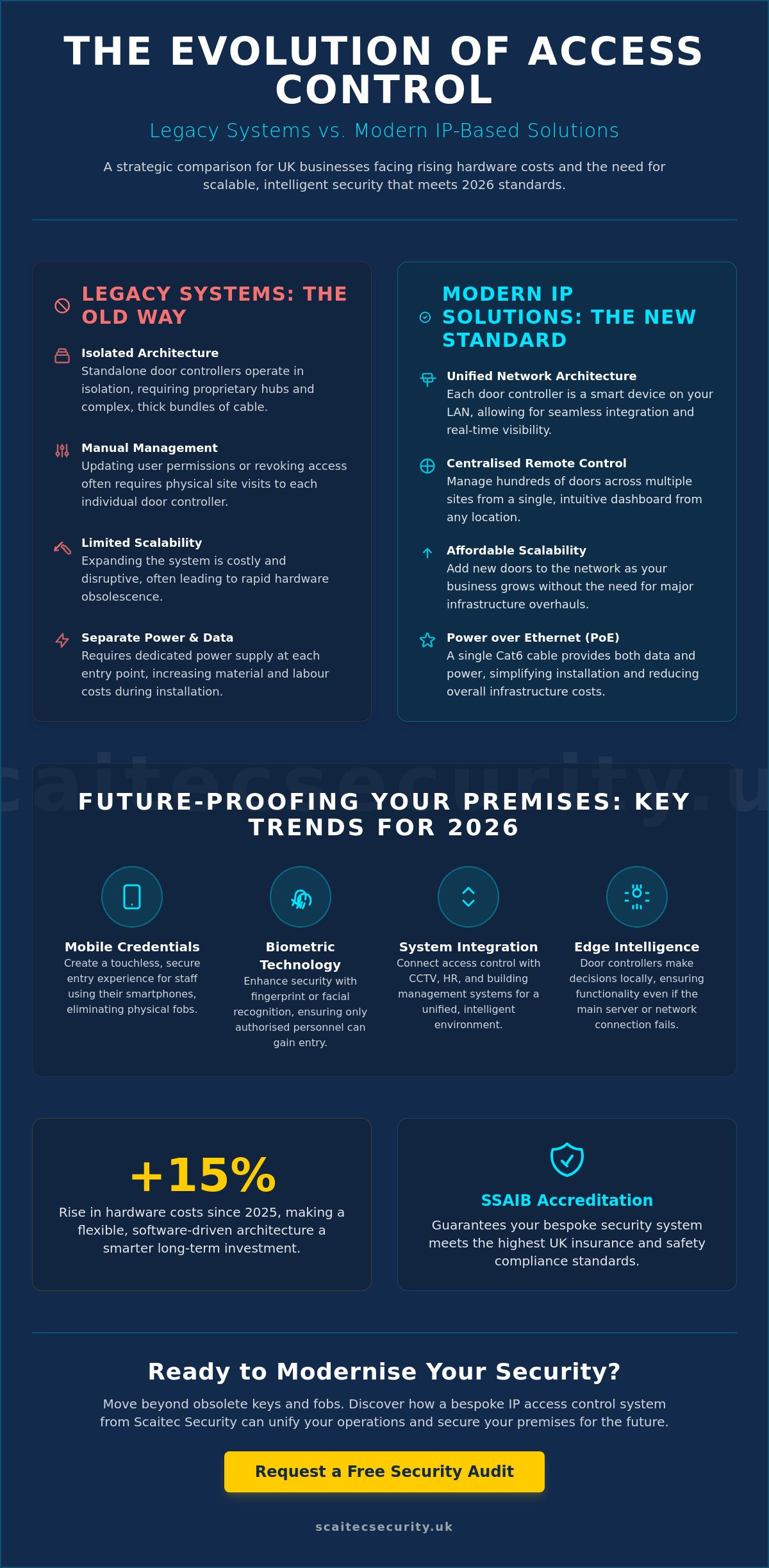
The landscape of physical security is undergoing a fundamental transformation. For decades, Access control relied on standalone door controllers that operated in isolation, often requiring physical visits to every door just to update a user list. Today, we’re seeing these legacy systems being phased out in favour of ip based access control. This isn’t just a technical upgrade; it’s a strategic move towards unified network security. As we move through 2026, the “Internet of Things” (IoT) has shifted expectations. We no longer just want a door that locks. We want a system that understands who is entering, why they’re there, and how their movement affects the rest of the building.
This shift represents a move from “locking doors” to “managing identity and flow”. Legacy systems often lack the flexibility to handle the hybrid working patterns common in modern UK offices. In contrast, networked systems allow for instant permission changes across multiple sites from a single location. With hardware prices for security components seeing increases of up to 15% recently, investing in flexible, software-driven architecture is the only way to avoid rapid obsolescence. 2026 is the tipping point where the costs of maintaining old, disconnected hubs finally outweigh the investment in a modern network.
Beyond Security: Access Control as a Business Intelligence Tool
Modern systems provide a wealth of data that extends far beyond simple entry and exit logs. By monitoring real-time office occupancy, you can optimise your heating and lighting, reducing energy waste in empty zones. This data-driven approach turns your security system into a building management asset. Integration with HR systems allows for automated time and attendance logging, which streamlines payroll and removes manual errors. Even the visitor experience is improved; you can send pre-authorised digital invites to guests, allowing them to bypass reception queues whilst maintaining a high level of security.
Addressing the Primary Concern: Is Networked Access Secure?
A common question we hear is whether putting security on the office network creates new vulnerabilities. The reality is that professionally installed ip based access control uses robust end-to-end encryption from the reader to the server. We often configure secure VLANs to isolate security traffic from your general office data. This separation ensures that your security system remains private and resilient. Professional configuration is our best defence, ensuring that your hardware isn’t just connected, but hardened against both cyber and physical threats. By using standards like ONVIF Profile T, we ensure your system remains secure and interoperable for years to come.
Technical Architecture: How IP Door Access Systems Operate
To understand the power of ip based access control, it’s best to think of each door as a smart device on your network. In a traditional setup, doors were wired back to a central, proprietary “hub” using thick, expensive bundles of cable. In a modern IP architecture, every door controller connects directly to your Local Area Network (LAN). It becomes a visible, manageable node just like a VoIP phone or a network printer. This direct connection is what allows for the real-time visibility and instant updates that modern businesses in Sheffield and Barnsley now require.
One of the most practical benefits of this setup is the use of Power over Ethernet (PoE). By using a single Cat6 cable to carry both data and power to the door, we can significantly simplify the installation process. This often removes the need for a dedicated power supply at every entry point, which reduces both material costs and labour time. We also focus on “Edge Intelligence”. This means that the controller at the door holds a local copy of the access database. If your main server or internet connection fails, the door still functions perfectly because the decision-making happens at the “edge” of the system rather than waiting for a response from a distant hub.
Managing these systems is handled through a centralised dashboard. Whether you’re overseeing a single office or a hundred doors across multiple regional sites, you can control everything from one screen. If you’re unsure how this architecture would fit into your existing building layout, our experts can help you design a bespoke access control system that integrates seamlessly with your current IT infrastructure.
The Components of a Modern IP System
- Smart Readers: We utilise readers supporting OSDP (Open Supervised Device Protocol). Unlike older Wiegand systems, OSDP offers bi-directional communication and high-level encryption, making it much harder for someone to intercept the signal between the reader and the controller.
- IP Controllers: These are the “brains” at the door. They communicate with the central database and manage the inputs from readers and sensors.
- Physical Hardware: This includes high-quality electric strikes or maglocks that trigger only when the network verifies a credential.
Server Options: On-Premise vs. Cloud-Based Management
Deciding where to host your security management software depends on your specific operational needs. On-premise solutions are often preferred by high-security environments that require total, physical control over their data. However, many businesses are now moving towards Access Control as a Service (ACaaS). The ACaaS market is growing rapidly and is predicted to reach approximately $3.06 billion by 2029. This cloud-based model offers incredible flexibility for multi-site businesses, whilst hybrid models allow you to keep local reliability with the added convenience of cloud-based remote management.
Legacy vs. IP Based Systems: A Commercial Comparison
Legacy access systems are rigid. Whilst they served their purpose for years, their reliance on proprietary hubs makes expansion a frustratingly expensive exercise. If you need to add a single door to a traditional 4-door controller that’s already full, you’re often forced to buy an entirely new controller hub. This isn’t the case when transitioning to ip based access control. Because each door connects individually to your network, you can scale your security one door at a time. This granular approach prevents the “over-provisioning” that plagues older hardware setups. If you’re evaluating which solution best suits your premises, our guide to the types of access control available to UK businesses in 2026 provides a comprehensive breakdown of every major security model.
The differences in maintenance are equally stark. Traditional systems usually require a physical site visit for every fault or programming change. If a controller in Barnsley stops responding, a technician has to travel there just to diagnose the issue. With a networked system, we can perform remote diagnostics to identify if a fault is software-based or hardware-related. This capability drastically reduces downtime. Managing users is also simplified. Instead of manually programming local panels at every site, you can push updates to every door across your entire estate instantly. Modern fob entry systems for business now act as the perfect bridge, allowing you to maintain the convenience of physical credentials whilst enjoying the backend benefits of ip based access control.
Cost Analysis: Capex vs. Opex
We need to be transparent about the initial investment. Hardware prices for security components have seen increases between 3.5% and 15% recently, which can make the upfront Capex for IP hardware seem higher than legacy alternatives. However, the long-term Opex is significantly lower. IP systems reduce the hidden costs of manual administration and site visits. When you integrate your access data with remote monitoring, you can often reduce your reliance on expensive manned guarding, providing a clear return on investment over a three-to-five-year period.
The Migration Path: Upgrading Your Existing Infrastructure
You don’t always have to rip out everything to modernise. We often use IP encoders to bring legacy Wiegand readers onto the network, allowing you to reuse your existing readers whilst upgrading the backend intelligence. A phased rollout is usually the most sensible approach. We recommend upgrading high-traffic doors first to manage your budget effectively. Before starting, it’s vital to ensure your network cabling is “Cat6 ready”. This provides the bandwidth and power delivery required for the next generation of security demands. For a comprehensive overview of how businesses across the region are making this transition, our access control Yorkshire guide for 2026 covers the latest strategies and solutions tailored to local premises.
Future-Proofing Your Premises: Key Trends for 2026
Looking ahead through the remainder of 2026, the focus of commercial security has shifted from simple entry to intelligent interaction. We’re seeing an explosion in the use of mobile credentials. Carrying a plastic card or a local fob is becoming a thing of the past for many Sheffield and Rotherham businesses. Staff now prefer using their smartphones or digital wallets. This isn’t just about convenience. It’s a significant security upgrade. A plastic card can be easily stolen or lost. In contrast, a smartphone is usually locked behind a biometric layer like a fingerprint or facial scan. This ensures that even if a device is misplaced, your building’s ip based access control remains uncompromised.
Mobile-First Entry: Convenience Without Compromise
Bluetooth Low Energy (BLE) and Near Field Communication (NFC) technologies now provide a truly seamless, hands-free experience. You don’t even need to take your phone out of your pocket to unlock a door. This is particularly useful for busy staff carrying equipment or for managing delivery drivers. We can now issue temporary digital keys to contractors that expire automatically after a set time. This removes the logistical nightmare of chasing down physical keys and ensures your security levels don’t dip due to human error. It’s a cleaner, more efficient way to manage your site’s daily flow.
AI-Driven Threat Detection
Artificial Intelligence is no longer a futuristic concept; it’s a standard feature in modern security. Modern systems use behavioural analytics to alert you when something isn’t right. If a user who typically works 9-to-5 tries to enter the building at 3 am, the system flags this as an unusual event. We can link these events directly to your cctv installation rotherham for instant visual verification. AI also helps identify “tailgating”, where an unauthorised person follows a staff member through a secure door. In the event of a fire or intruder alarm, your networked system can trigger automated lockdown or evacuation procedures across every door on the LAN.
Biometric technology has also become more accessible. Facial recognition and palm-vein scanning are now mainstream options as hardware costs have stabilised. Sustainability is another major driver this year. Modern hardware is more energy-efficient, and digital visitor management helps create a paperless office. As of June 2026, new products must also comply with updated standards like ONVIF Profile T to ensure they remain secure against modern cyber threats. If you want to ensure your building is ready for these changes, contact us today to discuss your access control requirements.
Implementing IP Access Control: The Scaitec Security Approach
We don’t believe in “one-size-fits-all” security. Every building has a unique rhythm, and every network has its own constraints. When we design ip based access control for our clients, we begin with a thorough network audit. This ensures your infrastructure can handle the traffic from readers and controllers without slowing down your business operations. As a dedicated partner, we provide full lifecycle support. This ranges from the initial design and installation to long-term system maintenance and remote monitoring. We take pride in our SSAIB accreditation, which serves as a mark of quality and ensures your system meets the highest UK insurance standards.
Our team holds specialist expertise in complex environments, particularly school access control systems across Yorkshire. Educational settings require a delicate balance between open accessibility for students and robust safeguarding measures. By using networked technology, we help schools manage visitor flow whilst keeping sensitive areas restricted. Whether it’s a single campus or a multi-academy trust, our approach remains methodical and detail-oriented.
Local Expertise for South Yorkshire Businesses
We have a deep understanding of the industrial and office sectors in Sheffield, Rotherham, and Doncaster. Local businesses cannot afford downtime, which is why we prioritise rapid response maintenance. We recently transformed a multi-site firm in Doncaster that was struggling with disconnected legacy panels. By migrating them to a unified ip based access control platform, they now manage three separate warehouses from a single central office. This level of visibility has not only improved their security but also simplified their daily logistics.
Compliance and Standards: Protecting Your Liability
Navigating the legal landscape is a critical part of our service. With the rise of biometric entry mentioned earlier, businesses must comply with UK GDPR requirements regarding personal data storage. We ensure your system is configured to protect user privacy whilst maintaining a clear audit trail. Fire safety is another vital consideration. We carefully plan fail-safe and fail-secure lock configurations to ensure that doors release correctly during an emergency. Regular preventative maintenance is the final piece of the puzzle. It keeps your networked hardware updated against cyber threats and ensures your physical locks remain in perfect working order for years to come.
Strengthening Your Operational Resilience with Networked Security
Moving your security to the network is more than just a technical upgrade; it’s a commitment to long-term efficiency and safety. By adopting ip based access control, you gain the ability to manage your premises with a level of precision that traditional systems simply cannot offer. Whether you are streamlining multi-site management or integrating mobile credentials to replace lost fobs, the shift towards unified network security ensures your business remains agile and secure throughout 2026 and beyond. You no longer have to worry about the logistical nightmare of physical keys or the lack of real-time visibility.
We understand that modernising your infrastructure is a significant decision. As SSAIB Accredited Installers with over 20 years of experience across South Yorkshire, we are here to guide you through every step of the process. Our team are specialists in commercial security systems sheffield, providing the technical proficiency and genuine care your project deserves. We focus on creating stable, protective environments that allow you to focus on your core business with total peace of mind.
Secure your premises with a professional IP access control audit from Scaitec Security. We look forward to helping you build a safer, smarter workplace that is ready for the future.
Frequently Asked Questions
What is the difference between IP based access control and traditional systems?
Traditional systems rely on central, proprietary hubs that require extensive, complex cabling. In contrast, ip based access control allows every door controller to connect directly to your local area network (LAN). This modern setup provides real-time visibility and easier scalability, as you can add doors individually without replacing expensive main controllers. It moves security from a disconnected hardware setup to an integrated network asset that grows with your business.
Can I use my existing network for an IP access control system?
You can often utilise your existing infrastructure, provided your network has the necessary bandwidth and Power over Ethernet (PoE) capabilities. We typically recommend using secure VLANs to isolate security traffic from your general office data. This prevents network congestion and adds an extra layer of protection for your security logs. A professional network audit is the best way to determine if your current cabling is ready for the transition.
How much does it cost to install IP based access control in the UK?
The total cost varies based on the number of entry points and the complexity of your existing network. Verified research shows that hardware prices for security components have increased between 3.5% and 15% recently due to semiconductor shortages. Because every installation is unique, we recommend a bespoke audit to provide an accurate estimate that accounts for your specific premises, hardware choices, and current IT infrastructure.
What happens to the doors if the internet or network goes down?
Your doors will continue to operate normally even if the network or internet connection fails. This is because modern IP controllers use edge intelligence to store a local copy of the access database. The decision to grant or deny entry happens at the door itself rather than relying on a distant server. Once the connection is restored, the system automatically synchronises all event logs with your central dashboard.
Are IP access control systems vulnerable to hacking?
Any networked device has potential vulnerabilities, but professional configuration and encryption significantly reduce these risks. We utilise end-to-end encryption and protocols like OSDP to protect communication between readers and controllers. By ensuring your hardware complies with 2026 standards, such as ONVIF Profile T and updated TLS configurations, we harden your system against cyber threats. Regular maintenance and software updates are also vital for staying protected.
Can IP access control integrate with my existing CCTV and Fire Alarms?
Integration is one of the primary benefits of a networked security system. Your access control can link directly with your CCTV to provide visual verification of every entry event. It also connects to your fire alarm system to ensure all doors automatically release in an emergency. This unified approach creates a more responsive environment, allowing for automated lockdown procedures or evacuation tracking across your entire site from one screen.
Is an IP based system suitable for small businesses in South Yorkshire?
An ip based access control system is highly suitable for smaller enterprises because it is completely scalable. You don’t need to invest in a massive central hub to get started; you can secure a single main entrance and add more doors as your business expands. This flexibility makes it a cost-effective choice for growing firms in Sheffield and Rotherham that need professional security without a heavy upfront hardware burden.
What are the best brands for IP access control in 2026?
Several industry leaders provide reliable hardware that meets the 2026 standards for interoperability and cybersecurity. Brands such as Paxton, HID, and Axis are frequently chosen for their robust build quality and software flexibility. When selecting a brand, we look for products that support ONVIF Profile T. This ensures your hardware won’t become obsolete and can integrate with other security components as your business requirements evolve over time.
Protect Your Business
Protect Your People
Book Your FREE Site Protection Survey

Since pioneering Scaitec Security Solutions in 2005, Paul Scaife, with his roots in the industry dating back to 1994, has distinguished the firm as a leading provider of bespoke fire and security solutions, servicing clients across Sheffield, Rotherham, and surrounding areas.
His leadership, underpinned by accreditation from the Security Systems and Alarms Inspection Board, ensures that Scaitec surpasses client expectations by blending advanced technology with a deep understanding of their unique needs.
Paul's ethos champions innovation and efficiency, driving Scaitec to deliver tailored, cutting-edge solutions that enhance safety and operational ease.
Discover more about Paul’s commitment to excellence on LinkedIn.