
Table of Contents
Did you know that over 80% of data breaches involve compromised credentials or the misuse of access privileges? For many companies, implementing robust fob entry systems for business has become a vital safeguard against these physical and digital vulnerabilities. Managing a traditional set of keys often feels like a losing battle; especially when a single lost master key can lead to the significant expense and disruption of changing every lock in the building.
We understand the anxiety that comes with staff turnover and the constant worry of not knowing exactly who is entering your premises. In this guide, we will show you how to protect your assets, simplify staff movement, and ensure your building meets strict insurance and ISO 27001 requirements. We’ll explore how to lower your long-term costs through instant de-authorisation and full audit trails, ensuring your security remains steadfast, reliable, and fully compliant with modern standards.
Key Takeaways
- Understand how to replace the administrative burden of physical keys with modern fob entry systems for business to gain instant control over building access.
- Discover why RFID technology provides a more secure and reliable authentication method than traditional locks, especially during staff transitions.
- Compare the durability and long-term value of fobs against other credentials to choose the most practical solution for your staff and budget.
- Learn how professionally maintained access control systems help satisfy insurance requirements and support compliance with international security standards.
- Gain insight into the importance of a bespoke site survey to ensure your security infrastructure is perfectly aligned with your specific commercial risks.
Understanding Fob Entry Systems for Business: Beyond the Traditional Key
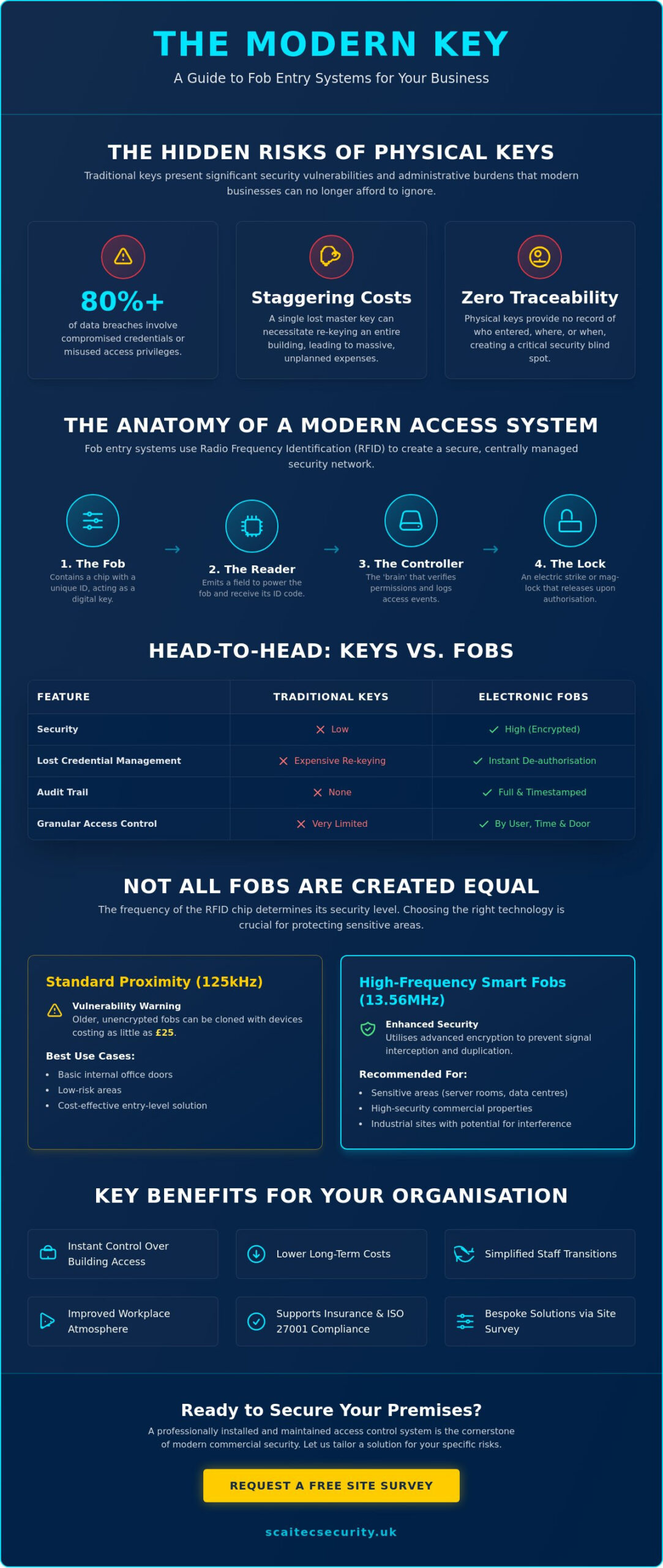
Transitioning to fob entry systems for business represents a fundamental shift in how we manage premises security. Unlike traditional mechanical locks, these systems utilise electronic access control to manage the flow of people through a building. This technology relies on Radio Frequency Identification (RFID) to grant or deny entry, replacing the physical metal key with a digital credential. We’ve observed a significant move amongst British businesses towards these contactless solutions, largely because they provide a level of traceability that old-fashioned keys simply cannot match.
Many commercial properties across South Yorkshire, particularly heritage buildings in Sheffield or industrial units in Rotherham, often struggle with the transition from traditional hardware. We’ve found that a hybrid approach often works best for these sites, integrating modern readers with existing door structures. This shift doesn’t just improve security; it changes the workplace atmosphere. Staff members generally feel a greater sense of reassurance when they know their environment is monitored. It creates a protective culture where everyone knows that unauthorised entry is managed systematically.
The Transition from Physical Keys to Electronic Fobs
Physical keys carry hidden financial risks. When an employee loses a master key, the cost of locksmith call-outs and re-keying every door can be staggering. Electronic fobs solve this crisis instantly. If a fob goes missing, we can de-authorise it through a central console in seconds. This prevents any security breach without needing to touch the physical locks. For authorised staff, the convenience is unmatched. One fob can be programmed to open every door they need, from the main gate to the server room, whilst keeping sensitive areas restricted.
Core Components of a Business Fob System
A reliable system consists of three main elements. First is the fob itself, which contains a small internal chip and antenna. Second is the reader, the wall-mounted unit that “interrogates” the fob when it’s held nearby. Finally, there is the controller and lock. The controller acts as the “brain,” checking the fob’s permissions before sending a signal to the physical mechanism, such as a mag-lock or electric strike, to release the door. This methodical process ensures that entry is always verified and logged.
How Commercial Key Fob Systems Work: The Technology Behind the Tap
To appreciate the security provided by fob entry systems for business, we must look at the invisible conversation happening every time a staff member approaches a door. The process relies on Radio Frequency Identification (RFID). When a fob is held near a reader, the reader emits an electromagnetic field that powers the small chip inside the fob. This triggers a digital “handshake” where the fob transmits its unique ID code to the reader. This entire interaction takes less than a second, yet it involves complex verification to ensure the person at the door is authorised to enter.
Encryption has become a vital part of this process. Older, unencrypted fobs operating on the 125kHz frequency are vulnerable; research from industry specialists like Swiftlane indicates that these basic credentials can be cloned with devices costing as little as £25. Modern systems prevent this by using encrypted data transmission, ensuring that the signal cannot be intercepted or duplicated by unauthorised parties. Whilst this technology is sophisticated, the backend software makes it simple for you to manage. Every “tap” is recorded with a precise timestamp, providing a clear audit trail of who accessed which area and when. If you’re concerned about your current hardware’s vulnerability, we can assess your setup through our system maintenance services.
RFID vs. Proximity: Choosing the Right Frequency
Standard proximity fobs, typically 125kHz, are often sufficient for basic internal doors where the risk of sophisticated cloning is low. However, for sensitive areas like server rooms or data centres, we recommend high-frequency smart fobs, such as Mifare or HID. These operate at 13.56MHz and offer significantly higher levels of encryption. For heavy-duty industrial sites across South Yorkshire, we often suggest these high-frequency options because they are more resistant to interference from heavy machinery and provide the robust security required for large-scale operations.
The Role of the Central Controller and Power Backup
The central controller acts as the brain of the entire operation. It stores the “access list” locally, which means the system continues to function perfectly even if your internet connection fails. We also prioritise the installation of dedicated battery backups. These ensure that your building remains secure during a power cut, preventing a total system shutdown. When designing your system, we’ll also guide you on the choice between “fail-safe” locks, which unlock when power is lost to allow for emergency egress, and “fail-secure” locks, which stay locked to protect high-value assets. This balance is essential for maintaining both security and fire safety compliance. For businesses seeking even greater network-level control and real-time visibility, ip based access control offers a powerful evolution beyond traditional standalone controllers.
Comparing Access Credentials: Fobs, Cards, or Mobile Access?
Choosing the correct physical credential is a pivotal decision when designing fob entry systems for business. Whilst the underlying technology remains consistent, the physical form of the key significantly impacts both your long-term budget and the daily experience of your staff. We often find that British businesses gravitate towards fobs because they represent a “fit and forget” solution. Unlike credit-card style proximity cards, which are prone to snapping or bending when kept in a wallet or pocket, polycarbonate fobs are incredibly robust.
According to the 2026 Buyer’s Guide to Fob Entry Systems, the shift towards mobile credentials is accelerating, yet physical fobs remain the most reliable choice for industrial or high-traffic environments. Cards typically have a lower initial cost per unit, making them attractive for sites with high staff turnover or large numbers of temporary visitors. However, when you factor in the “durability gap”, which is the frequency at which cards must be replaced due to damage, fobs often prove more cost-effective over several years.
Why Fobs Win on Durability and Convenience
The primary advantage of a fob is its resilience. Constructed from high-impact polycarbonate, these small devices can withstand the rigours of an active workplace without failing. They also align perfectly with existing employee behaviour. Most staff members already carry a set of car or house keys; adding a small fob to that ring is a natural adjustment that reduces the likelihood of the credential being left at home. For a professional finish, we can also provide custom-branded fobs that feature your company logo, reinforcing your brand identity every time a staff member enters the building.
When to Consider Mobile or Card-Based Access
There are specific scenarios where cards or mobile apps might be the superior choice. Cards are ideal for corporate headquarters where visual identification is required, as they can be printed with high-resolution ID photos and worn on lanyards. Similarly, school access control systems frequently utilise cards because they double as student ID and library cards. Mobile access via NFC or Bluetooth is a popular choice for tech-forward offices, though we always advise clients to consider the “dead battery” risk. If an employee’s phone dies, they are effectively locked out, which is why many of our clients choose to keep a small stock of physical fobs as a reliable backup.
Key Considerations for Installation: Security, Compliance, and Insurance
When evaluating the transition to electronic access, the most common question we encounter is whether the initial outlay justifies the return on investment. The answer lies in the long-term reduction of operational overheads. By implementing fob entry systems for business, you eliminate the recurring costs of locksmith call-outs and the administrative burden of tracking physical keys. Beyond these savings, a professionally installed system is a powerful tool for lowering business insurance premiums. Insurers recognise that verifiable audit trails and the ability to instantly revoke access credentials significantly reduce the risk of a successful breach.
We advocate for a holistic approach to premises protection. By integrating your entry points with commercial security systems Sheffield businesses can create a unified defence. For example, if a door is held open too long, the system can automatically prompt a nearby CCTV camera to focus on that area. Similarly, integration with fire alarm systems is a legal necessity. During an emergency, the access controller must receive a signal to release all fail-safe locks, ensuring your staff can evacuate without hindrance. This level of technical proficiency ensures your organisation remains both secure and compliant with UK safety regulations.
SSAIB Accreditation: The Gold Standard for Professional Installation
Choosing an installer with SSAIB (Security Systems and Alarms Inspection Board) certification is vital for your insurance validity. This accreditation serves as an independent guarantee that the installation meets the highest industry standards. Many UK insurers will only provide full coverage if your security infrastructure has been fitted and maintained by an accredited provider. We’ve seen cases where DIY or non-accredited installations have led to claim rejections. Our commitment to these rigorous standards ensures that your system is not only effective but also fully recognised by your insurance provider, giving you total peace of mind.
Scalability: Planning for Future Business Growth
Your security infrastructure should be designed with the future in mind. We utilise modular hardware that allows you to add new doors or additional users as your headcount grows, without needing to overhaul the entire system. This scalability is particularly beneficial for companies operating across multiple locations. Modern software allows for multi-site management, meaning you can control access for your Rotherham and Doncaster offices from a single, centralised screen. Businesses managing several sites may also wish to explore how ip based access control delivers centralised, network-driven oversight that scales seamlessly alongside your operations. This methodical approach to growth ensures that your protective vigilance remains consistent, no matter how many sites you manage. If you are ready to secure your premises with a bespoke solution, you can explore our range of access control systems today.
Implementing Your Fob Entry System with Scaitec Security Solutions Ltd
We take a methodical and highly organised approach to securing your commercial premises. Our team is deeply rooted in the South Yorkshire community, providing a consistent local presence across Rotherham, Sheffield, Barnsley, and Doncaster. This regional focus allows us to act as a dedicated partner who understands the specific security challenges that local businesses face. When you invest in fob entry systems for business, you’re not just buying hardware; you’re entering a long-term relationship focused on protective vigilance and technical excellence.
Our process begins with a comprehensive site survey where we evaluate your building’s layout and operational requirements. This allows Scaitec Security Solutions Ltd to design a bespoke system that balances high-level security with ease of movement. For high-security commercial sites, we also offer 24/7 remote monitoring. This ensures that any unauthorised access attempts or system irregularities are flagged instantly, providing a level of oversight that goes far beyond a simple lock and key. To maintain this stability, we provide structured system maintenance contracts that ensure your infrastructure remains compliant and fully functional for years to come.
Bespoke Design for South Yorkshire Businesses
Every commercial property has a unique rhythm of staff movement. We assess your specific entry points and traffic flow to ensure the system we design doesn’t create frustrating bottlenecks during the morning rush. A key part of our holistic approach involves layering your defences. By integrating your access points with CCTV installation Rotherham, you gain visual verification for every fob tap. This allows you to cross-reference digital logs with video footage, ensuring total accountability. We also help you customise access levels, giving you the power to restrict certain zones to specific times of day or specific personnel groups. For a broader perspective on how modern secure building entry solutions are evolving across the region, our access control Yorkshire guide provides an in-depth look at the latest advancements tailored to local businesses.
Expert Installation and Reliable Aftercare
On the day of installation, our engineers work with precision to ensure minimal disruption to your business operations. We understand that your time is valuable, so we aim for a seamless transition that respects your working environment. Once the hardware is fitted, we don’t simply hand over the keys. We provide thorough training for your administrative team, ensuring they’re confident in using the management software to add new staff or de-authorise fobs instantly. The Scaitec Security Solutions Ltd promise is one of steadfast reliability and technical support whenever you need it, providing the professional reassurance your business deserves. If you’re ready to upgrade your building’s security, we invite you to explore our full range of access control systems.
Securing the Future of Your Commercial Premises
Transitioning to digital access is a vital step towards modernising your operational security. We’ve explored how moving away from physical keys reduces administrative costs and provides the granular control needed in a modern commercial environment. By choosing high-frequency, encrypted fob entry systems for business, you protect your assets against cloning whilst creating a transparent, traceable environment for your entire team.
Professional installation remains the cornerstone of a reliable system. As SSAIB Accredited Installers with over 20 years of experience in South Yorkshire, we ensure your setup meets strict insurance requirements and incorporates state-of-the-art equipment. We provide 24/7 technical support to ensure your protective vigilance is never interrupted. Take the first step towards a more secure, streamlined workplace and Request your free, no-obligation business security survey from Scaitec Security today. We look forward to helping you achieve lasting peace of mind.
Frequently Asked Questions
What happens to the fob entry system during a power cut?
Your system will continue to operate via a dedicated battery backup unit installed within the central controller. These backups typically provide several hours of power, ensuring that authorised staff can still enter and exit the building during an outage. Once the main power is restored, the system automatically recharges the batteries. We recommend regular maintenance checks to ensure these batteries remain in peak condition for emergency situations.
Can I use the same key fob for multiple business locations?
Yes, you can use a single credential across multiple sites if your system is managed through a centralised software platform. This is a common solution for businesses with offices in different towns, such as Rotherham and Sheffield. By synchronising the user database, we can grant an employee access to every location they are authorised to visit, which simplifies management and reduces the number of fobs each person needs to carry.
How much does a key fob door entry system cost for a small business?
The cost of implementing fob entry systems for business depends on several factors, including the number of doors, the choice of hardware, and the complexity of the installation. Whilst industry averages vary, the total investment reflects the long-term savings gained from reduced lock maintenance and improved security. We recommend a bespoke site survey to provide an accurate reflection of the requirements for your specific commercial premises.
Is it possible to track employee attendance using a fob system?
Every fob interaction is recorded as a time-stamped event in the system software, which can be used to monitor staff attendance and punctuality. These audit trails provide a clear record of when employees enter or leave specific zones. Whilst primarily a security tool, this data can be exported to assist with payroll queries or to verify that health and safety protocols regarding building occupancy are being met.
Can fobs be easily cloned or hacked by intruders?
Modern high-frequency fobs using advanced encryption are extremely difficult to clone or hack. Whilst older proximity fobs are more vulnerable to simple cloning devices, the state-of-the-art systems we install use secure communication protocols to prevent unauthorised duplication. By choosing encrypted credentials, you ensure that the digital handshake between the fob and the reader remains protected against sophisticated intruder tactics.
What is the difference between fail-safe and fail-secure locks in a fob system?
Fail-safe locks automatically release when power is cut, which is essential for emergency exit doors to ensure life safety during a fire. In contrast, fail-secure locks remain locked when power is lost, keeping a building or sensitive room protected from outside entry. We carefully assess each door during the design phase to ensure your system complies with both fire safety regulations and your specific security needs.
Do I need to replace the entire system if I lose the master fob?
You don’t need to replace any hardware if a master fob or any other credential is lost. The software-based management allows us or your internal administrator to de-authorise the missing fob instantly. Once it is removed from the database, it will no longer grant access to any reader. This is the primary advantage of electronic systems over traditional locks, as it removes the need for expensive re-keying.
How many users can a standard commercial fob system support?
Standard commercial systems are highly scalable and can typically support thousands of individual users. Whether you have a small team of five or a large workforce of several hundred, the controller can store and manage unique permissions with ease. As your business grows, adding new staff members is a simple process of registering a new fob in the software, ensuring your security infrastructure keeps pace with your headcount.
Protect Your Business
Protect Your People
Book Your FREE Site Protection Survey

Since pioneering Scaitec Security Solutions in 2005, Paul Scaife, with his roots in the industry dating back to 1994, has distinguished the firm as a leading provider of bespoke fire and security solutions, servicing clients across Sheffield, Rotherham, and surrounding areas.
His leadership, underpinned by accreditation from the Security Systems and Alarms Inspection Board, ensures that Scaitec surpasses client expectations by blending advanced technology with a deep understanding of their unique needs.
Paul's ethos champions innovation and efficiency, driving Scaitec to deliver tailored, cutting-edge solutions that enhance safety and operational ease.
Discover more about Paul’s commitment to excellence on LinkedIn.