
Table of Contents
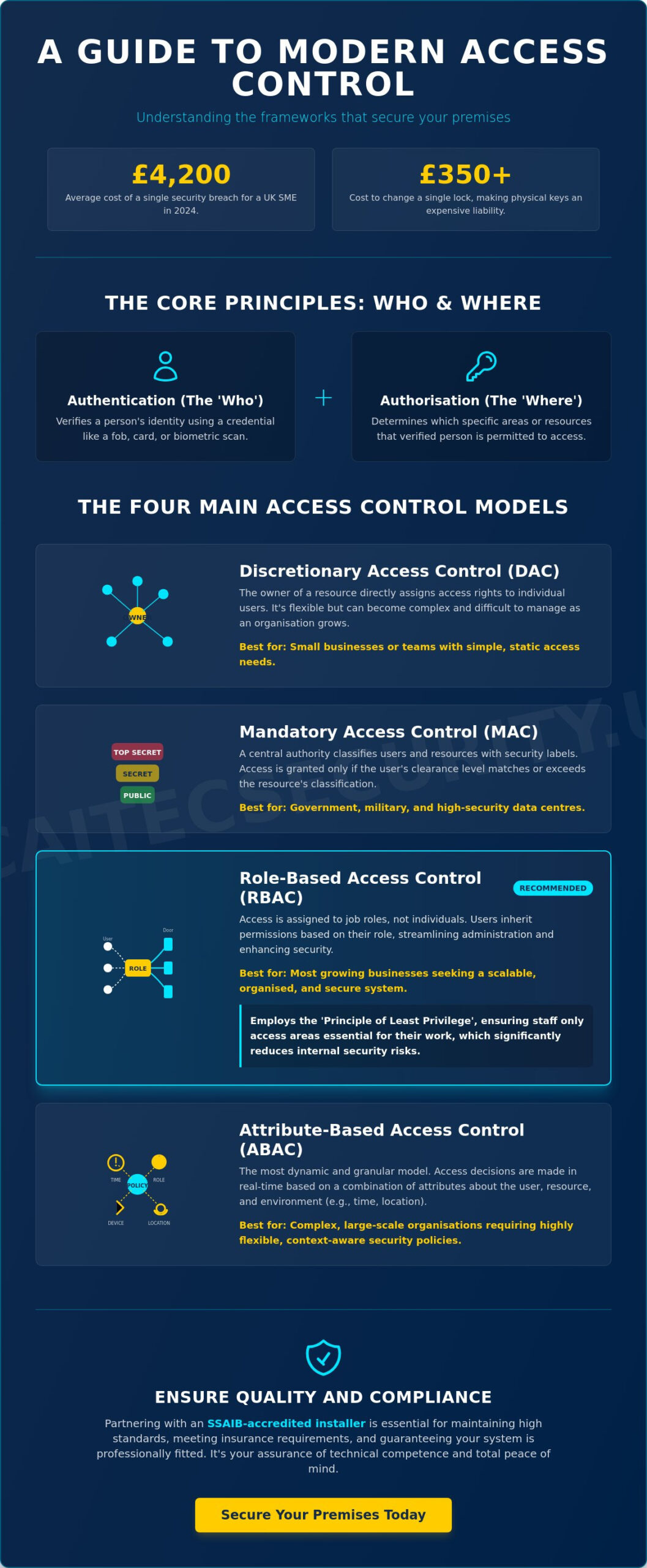
In 2024, the average cost of a single security breach for a UK SME reached £4,200. Most business owners feel the constant pressure of managing bulky keyrings and worrying about which types of access control actually keep a building safe after hours. It’s frustrating when you can’t instantly track who is in the building during an emergency or when jargon-heavy brochures make modern security feel more complex than it needs to be. We understand that your priority is a stable, protective environment for your team and your assets.
This guide simplifies the various security models to help you move from traditional fobs to AI-driven biometric systems with confidence. We’ll show you how to match specific hardware to your premises whilst ensuring your setup meets the latest 2026 standards, including the SSAIB’s new status as an ICO-accredited monitoring body. You’ll gain a clear understanding of modern technology and learn how to identify an SSAIB-accredited partner to keep your building compliant and secure.
Key Takeaways
- Understand the transition from traditional locks to electronic systems and how this shift improves your building’s oversight.
- Discover the four primary types of access control models and how they define the logic of your permission settings.
- Identify the most suitable physical hardware for your premises, ranging from durable proximity fobs to advanced biometric readers.
- Learn how to tailor your security setup to your specific industry needs whilst considering environmental factors like weatherproofing.
- Recognise why partnering with an SSAIB-accredited installer is essential for maintaining high standards and meeting insurance requirements.
What is Access Control and Why Does Your Business Need It?
At its core, What is Access Control? It is the selective restriction of access to a place or resource. For most UK businesses, this used to mean a heavy set of physical keys and the constant risk of them being lost, stolen, or copied. Today, we’ve seen a massive shift toward sophisticated electronic door access. This evolution isn’t just about keeping people out; it’s about managing exactly who enters and when they do so. By implementing modern types of access control, you replace the vulnerability of traditional locks with a system that offers both protective vigilance and operational clarity.
We often see clients move away from physical keys because they’re tired of the “re-keying” headache. The average cost to change a lock in a UK business is £350, and for larger offices, re-keying can easily exceed £1,000. Electronic systems solve this instantly. They provide unexpected benefits. You get streamlined time-tracking, clearer insights into building occupancy, and the ability to revoke access in seconds. As a dedicated expert guide for access control Yorkshire, we ensure your transition to these digital solutions is seamless and logically structured.
The Core Purpose: Authentication vs Authorisation
To build a robust security framework, you must understand two distinct processes that happen every time someone approaches a door. Authentication is the verification of identity; it’s the ‘Who’ of the process, confirming the person is who they claim to be via a fob, card, or biometric scan. Authorisation is the ‘Where’ of the process, determining which specific rooms or resources that person is permitted to use. These two processes work in tandem to ensure that only the right people reach the right areas at the right times. This distinction is vital for compliance with UK GDPR and helps businesses meet the strict security requirements often set by commercial insurance providers.
Physical vs Logical Access Control
Whilst our focus is primarily on physical security, it’s helpful to distinguish it from its digital counterpart. Physical access control manages the movement of people through campuses, buildings, and internal rooms. Logical access control governs entry to computer networks, system files, and sensitive data. Modern businesses require an integrated approach to both to ensure total peace of mind. When your physical entry points are secured with the correct types of access control, you create a stable foundation for your entire business operation, protecting both your physical assets and your staff.
The Four Main Access Control Models Explained
Choosing the right types of access control is often less about the physical locks and more about the underlying logic that governs them. These frameworks define who can go where, and when, without requiring a manual decision for every single entry. Many business owners worry that a high-security setup will naturally lead to a complex, frustrating daily routine. However, a professionally designed model ensures your security fits your existing workflow, rather than forcing your team to work around the system. We focus on creating a stable environment where safety feels like a natural part of your business day.
Discretionary (DAC) and Mandatory (MAC) Systems
Discretionary Access Control (DAC) is the most flexible model, where the system owner has total control over permissions. It’s a common starting point for small businesses, but it can become an administrative burden as a firm grows. In contrast, Mandatory Access Control (MAC) uses a centralised authority to assign access based on strict security clearances. Whilst MAC is essential for high-security centres or government facilities, a typical South Yorkshire SME might find it too rigid for daily operations. The administrative weight of MAC often outweighs the benefits for businesses that don’t handle highly classified data.
Role-Based Access Control (RBAC)
For most expanding businesses in Rotherham or Sheffield, Role-Based Access Control (RBAC) is the most efficient choice. Instead of managing permissions for every individual, you assign rights to specific job roles. If you hire a new office manager, they automatically inherit the access levels required for that position. This model relies on the ‘Principle of Least Privilege’, ensuring staff only have access to the areas necessary for their work. It’s a simple way to prevent internal security breaches whilst keeping your operations highly organised and scalable.
Attribute-Based Access Control (ABAC)
Attribute-Based Access Control (ABAC) is currently the most advanced option for modern premises. It uses specific ‘attributes’, such as the time of day, the user’s department, or even their physical location, to grant entry. For example, you can restrict warehouse access to specific shift hours whilst allowing the same staff member to enter the main office all day. This granular control is becoming the preferred choice for multi-site commercial building security, where different rules must apply across different locations simultaneously.
Selecting the correct framework is a vital step in creating a protective environment that doesn’t hinder your productivity. If you’re unsure which logic best suits your premises, our team can help you design and implement bespoke access control systems that grow alongside your business.
Roundup of Physical Access Control Hardware Types
Once you’ve selected the right logic amongst the various access control models, the next step is choosing the physical hardware. This is where security meets your building’s daily reality. It’s vital to select equipment that matches your premises’ aesthetic whilst providing the necessary level of protection. Whilst consumer-grade ‘smart’ locks might seem appealing for their low initial cost, they often lack the longevity and robust compliance of professional-grade systems. We focus on hardware that offers steadfast reliability over years of constant use, ensuring your investment remains secure for the long term.
The choice of types of access control hardware dictates how your staff and visitors interact with your building every day. A high-traffic reception area requires a different solution than a secluded warehouse loading bay. By matching the hardware to the specific environment, you create a security system that feels like a natural part of the building rather than an obstacle. Professional-grade hardware is designed to withstand the rigours of commercial use, offering a level of durability that cheaper alternatives simply cannot match.
Keypads, Fobs, and Proximity Cards
Keypads remain a cost-effective entry point for many, but they carry a specific vulnerability: code sharing amongst staff. This is why we generally recommend fob entry systems for business as the industry standard. They allow for instant deactivation if a credential is lost, preventing unauthorised entry. When choosing cards or fobs, the technical specification matters. Industry data shows that RFID fobs typically cost between £4 and £9 per unit. Legacy 125kHz systems are now easily cloned; therefore, we typically implement high-security 13.56MHz encrypted technology to ensure your building remains truly protected against modern bypass techniques.
Biometric Access Control Systems
Biometric systems represent the ‘Something You Are’ category of security. Whether it’s fingerprint scanning or facial recognition, these technologies have moved beyond high-security labs into modern Sheffield offices. They eliminate the risk of lost fobs or forgotten codes entirely. However, privacy is a common concern for many UK employees. Since the SSAIB became the first ICO-accredited monitoring body under UK GDPR in April 2026, businesses can have greater confidence that their biometric data storage meets the highest legal standards. This accreditation ensures that personal data is handled with the technical proficiency your staff deserve.
IP-Based and Mobile Access
The most significant trend for 2026 is the move toward ip based access control. This technology turns smartphones into digital keys via Bluetooth or NFC, which is incredibly convenient for a mobile workforce. Managers can revoke access rights instantly from a mobile app, even when they aren’t on-site. Cloud-based management has become the standard for 70% of new installations this year. These systems offer a level of flexibility and remote oversight that traditional wired systems simply cannot match, providing a holistic view of your building’s security from anywhere in the world.
Choosing the Right Type for Your Industry and Environment
Every building has its own unique rhythm and set of risks. The idea that a “one size fits all” approach works for security is a myth that often leads to expensive gaps in protection. When we assess a site, we consider the specific environmental factors that influence hardware choice. For instance, outdoor readers at a perimeter gate must be robust and weather-resistant, whilst internal office readers should blend seamlessly with your professional decor. By integrating these types of access control with your existing CCTV systems and intruder alarms, you create a unified safety net that provides far more comprehensive protection than isolated components ever could.
Our work across the South Yorkshire community has shown us that local businesses value stability and long-term reliability. Whether you are managing a single storefront in Sheffield or a sprawling industrial complex in Rotherham, your security needs to be as resilient as your operations. We focus on delivering a systematic approach that simplifies your daily management whilst maintaining rigorous safety standards.
Education and Healthcare Security
In sectors like education, the priority is often safeguarding and rapid response. Modern school access control systems now include critical lockdown functionality, allowing administrators to secure all external doors instantly from a central point. Hospitals and clinics face a different challenge: they must manage high-traffic public flow whilst keeping sensitive medicine stores and patient records strictly off-limits. Detailed audit trails are essential here, providing the documented evidence required for regulatory compliance and ensuring that every movement within the building is accounted for.
Warehousing, Industrial, and Multi-Site Offices
For large-scale operations, such as distribution hubs in Doncaster, security starts at the perimeter. We often implement heavy-duty turnstiles and vehicle barriers to manage entry before anyone even reaches the main building. If you are overseeing multiple sites from a base in Barnsley, cloud-based dashboards allow you to manage every entry point across the region from a single screen. To maintain strict internal security, we often recommend anti-passback logic; this feature prevents a second person from using the same credential to enter an area until the first user has officially exited through a designated reader.
Finding the perfect balance between accessibility and restriction requires a detail-oriented mindset. If you are ready to upgrade your building’s perimeter, we can help you install professional access control systems that are tailored to your specific industry requirements.
Professional Installation: Why SSAIB Accreditation Matters
Even the most advanced types of access control will fail if the installation is rushed or poorly planned. High-quality hardware requires a methodical approach to wiring and configuration to ensure it remains reliable over the long term. This is why we place such high value on the standards set by the SSAIB. As the first ICO-accredited monitoring body under UK GDPR since April 2026, the SSAIB ensures that certified installers maintain the technical proficiency and data security standards your business needs. We don’t just install systems; we build stable, protective environments that you can rely on daily.
Our commitment to your safety doesn’t end once the last cable is laid. We believe that preventative security maintenance is the only way to guarantee your system’s longevity. Regular checks prevent minor faults from becoming major security breaches, giving you the peace of mind that your protective vigilance is always active. By choosing a partner that values rigorous standards, you ensure that your security investment continues to perform as expected for years to come.
Insurance Compliance and Legal Standards
Using an SSAIB-accredited partner often has a direct impact on your bottom line. Many commercial insurers in South Yorkshire require professional certification before they will consider lowering business insurance premiums. Beyond cost savings, there are strict legal standards to meet. To comply with the Equality Act 2010, for example, access control readers and exit buttons must be mounted at a height between 900mm and 1200mm to accommodate wheelchair users. This level of detail-oriented planning is what sets a professional installation apart.
Fire safety is another critical area where your choice of types of access control matters. Under the Regulatory Reform (Fire Safety) Order 2005, your system must integrate perfectly with your fire alarm systems. Electronic locks on escape routes must be “fail-safe,” meaning they unlock automatically during an emergency to ensure a safe exit for everyone. We ensure that your hardware and software logic work in perfect harmony with these regulations, protecting both your property and the lives of those within it.
The Scaitec Approach: From Design to 24/7 Monitoring
We take a holistic view of every project, acting as your dedicated expert guide. Our process begins with a thorough site audit, followed by a bespoke design that addresses your specific vulnerabilities. We handle everything from the expert wiring to the final staff training, ensuring your team feels confident using the new technology. For those requiring the highest level of stability, we offer 24/7 remote monitoring for your access control and alarm systems. This means that if an issue arises, we’re already aware of it and ready to act. We are proud to support our local clients in Sheffield, Barnsley, and Doncaster with rapid call-outs and a dedicated support structure that lasts throughout the lifecycle of your system.
Securing Your Premises for the Future
Your building’s safety relies on a marriage between logical permission models and durable physical hardware. By understanding the different types of access control available, you move away from the vulnerability of traditional keys toward a more stable and observable security environment. Whether you need the granular oversight of attribute-based models or the convenience of mobile credentials, the right system should simplify your daily management whilst providing steadfast protection.
Since 2005, we’ve acted as a dedicated partner for organisations across the region, providing bespoke security design tailored to the unique needs of South Yorkshire businesses. As SSAIB Accredited Installers, we ensure your system meets every insurance and fire safety requirement, giving you the peace of mind that your premises are in expert hands. We’re here to help you navigate these technical choices and provide long-term aftercare that keeps your team safe.
Get a Professional Access Control Quote for Your Yorkshire Business and take the first step toward a more secure, efficient building today.
Frequently Asked Questions
What is the most secure type of access control for a small business?
Biometric systems combined with high-frequency encrypted fobs represent the most secure types of access control for small businesses. These solutions prevent the common risks of code sharing or lost physical keys that often plague traditional setups. By using “something you have” alongside “something you are”, you create a multi-layered defence that is exceptionally difficult for unauthorised individuals to bypass. This approach ensures that only verified personnel gain entry to your sensitive areas.
How much does a commercial door access control system cost to install in the UK?
The cost of a commercial installation depends on the complexity of the hardware and the total number of entry points. Whilst we don’t provide fixed pricing here, industry data indicates that standalone systems for a single door are generally less expensive than multi-door networked solutions. You should also account for the ongoing costs of credentials, such as fobs or cards, and annual maintenance to ensure the system remains reliable. A professional site audit is the best way to determine a precise budget for your premises.
Can I integrate access control with my existing CCTV and intruder alarms?
Yes, modern systems are designed for seamless integration with your existing CCTV and intruder alarms. This creates a holistic security ecosystem where an unauthorised door entry can automatically trigger a nearby camera to record or activate an alarm. Linking these technologies provides a more comprehensive view of your building’s safety. It also simplifies the management of your premises by allowing you to oversee multiple security layers from a single interface.
What happens to electronic door locks during a power cut or fire alarm?
Electronic locks are configured as either “fail-safe” or “fail-secure” depending on their location and the specific safety requirements of the building. During a fire alarm, locks on designated escape routes must fail-safe, meaning they automatically unlock to allow for a safe exit. In the event of a power cut, battery backup systems typically maintain security for several hours. This ensures your building remains protected whilst power is restored, preventing any temporary gaps in your perimeter defence.
Is biometric access control legal for UK employees under GDPR?
Biometric access control is legal in the UK provided you comply with UK GDPR and the Data Protection Act 2018. You must conduct a Data Protection Impact Assessment (DPIA) and ensure that biometric data is stored securely, often as an encrypted mathematical template rather than an actual image. Since the SSAIB became an ICO-accredited monitoring body in April 2026, businesses have a clearer framework for ensuring their data handling processes meet the highest legal and technical standards.
What is the difference between a standalone and a networked access control system?
A standalone system manages access at each individual door and is ideal for smaller premises with only one or two entry points. A networked system connects all doors to a central server or cloud platform, allowing you to manage permissions for the entire building from one location. Networked solutions are far more efficient for larger businesses or those with multiple sites. They enable instant updates to user rights across your entire estate, ensuring your security remains agile and organised.
How often should an access control system be serviced by a professional?
We recommend that your access control system is professionally serviced at least once a year to maintain its reliability. Regular maintenance ensures that electronic locks, readers, and backup batteries are functioning correctly and that software is updated to the latest security patches. This proactive approach prevents unexpected system failures and ensures your business remains compliant with insurance requirements and safety regulations. It’s a vital step in protecting the longevity of your security investment.
Protect Your Business
Protect Your People
Book Your FREE Site Protection Survey

Since pioneering Scaitec Security Solutions in 2005, Paul Scaife, with his roots in the industry dating back to 1994, has distinguished the firm as a leading provider of bespoke fire and security solutions, servicing clients across Sheffield, Rotherham, and surrounding areas.
His leadership, underpinned by accreditation from the Security Systems and Alarms Inspection Board, ensures that Scaitec surpasses client expectations by blending advanced technology with a deep understanding of their unique needs.
Paul's ethos champions innovation and efficiency, driving Scaitec to deliver tailored, cutting-edge solutions that enhance safety and operational ease.
Discover more about Paul’s commitment to excellence on LinkedIn.